Today, in Mercy, as we continue to read Jesus’s loving dialogue with his Father, we become the silent listener to an intimate conversation.
As I prayed with this passage, the memory of my own conversations with my mother came back to me. Many of these exchanges took place in person, but what I remembered today was our daily evening phone calls late in her life.
The calls were brief, but unflinchingly regular – 7PM every night. The exchanges werevery simple and almost formulaic: were we both OK, slept well, had a good day, had what for dinner, endured whatever weather….did we need anything?
But the real conversation was deep under any formula. It was the silent language of love, comfort, hope, trust and fidelity.It was the unspoken assurance that we were, and would always be, FOR each other.
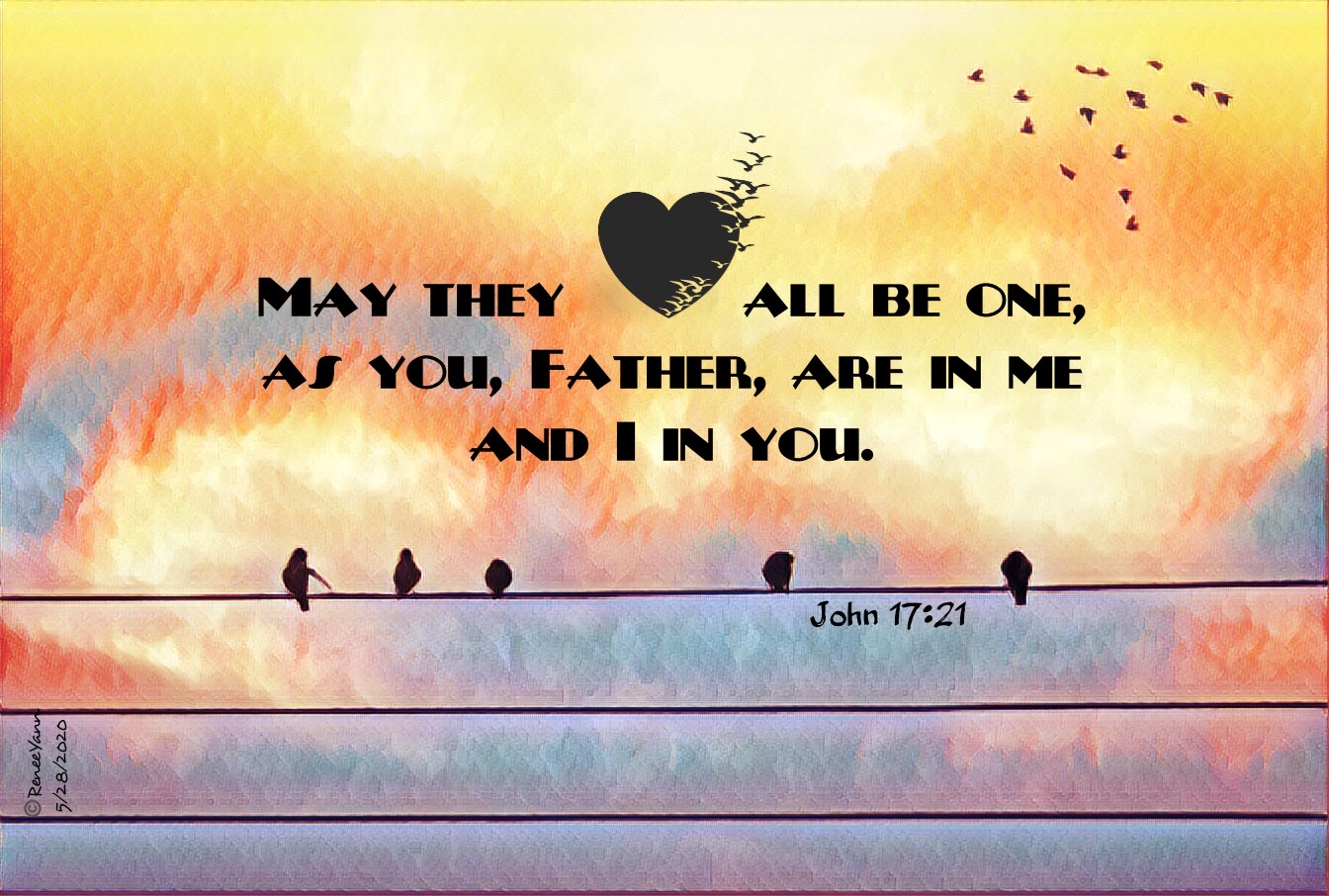
In John 17, we find the same kind of conversation between Jesus and his Father.
You and I are one
You have gifted me with your glory
You have empowered me in your Name
You have always loved me
I know your heart
and I am grateful
What a privilege to listen to God’s conversation! In our prayer today, we may just want to witness silently the infinite love between Jesus and the Father. As Jesus prays for us to be incorporated into that love, may our hearts overflow in gratitude.
Music: I Just Called fo Say I Love You – Stevie Wonder
Mom and I loved this song because it so clearly described our relationship. I still sing it to her sometimes… loooong distance for sure now🥰.
I think it’s a song we could easily share with God in our prayer.
Today, in Mercy, Paul gives the first part of his Ephesian farewell address which he will complete in tomorrow’s reading.
Paul really loved the Ephesian community. He lived with them for three years and poured his heart and soul into teaching them. He doesn’t say it outright, but like all ministers, he must have learned from them as well – from their faith, compassion, and openness to his teaching.
Now Paul begins the last journey back to Jerusalem, a passage which will mirror Christ’s own journey to that sacred city. But before he departs, Paul tells the Ephesians how much he loves and expects from them. And he blesses them.
In tomorrow’s continuation, Paul will say:
And now I commend you to God and to that gracious word of his that can build you up and give you the inheritance among all who are consecrated.
In our Gospel today, as Jesus commences his own final journey, he blesses his listeners as well:
Father, I pray for them. I do not pray for the world but for the ones you have given me, because they are yours, and everything of mine is yours
Today as we pray, whether we are at the beginning or late parts of our journey, we might take time to pray for the ones God “has given” us in our lives. Like Paul who shared life with the Ephesians, and like Jesus and his beloved disciples, God has given us communities to love and form us on our journey.
These extraordinary pandemic days have reminded us all of what’s most cherished in our lives. It’s such a perfect time to show our own beloved communities how much they mean to us. It doesn’t have to be a long address or a profound speech. My young nephew and his dear wife did it yesterday with a simple and delightfully surprising phone call just before they journeyed on a small vacation.
Just little phrases between us, passed over a thousand mile telephone signal, carried a much bigger message of love and gratitude:
just wanted to check on you
are you feeling well
do you have what you need
enjoy your time away
travel safely
thanks for thinking of me
I love you
God bless you
Today, as we read the orations of Jesus and Paul, we may not see the same exact phrases, but the message is the same. Jesus and Paul knew it was important to their communities to put that loving message into words. It’s important for our communities too.
Thanks Jimmy and Kristin. Thank you all my dear family and friends. I am so blessed to have these kinds of conversations with all of you. I don’t ever want to take that for granted.
Like Paul, I commend each one of you to God and to that gracious word of his that can build you up and give you the inheritance among all who are consecrated.
On this, and all your life journeys, travel safely and know you are deeply loved.
Music: The Lord Bless You and Keep You – John Rutter
Today, in Mercy, Jesus calls us friends. Just think about that!
Think about what it means to really be a friend.
We might have a little trouble reclaiming the true meaning in today’s culture. After all, in our world, you can be “friends” with thousands of people on Facebook, many of whom you might not even know.
On the other hand, if you have been blessed to have really good friends in your life, consider what created that friendship: love, honesty, acceptance, sacrifice, forgiveness, reverence, trust, fidelity, humor.
This is the kind of relationship to which Jesus invites each one of us – where He is part of us and we of Him..
If we listen to Jesus in today’s Gospel, we’ll see clearly what makes us a Friend of God:
We love God to the point of laying down our lives.
We obey God’s command to love unselfishly and inclusively.
We seek ever to know God more fully.
We acknowledge God’s love as a blessing and gift, not a right.
We act on our responsibility to share the love we have received.
Pope Francis has said that the saints are “Friends of God” because they loved with all their hearts. But he stresses that:
“They are like us; they are like each of us: They are people who, before reaching the glory of heaven, lived a normal life, with joys and griefs,
struggles and hopes….When they recognized the love of God, they
followed him with all their heart, without conditions and hypocrisies.”
Pope Francis encourages us, “The saints give us a message. They tell us: Be faithful to the Lord, because the Lord does not disappoint! He does not disappoint ever, and he is a good friend, always at our side.”
Let’s spend some prayer time in thanksgiving for God’s gift of friendship, asking how we might learn to be an even better friend, to love God even more.
Music: Bridge Over Troubled Water – Simon and Garfunkel
Today, in Mercy, as we inch closer to Holy Week, we meet both a very troubled Jeremiah and Jesus.
The Prophet Jeremiah Weeping Alone on a Hill (from the Wellcome Trust)
Jeremiah, the Old Testament mirror of Jesus’s sufferings, bewails the treachery even of his friends:
I hear the whisperings of many: “Terror on every side! Denounce! let us denounce him!” All those who were my friends are on the watch for any misstep of mine.
That’s really raw, because you can get through almost anything in the company of true friends.
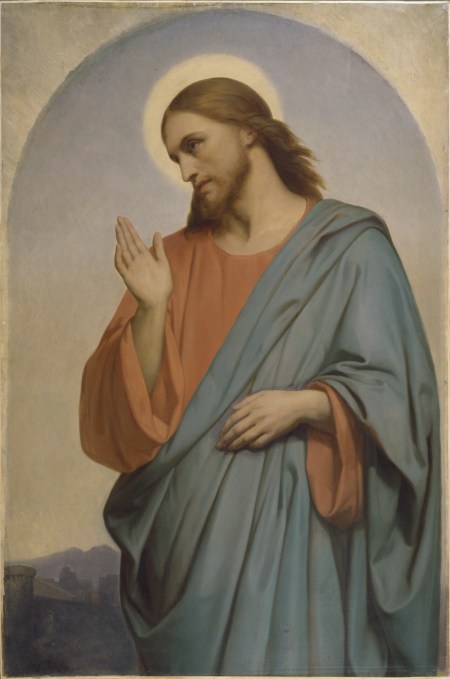
Jesus Weeping Over Jerusalem by Ary Scheffer (1795-1858)
Jesus came as a Friend and hoped to find Friends of God by his ministry. And he did find many. But not all.
It takes some work to be a true friend of Jesus. Some didn’t have the courage, or generosity, or passion, or hopeful imagination to reach past their self-protective boundaries – to step into eternal life even as they walked the time-bound earth.
In today’s Gospel this band of resisters project their fears and doubts to the crowds around them. The evil sparks light the ready tinder of human selfishness. The mob turns on Jesus, spiritual misers scoffing at the generous challenge to believe.
Jesus pleads with them to realize what they are doing:
If I do not perform my Father’s works, do not believe me; but if I perform them, even if you do not believe me, believe the works, so that you may realize and understand that the Father is in me and I am in the Father.
But Jesus and Jeremiah, though troubled, are grounded in God. Our Responsorial Psalm captures what might have been their silent prayer:
The following transliteration of Psalm 18, composed by Christine Robinson,might help us to be with Jesus in his moment, and in our own moments of fear, anxiety, or doubt.
I open my heart to you, O God for you are my strength, my fortress, the rock on whom I build my life. I have been lost in my fears and my angers caught up in falseness, fearful, and furious I cried to you in my anguish. You have brought me to an open space. You saved me because you took delight in me. I try to be good, to be just, to be generous to walk in your ways. I fail, but you are my lamp. You make my darkness bright With your help, I continue to scale the walls and break down the barriers that fragment me. I would be whole, and happy, and wise and know your love Always.
Today, in Mercy, our readings are about being at home with God.
In our passage from 2 Samuel, a highly anthropomorphized God informs David that He is sick of living in a tent while being carried to and fro. God goes on to recount for David all that God has done for him, demonstrating that David can fully trust God.
God wants a home. In other words, it’s time to make a permanent commitment and “move in together” into each other’s hearts.
In today’s Gospel, we find the familiar story of the Sower and the Seed. While the story doesn’t specifically mention “home”, Jesus indicates that only those “at home” with God’s Word will understand the true meaning of the parables.
You may have had the joy of visiting friends who greet you with the invitation, “Make yourself at home”. These friends will have done everything they can to make that possible – clean house, fresh bed linens, your brand of coffee, your favorite meals. They want you to be completely comfortable for your stay.
Well, God wants to stay forever within us. And God wants us to stay forever in God. That mutuality of homecoming is the whole purpose of our lives.
We know how to create this sacred hospitality for our friends. Let today’s reading remind us to do this for God as well by:
“learning” God within the Sacred Word of scripture
joy and awe at God’s desire to be with us
attention to those tendernesses that invite and welcome God
continual gratitude for God’s Presence
delighting God by our acts of love and hospitality
Music: Welcome to My Heart – Dean Martin
(Even though the song was not directed toward God, it works for me. I hope it does for you too.)
Today, in Mercy, we read about God’s call of Samuel, Hannah’s son.
New things are about to happen in Israel. The People have lived under the questionable leadership of a series of Judges. But now, threats from inside and outside loom. So God chooses to move in a new way among the community.
Samuel is going to be God’s bridge to that new way. In today’s reading and subsequent verses, he hears God’s call, listens, receives a vision, and prophesies to Eli.
In our reading from Mark, Jesus is the Divine Bridge to a new reality. Early now in his ministry, his call is blossoming in his heart, as he realizes that he must go all over Israel preaching and healing.
When Simon told Jesus the local villagers were looking for him, Jesus told them,
“Let us go on to the nearby villages that I may preach there also. For this purpose have I come.” So he went into their synagogues,
preaching and driving out demons throughout the whole of Galilee.”
Jesus continues his healing and enlightening mission through all who call themselves Christian. He calls each of us in different ways to be a “Bridge” with him to the Reign of God.
How are you hearing and listening to your particular call every day? Maybe, like Samuel, by the time God calls us three times, we may understand!😉
Music: Since I mentioned “bridge”, I can’t help including one of my favorite songs, Bridge Over Troubled Water by Simon and Garfunkel. It’s not really a religious song, but their popular song actually was inspired by a great Gospel song, Oh Mary, Don’t You Weep and its one freely interpreted verse very near the end: “I’ll be your bridge over deep water/If you trust in my name.’
Bridge Over Troubled Waters
Oh, Mary Don’t You Weep (Lyrics below, but they are VERY liberally interpreted by these wonderful Gospel singers.)
Lord, I’m singing . . . (solo)
Oh, Mary, don’t you weep. (group)
Tell Martha not to mourn. (solo)
Tell Martha not to mourn. (group)
Listen, Mary, (solo)
Oh, Mary, don’t you weep. (group)
Tell Martha not to mourn. (solo)
Tell Martha not to mourn. (group)
Pharaoh’s army, (solo)
Oh, Mary, don’t you weep. (group)
They got drownded in the sea, (solo)
Drowned in the Red Sea. (group)
Jesus said, Mary, (solo)
Oh, Mary, don’t you weep. (group)
Tell Martha not to mourn. (solo)
Tell Martha not to mourn. (group)
Can’t you hear me singing, Mary? (solo)
Oh, Mary don’t you weep. (group)
I want you to know, Martha don’t have to mourn. (solo)
Tell Martha not to mourn. (group)
Oh, listen, Mary, (solo)
Oh, Mary don’t you weep. (group)
Tell Martha not to mourn. (solo)
Tell Martha not to mourn. (group)
Pharaoh’s army, (solo)
Oh, Mary, don’t you weep, (group)
They got drownded in the sea, (solo)
Drowned in the Red Sea. (group)
Jesus said, Mary, (solo)
Oh, Mary don’t you weep, (group)
Tell Martha not to mourn, (solo)
Tell Martha not to mourn, (group)
Lord, and if I could tonight, (solo)
If I could, (group)
I want to tell you I surely would right now. (solo)
Surely would, (group)
I would stand on the rock. (solo)
Stand on the rock, (group)
Right on the rock where Moses stood. (solo)
Moses stood, (group)
Pharaoh’s army, (solo)
Oh, Mary don’t you weep (group)
They got drownded in the sea, (solo)
Drowned in the Red Sea. (group)
Jesus say, Mary, (solo)
Oh, Mary don’t you weep. group)
He said Mary . . . (solo)
Oh, Mary don’t you weep .(group)
Oh, Mary . . . (solo)
Oh, Mary, don’t you weep. group)
Tell Martha not to mourn. (solo)
Tell Martha not to mourn. group)
Today, in Mercy, we lay aside our holiday experiences and dress once again in our ordinary dailyness. It is time to begin again, in this new year, the faithful living of our lives.
 copyright: Photo: Wikipedia / Shakko
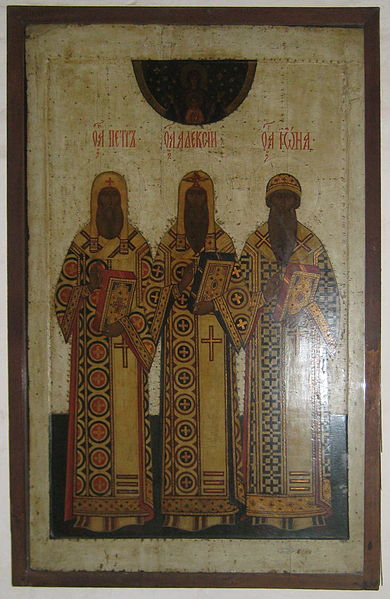
The Church encourages us with the celebration of two great friends, Basil and Gregory. These men are particularly venerated, with St. John Chrysostom, in the Eastern Churches, whose character they highly impacted. These tremendously influential ministers supported and inspired one another to do great things for God in a time when the faith was sorely tested.
The friendship and legacy of these iconic saints reminds us that we need one another’s support and example to stay strong in our own faith. In our first reading, John tells us the same thing.
We live in a world not unlike that of Basil, Gregory, and Chrysostom. Conflicting, and often deceitful, forces twist the faith to distort its original truth. In our world, these false perceptions are used as excuses for all kinds of evils: war, nationalism, prejudicial exclusion, and racial and economic domination.
But John the Evangelist says this in our first reading:
Let what you heard from the beginning remain in you. If what you heard from the beginning remains in you, then you will remain in the Son and in the Father. And this is the promise that he made us: eternal life.
Today’s Gospel shows us that even John the Baptist had to juggle thorny religious questions in order to stay focused on the core truth of Christ. The Baptist keeps this focus by his singular faith and humility:
… there is one among you whom you do not recognize, the one who is coming after me, whose sandal strap I am not worthy to untie.
So today, inspired by these great saints, let us take up the call to be true humble followers of Jesus, making our faith evident by our choices for mercy, justice and love in a conflicted world.
Music: Hymn of the Cherubim- Liturgy of St. John Chrysostom
Today, in Mercy, we celebrate Mary, Mother of Jesus.
I begin my prayer today by asking a question posed by distinguished theologian, Elizabeth Johnson, CSJ:
What would be a theologically sound, spiritually empowering and ethically challenging theology of Mary, mother of Jesus the Christ, for the 21st century? This question has no simple answer, for the first-century Jewish woman Miriam of Nazareth, also held in faith to be Theotokos, the God-bearer, is arguably the most celebrated woman in the Christian tradition. One could almost drown surveying the ways different eras have honored her in painting, sculpture, icons, architecture, music and poetry; venerated her with titles, liturgies, prayers and feasts; and taught about her in spiritual writings, theology and official doctrine.
In my own prayer today, though, I am not reaching for a deeper theological understanding of Mary. I simply want to talk with her as my Mother, my older Sister, my Friend. I want to seek her guidance and her inspiration. I want to thank her for her continual willingness to bear Christ into the world, and into my life.
How significant it is that the Church begins the year inviting us all to Mary’s Light! Our first reading blesses us in a way that Mary might bless us:
The LORD bless you and keep you! The LORD let his face shine upon you, and be gracious to you! The LORD look upon you kindly and give you peace!
Mary was all about giving us the LORD, not giving us herself. We see Mary best when we see her holding Christ toward us – the “God-bearer” or “Theotokos”.
Theotokos Vladimirskaya icon, Vologda, Vladimirskaya Church, mid-end 16 century
This title, used especially in Eastern Christianity, originated in the 3rd century Syriac tradition. It affirms Mary as the Mother of Jesus, Who was both human and divine in nature.
Our reading from Galatians assures us that we too, by our Baptism, are the daughters and sons of God – thus becoming Mary’s own. She is our Mother too by the power of this sacrament.
Our Gospel reveals the spirituality of Mary who “pondered” all the mysterious workings of God deep in her heart. This Mary is my revered sister, guiding me as I meet the unfolding of God in my own life.
Today, let us pray with Mary, our Mother, our Sister, Bearer of God. Let us pray for the whole Church, the whole world – all of whom she tenderly loves.
Music: Two selections today.
A Peaceful Hymn to the Theotokos – Nuns of the Carmazani Monastery in Romania
Today, in Mercy, we celebrate John, “the Beloved Disciple”.
Throughout John’s magnificent writings, the themes of Love and Light stretch our perception of God, and challenge us to love like God loves.
John’s deep love of God, and devotion to the Gospel of Jesus Christ, pour out in his epistles which we will be blessed with over the next several weeks.
Sometimes John’s poetic style can be a little off-setting to those more comfortable with practical prose. But if we can allow our minds to savor the rich layers of meaning within the words, we will start to experience the lyrical mystery of John’s relationship with God.
Jesus and St. John at Last Supper from 19. cent. in St. Michaels church (Michelskerk).
On these holy days, while we still bask in Christmas glory, we might ask in prayer to be deepened in our friendship with God. We might imagine ourselves resting our head on Jesus’s shoulder, just as John did at the Last Supper. We might listen there for the holy secrets God wants to whisper into our lives.
Today, in Mercy, our readings echo the end-time themes we have been considering for several days. And we may continue to pray with these as we approach Advent.
But as we approach Thanksgiving, I want to shift gears and offer you some reflections I have written over the years in celebration of this holiday. For these next few days, I will focus on these. In the past, readers have used them for their prayer and at their own Thanksgiving tables. I hope you find them beneficial.
You’re Welcome
Bill was a big Mid-western guy with the boots and belt buckles to prove it. His wife of thirty years was a patient in our east coast cancer wing. Hearing of a break-through experimental treatment, they had come seeking a cure despite every indication of its hopelessness.
Being away from home, Bill had a lot of empty time outside of visiting hours. He spent much of it observing things that would ordinarily go unnoticed in the bustle of his regular life: weather, nature and human idiosyncrasies.
During one cafeteria lunch, over a bowl of hot soup, he observed, “People around here don’t say ‘You’re welcome’. They hold a door. You say ‘Thank you’. They just say ‘Uh huh'”. Bill didn’t like that. It made him feel invisible. He said it was like one hand clapping.
In this season of Thanksgiving, it’s something to consider. Thanks are not offered in a vacuum. They are given to benefactors, both human and Divine, on whom we depend for a reciprocity of love, companionship, care and courage. Bill, at such a vulnerable, lonely place in his life, was infinitely sensitive when his thanks received no answer.
During this special time, we may hear a “Thank You” offered to us. In this cold age of our digital distractions, can we receive it consciously? Can we return it with a mutuality of gratitude that says, “You’re welcome! You are welcome in the embrace of my life. I see you as a unique and precious life and I rejoice at any kindness I can give you.”? A simple, sincere smile can say all that. Such is the power of our conscious spirits!
Doing this, we might even hear the Creator’s whisper, saying the same thing to us as we offer our Thanksgiving prayers: “I have created you from an abundance of love. You are precious to me and I believe in you. I hear your “Thank You” and you are welcome in the embrace of my infinite love.”
Music:Thanksgiving Classical Playlist (You may want to play this hour-long compilation during your Thanksgiving meal.)