Not Far

Thursday of the Ninth Week in Ordinary Time
June 8, 2023

Today’s Readings:

https://bible.usccb.org/bible/readings/060823.cfm

Today in God’s Lavish Mercy, our first reading invites us to a wedding and our Gospel shows us the way to heaven.

The marriage of Tobiah and Sarah is a nail-biter! Seven would-be husbands have already died in the honeymoon chamber! Sarah’s father is so convinced that Tobiah will be the eighth that, after the couple goes to bed, he digs a grave just in case. But Tobiah, like his father Tobit, is a good and just man. His heart is pure. Before they make love, Tobiah and Sarah pray and God hears their prayer, allowing Raphael to dispel the demon that has plagued Sarah’s earlier disastrous marriage attempts.


So what is happening here in terms of scriptural inspiration? Is this just a great beach book for the Jews scattered after the Assyrian captivity? Certainly not. The Book of Tobit offered spiritual stability to the uncertain world of the Jews in exile. In a clever story, the narrator outlines the essential guideposts for the believer to hold fast to their identity and faith – primarily with these concepts:

  • God is in charge and will remain faithful even if we do not. Imagine that!
  • Our faithfulness is demonstrated by religious fidelity, humility, prayer, patience and good works.
  • God’s faithfulness is demonstrated by bringing good even out of chaos and misfortune.

Our modern understandings are not that different from those of Tobit’s ancient author. In some sense, we all live “in exile”, at least from our final heavenly home. And God, of course, is still in charge. But we see God’s power in our lives not as preordained management but rather as a steadfast companionship in our own life’s unfolding drama.

Our life is not a book God has already written. In a mystery we cannot comprehend, our Omnipotent God chooses to live our lives with us, its direction unfolding as we continue to mature in God’s Love.


Our Gospel tells the story of a scribe deepening in that maturing process. He asks Jesus what is most important to live a good life. Jesus says what’s most important is love – love of God and love of neighbor. When the scribe responds in agreement, Jesus tells him that he is not far from the kingdom of God.

Perhaps our prayer today could be this: May deepening Love carry each of us all the way home to God’s heart.


Poetry: Heaven-Haven by Gerard Manley Hopkins

(A nun takes the veil)
I have desired to go
Where springs not fail,
To fields where flies no sharp and sided hail
And a few lilies blow.
And I have asked to be
Where no storms come,
Where the green swell is in the havens dumb,
And out of the swing of the sea.


Music: A Walk in Paradise – Darlene Koldenhaven
Sincerely

Tuesday of the Ninth Week in Ordinary Time
June 6, 2023

Today’s Readings:

https://bible.usccb.org/bible/readings/060623.cfm


Today, in God’s Lavish Mercy, our readings give us two examples of people talking to each other without communicating. Ever been there- just not quite on the same wavelength?

In the passage from Tobit, fiesty Anna brings home a bonus goat as a reward for her good work. Tobit, grumpy with the ill fortune of his blindness, accuses her of fencing stolen goods.

Anna said to me, “The goat was given to me as a bonus over and above my wages.”
Yet I would not believe her,
and told her to give it back to its owners.
I became very angry with her over this.
So she retorted: “Where are your charitable deeds now?
Where are your virtuous acts?
See! Your true character is finally showing itself!”

Tobit 2:14

Anna uses Tobit’s incalcitrance to make him take a good look at himself – his true character. She challenges another kind of blindness in Tobit beyond his physical challenges. He ultimately repents and prays for solace.


However, in our Gospel, a gang of antagonists intend to set a trap for Jesus. This is a whole different level of wavelength misalignment. Here, the questioners never had an intention to seek truth or come to mutual understanding.

Some Pharisees and Herodians were sent
to Jesus to ensnare him in his speech.
They came and said to him,
“Teacher, we know that you are a truthful man
and that you are not concerned with anyone’s opinion.
You do not regard a person’s status
but teach the way of God in accordance with the truth.

Mark 12:13-14

These two instances of fractious communication are differentiated by one key element: sincerity. Though out of alignment, both Anna and Tobit are sincere in their exchange. In our Gospel, only Jesus is sincere. His antagonizers use the reprehensible tool of gaslighting, attempting trap Jesus in his own words.


The Latin words “sine cera” mean ‘without wax”

“Sin-cere. Since the days of Michelangelo, sculptors had been hiding the flaws in their work by smearing hot wax into the cracks and then dabbing the wax with stone dust. The method was considered cheating, and therefore, any sculpture “without wax”—literally sine cera—was considered a “sincere” piece of art. The phrase stuck. To this day we still sign our letters “sincerely” as a promise that we have written “without wax” and that our words are true.”

Dan Brown, The Lost Symbol

How we communicate with one another affects how we build the kingdom of God together. The communication can be as ordinary as a couple’s banter, like Anna and Tobit. Or it can be as momentous as two cultures meeting in either resistance or transformation.

Our readings suggest that if we have not learned to practice sincerity even in small things, we will not have the awareness and spiritual freedom to practiice it in big things.


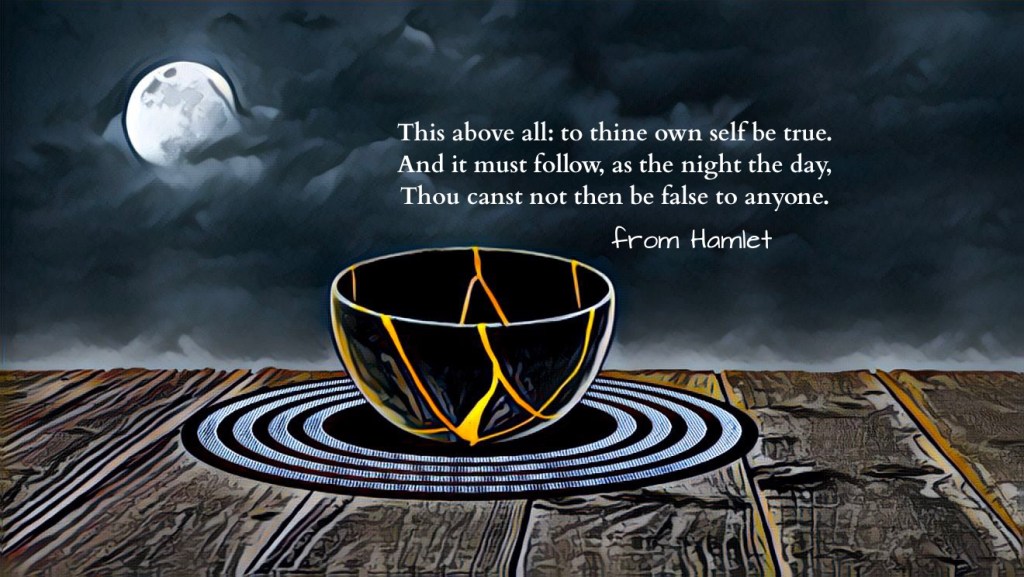
Poetry: “To thine own self be true” from Shakespeare’s Hamlet. Here, Polonius instructs his son, Laertes, as he leaves for college.

There, my blessing with thee.
And these few precepts in thy memory
Look thou character. Give thy thoughts no tongue,
Nor any unproportioned thought his act.
Be thou familiar but by no means vulgar.
Those friends thou hast, and their adoption tried,
Grapple them unto thy soul with hoops of steel,
But do not dull thy palm with entertainment
Of each new-hatched, unfledged comrade. Beware
Of entrance to a quarrel, but being in,
Bear ’t that th’ opposèd may beware of thee.
Give every man thy ear but few thy voice.
Take each man’s censure but reserve thy judgment.
Costly thy habit as thy purse can buy,
But not expressed in fancy—rich, not gaudy,
For the apparel oft proclaims the man,
And they in France of the best rank and station
Are of a most select and generous chief in that.
Neither a borrower nor a lender be,
For loan oft loses both itself and friend,
And borrowing dulls the edge of husbandry.
This above all: to thine own self be true,
And it must follow, as the night the day,
Thou canst not then be false to any man.
Farewell. My blessing season this in thee.

Music: To Thine Own Self Be True – Music by Brian Tate

And check out the just -for-fun extra song below.

Maybe you can imagine Anna singing this oldie but goodie to Tobit once they argued over the goat!

O My `Three’, My All

The Solemnity of the Most Holy Trinity
June 4, 2023

Today’s Readings:

https://bible.usccb.org/bible/readings/060423.cfm

Today, in God’s Lavish Mercy, we are wrapped in the loving mystery of the Holy Trinity. This mystery encompasses the Generative, Salvific, and Indwelling nature of the one true God.

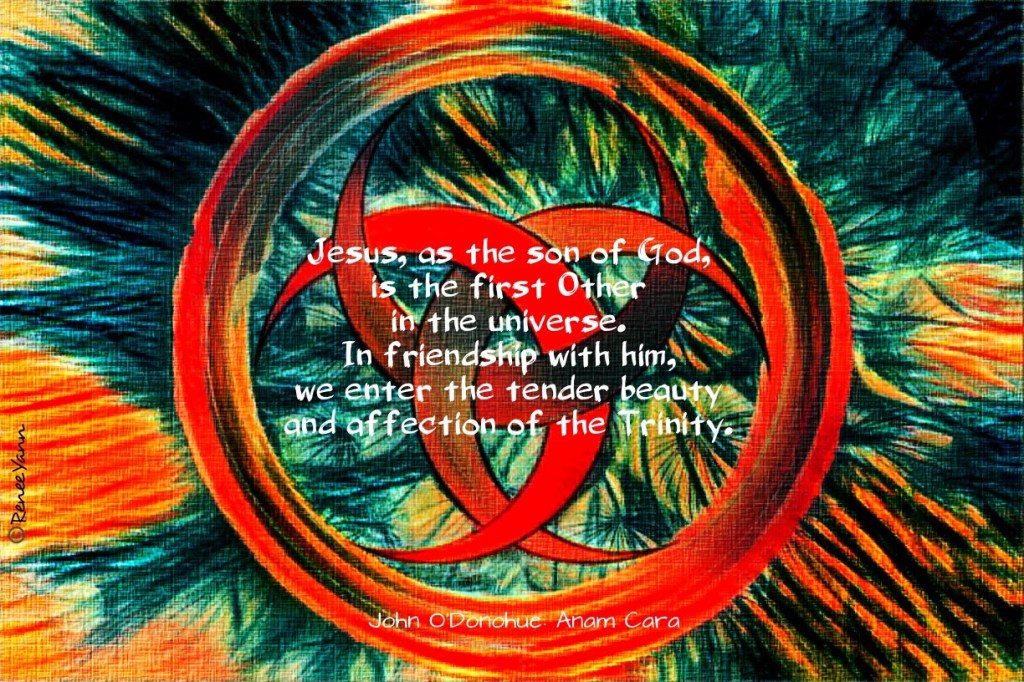
The Trinity is a mystery we approach with our hearts and souls, not with our minds. It is a Reality we fall in love with, and Which falls in love with us. John O’Donohue describes it like this:

The Christian concept of God as Trinity is the most sublime articulation of otherness and intimacy, an eternal interflow of friendship. This perspective discloses the beautiful fulfillment of our immortal longing in the words of Jesus, who said, Behold, I call you friends. Jesus, as the son of God, is the first Other in the universe. . . . In friendship with him, we enter the tender beauty and affection of the Trinity. In the embrace of this eternal friendship, we dare to be free.

from Anam Cara: A Book of Celtic Wisdom

In our first reading, Moses encounters the Creator, first Person of the Blessed Trinity and invites God into his company.

Having come down in a cloud, the LORD stood with Moses there
and proclaimed his name, “LORD.”
Thus the LORD passed before him and cried out,
“The LORD, the LORD, a merciful and gracious God,
slow to anger and rich in kindness and fidelity.”
Moses at once bowed down to the ground in worship.
Then he said, “If I find favor with you, O Lord,
do come along in our company.


In our second reading, Paul tells us how to invite God into our company:

Brothers and sisters, rejoice.
Mend your ways, encourage one another,
agree with one another, live in peace,
and the God of love and peace will be with you.


And in our Gospel, Jesus utters the iconic verse which is the foundation of our faith:

God so loved the world that he gave his only Son,
so that everyone who believes in him might not perish
but might have eternal life.


Each of our readings allows us to reflect on the wonder that we touch God in many different ways, just as God touches us.

  • Sometimes we invoke the Source of our life to guide and protect us.
  • At other times, we look to the Incarnate Word to teach us how to live.
  • Still there are other times when we reach deep into our hearts and pray without words in the Holy Spirit about things too deep to describe.

Prose: Prayer of St. Elizabeth of the Trinity – (excerpt from Drink of the Stream: Prayers of Carmelites compiled by Penny Hickey)

“O my God, Trinity whom I adore, let me entirely forget myself that I may abide in you, still and peaceful as if my soul were already in eternity; let nothing disturb my peace nor separate me from you, O my unchanging God, but that each moment may take me further into the depths of your mystery ! Pacify my soul! Make it your heaven, your beloved home and place of your repose; let me never leave you there alone, but may I be ever attentive, ever alert in my faith, ever adoring and all given up to your creative action.
O my beloved Christ, crucified for love, would that I might be for you a spouse of your heart! I would anoint you with glory, I would love you - even unto death! Yet I sense my frailty and ask you to adorn me with yourself; identify my soul with all the movements of your soul, submerge me, overwhelm me, substitute yourself in me that my life may become but a reflection of your life. Come into me as Adorer, Redeemer and Savior.
O Eternal Word, Word of my God, would that I might spend my life listening to you, would that I might be fully receptive to learn all from you; in all darkness, all loneliness, all weakness, may I ever keep my eyes fixed on you and abide under your great light; O my Beloved Star, fascinate me so that I may never be able to leave your radiance.
O Consuming Fire, Spirit of Love, descend into my soul and make all in me as an incarnation of the Word, that I may be to him a super-added humanity wherein he renews his mystery; and you O Father, bestow yourself and bend down to your little creature, seeing in her only your beloved Son in whom you are well pleased.
O my `Three', my All, my Beatitude, infinite Solitude, Immensity in whom I lose myself, I give myself to you as a prey to be consumed; enclose yourself in me that I may be absorbed in you so as to contemplate in your light the abyss of your Splendor!”

Music: Oh, Late Have I Loved You – Prayer of St. Augustine interpreted by Roc O’Conner, SJ

Don’t Miss Sirach!

Memorial of St. Justin, Martyr
June 1, 2023

Today’s Readings:

https://bible.usccb.org/bible/readings/060123.cfm

Today, in God’s Lavish Mercy, we pray with one of our last few readings from the Book of Sirach. On Saturday, we will finish this book and, on Monday, move on to the Book of Tobit.

Both Sirach and Tobit are considered deuterocanonical (or “second list”) books of the Bible. That’s a really big word that makes you sound smart but its meaning is simple. The term refers to a group of writings composed sometime in the 300 years before the birth of Christ. The Catholic Church considers them part of the Old Testament. Most Protestant denominations do not.

Therefore, my readers who are not Catholic may be unfamiliar with these books. The Protestant Bible is composed of the protocanonical (or “first list”) of books, the earlier texts which comprised the Hebrew scriptures. Catholic translations of the Bible include both proto and deutero books.


So who cares, you might be saying. Well, I think it’s helpful to realize that the formulation of what comprises the Bible was a fluid process. Jews, Catholics and Protestants mean different things when they say “my Bible”. We share many of the same readings, but may never have heard some others. Sirach and Tobit are good examples of those sometimes missed readings.


And what a shame it would be to miss the wise and lyrical Sirach who was a real poet writing around 200 years before Jesus was born. His work was preserved, popular and shared. Many references in the New Testament indicate that Jesus and the disciples were familiar with Sirach’s work. That’s cool, don’t you think? I like to think of Jesus listening to sacred stories or reading books like Sirach before he went to bed at night.


And maybe Jesus, as we might this morning, walked along the beach or sat by a dawn-lit window praying with these beautiful words:

Now will I recall God’s works;
what I have seen, I will describe.
At God’s word were his works brought into being;
they do his will as he has ordained for them.
As the rising sun is clear to all,
so the glory of the LORD fills all his works;
Yet even God’s holy ones must fail
in recounting the wonders of the LORD,
Though God has given these, his hosts, the strength
to stand firm before his glory.

Sirach 2:15-17

Our Gospel may lead us to pray with Bartimeus, begging for the kind of sight Sirach describes – an inner sight that comes from allowing God to plumb our hearts:

He plumbs the depths and penetrates the heart;
their innermost being he understands.
The Most High possesses all knowledge,
and sees from of old the things that are to come:
He makes known the past and the future,
and reveals the deepest secrets.

Sirach 42:18-19

Poetry: how about if we just enjoy more of Sirach’s elegant poetry

How beautiful are all God's works!
even to the spark and fleeting vision!
The universe lives and abides forever;
to meet each need, each creature is preserved.
All of them differ, one from another,
yet none of them has God made in vain,
For each in turn, as it comes, is good;
can one ever see enough of their splendor?

Music: Across the Universe – John Lennon and the Beatles

This song reminds me that God’s Universe is everlasting. Nothing will change God’s Presence to us. The phrase “Jai Guru Deva” is a Sanskrit phrase which can be translated “Glory to the Shining Remover of Darkness”, reminding us of Bartimeus’s experience of being healed from his blindness.

Do You Love Me?

Memorial of Saint Philip Neri, Priest
May 26, 2023

Today’s Readings:

https://bible.usccb.org/bible/readings/052623.cfm


Today, in God’s Lavish Mercy, we stand beside Peter as Jesus asks him the most important question of his life.

After Jesus had revealed himself to his disciples and eaten breakfast with them,
he said to Simon Peter,
“Simon, son of John, do you love me more than these?”

John 21:15

What was Jesus really getting at? Here they all are enjoying a nice breakfast on the beach. Their hearts are overjoyed to be in the presence of their Eastered Lord. Life must have felt good that sunny, post-Resurrection morning. And probably all that Peter really wanted out of life was another piece of fired fish or toasted bread, and for their seashore picnic to linger into an eternal evening.

Then here comes Jesus with his cosmic questions! What does he mean, “Do I love him”! Of course, I love him! Haven’t I hung around for three years trying to make this thing work, climbing out of my several missteps to try to be everything he wanted and needed? Oh my goodness, where is he going to call me now with this confusing question: Do you love me?


Yes, Jesus knows that Peter loves him in Peter’s way. He trusts Peter’s affection, devotion, and utter commitment to him. But Jesus’s question is pulling Peter way beyond the salted scents of that Tiberias beach. He wants Peter to love him in God’s way!

Jesus is calling Peter to a timeless answer and a transcendent love. What he is asking Peter is this:

  • Will you leave the man who was “Simon, son of John” to become “Peter, the Rock on which I build my Church”.
  • Will you love me to the point of giving yourself completely so that I may continue to love through you?

Today, as we settle into the sandy dunes with Jesus and his BFFs, Jesus might glance at us as he passes his smoked fish our way. His beautiful eyes might hold a question for us as well as for Peter. Through each of us, Jesus wants to continue to love the world into wholeness. Let’s ask his help in learning how to do that.


Maxim: from St. John of the Cross, a 16th century mystic, who understood Jesus’s eternal question and answered it in this way:

In the evening of our lives we will be judged on love.
Let us therefore learn to love God as God wishes to be loved.


Music: Fill the World with Love – from “Goodbye, Mr. Chips”, music and lyrics by Leslie Bricusse

In the morning of my life I shall look to the sunrise.
At a moment in my life when the world is new.
And the blessing I shall ask is that God will grant me,
To be brave and strong and true,
And to fill the world with love my whole life through.

And to fill the world with love
And to fill the world with love my whole life through.

In the noontime of my life I shall look to the sunshine,
At a moment in my life when the sky is blue.
And the blessing I shall ask shall remain unchanging.
To be brave and strong and true,
And to fill the world with love my whole life through.

And to fill the world with love
And to fill the world with love my whole life through.

In the evening of my life I shall look to the sunset,
At a moment in my life when the night is due.
And the question I shall ask only God can answer.
Was I brave and strong and true?
Did I fill the world with love my whole life through?

Did I fill the world with love?
Did I fill the world with love
My whole life through?

Amid Trumpet Blasts

The Ascension of the Lord
May 18, 2023

Today’s Readings:

https://bible.usccb.org/bible/readings/051823-Ascension.cfm

Today, in God’s Lavish Mercy, we pray with Psalm 47, one of seven enthronement psalms which celebrate a “coronation” of God.

All you peoples, clap your hands,
    shout to God with cries of gladness,
For the LORD, the Most High, the awesome,
    is the great king over all the earth.

Psalm 47: 1

Used for the feast of the Ascension, the point of the psalm is much more than an exercise of pageantry. It is an act of faith and reverence to God, the Loving Omnipotence who chose to redeem us by assuming our humanity.

It is a confirmation that we believers do see the Supreme Being in the human Jesus we have come to love. This is what Paul prays for the Ephesians in our second reading:

May the eyes of your hearts be enlightened,
that you may know what is the hope that belongs to his call,
what are the riches of glory
in his inheritance among the holy ones,
and what is the surpassing greatness of his power
for us who believe,
in accord with the exercise of his great might,
which he worked in Christ,
raising him from the dead
and seating him at his right hand in the heavens,
far above every principality, authority, power, and dominion,
and every name that is named
not only in this age but also in the one to come.

Ephesians 1:18-21

The Great Commission, found in today’s Gospel, is the true gift of the Ascension.

Go into the whole world
and proclaim the gospel to every creature.

Mark 16: 15

Jesus tells us that his time on earth is complete. The lesson of Incarnational Love has been taught. We now are given the power to continue the message for all time. 

Jesus promises that our faith will:


overcome evil
-create new possibilities to preach the Gospel
-show courage against antagonism
-resist suppression
-heal and strengthen others to believe

These signs will accompany those who believe:

-in my name they will drive out demons,
-they will speak new languages.
-They will pick up serpents with their hands,
-drink any deadly thing, it will not harm them.
lay hands on the sick, and they will recover.


If we believe and open our hearts to this message, indeed, it is a day for trumpet blasts! Here are a few from one of my favorite triumphal pieces! If the Apostles had only had trumpets, they might have played something like this for the Lord as He ascended 🙂


Poetry: Ascension Sonnet – Malcolm Guite

We saw his light break through the cloud of glory
Whilst we were rooted still in time and place
As earth became a part of Heaven’s story
And heaven opened to his human face.

We saw him go and yet we were not parted
He took us with him to the heart of things
The heart that broke for all the broken-hearted
Is whole and Heaven-centred now, and sings,

Sings in the strength that rises out of weakness,
Sings through the clouds that veil him from our sight,
Whilst we our selves become his clouds of witness
And sing the waning darkness into light,

His light in us, and ours in him concealed,
Which all creation waits to see revealed.

Music: Psalm 47 – Rory Cooney

Faith and Truth

Wednesday of the Sixth Week of Easter
May 17, 2023

Today’s Readings:

https://bible.usccb.org/bible/readings/051723.cfm

Today, in God’s Lavish Mercy, Paul is the headliner at the famed Areopagus in Athens.

The Areopagus is a prominent rock outcropping located northwest of the Acropolis in Athens, Greece. The name Areopagus also referred, in classical times, to the Athenian governing council, because they convened in this location. It was the ancient version of a stadium, but one provided by nature rather than human hands.

Paul’s address, from Acts today, has been perfectly crafted for his audience who are Gentile intellectuals and philosophers. We are familiar, up until now, with Paul’s speeches to Jews whom he wishes to convert. In those circumstances, he drew on the Hebrew scriptures with which they are familiar. But for the Athenians, Paul uses their art, poetry and philosophy to lead them to the topic of Jesus as the one true God.

And things go well for Paul in his long and finely detailed oration. The thoughtful Athenians are listening, that is until they hit a snag:

(Paul proclaimed) God demands that all people everywhere repent
because he has established a day on which he will ‘judge the world
with justice’ through a man he has appointed,
and he has provided confirmation for all
by raising him from the dead.”

When they heard about resurrection of the dead,
some began to scoff, but others said,
“We should like to hear you on this some other time.”
And so Paul left them.

Acts 17:30-33

Jesus Christ, Risen from the dead is the touchstone of our Christian faith. It is the Sacred Reality that surpasses and changes every other reality we encounter.

Resurrection faith is not something we can study, analyze, or comprehand with simply the powers of our minds. That’s what the Athenians tried to do, but their analytical inclinations blocked them.

Resurrection faith is a Divine gift, given through the Spirit, to a heart opened in trust and readiness to God. It defies logic and philosophy because it is greater than they are. For one who has this kind of faith, explanations are not only unnecessary, they are restrictive and superfluous.

Jesus understood that to live with such faith is challenging. He suggests that the disciples cannot bear the weight of it without the indwelling companionship of the Holy Spirit.

Jesus said to his disciples:
“I have much more to tell you, but you cannot bear it now.
But when the Spirit comes, the Spirit of truth,
you will be guided to all truth.

John 16:12-13

As people desiring to grow in faith, we can learn from the Athenians who walked away from the Grecian hillside. Is my capacity to believe limited by what my small human intellect can define? Or are my heart and mind given in trust to the infinite God Who loves me into the fullness of Truth.


Poetry: Tell All the Truth, but Tell It Slant – Emily Dickenson

Tell all the Truth but tell it slant –
Success in Circuit lies
Too bright for our infirm Delight
The Truth’s superb surprise
As Lightning to the Children eased
With explanation kind
The Truth must dazzle gradually
Or every man be blind –


Music: The Faith – Leonard Cohen

The sea so deep and blind
The sun, the wild regret
The club, the wheel, the mind,
O love, aren’t you tired yet?
The club, the wheel, the mind
O love, aren’t you tired yet?

The blood, the soil, the faith
These words you can’t forget
Your vow, your holy place
O love, aren’t you tired yet?
The blood, the soil, the faith
O love, aren’t you tired yet?

A cross on every hill
A star, a minaret
So many graves to fill
O love, aren’t you tired yet?
So many graves to fill
O love, aren’t you tired yet?

The sea so deep and blind
Where still the sun must set
And time itself unwind
O love, aren’t you tired yet?
And time itself unwind
O love, aren’t you tired yet?

Unchained….

Tuesday of the Sixth Week of Easter
May 16, 2023

Today’s Readings:

https://bible.usccb.org/bible/readings/051623.cfm

Today, in God’s Lavish Mercy, we meet people who are deeply dedicated to their life commitments – sometimes for good, sometimes for woe.

In Acts, we meet the unnamed “jailer”. Paul and Silas have been manhandled and thrown into prison. Their jailer receives the instruction to “guard them securely” and he takes it very seriously, binding them in chains in the innermost dungeon.

This man revels in his job, to the degree that it is his only identification in the scriptures. We never know his real name.

His job gives him authority and power he would not have in his ordinary circumstances. Perhaps his job has even become his identity so that without it, he feels like little or nothing. When God decides to “earthquake” Paul and Silas out of their chains, the guard freaks. It’s more than an earthquake to him – his very identity is crumbling in the tumult.


And how about Paul? Is he cool in this reading, or what??? Paul’s power relies not on an assumed identity but on God’s centrality in his life.

When the jailer woke up and saw the prison doors wide open,
he drew his sword and was about to kill himself,
thinking that the prisoners had escaped.
But Paul shouted out in a loud voice,
“Do no harm to yourself; we are all here.”

The jailer’s awed response is full-hearted! He does a transformational flip which transfers all his past “job dedication” into his new spiritual conversion. Not only does he allow the disciples to go free, he guides them to his own house, ministers to them, and is baptised. No doubt, his past employers were not too happy with him!


In our Gospel, the disciples, who are deeply dedicated to their vocations, still demonstrate a bit of job-jitters.

Jesus has made it clear that he’s on his way to another dimension and that his disciples will to have to carry on the evangelization business on their own. He promises them all kinds of supernatural help but they can’t imagine functioning without him.

Finally Jesus tells them that, in his physical absence, the Spirit will give them an enhanced power to promulgate the Gospel:

But I tell you the truth, it is better for you that I go.
For if I do not go, the Advocate will not come to you.
But if I go, I will send him to you.
And when he comes he will convict the world
in regard to sin and righteousness and condemnation

Both our readings today remind us that it’s all about what really makes us tick. Do we really understand that it is God’s life with us that gives us “importance”, security and identity? Do we tap into that Infinite Power to give us hope, confidence and transformational resilience in life’s many earthquakes? If so, we like the disciples, will be “unchainable” — because it isn’t about us. It is about the God we love whose Spirit lives in us.


Poetry: Peter and the Angel – Denise Levertov

(This poem is not about Paul and Silas, but rather about Peter when he too was freed from prison by Divine intervention (Acts 12:5-17))

Delivered out of raw continual pain,
smell of darkness, groans of those others
to whom he was chained—
unchained, and led
past the sleepers,
door after door silently opening—
out!
And along a long street's
majestic emptiness under the moon:
one hand on the angel's shoulder, one
feeling the air before him,
eyes open but fixed . . .
And not till he saw the angel had left him,
alone and free to resume
the ecstatic, dangerous, wearisome roads of
what he had still to do,
not till then did he recognize
this was no dream. More frightening
than arrest, than being chained to his warders:
he could hear his own footsteps suddenly.
Had the angel's feet
made any sound? He could not recall.
No one had missed him, no one was in pursuit.
He himself must be
the key, now, to the next door,
the next terrors of freedom and joy.

Music: Love is the Only Way – from the film Paul, Apostle of Christ by Jan Kaczmarek


An extra treat to bless your day: this beautiful and powerful rendition of “Unchained Melody’

The Musikschau der Nationen invites army orchestras from almost a dozen countries the U.S. Army website classifies as “Europe’s biggest brass band music festival.” Though not always consecutive, the festival enjoys over 35 years of time-honored traditions. Some participants besides the U.S. included Vietnam, Russia, and Mexico, among others. In 2002, they performed an all-orchestra version of “Unchained Melody”. The performance represented the largest millitary orchestra in the world.

Colorful Faith

Monday of the Sixth Week of Easter
May 15, 2023

Today’s Readings:

https://bible.usccb.org/bible/readings/051523.cfm

Today, in God’s Lavish Mercy, our first reading opens with the beautiful image of Paul and co-ministers sailing off into the Mediterranean blue, finally ending up in Philippi.

There they meet Lydia, “a dealer in purple cloth”. Lydia was a notable figure. Some scripture scholars say she was businesswoman and head of a significant household who offered hospitality to Paul’s entire traveling team. Others see her as a morally questionable “huckster” whose invitation of men to her home would have been morally questionable.

In a magnificent paper for her doctoral dissertation, Alexandra Gruca-Macaulay argues for Lydia as the “Perceptive Disciple” whose true heart became an agent for God’s Word.

A complex but excellent read for those who might be interested.

However we imagine Lydia, Acts clearly notes that she was already a “worshipper of God”, Lydia listened to the disciples’ evangelization. God opened her heart and she accepted Jesus Christ. This is most significant because her heart-opening, much like Mary’s, allowed the Gospel to pass through to her household and, symbolically, to all of Asia Minor.

Halliday, Edward Irvine; St Paul Meeting Lydia of Thyatira; University of Liverpool; http://www.artuk.org/artworks/st-paul-meeting-lydia-of-thyatira-66511

Lydia is the first Christian convert in Philippi, a church which Paul grew to love deeply as we can discern from his beautiful letter to the Philippians. As Paul and his company finish their initial evangelization in Philipppi, the community is entrusted to the hands of Lydia and her devoted neighbors.

What exactly was Lydia’s role as Paul sailed on to other horizons? As in so many cases involving early Church women, history folds that answer into the opinionated edits of 2000 years of monks and translators.

I choose to think that Lydia continued at least as a presbyter, if not a priest. The community had long gathered around her generous and dynamic leadership. Why would that change after Paul departed?


In our Gospel, Jesus is speaking to people like Lydia and like us, down through the ages. He indicates that once we are transformed in the Holy Spirit, we can’t help but cry out the wonder of God in our lives.

Jesus said to his disciples:
“When the Advocate comes whom I will send you from the Father,
the Spirit of truth who proceeds from the Father,
he will testify to me.
And you also testify,
because you have been with me from the beginning.

John 15:26-27

Let’s pray to and for all true disciples, especially the women God has chosen to stand at the center of an ever-evolving Church and to weave its energy always toward an inclusive community.


Poetry: Epilogue – Sister Lou Ella Hickman, a widely published poet whose collection ” she:robed and wordless” captures the essence of many biblical women. Her poem cited here attracted me because of the colors – purple, of course, then oranges and reds. I can almost hear our Lydia reciting such a poem!


Music: Piano instrumental of the beautiful song Deep Purple


Upside-Down, Inside-Out

Thursday of the Fourth Week of Easter
May 4, 2023

Today’s Readings:

https://bible.usccb.org/bible/readings/050423.cfm

Today, in God’s Lavish Mercy, our two readings take us on a journey. We sail through Israel’s long and spectacular salvation history from Moses through David and forward to Jesus. And in the sailing, we get turned head over heels.


In our first reading, Paul encapsulates twelve hundred years in a few elegant verses. (Nice job, Paul!)

The touchpoints of his homily are these:

  • the sojourn in the land of Egypt. 
  • forty years in the desert.
  • destruction of Canaan,
  • judges up to Samuel the prophet.
  • King Saul, for forty years. 
  • King David whose descendants gave Israel …
  • JESUS
  • then a little mention of John the Baptist

Paul’s succinct preaching allows us to see God’s powerful arm reaching through the long sleeve of Isreal’s history, finally handing the Chosen People the ultimate gift — Jesus Christ the Messiah.


Ah, but then we have our Gospel – which does today what it always does so well. It turns everything upside down and inside-out.

Through the twelve hundred years of Israel’s pre-Christian history, we see an agonizingly slow rise to power and glory culminating in David’s reign. How deeply later Israelites longed for a future Savior who would shine like the royal David had – who would restore the glory of Israel. That was their cherished expectation.


But Jesus turns that long sleeve of salvation history inside out. He preaches an inverse power fueled by service, a glory dressed in humble acts of mercy and forgiveness.

His longing is not for a worldly restoration, but for a whole New Creation born of sacrificial love. His hope is not for a secular kingdom but for a transformational community enlivened in the Triune God.

When Jesus had washed the disciples’ feet, he said to them:
“Amen, amen, I say to you, no slave is greater than his master
nor any messenger greater than the one who sent him.
If you understand this, blessed are you if you do it.

John 12:16-20

As we read and pray the scriptures, we get better at seeing the sacred understory of grace sustaining us. Upside-down, inside-out, our daily life is filled with divine mystery and revelation. We just have to look at the flip side to catch hold of the sail.

I was a teenager during the golden age of the 33 and 45 rpm records. I had a slew of Elvis, Fats Domino, Roy Orbison, The Everley Brothers, Ray Charles, The Supremes and many others. Each record had a hit on one side, and I rarely bothered to look at the other side. One day I flipped one of my “Top 10s” (The Wildcat Blues) to take a look at the other side, only to find what would become one of my favorite songs of all time: Petite Fleur. After the 1950s, it faded from the top ten list, but it has stayed on my list for 60 years.

When I hear that song, it sinks into my spirit creating a feeling that resists words. Like much good music, it reorders something in my spirit so that I see the world a little differently. And I would never have found it if I hadn’t turned things upside down to listen to the understory.


If we allow ourselves to dive deep under the scriptures – to go to the “flip side” – as Jesus invites us to do in today’s Gospel, we will find our own “petite fleurs” of insight and grace.

If you understand this,
blessed are you if you do it.

John 13:17

Prose: from Seeing by Annie Dillard

The secret of seeing is, then, the pearl of great price. 
If I thought he could teach me to find it and keep it forever 
I would stagger barefoot across a hundred deserts 
after any lunatic at all. 

But although the pearl may be found,
it may not be sought. 
The literature of illumination reveals this above all: 
although it comes to those who wait for it, 
it is always, even to the most practiced and adept, 
a gift and a total surprise… 

I cannot cause light; 
the most I can do is try to put myself 
in the path of its beam. 
It is possible, in deep space, to sail on solar wind. 
Light, be it particle or wave, has force: 
you rig a giant sail and go. 

The secret of seeing is to sail on solar wind.
Hone and spread your spirit till you yourself are a sail, 
whetted, translucent, broadside to the merest puff.

Music: Petite Fleur – Chris Barber