Seeing Clearly

February 16, 2022
Wednesday of the Sixth Week in Ordinary Time

Today, in God’s Lavish Mercy, our readings are around the theme of our spiritual senses.

James tells us to listen, look, see, and act on the Word planted within our hearts. Once again, he gives us great images to help our understanding.

For if anyone is a hearer of the word and not a doer,
he is like a man who looks at his own face in a mirror.
He sees himself, then goes off and promptly forgets
what he looked like.

James 1:3-24

If anyone thinks he is religious
and does not bridle his tongue
but deceives his heart, his religion is vain.

James 1: 26

In our Gospel, once again our dear, earthy Jesus heals someone in a deeply human way. Jesus takes the blind man aside, holding his hand to lead him. As he did in a passage recently, Jesus spits on his fingers and massages the blind man’s eyes.

The man tries to work with Jesus, exclaiming that he sees “people like trees walking”.

I’ve always loved that line because it makes me feel like I’m right there, in that little dusty village of Bethsaida, listening like the rest of the stunned crowd to the man’s amazement!


As we pray this morning, we might wonder what Jesus said back to that overwhelmed man as they sat together, helping him to learn how to see. What might Jesus say to us as he lifts one of our many blindnesses from our hearts?


Prose: from Pilgrim at Tinker Creek by Annie Dillard

(This passage is from one of my all-time favorite books written by Annie Dillard whom I think of as the “Mary Oliver” of prose. Here’s the way wikipedia describes the book:)

Pilgrim at Tinker Creek is a 1974 nonfiction narrative book by American author Annie Dillard. Told from a first-person point of view, the book details an unnamed narrator's explorations near her home, and various contemplations on nature and life. The title refers to Tinker Creek, which is outside Roanoke in Virginia's Blue Ridge Mountains. Dillard began writing Pilgrim in the spring of 1973, using her personal journals as inspiration. Separated into four sections that signify each of the seasons, the narrative takes place over the period of one year.
The book records the narrator's thoughts on solitude, writing, and religion, as well as scientific observations on the flora and fauna she encounters. Touching upon themes of faith, nature, and awareness, Pilgrim is also noted for its study of theodicy and the inherent cruelty of the natural world. The author has described it as a "book of theology", and she rejects the label of nature writer.

I think this is a great book to pick up at the beginning of any season of nature or life. The excerpt I chose for today, in honor of the Gospel, is from a chapter entitled ” Seeing”:

A fog that won’t burn away drifts and flows across my field of vision. When you see fog move against a backdrop of deep pines, you don’t see the fog itself, but streaks of clearness floating across the air in dark shreds. So I see only tatters of clearness through a pervading obscurity. I can’t distinguish the fog from the overcast sky; I can’t be sure if the light is direct or reflected. Everywhere darkness and the presence of the unseen appalls. We estimate now that only one atom dances alone in every cubic meter of intergalactic space. I blink and squint. What planet or power yanks Halley’s Comet out of orbit? We haven’t seen that force yet; it’s a question of distance, density, and the pallor of reflected light. We rock, cradled in the swaddling band of darkness. Even the simple darkness of night whispers suggestions to the mind.

The secret of seeing is, then, the pearl of great price. If I thought he could teach me to find it and keep it forever I would stagger barefoot across and hundred deserts after any lunatic at all. But although the pearl may be found, it may not be sought. The literature of illumination reveals this above all: although it comes to those who wait for it, it is always, even to the most practiced and adept, a gift and a total surprise. I return from one walk knowing where the killdeer nests in the field by the creek and the hour the laurel blooms. I return from the same walk a day later scarcely knowing my own name. Litanies hum in my ears; my tongue flaps in my mouth Ailinon, alleluia! I cannot cause light; the most I can do is try to put myself in the path of its beam. It is possible, in deep space, to sail on solar wind. Light, be it particle or wave, has force: you rig a giant sail and go. The secret of seeing is to sail on solar wind. Hone and spread your spirit till you yourself are a sail, whetted, translucent, broadside to the merest puff.

Music: I Can See Clearly Now – Jimmy Cliff

Joyful Calculation

February 14, 2022
Monday of the Sixth Week in Ordinary Time

Today, in God’s Lavish Mercy, Lent is just a little over two weeks away. We will spend the intervening time in good company with daily insights from James, Peter and Mark. Today we begin the Epistle of James.

The Epistle of James- Chapter 1: Illustration provided to Wikimedia Commons by Distant Shores Media/Sweet Publishing as part of a cooperation project. Sweet Publishing released these images, which are taken from now-out-of-print Read’n Grow Picture Bible Illustrations (Biblical illustrations by Jim Padgett, courtesy of Sweet Publishing, Ft. Worth, TX, and Gospel Light, Ventura, CA. Copyright 1984.), under new license, CC-BY-SA 3.0

This letter is one of the very earliest of the New Testament. Scholars are mixed about exactly which “James” wrote it, but agree that it was one of several who were very close to Jesus – perhaps one of “the brothers of Jesus” mentioned in several New Testament passages:

  • Matthew 12:46-50
  • Mark 3:31
  • Luke 8:19
  • John 2:12
  • Acts 1:14
  • 1 Corinthians 9:5
  • and specifically “the Lord’s brother James” in Galatians 1:19

James writes in the style of Wisdom Literature, those Old Testament books that give advice, proverbs, and insights for living a holy life. His immediate audience was a community of dispersed Christian Jews whose world was filled with increasing upheaval and persecution.


When I read the following description I thought how germane James’s letter could be for our world today. His themes echo the teachings of Pope Francis for our chaotic time:

The epistle is renowned for exhortions on fighting poverty and caring for the poor in practical ways (1:26–27; 2:1-4; 2:14-19; 5:1-6), standing up for the oppressed (2:1-4; 5:1-6) and not being “like the world” in the way one responds to evil in the world (1:26-27; 2:11; 3:13-18; 4:1-10). Worldly wisdom is rejected and people are exhorted to embrace heavenly wisdom, which includes peacemaking and pursuing righteousness and justice (3:13-18).

Jim Reiher, “Violent Language – a clue to the Historical Occasion of James.”Evangelical Quarterly. Vol. LXXXV No. 3. July 2013

Here is the golden advice James gives us today:

  • Be joyful in trials.
  • Let trials increase your perseverance not discourage you.
  • Doing this is a sign of wisdom.
  • When your wisdom is depleted, ask God for more with an open and trusting heart.
  • Honor all people, high or low in circumstances
  • Don’t be fooled by riches. They fade away.

In our Gospel, Jesus is frustrated with the Pharisees who insincerely demand a magical sign from him. They demonstrate none of the spiritual wisdom and openness to grace that James describes.

When we think about our own faith, where does it fall on the scale of sincerity, on the spectrum joy, justice, and faithful perseverance?


Poetry: On Joy and Sorrow – Kahlil Gibran

Then a woman said, Speak to us of Joy and Sorrow.
And he answered:
Your joy is your sorrow unmasked.
And the selfsame well from which your laughter rises 
was oftentimes filled with your tears.
And how else can it be?
The deeper that sorrow carves into your being, 
the more joy you can contain.
Is not the cup that holds your wine 
the very cup that was burned in the potter’s oven?
And is not the lute that soothes your spirit, 
the very wood that was hollowed with knives?
When you are joyous, look deep into your heart 
and you shall find it is only that which has given you sorrow 
that is giving you joy.
When you are sorrowful look again in your heart, 
and you shall see that in truth you are weeping for 
that which has been your delight.
Some of you say, “Joy is greater than sorrow,” 
and others say, “Nay, sorrow is the greater.”
But I say unto you, they are inseparable.
Together they come, 
and when one sits alone with you at your board, 
remember that the other is asleep upon your bed.
Verily you are suspended like scales 
between your sorrow and your joy.
Only when you are empty 
are you at standstill and balanced.
When the treasure-keeper lifts you 
to weigh his gold and his silver, 
needs must your joy or your sorrow rise or fall.

Music: Count It All Joy

Sailing home…

February 7, 2022
Monday of the Fifth Week in Ordinary Time

Today, in God’s Lavish Mercy, our readings are woven through with the theme of “coming home”.

In 1 Kings, Solomon believes he has constructed the perfect home for God:

Then Solomon said, “The LORD intends to dwell in the dark cloud;
I have truly built you a princely house,
a dwelling where you may abide forever.”

1 Kings 8:13

Psalm 132 invites God to dwell in that home, and in the home of the psalmist’s heart:

Lord, go up to the place of your rest!

Psalm 132: 8

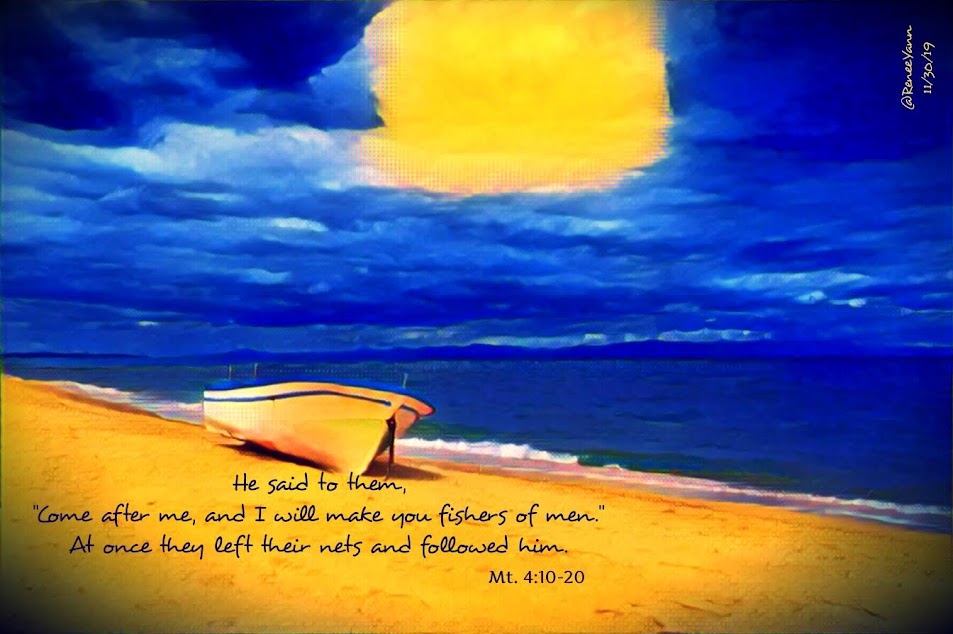
And in our Gospel, Jesus sails toward a quiet, homey place for peace and quiet:

After making the crossing to the other side of the sea,
Jesus and his disciples came to land at Gennesaret
and tied up there.

Mark 6:53

Thinking of home, and sailing, and sea, my prayer this sunny morning is filled with thoughts of Ann. We, with fifty other young and vibrant souls, entered the convent together almost 60 years ago.

Among us, Ann was probably the only one who had ever sailed a boat. She was the child of surf and sand while most of us were children of bricks and trolley tracks.

She told me way back then how much she loved and missed the sea spray anointing her face as she sailed. She was then, and remained, a ray of freedom and delight.

Ann died a week ago after a Sunlit Life in God’s Mercy. I can almost see her grave from my window behind the Motherhouse, especially on this brilliant morning.

Reading Mark today, and picturing Jesus tie up his boat at the golden shore, I think of Ann on heaven’s morning – Spirit’s seaspray and sunlight come fully home.

Poem: Prayer – Renee Yann, RSM

You wait for me
to find morning’s
Eternal Edge.

Coiled prayer
slowly unwinds
within and around.

I see that You
sail forever
toward me.

Come,
tie up now
at my heart.

Music: Sailing

Witness for ?

February 6, 2022
Fifth Sunday in Ordinary Time

I bet I know the first word that popped into your mind when you read today’s headline: PROSECUTION!

But today, in God’s Lavish Mercy, our readings invite us to consider WITNESS — not for the prosecution, but for the RESURRECTION!

In our first reading, we see Isaiah dramatically commissioned to WITNESS to the vision of faith in his heart. He responds wholeheartedly:

Then I heard the voice of the Lord saying,
“Whom shall I send? Who will go for us?”
“Here I am,” I said; “send me!”

Isaiah 6:8

Our second reading, Paul describes how Christ appeared to him and commissioned him, “the least of the Apostles” to be his WITNESS. Paul, too, responds wholeheartedly:

He appeared to me.
Therefore, … so we preach and so you believed.

1 Corinthians 15:11

In our Gospel, Simon Peter, James and John are awed by the miraculous power of Jesus as their nets pull hundreds of fish from the otherwise unproductive sea. Jesus tells them that, by their WITNESS, they will attract hundreds of souls to his message. They also respond wholeheartedly:

When they brought their boats to the shore,
they left everything and followed him.

Luke 5:11

Macrina Wiederkehr, OSB, in her beautiful book, “Seven Sacred Pauses”, describes the level of WITNESS in the first disciples:

They were impelled to continue proclaiming the Gospel in the face of opposition. 
They were zealous in preaching because they felt passionate 
about being entrusted with the sacred message.

Think of this often-heard philosophical conundrum:

Photo by Vasilis Karkalas on Pexels.com

If a tree falls in the forest,
and no one is there to hear it,
does it make a sound?

Logic tells us that it does. But what does it matter if no one hears it?


If the Resurrection happened, and no one bears witness to it, what does it matter? That is the importance of our call to WITNESS – just like Isaiah, Paul, Peter, James, John, and two millennia of believers who carry on the sound of that tomb bursting open to eternal life.

How will we witness to our faith today –
not by preachy words or empty opinions,
but by our active passion for justice and mercy
in the world, and in our own everyday choices?


Poetry: In Whom We Live and Move and Have Our Being – Denise Levertov

Birds afloat in air's current,
sacred breath? No, not breath of God,
it seems, but God
the air enveloping the whole
globe of being.
It's we who breathe, in, out, in, in the sacred,
leaves astir, our wings
rising, ruffled -- but only the saints
take flight. We cower
in cliff-crevice or edge out gingerly
on branches close to the nest. The wind
marks the passage of holy ones riding
that ocean of air. Slowly their wake
reaches us, rocks us.
But storms or still,
numb or poised in attention,
we inhale, exhale, inhale,
encompassed, encompassed.

Music: I Will Stand as a Witness

Come Away Awhile

February 5, 2022
Memorial of Saint Agatha, Virgin and Martyr

Today, in God’s Lavish Mercy, in our readings, both Solomon and Jesus seek a quiet place to pray, reflect, recenter, and commune with God.

Solomon went to Gibeon to sacrifice there,
because that was the most renowned high place.
Upon its altar Solomon offered a thousand burnt offerings.
In Gibeon the LORD appeared to Solomon in a dream at night.
God said, “Ask something of me and I will give it to you.”

1 Kings 3:4
Dream of Solomon – Luca Giordano

Solomon’s retreat is characterized by his sincere humility and gratitude. In this, his first documented encounter with God, Solomon hits a homer in relationship. God is pleased with Solomon’s self-abnegating request for only wisdom to benefit others.

O LORD, my God, you have made me, your servant,
king to succeed my father David;
but I am a mere youth, not knowing at all how to act.
I serve you in the midst of the people whom you have chosen,
a people so vast that it cannot be numbered or counted.
Give your servant, therefore, an understanding heart
to judge your people and to distinguish right from wrong.
For who is able to govern this vast people of yours?”

1 Kings 3:7-9

In his prayer, Solomon has been able to get himself out of the way in order to really see and hear God – to fully receive God’s Presence in his life.


In our Gospel, Jesus seeks retreat for himself and his disciples because of the pressures of their ministries and the recent gut-punch news of John the Baptist’s execution.

Turns out, they don’t really get much of a chance for a “holy chill”. As with many of us, the responsibilities are so pressing that they conspire to find us no matter what.

So they went off in the boat by themselves to a deserted place.
People saw them leaving and many came to know about it.
They hastened there on foot from all the towns
and arrived at the place before them.

When Jesus disembarked and saw the vast crowd,
his heart was moved with pity for them,
for they were like sheep without a shepherd;
and he began to teach them many things.

Mark 6: 32-34

We too, like Solomon and Jesus, need times of retreat and dedicated prayer in our lives. But sometimes, our responsibilities and work follow us as we attempt to find that sacred space.

How can we free ourselves for such spiritual renewal? By planning, asking for assistance, disciplining our time and choices. But the key is that we really have to want that precious deserted place for meeting God in a special way.

These “retreats” must be a way of life for us, consistent choices to bring our busy lives before God, humbly open our hearts, and ask to see ourselves in a new and graced way.

Our “going off to rest awhile” in God can be as short as a few minutes morning and evening, or as long as a 30 day retreat. But they must be a consistent and disciplined desire of our hearts.


“Discipline” may seem like a hard word for it, especially if we think of our high school demerits when we hear that word🤪 But remember, without disciple music would be just noise, art would be just scribble, dance would be contortion, and conversation would be babble.

When you consider “discipline”, think instead of the elegant balance of a beautiful dance and let God lead, or of the sweet perfection of glorious music and let God sing to you.


Prose: A treasured thought of the Jesuit Pedro Arrupe suggests itself here:

Nothing is more practical than
finding God, than
falling in Love
in a quite absolute, final way.
What you are in love with,
what seizes your imagination, will affect everything.
It will decide
what will get you out of bed in the morning,
what you do with your evenings,
how you spend your weekends,
what you read, whom you know,
what breaks your heart,
and what amazes you with joy and gratitude.
Fall in Love, stay in love,
and it will decide everything.

Music: These Alone Are Enough – Dan Schutte

Paying Respect

February 4, 2022
Friday of the Fourth Week in Ordinary Time

Today, in God’s Lavish Mercy, Sirach gives us a beautiful eulogy for King David.

With his every deed he offered thanks 
            to God Most High, in words of praise.
With his whole being he loved his Maker
            and daily had his praises sung;
            He set singers before the altar and by their voices
                        he made sweet melodies…


A eulogy sets a particular frame of remembrance around a person’s life. Like Sirach today, that frame tries to capture the positive accomplishments of the person who has died. We set aside any mistakes and negativity. Or we acknowledge them as Sirach has done for David by invoking God’s forgiveness:

The LORD forgave him his sins
and exalted his strength forever.


To tell the truth, I’ve attended a few funerals where I wondered what the speaker might come up with in a positive regard. You know, you need more than a sentence or two for a decent eulogy! Despite my wondering, every tribute has provided an enriching lesson on the sacred beauty of a human life, and how hard most of us try — even if we make a ton of mistakes.

There are times when I leave such a life celebration thinking, “Gosh, I never realized that about him!” or “Wow, there are so many things we don’t understand about someone’s life!”

If only we could treat every living person with the same respect their eulogies inspire!


Icon of St. John the Baptist (16th c.) Dionysiou Monastery

In our Gospel, we read the sad and violent story of John the Baptist’s martyrdom. It’s a passage filled with the best and the worst of the human heart. One would wonder what kind of eulogy could have eventually been crafted for the likes of Herod, Herodias, and Salome!

But for John the Baptist, Jesus had given him the perfect epitaph even before John died.

I say to you, among those born of women 
there is no one greater than John;

In the verse, Jesus also reveals what it takes to earn greatest accolade in God’s eyes:

… yet the one who is least in the kingdom of God 
is greater than John.

Luke 7:28

When Jesus spoke that verse, John had not yet died. If Jesus said anything about John after his death, the words are not recorded. All we have is this poignant response from Matthew:

Photo by Maria Orlova on Pexels.com

Later, John’s disciples came for his body and buried it.
Then they went and told Jesus what had happened.
As soon as Jesus heard the news,
he left in a boat to a remote area to be alone.
But the crowds heard where he was headed
and followed on foot from many towns.
Jesus saw the huge crowd as he stepped from the boat,
and he had compassion on them and healed their sick.

Matthew 14:12-14


As we pray today with the legacies of David and the Baptist, we might consider what we’d want to see engraved on our own tombstones. I’ve told my friends I’d like to see this:

She was kind.

Still working on it! 😉

What about you?


Music: Lay Me Down – in this song, two icons of country music, Loretta Lynn and Willie Nelson sing their own kind of eulogy. (Lyrics below)

I raised my head and set myself
In the eye of the storm, in the belly of a whale
My spirit stood on solid ground
I’ll be at peace when they lay me down
When I was a child, I cried
Until my needs were satisfied
My needs have grown up, pound for pound
I’ll be at peace when they lay me down
When they lay me down someday
My soul will rise, then fly away
This old world will turn around
I’ll be at peace when they lay me down
This life isn’t fair, it seems
It’s filled with tears and broken dreams
There are no tears where I am bound
And I’ll be at peace when they lay me down
When they lay me down some day
My soul will rise, then fly away
This old world will turn around
I’ll be at peace when they lay down
When they lay me down some day
My soul will rise and fly away
This old world will turn around
I’ll be at peace when they lay me down
When I was a child, I cried

Spirit Set Free

Today, in God’s Lavish Mercy, we have two highly dramatic passages in which a lot of people are annoying one another! If there were an Oscar category for “Best Biblical Drama”, these stories would definitely be nominees!

In our ongoing “David Saga”, the troubled king flees Jerusalem because his own son Absalom is plotting to overthrow him. David, at this point in time, is humbled and not a little wearied by the theatrics of his life. His sins continue to haunt him and wreak a recompense. 

Shimei curses David by Julius Schnorr von Karolsfeld

In today’s passage, we meet Shimei who has his own little miniseries going on in the Bible. Shimei is part of Saul’s family and holds David responsible for Saul’s demise. When meeting David in this passage, Shimei dangerously, and we might say stupidly, sets on him, throwing dirt and stones at the King. David prevents the troops from responding to the wildly outraged man. David even suggests that God may be trying to teach David something in the attack.

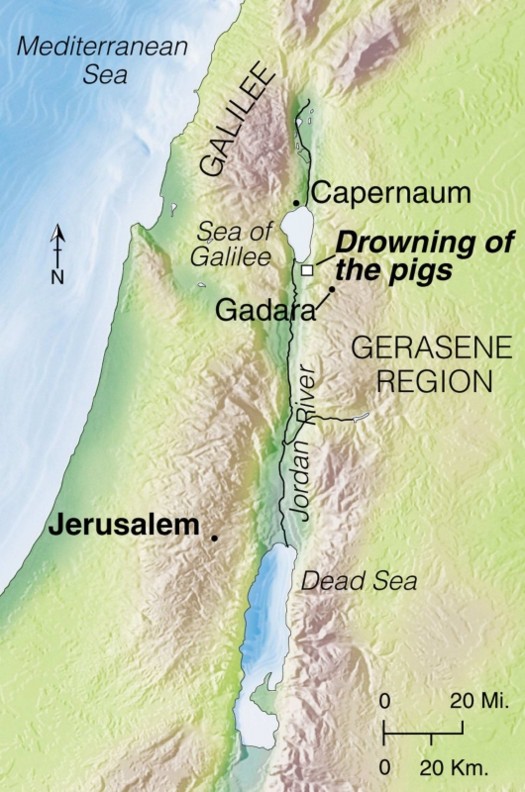
The Demoniac at Gadara

In our Gospel, we meet another wildly outraged man. This one is tormented by his inner demons, causing him also to put himself in dangerous situations. Jesus names this man’s tormentor and casts it out, giving the man control of himself again.


Have you ever been so offended, humiliated or injured that you felt outrage for yourself or another? Such fury chains us, making rationality and reconciliation close to impossible. Sometimes, it renders us impotent to name and address the deep source of our indignation.

Instead, we lash out with stones of anger or passive aggression – throwing the dirt of condemnation rather than seeking inner balance and healing.


Most of us have encountered large or small “dementors” in our life.
(Thanks for the term AND the image, Harry Potter)

But when I think of those who have endured unbelievable degrees of torment, I am amazed at their stories of faith and resolution: Anne Frank, Victor Frankel, Nelson Mandela, Harriet Tubman …. Jesus Christ. How did they come through it whole and blessed?

Maybe the possessed man in Mark’s Gospel was just lucky that day to run into Jesus. Or maybe he sought out Christ, trying to find stability in the midst of his derangement.

When we face our own imbalances can we stay still long enough to ask, as David did, “What is God teaching me in this. How can this lead me closer to God?” If we could, might we not be surprised to see our demons named, cast into the greater sea of God’s eternal wisdom, peace and love?


Poetry: Matthew VIII, 28 Fr. – Richard Wilbur
This poem, spoken by the residents of Gadara or Gerasa, imagines that they are more interested in their commerce than in miracles. They’re pretty disturbed about their pigs too

Rabbi, we Gadarenes
Are not ascetics; we are fond of wealth and possessions.
Love, as You call it, we obviate by means
Of the planned release of aggressions.
We have deep faith in properity.
Soon, it is hoped, we will reach our full potential.
In the light of our gross product, the practice of charity
Is palpably non-essential.
It is true that we go insane;
That for no good reason we are
possessed by devils;
That we suffer, despite the amenities
which obtain
At all but the lowest levels.
We shall not, however, resign
Our trust in the high-heaped table and the full trough.
If You cannot cure us without destroying our swine,
We had rather You shoved off.


Music: Set My Spirit Free – Maranatha Singers

Love – The Unfailing Bridge

Today, in God’s Lavish Mercy,  we begin our readings with God’s stern but magnificent commission to the prophet Jeremiah: 

… stand up and tell them
all that I command you.

What Jeremiah had to tell the Israelites was not comforting news. He prophesied that if they didn’t repent from their idolatry, Jerusalem would fall into the hands of foreign oppressors. Nobody wanted to hear it. They led Jeremiah a life, to the point that he is often referred to as “The Weeping Prophet”. Over the course of forty years and the reign of five Judean kings, Jeremiah’s message continues until, in the end, it comes to fulfillment in the Babylonian Captivity.

Jeremiah Lamenting the Fall of Jerusalem
Rembrandt

How did Jeremiah sustain such confrontational preaching in the face of intractable resistance?

Perhaps the answer lies in our second reading. He did it out of love.

Arthur Cundall, a British scripture scholar writes:

“God wanted a person
with a very gentle and tender heart
for this unrewarding ministry of condemnation.
Jeremiah’s subsequent career shows that
he had this quality in full measure.”

Jeremiah is a living example of the loving, humble, truth-seeking, hope-impelled soul described in 1 Corinthians, our second reading.

Strive eagerly for the greatest spiritual gifts.
But I shall show you a still more excellent way.
If I speak in human and angelic tongues,
but do not have love,
I am a resounding gong or a clashing cymbal.
And if I have the gift of prophecy,
and comprehend all mysteries and all knowledge;
if I have all faith so as to move mountains,
but do not have love, I am nothing.

1 Corinthians 13: 1-2

In Luke’s Gospel today, we see Jesus rejected in the same manner as Jeremiah. Jesus’s message calls his listeners to deep conversion of heart in order to be redeemed. Like the ancient Israelites, they don’t want to hear it. They cannot break through their comfortable existence to acknowledge its emptiness.

Jesus is Rejected at Nazareth
Maerten de Vos – 16th Century

And he said, “Amen, I say to you,
no prophet is accepted in his own native place….

… When the people in the synagogue heard this,
they were all filled with fury.
They rose up, drove him out of the town,
and led him to the brow of the hill
on which their town had been built,
to hurl him down headlong.
But Jesus passed through the midst of them and went away.

Luke 4:24; 28-30

The message for us today? Is there an emptiness somewhere in our hearts that we have not yet given over to God? Are we filling it with “false gods”, rather than the loving virtues described in Corinthians? Is there even a small resistance to the Word that keeps us in a “dead space”.

We know where our “dead spaces” are, and we deeply intend them to come alive again. Today, let’s choose to walk the bridge from intention to practice.


Poetry: Jeremiah – Saint John Henry Newman

"WOE'S me!" the peaceful prophet cried,
"Spare me this troubled life;
To stem man's wrath, to school his pride,
To head the sacred strife!

"O place me in some silent vale,
Where groves and flowers abound;
Nor eyes that grudge, nor tongues that rail,
Vex the truth-haunted ground!"

If his meek spirit err'd, opprest
That God denied repose,
What sin is ours, to whom Heaven's rest
Is pledged, to heal earth's woes?

Music:  One of my all time favorite songs (Wow! And how about the snow geese at the end of this video!)

David Falls Down

January 28, 2022
Memorial of Saint Thomas Aquinas, Priest and Doctor of the Church

Today, in God’s Lavish Mercy, we clearly are being taught. The first lesson comes from a gripping iconic story in Samuel – the treacherous murder of Uriah; the second from the Markan Parables – the miraculous mustard seed.

In our first reading, the noble, kingly David takes a mighty fall. He has tripped over his own power and descended into a chasm of indifference, lust, manipulation, deceit, and murder. Walter Brueggemann captures the immensity of the story here:

II Samuel 11:1–27 
We are now at the pivotal turning point in the narrative plot of the books of Samuel. We are also invited into the presence of delicate, subtle art. We are at the threshold of deep, aching psychology, and at the same time we are about to witness a most ruthless political performance. In this narrative we are in the presence of greatness. For David and for Israel, we are at a moment of no return. Innocence is never to be retrieved. From now on the life of David is marked, and all Israel must live with that mark.

David handing over a letter to Uriah, 1619 – Pieter Lastman

Unfortunately, David’s moral depravity is reshaped and retold in thousands of other biographies throughout history as “strongmen” (and women) grasp power. Too bad David, and those like him, could not have benefitted from some later-age wisdom such as these two quotables:

Power tends to corrupt, and absolute power corrupts absolutely.
~ John Dalberg-Acton, letter to Bishop Mandela Creighton, (April 1887)


One uncontrolled character flaw can ruin your greatest accomplishment.
~ Wayde Goodall, Why Great Men Fall: 15 Winning Strategies to Rise Above It All (2005)


While David’s sinfulness had corrupted the concept of “kingdom”, in Mark, Jesus teaches us a divinely refreshed understanding of the term.

When asked what the kingdom of heaven is like, Jesus describes generous, inclusive reality sprung from humble, hopeful investment:

To what shall we compare the Kingdom of God,
or what parable can we use for it?
It is like a mustard seed that, when it is sown in the ground,
is the smallest of all the seeds on the earth.
But once it is sown, it springs up and becomes the largest of plants
and puts forth large branches,
so that the birds of the sky can dwell in its shade.

Mark 4: 30-32

Perhaps our prayer today is best reflected in the Alleluia Verse – a plea to retain, in our choices, the deep innocence of faith:

Blessed are you, Creator, Lord of heaven and earth;
you have revealed to little ones the mysteries of the Kingdom.

Matthew 11:25

Praying with that this morning, I offer you the innocent drawing of my 6 year-old grand-nephew Robert, an interpretation of what it means to fall down.

Something Falling Down, as titled by the Artist

Poetry: When the Great Trees Fall – Maya Angelou

When great trees fall,
rocks on distant hills shudder,
lions hunker down
in tall grasses,
and even elephants
lumber after safety.
When great trees fall
in forests,
small things recoil into silence,
their senses
eroded beyond fear.
When great souls die,
the air around us becomes
light, rare, sterile.
We breathe, briefly.
Our eyes, briefly,
see with
a hurtful clarity.
Our memory, suddenly sharpened,
examines,
gnaws on kind words
unsaid,
promised walks
never taken.
Great souls die and
our reality, bound to
them, takes leave of us.
Our souls,
dependent upon their
nurture,
now shrink, wizened.
Our minds, formed
and informed by their
radiance,
fall away.
We are not so much maddened
as reduced to the unutterable ignorance
of dark, cold
caves.
And when great souls die,
after a period peace blooms,
slowly and always
irregularly. Spaces fill
with a kind of
soothing electric vibration.
Our senses, restored, never
to be the same, whisper to us.
They existed. They existed.
We can be. Be and be
better. For they existed.

Music: All the King’s Horses – Aretha Franklin
Although the song is not biblical, the lyrics carry similar emotions to the ones we find in the reading from Samuel.

David, the King

January 24, 2022
Monday of the Third Week in Ordinary Time
Memorial of Saint Francis de Sales, Bishop and Doctor of the Church

Today, in God’s Lavish Mercy, our readings place us at watershed moments in the lives of David and Jesus.

All the tribes of Israel came to David in Hebron and said:
“Here we are, your bone and your flesh.
In days past, when Saul was our king, 
it was you who led the children of Israel out and brought them back.
And the LORD said to you, ‘You shall shepherd my people Israel 
and shall be commander of Israel.’”
When all the elders of Israel came to David in Hebron, 
King David made an agreement with them there before the LORD, 
and they anointed him king of Israel.

2 Samuel 5:1-4

In 2 Samuel 5, David fully assumes the kingship through the approbation of the community. The scene marks the culmination of his rise to power and “the beginning of the rest of his life”.

Through our readings in Samuel until now, we have ascended with David to the pinnacle of his life. We are about to begin weeks of moving down “the other side of the mountain”.


Scholars generally see the David narrative in two primary units, the Rise of David (I Sam. 16:1—II Sam. 5:10) and the Succession Narrative (II Sam. 9:1—20:26; I Kings 1:1—2:46). Chapters 5:11—8:18, fall between two larger units. Whereas the first presents David in his ascendancy, the second presents David in his demise and expresses pathos and ambiguity. Our chapters thus come after the raw vitality of the rise of David and before the terrible pathos of the succession narrative. They show the painful process whereby this beloved chieftain is transformed into a hardened monarch, who now has more power than popular affection.

Walter Brueggemann, First and Second Samuel

In our Gospel, Jesus also comes to a sort of “continental divide”. But rather than community approbation, Jesus encounters the condemnation of the scribes who have come from Jerusalem to assess him.

The scribes who had come from Jerusalem said of Jesus, 
“He is possessed by Beelzebul,” and
“By the prince of demons he drives out demons.”

Mark 3:22

From this moment in his life, Jesus too launches into his “kingship”, one that looks very different from David’s. The ensuing chapters of Samuel will reveal how David struggles and succumbs to the temptations of power and domination. The Gospels, on the other hand, describe Jesus’s “kingdom” as one of humility, mercy, and love for those who are poor and suffering.

Only through faith can we understand the inverse power of God present in the Life, Death and Resurrection of Jesus, and in our own lives. Jesus, the “new David”, is anointed in the Spirit to reveal and incorporate us into the kingdom of God.


Prose: from Immanuel Jakobovits who was the Chief Rabbi of the United Hebrew Congregations of the Commonwealth from 1967 to 1991.

To those without faith
there are no answers.
To those with faith, 
there are no questions.

Music: King David, music by Herbert Howells, sung by Sarah Connolly from a poem by Walter de la Mare

King David – Walter de la Mare

King David was a sorrowful man:
    No cause for his sorrow had he;
    And he called for the music of a hundred harps,
    To ease his melancholy.

    They played till they all fell silent:
    Played-and play sweet did they;
    But the sorrow that haunted the heart of King David
    They could not charm away.

    He rose; and in his garden
    Walked by the moon alone,
    A nightingale hidden in a cypress-tree
    Jargoned on and on.

    King David lifted his sad eyes
    Into the dark-boughed tree-
    ''Tell me, thou little bird that singest,
    Who taught my grief to thee?'

    But the bird in no wise heeded
    And the king in the cool of the moon
    Hearkened to the nightingale's sorrowfulness,
    Till all his own was gone.