Psalm 1: The First Word

Wednesday of the Twenty-eighth Week in Ordinary Time

October 14, 2020


Today, in God’s Lavish Mercy, we pray with Psalm 1.

Patrick D. Miller, Hebrew Scriptures scholar, suggests that Psalm 1 “sets the agenda for the Psalter through its identification of the way of the righteous and the way of the wicked as well as their respective fates” along with “its emphasis on the Torah, the joy of studying it and its positive benefits for those who do“.

Blessed the one who follows not
the counsel of the wicked
Nor walks in the way of sinners,
nor sits in the company of the insolent,
But delights in the law of the LORD
and meditates on God’s law day and night.

Psalm 1:1-2

What does it really mean to “meditate on God’s law day and night”? Become a monk? Read the Bible all day? Never sleep?

Of course not. I think it means to live in the firm belief that God is in everything, and to train our hearts to see and respond to that Omnipresent Love.

We all know people who, no matter the circumstances, are focused on good and radiate a joyful confidence. There is a light within them and a peace around them. The living of their ordinary lives is a meditation on God’s order in all things.

Such a person …

… is like a tree
planted near running water,
That yields its fruit in due season,
and whose leaves never fade.
Whatever that faithful one does, prospers.

Psalm 1:3

It doesn’t mean there aren’t challenges … even protests, righteous anger, sadness and pain. Think of Jesus as he overturned the Temple tables!

It means rather that the focus is never lost because …
Creation’s sacred order is our Light;
and God’s law has taught ours hearts 
to find our joy in its Beauty.

my transliteration of Psalm 1:2

Let’s be that tree near
the running water of Grace!🙏


Poem: On Beauty by Khalil Gibran

And a poet said, Speak to us of Beauty.
     And he answered:
     Where shall you seek beauty, and how
shall you find her unless she herself be your
way and your guide?
     And how shall you speak of her except
she be the weaver of your speech?
    
The aggrieved and the injured say,
“Beauty is kind and gentle.
     Like a young mother half-shy of her
own glory she walks among us.”
     And the passionate say, “Nay, beauty is
a thing of might and dread.
     Like the tempest she shakes the earth
beneath us and the sky above us.”
    
The tired and the weary say, “Beauty is
of soft whisperings. She speaks in our spirit.
     Her voice yields to our silences like a faint
light that quivers in fear of the shadow.”
     But the restless say, “We have heard her
shouting among the mountains,
     And with her cries came the sound of
hoofs, and the beating of wings and
the roaring of lions.”
    
At night the watchmen of the city say,
“Beauty shall rise with the dawn from the
east.”
     And at noontide the toilers and 
the wayfarers say, 
“We have seen her leaning over
the earth from the windows of the sunset.”
    
In winter say the snow-bound, “She shall
come with the spring leaping upon the hills.”
     And in the summer heat the reapers say,
“We have seen her dancing with the autumn
leaves, and we saw a drift of snow in her hair.”
     All these things have you said of beauty,
     Yet in truth you spoke not of her but of
needs unsatisfied,
     And beauty is not a need but an ecstasy.
     It is not a mouth thirsting nor an empty
hand stretched forth,
     But rather a heart enflamed and a soul enchanted.
     It is not the image you would see nor the
song you would hear,
     But rather an image you see though you
close your eyes and a song you hear though
you shut your ears.
     It is not the sap within the furrowed bark,
nor a wing attached to a claw,
     But rather a garden for ever in bloom and
a flock of angels for ever in flight.
    
People of Orphalese, beauty is life when
life unveils her holy face.
     But you are life and you are the veil.
     Beauty is eternity gazing at itself in a mirror.
But you are eternity and you are the mirror.


Music: I Delight in You, Lord – David Baroni

Psalm 119: Come, Sweet Mercy!

Tuesday of the Twenty-eighth Week in Ordinary Time

October 13, 2020


Today, in God’s Lavish Mercy, we pray with Psalm 119 whose refrain is beautiful to the ears of those who love Mercy.


We can invite Mercy in many ways.

One way is to ask Mercy to heal the fractured circumstances of our lives – the outside of the cup, if we would borrow an image from today’s Gospel:

  • to strengthen us against any pain or fear in our own lives
  • to deliver us and those we love from all that overwhelms
  • to forgive our inexcusable retreats into selfishness
  • to repair that which seems irrevocably broken 

But another, deeper way is to invite Mercy to the inside of our “cup”:

  • to indwell our hearts
  • to transform, within us, the place where we encounter life
  • to inspire us to respond always with the heart of Jesus
  • to flow from us in continual witness to God’s Mercy

Today, in our prayer, let’s spend some time with Mercy, the most beautiful Face of God.


Poem:  Blest are the undefiled in heart (Psalm 119)
by Isaac Watts (1674 – 1748) was an English Christian minister (Congregational), hymn writer, theologian, and logician. He was a prolific and popular hymn writer and is credited with some 750 hymns. He is recognized as the “Godfather of English Hymnody”; many of his hymns remain in use today and have been translated into numerous languages.

Blest are the undefiled in heart,
whose ways are right and clean;
who never from your law depart,
but flee from every sin.

Blest are the ones that keep your word,
and serve you with their hands;
with their whole heart they seek you, Lord,
obeying your commands.

Great is their peace who love your law;
how firm their souls abide!
Nor can a bold temptation draw
their steady feet aside.

Then shall my heart have inward joy!
I’ll keep my steps from shame;
your statutes help me to obey,
and glorify your name.

Music- Sanctuary by Secret Garden

Psalm 19: Declare God’s Glory

Feast of Saint Matthew, Apostle and Evangelist

September 21, 2020


Today, in God’s Lavish Mercy, we pray with Psalm 19, one of the unique “Torah Psalms” (1, 19, 119) in which Israel celebrates the divine structure of life in all Creation, including ourselves.

James Luther Mays, in his article The Place of the Torah-Psalms in the Psalter, suggests that these psalms serve as a guide to how all the other psalms are to be read, interpreted and prayed.


Walter Brueggemann describes life without God as “normless” – without the structure of grace and relationship with God that holds all Creation in abundant Life. He refers to the Torah as a “norming” dynamism, and writes:

And when Israel … used the term “Torah” (never meaning simply or simplistically “law”), it refers to the entire legacy of norming that is elastic, dynamic, fluid, and summoning. The outcome of that legacy in the Psalter is the great Torah Psalms in which Israel celebrates, with joy, that the creator God has not left the world as a normless blob but has instilled in the very structure of creation the transformative capacity for enacted fidelity. That is why Psalm 19 juxtaposes the glory of creation that attests the creator (vv. 1–6) with the commandments that are the source of life.


Our verses today for the Feast of St. Matthew include this phrase…

Their message goes out through all the earth.

… perhaps equating the universal ministry of the Apostles to the transformative power and witness of the heavens to God’s immutable glory.

The heavens declare the glory of God;
and the firmament proclaims his handiwork.
Day pours out the word to day,
and night to night imparts knowledge.
Not a word nor a discourse
whose voice is not heard;
Through all the earth their voice resounds,
and to the ends of the world, their message.


The teaching of the Apostles is codified for Catholics in the Apostles Creed. We might want to pray it slowly today, attentive to those “norming ” beliefs – our sort of fundamental “Torah” – which hold our lives in graceful relationship with God through Jesus Christ.

Apostles Creed

I believe in God, the Father Almighty, 
Creator of Heaven and earth;
and in Jesus Christ, His only Son Our Lord,
Who was conceived by the Holy Spirit, 
born of the Virgin Mary, 
suffered under Pontius Pilate, 
was crucified, died, and was buried.
He descended into Hell; 
the third day He rose again from the dead;
He ascended into Heaven, 
and sits at the right hand of God, the Father almighty; 
from thence He shall come to judge the living and the dead.
I believe in the Holy Spirit, 
the holy Catholic Church, 
the communion of saints, 
the forgiveness of sins, 
the resurrection of the body 
and life everlasting.
Amen.

Poetry: XIX Caeli Ennarant by Malcolm Guite

In that still place where earth and heaven meet
Under mysterious starlight, raise your head
And gaze up at their glory:  ‘the complete

Consort dancing’ as a poet said
Of his own words. But these are all God’s words;
A shining poem, waiting to be read

Afresh in every heart. Now look towards
The brightening east, and see the splendid sun
Rise and rejoice, the icon of his lord’s

True light. Be joyful with him, watch him run
His course, receive the gift and treasure of his light
Pouring like honeyed gold till day is done

As sweet and strong as all God’s laws, as right
As all his judgements and as clean and pure,
All given for your growth, and your delight!


Music: Wonderland – David Nevis

Psalm 145: Always Mercy

Twenty-fifth Sunday in Ordinary Time

September 20, 2020

Today, in God’s Lavish Mercy, we pray with Psalm 145 which, with our Sunday readings, ties together the themes of call and commitment.

In our first reading, Isaiah proclaims a repentant urgency to that call:

Seek the LORD 
while he may be found,
call him 
while he is still near.


In our second reading, Paul confirms his own ultimate commitment to that call and urges his followers to imitate him:

Christ will be magnified in my body,
whether by life or by death….

Only, conduct yourselves in a way worthy of the gospel of Christ, so that, whether I come and see you or am absent, I may hear news of you, that you are standing firm in one spirit, with one mind struggling together for the faith of the gospel.


But our Gospel reveals that not everyone responds immediately to God’s voice in their lives. Some of us come late to the call of grace. Nevertheless, our generous God seeks us, time and again, and embraces us fully no matter how close to the evening.

The early hires chafe against this system, imagining themselves somehow deprived by the Master’s abundance. Perhaps we heard attitudes like theirs expressed in self-sufficient phrases like:

  • but I’ve worked hard for everything I have
  • you need to earn your way in life
  • it’s not a free ride
  • if you can’t stand the heat, get out of the kitchen

Walter Brueggemann writes that the Psalms refute such an attitude:

The counter-world of the Psalms
contradicts our closely held world of self-sufficiency
by mediating to us a world confident in God’s preferential option
for those who call on him in their ultimate dependence.


Psalm 145 lifts us beyond our selfish imaginations. It expresses the grateful praise of one who, swaddled in God’s lavish blessing, recognizes that Divine Justice looks like Mercy not calculation.

The LORD is gracious and merciful,
slow to anger and of great kindness.
The LORD is good to all
and compassionate toward all his works.


Poem: by Rumi

By the mercy of God,
Paradise has eight doors.
One of those is the door of repentance, child. 
All the others are sometimes open, 
sometimes shut, 
but the door of repentance is never closed. 
Come seize the opportunity: 
the door is open; 
carry your baggage there at once.

Music: I Will Praise Your Name – Marty Haugen, David Haas

Psalm 56: Light from Dark

Saturday of the Twenty-fourth Week in Ordinary Time

Saturday, September 19, 2020


Today, in God’s Lavish Mercy, we pray with Psalm 56, an unusual mix of lamentation and praise, of light and dark emotions. Many consider the psalm to be a prayer of David in the midst of his problems with Solomon.

Our prayer can be this kind of mix at times. We might feel stressed by the exigencies of life, calling on God to ease our angst and protect us. At the same time, we have a underlying confidence that God is with us, even in difficulty. Such a prayer is not unlike the one Jesus prayed in Gethsemane.


I cherish a verse from Psalm 56 not included in today’s reading. In beautiful simile, the line captures suffering still imbued with trust. I especially like the old translation from the King James Version:

Today’s verses reflect the confidence born of such honest and steadfast prayer. There comes a surety in God’s abiding, a shift from self-centered fear, a welling up of praise for the One who saves us, not only from our troubles, but from our anxious selves.

Now I know that God is with me.
In God, in whose promise I glory,
in God I trust without fear;
what can flesh do against me?


Poetry: Mount of Olives by Irene Zimmerman, OSF

He falls, crying,
“Help me, Father.”
Though his acquiescence rings
true as a well-tuned violin, the searing bow brings
tears of blood
as it plays across the taut strings
of his human dread of dying.

Music: Psalm 56 – by Share Faith

Psalm 118:

Thursday of the Twenty-fourth Week in Ordinary Time

Thursday, September 17, 2020


Today, in God’s Lavish Mercy, we pray with Psalm 118 (Confitemini Domino), part of the Hallel. Hallel consists of six Psalms (113–118), which are recited as a unit, on joyous occasions such as Passover.

This joy arises from the core belief
and experiential evidence that
 “God’s Mercy endures forever”.

Give thanks to the LORD, Who is good,
Whose mercy endures forever.
Let the house of Israel say,
“God’s mercy endures forever.”

Psalm 118: 1-2

Looking at the entire psalm, we see the prayer of a person delivered from enemies, one who has taken refuge in the Lord. And the Lord has responded both in protection and abiding relationship.


Our Gospel story of the woman with the alabaster jar reiterates this theme. Surely this woman is beset by enemies, both within and without. Ultimately, grace moves her to take refuge at the feet of Jesus’s Mercy. She does this by breaking through any inhibiting tradition in order to offer Jesus her own intimate act of tenderness. Moved, Jesus reciprocates.

As we seek to be fully embraced in God’s Lavish Mercy, what “ointments”, held too long, must we pour out to God. What illusions do we cling to convincing us we have no need for repentance, forgiveness, transformation?

What little jars of selfishness, pride, or arrogance keep us from fully giving and receiving Mercy?

In my distress, I poured my heart out to the LORD;
the LORD answered me and set me free.
The LORD is with me now, I am not afraid;
darkness has no power against me.

Psalm 118: 13-14

Poem: Mended by Annie Villiers

Invisible mending
This is the place where souls come
To be mended                               where
Tatty ends of unfinished business
Or business                              unravelled
Are drawn together and tenderly
Made new.
Nimble stitches
Seen                           only by the weaver
Whose loving                                 fingers
Repair the frangible fabric of lives.


Music: Confitemini Domino – Taize Community

Confitemini Domino, quoniam bonus, 
quoniam in sæculum misericordia ejus.

O give thanks unto the Lord, for he is gracious,
because his mercy endureth for ever.

Psalm 24: Vanity, Vanity

Memorial of Saint Gregory the Great, Pope and Doctor of the Church

Thursday, September 3, 2020


Today, in God’s Lavish Mercy, we pray with Psalm 24 which encourages us to be sinless, pure of heart, and humble. And that’s hard!

Who can ascend the mountain of the LORD?
or who may stand in his holy place?
He whose hands are sinless, whose heart is clean,
who desires not what is vain.


Do you remember the song “You’re So Vain”? Here is a reminder.

The song expresses a common understanding of the word “vanity”:

excessive pride in or admiration of one’s own appearance or achievement


We all know people who seem to think they’re hot stuff. Maybe we’re even one of them! But I think that often a person behaving vainly really is quite unsure of himself.

The apparent vanity is a veneer to hide the emptiness inside. It is a veiled fear that, rather than being “all that”, one is really “not enough”.

The word vanity comes from the Latin root vanus which means empty – not “empty” with a readiness to be filled. Instead it connotes an emptiness that rattles with accumulated pretenses and falsehoods. It is a place of loud but lonely echoes.


Paul addresses this kind of emptiness when he writes to the Corinthians. He tells them not to get caught up in the contest of human vanity because we already are sufficient in God’s love and grace. Everything important is already ours in Christ, in God.

So let no one boast about human beings, for everything belongs to you,
Paul or Apollos or Cephas,
or the world or life or death,
or the present or the future:
all belong to you, and you to Christ, and Christ to God.


Psalm 24 assures us that to participate in this blessing, to be embraced by God’s favor only this is sufficient:

Who can stand in God’s holy place?
The clean of hand and pure of heart,
who have not given their soul to useless things,
to what is vain.
They will receive blessings from the LORD,
and justice from their saving God.


Poetry: Vanity by George Herbert

The fleet astronomer can bore 
And thread the spheres with his quick-piercing mind: 
He views their stations, walks from door to door, 
         Surveys, as if he had designed 
To make a purchase there; he sees their dances, 
                   And knoweth long before 
Both their full-eyes aspècts, and secret glances. 
         
         The nimble diver with his side 
Cuts through the working waves, that he may fetch 
His dearly-earnèd pearl, which God did hide 
         On purpose from the venturous wretch; 
That he might save his life, and also hers 
                   Who with excessive pride 
Her own destruction and his danger wears. 
         
         The subtle chymic can divest 
And strip the creature naked, till he find 
The callow principles within their nest: 
         There he imparts to them his mind, 
Admitted to their bed-chamber, before 
                   They appear trim and dressed 
To ordinary suitors at the door. 
         
       What hath not man sought out and found, 
But his dear God? who yet his glorious law 
Embosoms in us, mellowing the ground 
         With showers and frosts, with love and awe, 
So that we need not say, “Where’s this command?” 
                   Poor man, thou searchest round 
To find out death, but missest life at hand.

Song: As We Seek Your Face – Divine Hymns

Psalm 67: Bless Us All!

Twentieth Sunday in Ordinary Time
August 16, 2020

Today, in Mercy, we read the story of the Canaanite woman whom Jesus first meets with a sarcastic banter. The banter however serves to expose some of the alienating prejudices of Jesus’s time which he then dissolves in a sweeping act of mercy and inclusion. His actions signify a new culture of divine justice offered to all people. The reading challenges us to confront our own prejudices and any limitations we place on who belongs to the Kingdom of God.

from this Sunday’s Reflection – 2017

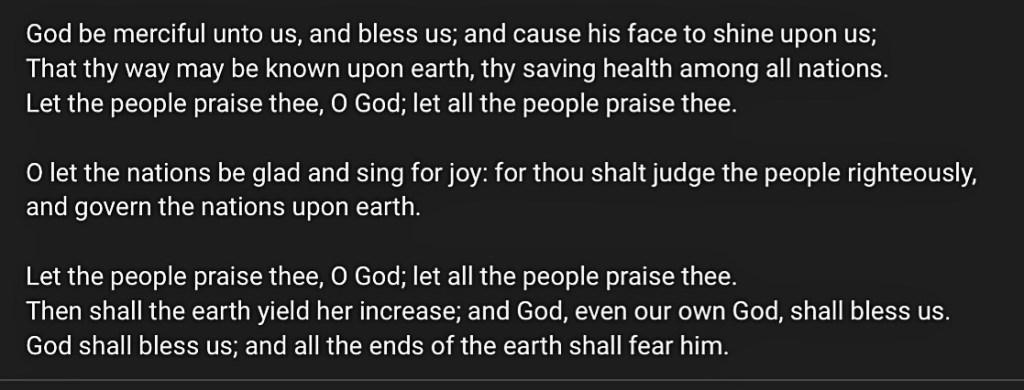
Today, in God’s Lavish Mercy, we pray with Psalm 67, a call to God for universal blessing on all Creation. Written to invoke a benediction on the land’s harvest, the Psalm blossoms into a generous prayer for the whole world to bask in God’s abundance.

May the nations be glad and rejoice;
for you judge the peoples with fairness,
you guide the nations upon the earth.

What if we prayed like that for all our brothers and sisters worldwide! What if we acted toward them with a justice that would make their abundance possible as well as our own! This is the Gospel mandate Jesus entrusted to us.

Psalm 67 shows the maturing of a nation from its own legitimate self-interests into its responsibility within all Creation.


In the USA, as our pre-election political awareness heightens, let’s learn from Psalm 67. Let’s broadly educate ourselves to the fundamental moral issues underlying various partisan platforms. 

For a religious person, voting is hard. There are profound moral issues on all sides of the question. A single issue approach does not work. An adamant stance on a single issue is the easy but inadequate approach. 


Even Jesus, in today’s Gospel, can be moved to a new way of thinking. The outcast Canaanite woman prevails on Jesus to broaden his kingdom. He opens his heart to another way of bringing mercy to all those longing for it.


Voting is a moral act. How we choose demonstrates the God we believe in.


May the peoples praise you, God;
may ALL the peoples praise you!


Poetry: Selah by Honoreé Fannane Jeffers

“The past few weeks were very hopeful for me, as an African-American. I saw images of young Black people out in the streets protesting, to make this country a better place. As an older person who stayed inside while these young folks put their bodies on the line, I wanted to celebrate them. I wrote this poem as a spiritual exaltation of Black faith, that our hoped-for change for our country is coming.”

Honoreé Fanonne Jeffers

Selah
after Margaret Walker’s “For My People”


The Lord clings to my hands
             after a night of shouting. 
                           The Lord stands on my roof 
             & sleeps in my bed. 
Sings the darkened, Egun tunnel— 
             cooks my food in abundance, 
                           though I was once foolish 
             & wished for an emptied stomach. 
The Lord drapes me with rolls of fat 
             & plaits my hair with sanity. 
                           Gives me air, 
             music from unremembered fever. 
This air
                            oh that i may give air to my people 
                            oh interruption of murder 
                                         the welcome Selah
The Lord is a green, Tubman escape. 
             A street buzzing with concern, 
                           minds discarding answers. 
             Black feet on a centuries-long journey.
The Lord is the dead one scratching my face, 
             pinching me in dreams. 
                           The screaming of the little girl that I was, 
             the rocking of the little girl that I was— 
the sweet hush of her healing. 
             Her syllables 
                           skipping on homesick pink. 
             I pray to my God of confused love, 
a toe touching blood 
             & swimming through Moses-water. 
                           A cloth & wise rocking. 
             An eventual Passover, 
outlined skeletons will sing 
             this day of air 
                           for my people—
                                         oh the roar of God 
                                         oh our prophesied walking

Music: Charles Ives – Psalm 67

Psalm 78: It’s Harsh

Thursday of the Nineteenth Week in Ordinary Time

August 13, 2020

Today, in God’s Lavish Mercy, we pray with Psalm 78, one of the twelve “Psalms of Asaph”. These psalms have a common theme of God’s judgement relative to Israel’s faithlessness to the Law.

Psalm 78 is the second longest psalm, the whole of which reads a lot like a history lesson. It recounts God’s enduring faithfulness even in the face of Israel’s fickleness.

They tempted and rebelled against God the Most High,
and kept not his decrees.
They turned back and were faithless like their fathers;
they recoiled like a treacherous bow.


The psalm fits well with today’s readings. Poor Ezekiel is commanded by God to act out the impending Assyrian devastation of the kingdom. He has to pack up, dig through a wall, hide his face, and escape into the night — just as Israel will have to do when the conquerors besiege them. All this, because God is passing judgement on Israel’s infidelities and God wants them to recognize it.

They angered him with their high places
and with their idols roused his jealousy.
God heard and was enraged
and utterly rejected Israel.


Psalm 78 remembers this history and retells it for the instruction of the generations. It is a reminiscence not unlike one that we all practice, I think.

Sometimes, especially in prayer or retreat, don’t we look back over our lives to rediscover how God was with us even in difficulty and darkness? Even in our poorest choices and most stupid sins? Aren’t we gratefully surprised that God’s Mercy was the ultimate fruit of such trials? When we face new challenges, don’t we remind ourselves of these things for the sake of our future courage and hope?

That’s what Psalm 78 is doing. Israel messed up, suffered judgement, and was made new in Mercy. The psalmist wants future generations never to forget.


Each of us, both as individuals and within our communities, experience such cycles of sin and redemption. Each turn should make us stronger, grateful, more faithful. Our witness to God’s abiding mercy should be shared for the sake of the generations… our personal Psalm 78 – written not in words, but in the fidelity of our lives.

Psalm 78 is not pretty or easy. Life isn’t always that way either. In our Gospel, Jesus assures us that God is a generous Creator who wants to redeem us in Mercy. But we have to do our part too, or we could wind up like the unfaithful servant – defeated by our own selfish choices.


Poetry: Mercy by David Baker

Small flames afloat in blue duskfall, beneath trees
anonymous and hooded, the solemn trees—by ones
and twos and threes we go down to the water's level edge
with our candles cupped and melted into little pie-tins
to set our newest loss free. Everyone is here.

Everyone is wholly quiet in the river's hush and appropriate dark.
The tenuous fires slip from our palms and seem to settle
in the stilling water, but then float, ever so slowly,
in a loose string like a necklace's pearls spilled,
down the river barely as wide as a dusty road.

No one is singing, and no one leaves—we stand back
beneath the grieving trees on both banks, bowed but watching,
as our tiny boats pass like a long history of moons
reflected, or like notes in an elder's hymn, or like us,
death after death, around the far, awakening bend.

Music:  Mercy – Amanda Cook

Psalm 102: For the Generations

Memorial of Saint John Vianney, Priest

August 4, 2020

The USCCB website (that you click for daily readings) has been beautifully updated. Make sure you take a look!


Today, in God’s Lavish Mercy, we pray again with Psalm 102. Today’s chosen verses proclaim the psalmist’s confidence that the Covenant Promise will endure through the generations.


The psalm really rings a bell for me today. We are expecting two new babies in my family within the next month. The excitement and joy are building throughout the family branches, scattered over several states and hundreds of miles.

Due to Covid-19, I probably won’t be with these new “grands” for a long time. That’s why I am so grateful for FaceTime to help me feel a real part of their lives.


Psalm 102 is David’s FaceTime.
Through it, he looks into a future
physically distant from him.
He has confidence that that future
is already blessed by God
through the faith which it inherits.


Thinking about this, I realize that I am someone’s “future” – my parents, grandparents and all the long line of ancestors before them. They thought about me, hoped in me, prayed for me the way I am praying for these coming babies.

Those Elders passed on to me a strong faith, hard-earned on the soils of Ireland, hard-carried over immigrant waters, hard-kept in a highly secularized culture. Like David, they wanted God’s faithfulness to be remembered by all who came after them:

Let this be written for the generation to come,
and let God’s future creatures praise the LORD …


When my Aunt Mary died last October, I became the oldest living member of our family. I take that role seriously. I pray for our entire family, by blood and law, every day.

Each day, I pick one who gets special prayers for blessing on his or her life. Sometimes I know they need it for a certain reason. Sometimes, they have no idea I am praying for them – or perhaps, if they are distant relatives, that I even know their names.


As we pray Psalm 119 today, let’s consider our place in the generations of faith, and our responsibility to give and receive the riches of that faith to one another.

The children of your servants shall abide,
and their posterity shall continue in your presence,
That the name of the LORD  and God’s praise
may be ever declared;
When the peoples gather together
and the families, to serve the LORD.


Poetry: Isaac’s Blessing by Janet Eigner whose adult daughter died young, leaving the freckled boy in this poem:

When Isaac, a small, freckled boy 
approaching seven, visits us for Family Camp, 
playing pirate with his rubber sword,

sometimes he slumps in grief, 
trudging along, his sacrifice and small violin 
in hand, his palm over his chest,

saying, Mother is here 
in my heart. Before he leaves for home, 
we ask if he’d like a Jewish blessing.

Our grandson’s handsome face ignites; 
he chirps a rousing, yes, for a long life. 
We unfold the prayer shawl,

its Hebrew letters silvering the spring light, 
hold the white tallis above his head, 
recite the blessing in its ancient language

and then the English, adding, for a long life. 
Isaac complains, the tallis didn’t 
touch his head, so he didn’t feel the blessing.

We lower its silken ceiling 
to graze his dark hair, 
repeat the prayer.

Music: As for Me and My House – a prayer for our families for the generations