Psalm 59: Did Martha Pray It?

Memorial of Saint Martha

July 29, 2020
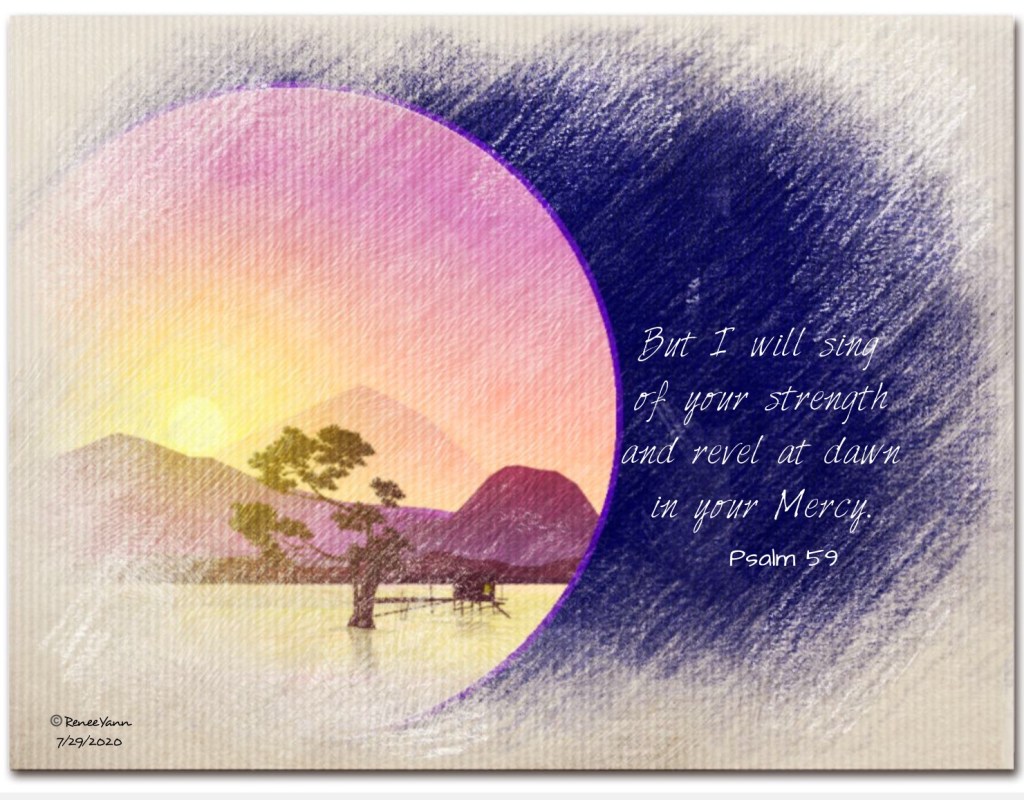

Today, in God’s Lavish Mercy, on this feast of St. Martha, we pray with Psalm 59.

The psalm is introduced with an interesting phrase: a miktam of David, when Saul sent people to watch his house and kill him. 

The meaning of the word mitkam is unclear, but the meaning of the rest of the phrase is abundantly evident. David felt threatened by the forces of King Saul who surrounded his house day and night awaiting an opportunity to attack him.

The psalm bemoans that situation. In two complementary stanzas, the psalmist asks God for victory and deliverance. Each ends with a refrain of praise and gratitude.

As I pray this psalm today, my mind goes to a house in Bethany. Three siblings live there who are friends of Jesus. Each loves Jesus in her or his own way, according to their personalities. 

The Gospels give us a vivid perception of Mary’s love. We can easily imagine the immensely grateful love of resurrected Lazarus. 

Then there is Martha of whom we know so little. A woman who found comfort in creating a hospitable home. A woman who commanded a well-functioning kitchen. A woman who, silent except for her famous sisterly complaint, let her works speak her love.

As their friendship with Jesus grew, and as Jesus became more notorious to the Jewish leaders, their little house no doubt became the object of inimical fascination.

Jesus’s enemies watched him, but that also watched his friends, frightening many away from Jesus’s side.

As this reality intensified, perhaps phrases of Psalm 59 rose in Martha’s heart as she prayed:

Rescue me from my enemies, O my God;
from my adversaries defend me….
… For behold, they lie in wait for my life;
mighty men come together against me,
Not for any offense or sin of mine, O LORD.

We can only guess what this little family suffered in order to be Jesus’s friends, both during his lifetime and by their witness in the subsequent early Christian Church. But by faith, we can be certain they rejoiced in the Divine Gift these sufferings brought them.

But I will sing of your strength
and revel at dawn in your mercy;
You have been my stronghold,
my refuge in the day of distress.
O my strength! your praise will I sing;
for you, O God, are my stronghold,
my merciful God!

Let us pray today to be, like Martha of Bethany, devoted friends of God.

Poetry:  You, neighbor God – Rainer Maria Rilke

You, neighbor god, if sometimes in the night
I rouse you with loud knocking, I do so
only because I seldom hear you breathe
and know: you are alone.
And should you need a drink, no one is there
to reach it to you, groping in the dark.
Always I hearken. Give but a small sign.
I am quite near.
Between us there is but a narrow wall,
and by sheer chance; for it would take
merely a call from your lips or from mine
to break it down,
and that without a sound.
The wall is builded of your images.
They stand before you hiding you like names.
And when the light within me blazes high
that in my inmost soul I know you by,
the radiance is squandered on their frames.
And then my senses, which too soon grow lame,
exiled from you, must go their homeless ways.

Music: Psalm 59 – Esther Mui

Deuteronomy 32: Moses’ Psalm

Monday of the Seventeenth Week in Ordinary Time

July 26, 2020

Today, in God’s Lavish Mercy, we pray with Deuteronomy 32, commonly referred to as the Song of Moses. Most biblical scholars agree that the selection was composed long after Moses died and inserted in Deuteronomy perhaps at the time of the prophet Samuel.

As literature, the poem shows Moses prophesying the troubles that will come upon the people because of their faithlessness. As history, these troubles have already occurred and are referenced as a lesson for the future.


The verses highlighted today are unhappy ones. With exaggerated anthropomorphism, God is characterized as really mad and passive-aggressive with Israel. It’s not a nice picture of how God relates to us. It’s not real either.

Still, the writer was a human being searching for some rational way to understand the trauma Israel was experiencing at the hands of their enemies. The logic, or illogic, goes something like this:

  • things are a mess
  • it must be our fault
  • we did bad things
  • so God’s mad and did bad things back
  • we better straighten up
  • then God might relent

We are all tempted to reason like this when we experience misfortune, pain, and trauma. We think evil should make sense. It doesn’t. The interplay of good and evil is a mystery we will never understand in this life.


What we can understand is faithfulness – God’s to us, and ours to God.

God, you are my Rock—how faultless are your deeds,
how right all your ways!
You are faithful God, without deceit,
You are Justice, Righteousness, and Mercy

This is the true message of the Song of Moses: Our merciful God is always faithful. When we experience suffering in life, – even the kind we bring on ourselves and one another – let our sorrow draw us ever closer to God’s Mercy which abides with us in all our troubles. Within the sacred mystery of grace, that Mercy seeks to transform us into Mercy ourselves.


Poetry:  Possible Answers to Prayer by Scott Cairns
The poem gives a wake up call about self-absorption in our prayers, and – with its own touch of anthropomorphism – images how God might perceive narrow prayers. The poem encourages us to accompany others in their greater sufferings.

Your petitions—though they continue to bear
just the one signature—have been duly recorded.
Your anxieties—despite their constant,

relatively narrow scope and inadvertent
entertainment value—nonetheless serve
to bring your person vividly to mind.

Your repentance—all but obscured beneath
a burgeoning, yellow fog of frankly more
conspicuous resentment—is sufficient.

Your intermittent concern for the sick,
the suffering, the needy poor is sometimes
recognizable to me, if not to them.

Your angers, your zeal, your lipsmackingly
righteous indignation toward the many
whose habits and sympathies offend you— 
      
these must burn away before you’ll apprehend
how near I am, with what fervor I adore
precisely these, the several who rouse your passions.

Music: Audite Caeli – Michel Richard Delalande

This motet captures the opening words of the Song of Moses, Deuteronomy 32.

Audite, caeli, quae loquor: audiat terra verba oris mei.
Concrescat ut pluvia doctrina mea, fluat ut ros eloquium meum,
quasi imber super herbam, et quasi stillae super gramina.
Quia nomen Domini invocabo: date magnificentiam Deo nostro.
Dei perfecta sunt opera, et omnes viae ejus judicia.

Hear, O ye heavens, the things I speak,
let the earth give ear to the words of my mouth.Let my doctrine gather as the rain, let my speech distil as the dew,
as a shower upon the herb, and as drops upon the grass.
Because I will invoke the name of the Lord: give ye magnificence to our God.
The works of God are perfect, and all his ways are judgments.

Psalm 119:Acrostic Prayer

Seventeenth Sunday in Ordinary Time

July 26, 2020


Today, in Mercy, we pray with young Solomon, as God asks him to carry the weight of leadership. Of all that Solomon might have asked from God, he requested only wisdom, which is described in James 3:17. “But the wisdom that comes from heaven is first of all pure; then peace-loving, considerate, teachable, full of mercy and good fruit, impartial and sincere.” We pray for wisdom for ourselves in the discharge of our responsibilities. We pray for this gift for all who hold power in our world.

from 2017 – 17th Sunday in Ordinary Time

Today, in God’s Lavish Mercy, we pray with Psalm 119, the longest psalm, and a meticulously constructed poem. It is one of about twelve acrostic poems in the Bible, employing the twenty-two characters of the Hebrew alphabet to teach a lesson about love of the Torah, the Law.

Acrostic poems have been popular throughout history because they let the reader examine a theme from multiple, memorable perspectives. Although often tricky to compose, they are simple to read, and sometimes so commonplace as to be transparent.

Here is an example of an acrostic poem from 19th century America


So why did the psalmist take the trouble to compose a complicated verse like Psalm 119? The answer seems apparent, I think. The love of the Law was that important to the writer. It was the one true treasure, and he wanted others to share the treasure.

The theme of “treasure” ties together all of our Sunday readings.

In our first reading, young Solomon could have asked God for anything. But Solomon already treasures the Wisdom of God:

The LORD was pleased that Solomon made this request.
So God said to him:
“Because you have asked for this—
not for a long life for yourself,
nor for riches,
nor for the life of your enemies,
but for understanding so that you may know what is right—
I do as you requested.


Our second reading confirms that those who love God, like Solomon did, are blessed with the treasure of confidence and peace:

We know that all things work for good
for those who love God.


Matthew’s Gospel tells us to seek that treasure buried in the field of our lives. When we find it, we should give everything to make it our own:

When he finds a pearl of great price,
he goes and sells all that he has and buys it.


Praying Psalm 119 allows us to appreciate the treasure of God’s Law, God’s heartbeat, in our lives. It holds the Word up before us, facet by facet, the way we would lift a diamond to the Light. When we come to love Wisdom/Word/Law as Solomon did, we give everything to possess it fully.


Poetry: Last Hike Before Leaving Montana by Patricia Traxler.
In this poem, the poet is ostensibly talking about a bear, but listen a little deeper and she is talking about God.

Late winter, almost spring. It's like finding a diamond;
now I don't want to leave. I sit in the dirt and put my hands
in your tracks. For the first time in a long time I don't
doubt. Now I know I always knew you were here. You
are the beginning of disclosure, the long-felt presence

Suddenly incarnate. Behind me my friend warns, If we
see the bear, get into a fetal position. No problem,
I tell her, I'm always in a fetal position—I was born
in a fetal position. Did you know, she says, the body
of a shaved bear looks exactly like a human man?
I skip a stone, feel a sudden bloat of grief, then laugh.
I ask her, Who would shave a bear? We climb

Farther up Rattlesnake Creek, watch winter sun glitter
off dark water. No matter how high we go I look higher.
Sometimes absence can prove presence. That's not exactly
faith, I know. All day, everywhere, I feel you near at hand.
There's so much to understand, and everything to prove.
Up high the air is thin and hard, roars in the ears like love.

Music: Lord, You Are More Precious Than Silver – Divine Hymns

Psalm 86: Incline Your Ear to Me, O Lord

Sixteenth Sunday in Ordinary Time

July 19, 2020

From 2017:

Today, in Mercy, we pray with a tiny mustard seed. Like this seed, any small act of kindness, courage or faith multiplies and yields a harvest greater than seems possible. A holy life is made of such small seeds… given daily with loving intention. We pray today for a vibrant and firmly rooted faith that, like the mature tree, offers a haven for others on the journey.


Today, in God’s Lavish Mercy, we pray with Psalm 86, “a prayer of David”. Today’s verses provide a bridge between our first and second readings, as is usually the case on Sundays.

The thread holding all three passages together is the topic of prayer.

Both the first reading and psalm display a particular type of prayer, which I think of as a “Butter God Up” prayer. Both the Wisdom writer and psalmist tell God how good God is, presumably hoping that God will be good to them:

There is no god besides you who have the care of all,
that you need show you have not unjustly condemned….
…. But though you are master of might, you judge with clemency,
and with much lenience you govern us .

Wisdom 12

You, O LORD, are good and forgiving,
abounding in kindness to all who call upon you.
Hearken, O LORD, to my prayer
and attend to the sound of my pleading.

Psalm 86

There’s nothing wrong with the human psychology here. I used it on my parents a few times when I was young:

Mom, Dad, you’ve always trusted me.
Would it be OK if I go to the shore overnight with my friends?

In other words, “You are good, so bless me.” It’s an innocent prayer that pleads for the Provider’s benevolence and mercy on our petition


But Paul, in our second reading, teaches another, deeper way of prayer:

The Spirit comes to the aid of our weakness;
for we do not know how to pray as we ought,
but the Spirit himself intercedes with inexpressible groanings.

This deeper prayer arises out of a complete confidence and abandonment to God’s Mercy. Convinced that God loves us and wills our good, our prayer becomes an underlying, often wordless, relationship with God.

And the one who searches hearts
knows what is the intention of the Spirit,
because the Spirit intercedes for the holy ones
according to God’s will.


Poetry: Primary Wonder – Denise Levertov

Days pass when I forget the mystery.
Problems insoluble and problems offering
their own ignored solutions
jostle for my attention, they crowd its antechamber
along with a host of diversions, my courtiers, wearing
their colored clothes; cap and bells.
                                                        And then
once more the quiet mystery
is present to me, the throng's clamor
recedes: the mystery
that there is anything, anything at all,
let alone cosmos, joy, memory, everything,
rather than void: and that, O Lord,
Creator, Hallowed One, You still,
hour by hour sustain it.

Music:  Bow Thine Ear, O Lord – by William Byrd, sung here by The Cambridge Singers with John Rutter
The loss of Jerusalem is an inspiration for William Byrd (1539-1623) in his setting of Bow thine ear, O Lord.

Bow thine ear, O Lord, and hear us:
Let thine anger cease from us.
Sion is wasted and brought low,
Jerusalem desolate and void.

Psalm 93: Nestle in God’s Robe

Memorial of Saint Benedict, Abbot

July 11, 2020

Today, in God’s Lavish Mercy, we pray with Psalm 93, the first of the royal psalms (93-99) which praise God as King.

As we pray with today’s verses, we can easily feel the psalmist stretching for a description of God Who is, of course, indescribable. Never having seen God, we can only imagine the Divine Being in human terms. This writer imagines God as a King beyond even the greatness of human kings, and it is a beautiful image:

The LORD is king, in splendor robed;
robed is the LORD and girt about with strength.


Like the psalmist, we may tend to paint God in the colors of those who have had greatest influence in our lives

  • those with power over us, like parents and teachers
  • those who have loved us, or failed to
  • those in positions of success, and strength

Because all human models are flawed in some way, this tendency can give us a blurry, if not distorted picture of God.


Jesus came to correct our perspective.


A beautiful extra hymn for today. Just love this one.

Jesus showed us that, while we live on this earth, the glory of God is a hidden glory. It is robed in the suffering of the poor and abandoned. Its splendor is in the innocence of children. Its strength is in the hope of the sick and weak. Its beauty shines out to us in the vulnerability of our sisters and brothers.


In today’s Gospel, Jesus gives us the tender image of God as One who cherishes every hair on our heads. As we pray today, we might let that gentle God reach down and caress any pain, exhaustion or fear, like a Mother brushing her child’s hair. Just be with God Who knows our needs. Be cradled in the splendrous robe.


Poetry:  God’s True Cloak – Rainer Maria Rilke

We must not portray you in king’s robes,
you drifting mist that brought forth the morning.
Once again from the old paintboxes
we take the same gold for scepter and crown
that has disguised you through the ages.
Piously we produce our images of you
till they stand around you like a thousand walls.
And when our hearts would simply open,
our fervent hands hide you.

Music: George Frideric Handel – Chandos Anthem, #4/ Psalm 93 – O Sing Unto the Lord

Psalm 50: God Doesn’t Do “Fake”

Wednesday of the Thirteenth Week in Ordinary Time

July 1, 2020

I don’t have a past reflection on today’s readings. But here is a good one from Joe Zaborowski at Creighton University.

Today, in God’s Lavish Mercy, we pray with Psalm 50 which is set up like a court proceeding in which God is both prosecutor and judge of the Israelite community.

Hear, my people, and I will speak;
Israel, I will testify against you;
God, your God, am I.

Today’s section, one of two orations, explains God’s dissatisfaction with the display of sacrifices empty of any real commitment to God’s service. In other words, God tells the people that all their fiery and bloody rituals are fake and useless to him.

One might picture the high priests standing dumbfounded at this announcement. 


What! I worked hard on this sacrifice… made sure it was perfect. All the bells and whistles! And You’re still not satisfied??? What do You want from me then?


It reminds me of a married couple. One cooks a beautiful meal for the other but the love between them has faded. As they eat, there is no caring conversation and no joy in each other. They finish perfunctorily in a fog of empty words. They retreat to their separate distractions, waiting to repeat the charade the next day.

In Psalm 50, God says he doesn’t want to be loved like that.
So what does God want then?

Our reading from Amos today offers the thread of an answer which is woven through the rest of Psalm 50:

But if you would offer me burnt offerings,
then let justice surge like water,
and goodness like an unfailing stream.

God wants our sincere love expressed in goodness and actions for justice.

Just like that beautiful dinner, rituals have meaning only as celebrations of faithful and demonstrated love. Sounds like 1 Corinthians 13, doesn’t it?

The parallels to our own lives are obvious and don’t need my elucidation. Let’s just think about how God might answer us if we ask in prayer, “What is it that You really want from me?”.

Poetry: Rabindranath Tagore, from Gitanjali

I am only waiting for Love 
to give myself up at last into his hands.

That is why it is so late 
and why I have been guilty of such omissions.
They come with their laws and their codes to bind me fast; 
but I evade them ever, 

for I am only waiting for Love 
to give myself up at last into his hands.

People blame me and call me heedless; 
I doubt not they are right in their blame.
The market day is over 
and work is all done for the busy. 
Those who came to call me in vain 
have gone back in anger. 

I am only waiting for Love 
to give myself up at last into his hands.

Music: Proof of Your Love – King and Country

Psalm 5: You Are God’s Flute

Tuesday of the Thirteenth Week in Ordinary Time

June 30, 2020

A Brief Prayer on Today’s Gospel from 2016
Today, in Mercy, we pray for all those tossed on a stormy sea, like Christ’s disciples. For all who are alone, in darkness or full of fear. There is no storm through which God cannot come to us. May we always trust that God is taking us to a new grace beyond the storm.


Today, in God’s Lavish Mercy, we pray with Psalm 5, the first one of several to mention “the Name of God” as a theme.  The psalm, a morning prayer to be “accompanied by a flute”, is a mix of lament and exaltation – like many of our own morning prayers, no doubt.

At dawn I bring my plea expectantly before you.
For you, O God, delight not in wickedness;

the evil one does not remain with you;
the arrogant may not stand in your sight.


Now, first off in the morning, we’re probably not going to talk to God about wickedness, evil, and arrogance unless we went to bed pretty upset the night before. The psalmist apparently has “slept on” his troubles without complete resolution.

We had a dear, wise Directress of Postulants who, on many an evening, patiently listened to our various vocational waverings. We were young. Just like the disciples in Matthew’s boat, we really weren’t as sure of our calls as we would like to have been. Sister Inez’s repeated advice soothed a lot of our growing pains, “Just give it to God and get a good night’s sleep. Things will be clearer in the morning.” And they always were.


As the psalmist prays this morning prayer, things clear as well. After a brief diatribe, the prayer realizes:

But I, through the abundance of your mercy,
will enter into your house.
I will bow down toward your holy sanctuary

in awe of your greatness.


Psalm 5 beautifully complements today’s Gospel. Jesus is in the storm-tossed boat peacefully “sleeping on it”. The disciples, on the other hand, cannot just “give” their terror over to God. When they wake Jesus, terrified, he gently reprimands them, “O ye of little faith”.

Jesus wants them and us, to realizes what the psalmist realizes in verse 12:

All who trust in God will be glad
and forever shout for joy.
God protects them 
and their lives are a melody
to God’s beloved Name


Poetry: A Hole in a Flute ~ Hafiz

I am a hole in a flute
that the Christ's breath moves through; 
listen to this music.

I am the concert 
from the mouth of every creature 
singing with the myriad chorus.

I am a hole in a flute 
that the Christ's breath moves through; 
listen to this music.

Music: The Edge of Night by a group called “Siyotanka” which is actually the Lakota name for this type of flute.

Psalm 60: Punch Drunk with Troubles

Monday of the Twelfth Week in Ordinary Time

June 22, 2020


It has been suggested that I make it easier to find previous reflections on the readings for the day, just in case you would like to pray with the First Reading or Gospel. I’ll try to remember to do that.


Today, in God’s Lavish Mercy, we pray with Psalm 60, and it’s a doozy. It is a hard Psalm to pray with because it contains many layers of meaning. But, in the end, I think it is worth the effort.

The Psalm emerges from a time filled with violence. David struggles to keep control both within and outside his kingdom. His own son and nephew turn against him. His nephew wreaks unspeakable mayhem in Israel’s name. Everything in David’s world is in violent disarray. He actually whines to God about the mess:

  • O God, you have rejected us and broken our defenses …
  • You have rocked the country and split it open …
  • You have made your people feel hardships …
  • You have given us stupefying wine…

Like many of you, I read these verses in the wake of another divisive political rally, in a country riven by fearful hatred, racism, biased brutality, political corruption, and poisonous propaganda. I am so tempted to immediately tie Psalm 60 to these current realities.

But I think that, when we pray the psalms, we must let them first teach us about ourselves. Once that conversion or enlightenment occurs, it may then be possible to apply their wisdom to our world.


King David by Matthias Stom

What is it that makes Psalm 60 a prayer and not a political manifesto? We find the answer in verse 7:

Help us with your right hand, O Lord, and answer us.

David realizes that he is completely out of whack. He has just put all the responsibility for his chaos in God’s lap when it is really David’s own self-serving choices that have caused the problem. 

David’s selfish, short-sighted, and sinful decisions have blinded him like “stupefying wine”. One might say he has drunk his own kool-aid. He needs God’s justice to detoxify him … that divine “right hand” which created a perfectly balanced world.

Each of David’s previously mentioned “whines” is completed with a sincere and contrite plea:

  • rally us!
  • repair the cracks in the country
  • give us aid against the foe

Once we realize, like David:

  • that the “country” is our own heart,
  • that the “foe” is any residue there of injustice, 
  • and that the “rally” must be of our own merciful love,

… only then might we be ready to pray for our fractured country and our broken, weeping world.


Poetry: Manifesto: The Mad Farmer Liberation Front – Wendell Berry’s inspired poem about conversion and recovery of the soul in a soul-killing culture.

Love the quick profit, the annual raise,
vacation with pay. Want more 
of everything ready-made. Be afraid 
to know your neighbors and to die.

And you will have a window in your head. 
Not even your future will be a mystery 
any more. Your mind will be punched in a card 
and shut away in a little drawer.
 
When they want you to buy something 
they will call you. When they want you 
to die for profit they will let you know. 
So, friends, every day do something 
that won't compute. Love the Lord. 
Love the world. Work for nothing. 
Take all that you have and be poor. 
Love someone who does not deserve it.

Denounce the government and embrace 
the flag. Hope to live in that free 
republic for which it stands. 
Give your approval to all you cannot
understand. Praise ignorance, for what man 
has not encountered he has not destroyed.

Ask the questions that have no answers. 
Invest in the millenium. Plant sequoias. 
Say that your main crop is the forest 
that you did not plant, 
that you will not live to harvest.

Say that the leaves are harvested 
when they have rotted into the mold.
Call that profit. Prophesy such returns. 
Put your faith in the two inches of humus 
that will build under the trees 
every thousand years.

Listen to carrion — put your ear 
close, and hear the faint chattering 
of the songs that are to come. 
Expect the end of the world. Laugh. 
Laughter is immeasurable. Be joyful 
though you have considered all the facts. 
So long as women do not go cheap 
for power, please women more than men.

Ask yourself: Will this satisfy 
a woman satisfied to bear a child? 
Will this disturb the sleep 
of a woman near to giving birth? 

Go with your love to the fields. 
Lie down in the shade. Rest your head 
in her lap. Swear allegiance 
to what is nighest your thoughts.

As soon as the generals and the politicos 
can predict the motions of your mind, 
lose it. Leave it as a sign 
to mark the false trail, the way 
you didn't go.

Be like the fox 
who makes more tracks than necessary, 
some in the wrong direction. 
Practice resurrection.

Music: Be Still My Soul – Exultate Singers

Psalm 71: From My Youth ’til Now

Saturday of the Ninth Week in Ordinary Time

June 6, 2020

Click here for readings

Today, in God’s Lavish Mercy, we pray with Psalm 71.

Psalm 71_16

This is the psalm of someone who has loved God all their lives. Theirs is a proven love, a long faithfulness.

O God, you have taught me from my youth,
and till the present I proclaim your wondrous deeds.


As we look back over our own lives in humility and gratitude, we might speak a similar prayer.

Some of us have been blessed with an early faith that has illuminated every page of our life story. Some of us have come by it a little harder, or a little later, or with frequent clouds around our light.

But we are still here praying, aren’t we – still reaching, like the psalmist, for God’s steadying hand.

My mouth shall be filled with your praise,
with your glory day by day.
Cast me not off in my old age;
as my strength fails, forsake me not.


The psalmist’s enduring relationship with God is rooted in this understanding: that every moment of our lives reveals the face of a just and merciful God. Our part is to believe and trust enough to discover that Face and reveal it to others.

But I will always hope
and praise you ever more and more.
My mouth shall declare your justice,
day by day your salvation.


king harpThe psalmist promises to witness to God’s faithfulness by singing with the lyre. In his letter today, Paul charges Timothy to do the same thing (sans lyre):

I charge you in the presence of God and of Christ Jesus,
who will judge the living and the dead,
and by his appearing and his kingly power:
proclaim the word;
be persistent whether it is convenient or inconvenient …


In our Gospel, Jesus says that the proclamation of our faith must be sincere, generous, and humble, never used to politicize and advance our stature over others, or as a tool for our personal aggrandizement:

scribeBeware of the scribes, who like to go around in long robes

and accept greetings in the marketplaces,
seats of honor in synagogues,
and places of honor at banquets.
They devour the houses of widows and, as a pretext,
recite lengthy prayers.
They will receive a very severe condemnation.


Oh, so many modern applications come to mind regarding this advice! But, for today, let’s just examine our own hearts.

Music: Psalm 71 – Jason Silver


Poetry: For Light
 by John O’Donohue

Light cannot see inside things.
That is what the dark is for:
Minding the interior,
Nurturing the draw of growth
Through places where death
In its own way turns into life.

In the glare of neon times,
Let our eyes not be worn
By surfaces that shine
With hunger made attractive.

That our thoughts may be true light,
Finding their way into words
Which have the weight of shadow
To hold the layers of truth.

That we never place our trust
In minds claimed by empty light,
Where one-sided certainties
Are driven by false desire.

When we look into the heart,
May our eyes have the kindness
And reverence of candlelight.

That the searching of our minds
Be equal to the oblique
Crevices and corners where
The mystery continues to dwell,
Glimmering in fugitive light.

When we are confined inside
The dark house of suffering
That moonlight might find a window.

When we become false and lost
That the severe noon-light
Would cast our shadow clear.

When we love, that dawn-light
Would lighten our feet
Upon the waters.

As we grow old, that twilight
Would illuminate treasure
In the fields of memory.

And when we come to search for God,
Let us first be robed in night,
Put on the mind of morning
To feel the rush of light
Spread slowly inside
The color and stillness
Of a found word.

Closing the Book

Saturday of the Seventh Week of Easter

May 30, 2020

Click here for readings

Today, in Mercy, on this day before Pentecost, we close the book on both Acts and John’s Gospel, companions we have been praying with since mid-April.

When I read a really great book, I hate it to end. The characters and their story linger in my mind. The places where I’ve pictured them seem real – as if I’ve visited there myself. And the core of their stories becomes part of me, a reference point for my own experience.

Hopefully, the same thing happens when we read and pray with scripture. 

bible


apostles

As we leave Acts today, we should feel like we know the early disciples better, especially Peter, Paul, Barnabas, Stephen, Lydia and others whose story might have touched us. We should better understand the ups and downs of the early Church, the passion for mission, and the evolution of faith – and how these speak to our own times.


Finishing John, we have a slightly different picture of Jesus from that of the Synoptic Gospels of Matthew, Mark, and Luke. We see a Jesus full of Light, his human existence described through the lens of his Divinity. Johannine scholar Raymond E. Brown describes the difference like this:

That Jesus is the center of John’s message is confirmed by even a hasty reading of the Gospel itself. The emphasis on the Kingdom of God, so prominent in the Synoptic Gospels, has yielded in John to an emphasis on Jesus as the embodiment of life, truth, and light. No more is the parabolic language introduced by “The kingdom of God is like,..”; rather we hear the majestic “I am ” Whereas it is the Kingdom that the Synoptic Gospels describe in terms of vineyard, wheat, shepherd and sheep, in John it is Jesus who is the vine, the bread, the shepherd, and the sheepgate.


shepherdvineeucharist


Today, in our prayer, we might want to glance back through these books, reminding ourselves of the words, phrases and stories that touched our own experience most deeply. 

John_I

Sketching such phrases – perhaps in a daily prayer journal –  is a good way to let our minds turn them over and over again in prayer, discovering new depths with each turn.


Music:  Cavalleria Rusticana: Easter Hymn – Pietro Mascagni, featuring Australian soprano Kiandra Howarth

I thought we’d close these two wonderful books, and the Easter Season, with a bang. (Lyrics and explanation below)


Click here to learn more about Cavalleria rusticana: The Easter Hymn

Lyrics:
LATIN AND ENGLISH:
CHORUS (within the church)
Regina coeli, laetare—Alleluia!
Quia, quem meruisti portare—Alleluia!
Resurrexit sicut dixit—Alleluia!

CHORUS (in the square)
We rejoice that our Saviour is living!
He all-glorious arose from the dead;
Joys of heaven the Lord to us giving,
All the sorrows of darkness are fled!
(The chorus goes out slowly)


ITALIAN:
CORO INTERNO (dalla Chiesa.)
Regina coeli, laetare—Alleluja!
Quia, quem meruisti portare—Alleluja!
Resurrexit sicut dixit—Alleluja!

CORO ESTERNO (sulla piazza.)
Inneggiamo, il Signor non è morto.
Ei fulgente ha dischiuso l’avel,
inneggiamo al Signore risorto
oggi asceso alla gloria del Ciel!
(il Coro esce lentamente)