Today, in Mercy, our readings gather us into the arms of the Good Shepherd.
This beautiful image, which is beloved to us even in our highly urbanized society, certainly held even greater meaning to the early Christians. They understood, from experience, the utter self-donation of a shepherd to his flock. The shepherd needed his sheep in order to live, just as they needed him. Their lives were critically interdependent.
In a sense, the shepherd became one with the sheep. From sunrise to sunset, and even through the night, he led them to food, water, and rest. He protected them as they slept, by laying his own body across the sheep gate.
In our own time, a more familiar image might be that of a horse-whisperer, someone who through natural sensitivity and studious training, is able to understand and communicate with animals. Rather than “breaking” a horse, as seen in old westerns, the horse-whisper leads them to trust by listening and responding to them through body-language.
As we pray with the image of the Good Shepherd today, we might imagine Jesus as our “Soul-Whisperer”. Jesus stands beside us in the vast, open loneliness of life, which sometimes tries to “break” us. But we are never alone. He is listening. As he opens our life before us, let us trust and follow him. He has made our welfare his own by becoming one of us.
Music: The Lonely Shepherd
( Tap the center of the picture below to hear the song.)
Today, in Mercy, Matthew describes Jesus as He begins to experience a mortal resistance to his message. Jesus slowly realizes that some listening to him are full of hate, fear, and deception. His response reflects the counsel he himself offered earlier in his ministry: offer the evil one no resistance.
Jesus does not respond to evil or sin. He confronts it. He stands firm against it. But Jesus does not stoop to argument, violence, or any other form of engagement which would legitimize evil. He will not step into the trap evil always sets for its prey. When we fight evil with evil’s own weapons, we have already lost.
In today’s Gospel, Jesus simply walks away. We can feel his sadness. His offer of eternal love and grace has fallen on recalcitrant hearts. He sees that these hearts are lost to God.
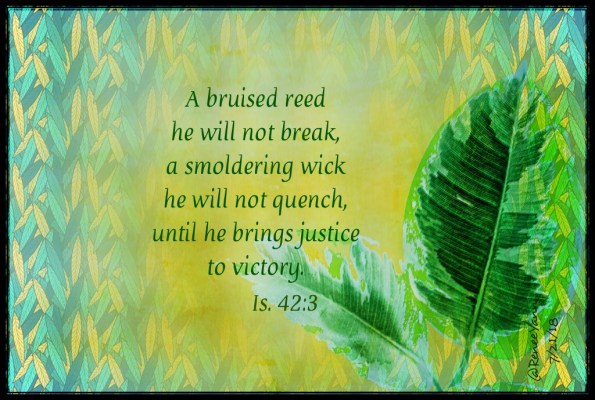
Instead, Jesus gathers around him the humble and wounded, the ones whose hearts have been softened by suffering and shadows. He gently comforts them, heals them, and leads them to a new Light. They are the bruised reeds which he does not break. They are like smoldering wicks which he tenderly rekindles with his Word.
Let us place our own bruises and flickering lights in his presence today. Let us gather the world’s hurts and darknesses in our prayer. We give ourselves to the gentle love of Jesus.
I remember this morning a beloved prayer of my youth. Some of you may remember too: The Prayer before the Crucifix
Look down upon me, good and gentle Jesus, While before Thy face I humbly kneel And with burning soul, pray and beseech Thee, To fix deep in my heart, Lively sentiments of faith, hope and charity, True contrition for my sins And a firm purpose of amendment. While I contemplate with great love and tender pity, Thy five most precious wounds, Pondering over them within me, And calling to mind the words that David, Thy prophet, said of Thee , my Jesus, “They have pierced My hands and feet, They have numbered all my bones.”
Music: My Heart Longs for a Touch
(To hear music, tap the center of the picture below.)
Today, in Mercy, Jesus breaks the law. He and his hungry disciples, walking through a grain field on the Sabbath, gather the corn and eat. The Pharisees condemn their actions as a violation of Jewish Law. Jesus says no – that some laws supersede others.
The concept of “law” is complex. For centuries, Catholic social teaching has tried to guide us through its complexity. This body of teaching draws on St. Thomas Aquinas’s early definitions that there are four types of law: eternal, divine, natural, and human.
Divine law: The law that pertains to “our last end” – which refers to our ultimate fate after divine judgment
Eternal law: The set of timeless truths that govern the movement and behavior of all things in the universe, including non-human things.
Natural law: That portion of the eternal law that applies to the behavior of human beings.
Human law: Law that “purports” to have a human source.
When any of these laws come into contradiction, we must obey the higher law.
That’s what Jesus does in this situation. He emphasizes the rightness of his action by reminding the Pharisees of God’s pronouncement through the prophet Hosea, “I desire mercy not sacrifice.”
What are we to learn from this reading? Our modern world is filled with laws, many of them in contradiction to each other. Like the people of Jesus’ time, we like our world to be ordered in a way that benefits us personally. But this inclination can lead to laws which disadvantage others. We end up in a place where law and justice are at odds.
Consider the current dilemma at the Mexican – US border. Some US citizens believe that the “illegals” deserve family separation and incarceration because they have broken “the law”. Others see that the refugees critical need for asylum, and their natural rights as a family, far supersede the imposition of any arbitrary human law.
When we think about the border situation, we may realize that it is not too different from Jesus’ dilemma. Today’s immigrants are “hungry” for safety, justice, and compassion. Even though a man-made law inhibits them from satisfying their “hunger”, they are driven to challenge it. In God’s eyes, – the one who desires Mercy, not sacrifice- what does true justice require?
Let’s pray today for clarity and merciful justice in ourselves and our governments as we interpret and impose our human laws.
Today, in Mercy, Jesus stretches out his arms to all the suffering, troubled, lonely, upset people of the world. He opens his arms to us when we are feeling exhausted, confused or lost.
“Come to Me”, Jesus says. I am waiting for you. I see your burdens and distress. It doesn’t even matter if you are the cause of your own problems. I love you and I will comfort you.
Today, let’s just give ourselves, without reservation, into his loving invitation.
Today, in Mercy, we read one of the saddest Gospel passages, the woes to Chorazain, Bethsaida and Capernaum.These little villages were precious to Jesus, like little children to a loving teacher. Jesus had preached and performed amazing miracles in these towns. Still they had not demonstrated that basic change of heart which proclaims, “I believe”. They had not become places of mercy, justice and mutual love.
Notice that Jesus does not deliver these woes to individuals. He doesn’t say, “Harry, you messed up!” or “Gert, you better get it together”. What Jesus is talking about here is corporate guilt, that kind of hard-hearted sinfulness that affects whole institutions, clubs, societies, cities, nations.
This kind of sin manifests itself in a dehumanization of people, and a blindness to mercy and love. In Jesus’ day, such sin had infected the Pharisees, Sadducees, Romans, and probably a host of smaller religious, political and social networks.
In our day, we might recognize it in our churches, governments, or social associations. Its dead giveaway is the act of marking any person as “other”: not white like us, not men like us, not American like us, not Gentiles like us, not straight like us, smart, rich, educated and privileged like us — not fully human like us.
Corporate sin confuses justice with law, power with control, importance with success, wealth with possession, strength with domination. It is the kind of sin wherein a weaker group must suffer in order for the stronger group to thrive. We see its effects in war, economic suppression, racism and nationalism, misogyny and homophobia, and in the devastation of the Earth.
To the degree that we espouse and benefit from such corporate sin – or to the degree that we remain silent in its presence – woe to us as well.
Music: De Profundis – Gregorian Chant
From the depths of woe I cry to You, Lord, hear my voice! Let Your ears be attentive to my voice in supplication:
If You, O Lord, mark iniquities, Lord, who can stand? But with You is forgiveness, that You may be revered.
I trust in the Lord; my soul trusts in His word. My soul waits for the Lord more than sentinels wait for the dawn.
More than sentinels wait for the dawn, let Israel wait for the Lord. For with the Lord is kindness, and with Him is plenteous redemption; And He will redeem Israel from all their iniquities.
Today, in Mercy, we pray with the word “Truth”. The word appears 137 times in the Bible. God clearly has something to tell us about it!
A truth theme runs through today’s readings like a magnetic thread, drawing us to deeper self-understanding. Friday the 13th is a good day for that, don’t you think – a day fraught with superstitions and falsehoods?
When I was a teenager, my parents decided to wallpaper our living room. Dad, a master craftsman at just about any DIY project, had been physically incapacitated by several heart attacks. So, while he was the architect, I was the contractor for this home project.
Dad was an exact yet patient teacher. I learned how to cut, paste and match seams. I absorbed the craftsperson’s essential mantra: measure twice, cut once. Even the mysteries and miracles of Dad’s old, treasured toolbox were opened to me.
One morning, Dad said we had to “true up” a wall and that we were going to “drop a plumb line”. It was Greek to me. But he explained that no building is perfectly level. If we didn’t begin our papering from a leveled line, we would end up feeling like our living room was a tilted funhouse.
Don’t you sometimes feel like our world is that funhouse? But it isn’t really very much fun, is it? We live in a time when information and communication are at our fingertips. Yet, we are confused by half-truths and distorted facts. We are assailed with propaganda and cyber-manipulation. We are fed a diet of constant cabled lies AND we consume them to satisfy our biases. Even in our personal lives, we may be undercut by false friends and masquerading enemies. Like Pontius Pilate, we are left with the question, “Truth! What is “Truth”?
Today’s readings drop a plumb line into that skewed world.
Hosea tells us, “Straight are the paths of the Lord; in them the just walk.”
Our Psalm implores God to create in us a true heart.
Our Gospel tells us that, even in the midst of deceit, that true heart will be guided by the Holy Spirit.
On this Friday the 13th, we can start by truing up our own spirits. Let’s pray for the grace today to be true friends – not fair weather; true patriots – not nationalists; true believers – not Pharisees.
Behold, you are pleased with sincerity of heart, and in my inmost being you teach me wisdom. Cleanse me of sin with hyssop, that I may be purified; wash me, and I shall be whiter than snow. (from today’s Psalm)
Today, in Mercy, on this feast of St. Benedict, we pray with the words of Psalm 105:
Seek always the face of the Lord.
One of the fundamental questions a spiritual director might ask us when we share our life experiences is this: “Where is God in this for you?” It is a steadying question which we can ask ourselves as we try to navigate our life challenges.
We can trust that God is somewhere in every situation, either encouraging us to go forward or to retreat — in either case, calling us toward the Divine and Loving Will. As we deepen in our habits of prayer, grateful quiet, and merciful practice, we begin to see God more clearly in everything.
St. Benedict prayed for this kind of vision. May we share in his prayer.
“Almighty God, give me wisdom to perceive You, intelligence to understand You, diligence to seek You, patience to wait for You, eyes to behold You, a heart to meditate upon You and life to proclaim You, through the power of the Spirit of our Lord Jesus Christ. Amen.”
Music: I Can See – Steve Green
This song shares the experience of the Emmaus disciples as their eyes were opened and the saw Jesus walking with them along their life’s road.
Has doubt ever dogged you, or at least nipped at the edges of your soul?All kinds of doubt, I’m talking about! Doubt yourself. Doubt your loved ones. Doubt the Church, the government, the media. You get the idea.
Some doubt is good. It’s more like “discernment”, and it saves us from misplaced trust. A skill that’s honed through a lifetime, it can eventually be exercised prudentially, without skepticism or aloofness.
But another type of doubt can be crippling. Call it the “not enough” type: I am not good enough, smart enough, good-looking enough, experienced enough, – so on and on – to take on a challenge or make a contribution. Ever felt that kind of doubt?
There is third type of doubt which I call “the flip side of faith”. It’s that fine line where we balance between wanting to believe and wanting to know. This type of doubt whispers things like this in our minds: “You don’t really know if there is a God, so how can you believe?” But isn’t that the whole point of faith? If we really knew, for certain, of God’s existence, we wouldn’t have to believe!
What’s the difference between these flip sides of the coin?
With faith, we give our love and service unreservedly, even though we have not seen. With doubt, we skimp or reserve these until given proof.
So today, we meet “doubting Thomas”. He needed the touch of nail marks and lance wounds before he could believe. And it’s not hard to understand why.
The Resurrection of Jesus was mind-blowing. It changed history for all time to come. It conquered the one unconquerable – DEATH itself. Thomas had not yet seen proof of the Resurrection. The other disciples had. No wonder his coin was spinning between heads and tails!
What about us? Have we seen the Easter Power in our lives? Have we let God win the toss up between our faith and doubt? Today, on this feast of St. Thomas, we might ask his help to let us learn from the wounds of Christ exactly how that Power can assure us.
Music: Blessed Assurance ~ a well-known Christian hymn. The lyrics were written in 1873 by blind hymn writer Fanny Crosby to the music written in 1873 by Phoebe Knapp.
Today, in Mercy, our readings tell the story of the woman with the hemorrhage, and the little girl raised to life. I wrote the following homily about this passage for the Catholic Health association in 2015. I hope you find it worth reading.
For more inspiring prayer and scripture resources from CHA, please see:
Healing of the Daughter of Jairus and the Woman with a Hemorrhage
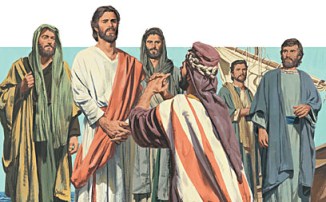
It is a soft, summer morning in Capernaum and Jesus is in the height of his ministry. Large crowds follow him wherever he goes, crowds hungry with hope; crowds fired by his counter-cultural words and miraculous deeds. This morning, Jesus prepares to speak to them, to translate into language they can comprehend the Eternal Life that lives in his heart. His back is to the gentle, sunlit sea. The hubbub softens to a murmur, finally stilled by the lapping waves.
But before Jesus can begin, a distressed man bursts through the gathered crowd. His robes fly about him as he runs to Jesus and falls at his feet. This man is important, so important that we all have known his name for two thousand years. This is Jairus who lives nearby and organizes the worship in the synagogue. Now breathless and swallowing sobs, Jairus pleads with Jesus: Please! My daughter! You can give her life!
Every loving father has been Jairus at least once in his life. We know these fathers. We are these fathers. They are the ones who burst into emergency rooms with a seizing infant in their arms. They are the ones who stare blankly at the pronouncement of a stillborn child. They are the old men in war-ravaged countries who kneel at the sides of their fallen sons and desecrated daughters. They are all the men throughout history rendered helpless by the forces of unbridled power, greed and death.
The merciful heart of Jesus understands this man and his desperate urgency. Without even a word, Jesus gets up and accompanies Jairus to the place of his pleading.
But there is another urgency pushing forward from the crowds: a woman, apparently of low importance for we have never known her name. She is a woman whom the ages have defined by her affliction. She is “The Woman with the Hemorrhage”. Without the status of Jairus, she approaches Jesus as such a woman must. She crawls behind him at his heels, reaching through the milling masses to even scrape the hem of his garment.
This is a troubled woman, a stigmatized woman. Her life has been spent, literally, in embarrassment, isolation, fatigue and, no doubt, abuse. For twelve years – coincidentally the life span of Jairus’ s daughter – her vitality has bled out of her. Her face is gaunt; her eyes sunken. Her soul’s light is all but extinguished. She is a woman who knows a particular kind of scorn.
We know these women. We are these women. They are the ones filled with remorse for an aborted baby. They are the ones who miscarry their longed-for child. They are the women whose beautiful young sons are profiled, stereotyped and hunted on the violent streets. They are the mothers of “The Disappeared”. They are the women who suffer disproportionately from war, poverty, hunger and violence. They are trafficked women, prostituted women, women victimized by the long saga of domination. They are the women whose children have been torn from them at the borders.
It is just such a broken woman who stretches her fingers through the Galilean dust in a last reckless reach for healing. She finds only the hem of his robe. Touching it, she is transformed, like a parched meadow in the spring rain. Her whole being reaches up to receive the holy restoration. She knows herself to be healed. And it is enough; it is everything. She retreats into the resignation of her otherwise lonely life.
But Jesus wants more for us than just the practical miracles we beg for. We ask for one healing; Jesus wants our eternal salvation. We ask for one blessing; Jesus wants our entire lives to be filled with grace. We ask for one prayer to be answered; Jesus wants our life to become a prayer.
Jesus feels the electrical touch of her hope. He feels the secret healing she has extracted from him. He turns to seek her. Can you see their eyes meet? Yes, the bleeding has been stemmed, but he sees the deeper wounds that scar her soul. His look of immense mercy invites her to tell him “the whole truth”. By her touch, she has commandeered a physical healing. But by his gracious turning toward her, her entire being is renewed. In this sacred glance, her history has been healed. Her future has been pulled from darkness into light. Her capacity to love has been rekindled. She now and forever will remember herself as a child of God.
Jairus waits, no doubt impatiently, at the edge of this miracle, anxious for such power to touch his daughter’s life. He fears they have lingered too long with the woman. His servants arrive, confirming his fears. He receives the dreaded report, “Your daughter has died.”
Jesus now pushes Jairus to the gauntlet of pure faith. In the face of this devastating news, Jesus tells him, “Do not be afraid; just have faith.” Is this not an almost impossible command? Like Jairus, we all know what it is to worry for our children:
Fathers of color teach their sons behaviors to protect them from profiling.
Immigrant parents fear their children will be ripped from them in a pre-dawn raid.
Famine-ravaged mothers watch their children disappear into hunger.
In hospitals and doctors’ offices, devastated parents summon the courage to accompany their critically ill child.
And Jesus says, “Don’t be afraid. Have faith.”! What can he possibly mean?
Perhaps it is this simple. In Jairus’s home, Jesus takes the dead girl’s hand. He says, “Talitha, koum – Little girl, arise.” His call to her heart tells her there is no darkness, devastation or death from which God cannot draw us into life. This is the truth Jesus brings to the little girl and to us. But it is a truth that, in our fear and need, we cannot always see.
For the moment, this girl lives. But at some time in history she, like all of us, will die. So the miracle is not the restoration of her life. The miracle is that her eyes, and her parents’ eyes, are opened to the power of God over death. Despite all appearances, God’s life endures eternally.
This is the revelation of this Gospel passage. If we live by faith, we live beyond cure into healing. If we live by faith, even death can bring life. If we live by faith, we are free to release all worry into the abundant mercy of God who grants us healing even beyond our asking or desire.
Man or woman, old or young, at some time in our lives each one of us has been Jairus. Each one of us has been one or the other of these two women. Within their stories of woundedness and deep faith, our stories shelter. Jairus and the afflicted women – unnamed like so many women throughout time – believed there was a way to new life. They reached for it. They begged for it. What is it in us that cries out for such healing? What is it in us that, without the touch of Jesus, teeters on the verge of death?
Simply by believing, these three Gospel figures became new beings. Simply by believing, their orientation changed from darkness to light. By their example, let us lift up those wounded and deadened places in our hearts and world before the loving gaze of Jesus.
To what suffering in our souls is God whispering the encouragement, “Talitha, koum”? What is the “whole truth” Jesus is inviting us to confide? Let us arise and respond to him in the full energy of our faith. Let us gaze with boundless confidence into the eyes of God’s mercy.
Today, in Mercy, we celebrate the great Apostles Peter and Paul. The stories of these men embody all the hills and valleys of a Christian life: call, conversion of heart, ministry, miracles, sacrifice, suffering, failure and glory.
Every human being passes through these hills and valleys. Why do some emerge as saints for the ages and others not?
Today’s readings would suggest this answer: they believed, and submitted their hearts to God’s unimaginable grace and power. Through that faith, they ultimately were led to the heights of holiness and carried the rest of us believers with them.
Paul says,
“The Lord stood by me and gave me strength,
so that through me the proclamation of the Word
might be completed.”
When Jesus asks Peter what he believes, Peter says,
“You are the Christ, the Son of the living God.”
Ordinary men responding with a clear and extraordinary faith.
One June morning, about forty years ago, I sat in a sun-filled field in the Golan Heights of Israel at a spot named Caesarea Philippi. Thirty other pilgrims composed the group as we heard today’s Gospel being read. Listening, I watched the rising sun grow brilliant on the majestic rock face in the near distance. I thought how Peter might have watched his day’s sunplaying against the same powerful cliffs.
Jesus said to him,
You are Peter (which mean “Rock”), and upon this rock I will build my Church.
A few years later, I stood at the center of St. Peter’s Basilica in the Vatican. Looking up, I saw these words emblazoned on the awesome rotunda dome:
Tu es Petrus, et super hanc petram
aedificabo ecclesiam.
On that lazy afternoon, two thousand years ago, Peter could never have imagined what God already saw. Yet, Peter responded – with his whole life. This is what makes a Saint.









 Lavish Mercy