Psalm 119: DiliGENTLY

Saturday of the First Week of Lent

February 27, 2021


Today, in God’s Lavish Mercy, we pray with our familiar Psalm 119. Because it is the longest of the Psalms, there is plenty of material for its frequent use.


But sometimes, when things are frequent and familiar, they can also become “humdrum”. Our prayers, especially repeated vocal prayers such as those we say at Mass, can become veiled in monotony.


Thinking of this, I read Psalm 119 with new eyes today, looking for a dynamic word to pop out and speak to me. And here it was:

You have commanded that your precepts
    be diligently kept.
Oh, that I might be firm in the ways
    of keeping your statutes!

Psalm 119: 4-5

Diligently” – it is a wonderful word that suggests a range of attitudes we should hold in the Presence of God.

The word is derived from the Latin diligere: “to single out, value highly, esteem, prize, love; aspire to, be content with, appreciate”.

The psalmist suggests that God wants us to esteem and love God’s Word in a singular manner – that we should pay sharp attention, prize, and develop a deep appreciation for God’s precepts.


Our careful engagement of the Word of God must be delicate and gentle, as the root of “diligently” implies. We might imagine careful fingers peeling ripe fruit so delicately that nothing is lost of its pulp or juice.

In our daily prayer, we then savor that sweetness over and over, releasing its eternal meaning into the circumstances of our lives, feeding our spirits with its graces.

I will give you thanks with an upright heart,
    when I have learned your just ordinances.

Psalm 119:7

Poetic Advice: Taken from “The Journey of the Mind to God” by St. Bonaventure (1221–1274)

Do not assume that mere
Reading will suffice without fervor,
Speculation without devotion,
Investigation without admiration,
Observation without exaltation,
Industry without piety,
Knowledge without love,
Understanding without humility,
Study without divine grace.

Music: Wonderful Words of Life – Philip Bliss, 1874.
This is a lesser known hymn by the prolific Bliss who also composed the music for the more popular “It Is Well with My Soul”.


Psalm 130: The Depths

Friday of the First Week of Lent

February 26, 2021


Today, in God’s Lavish Mercy, we pray with Psalm 130, the De Profundis. This is a transformative prayer whose power we may not fully realize.

Have you ever been disappointed with God? Have you ever let God know it in your prayer? 

Psalm 130 is the psalmist’s complaint to God that things are as bad as they can get and God doesn’t appear to care. It is a plea – even a demand- for God to pay attention and do something. (See my poem, sent a little later, called “These Things”.)

Out of the depths I cry to you, O LORD;
    LORD, hear my voice!
Let your ears be attentive
    to my voice in supplication.


But Psalm 130 is not just a private complaint. As well as being a penitential psalm, 130 is marked as a “Psalm of Ascent”. This means that it was sung by the community as they went to the Temple to worship.

Psalm 130 carries the tone of a national or global lament. It has the feeling of a deeply bruised people bearing a desperate hope mixed with some bewilderment. It is a feeling we all recognize.

Remembrance of Lives Lost to Covid 19

Yesterday in my neighborhood, we had our first hint of spring weather. On a short walk, I met a few people whose winter-weary eyes, above their masks, held a spark of resurrection hope.

With distribution of COVID vaccines, hope for deliverance from the pandemic surfaces like a tentative bud. We are starting the slow ascent from the depths we have all shared. We are on our way to the temple of thanksgiving and praise.


But Psalm 130 reminds that, on that ascent, fully voicing our lament is imperative for true healing. In reference to the pandemic, and to any other devastation we face in life, we must be honest with God about our fear, confusion, sadness, hopelessness, and shaken faith … about our disappointment in God, our splintered expectations which need healing.

If you, O LORD, mark iniquities,
    LORD, who can stand?

It is only by asking God how these things – whatever they might be – could be allowed to happen to us, or to any of God’s beloved, that we will open ourselves to the Divine answer – a mystery too deep for words.

I trust you, LORD;
    my soul trusts in your word.
My soul waits for you
    more than sentinels wait for the dawn.
    Let me wait for the LORD.

Such prayer heals, leading us to a deeper, truer relationship with God.

For with the LORD is kindness
    and plenteous redemption;
And the Lord will redeem Israel
    from all their suffering and sin.

Poetry: Spring – Mary Oliver

Somewhere
a black bear
has just risen from sleep
and is staring

down the mountain.
All night
in the brisk and shallow restlessness
of early spring

I think of her,
her four black fists
flicking the gravel,
her tongue

like a red fire
touching the grass,
the cold water.
There is only one question:

how to love this world.
I think of her 
rising
like a black and leafy ledge

to sharpen her claws against 
the silence
of the trees.
Whatever else

my life is
with its poems
and its music
and its cities,

it is also this dazzling darkness
coming 
down the mountain,
breathing and tasting;

all day I think of her –
her white teeth,
her wordlessness, 
her perfect love.

Music: Pié Jesu – Michael Hoppé

Psalm 138: Favors Received

Thursday of the First Week of Lent

February 25, 2021


Today, in God’s Lavish Mercy, we pray with Psalm 138, an ardent thanksgiving for favors received.

Lord, on the day I called for help,
you answered me.

Psalm 138:3
Queen Esther by Andrea del Castagno – 15th C.

The psalm today reflects back to our first reading from the Book of Esther. The “favor received” in that story is a monumental one: saving the Jewish people from extinction. This deliverance is commemorated on the Jewish Feast of Purim which, coincidental to our liturgical reading, is celebrated this year on February 25th.


 Reflecting on “favors received”, we might be moved to thank God for the blessings in our lives. Some blessings are evident from the get-go. But some come initially wrapped in challenge, worry, even anguish:

Queen Esther, seized with mortal anguish,
had recourse to the LORD.
She lay prostrate upon the ground, together with her handmaids, 
from morning until evening, and said:
“God of Abraham, God of Isaac, and God of Jacob, blessed are you. 
Help me, who am alone and have no help but you,
for I am taking my life in my hand.

Esther C: 12-16

What is it that changes these darknesses into Light? Psalm 138 offers us this clue:

When I called, you answered me;
    you built up strength within me.
    Your right hand saves me.
The LORD will complete what he has done for me;
    your kindness, O LORD, endures forever;
    forsake not the work of your hands.

Psalm 138: 3,7-8

Certainly a positive outcome to our prayer, like Esther’s, allows us to see a blessing. But what about the times when the outcome disappoints or even devastates us?

The answer has something to do with spiritual “strength”, with a long faith like Esther’s. She puts her hope in the Lord and waits for the answer to unfold even at the risk of her life.

Trusting God like this means that we believe in God’s bigger picture for us and for all that we love. 

  • It means that, by faith, we live partly in the eternal world we cannot yet see. 
  • It means that the quintessential things of our heart and soul exist beyond time, in the unbounded love of God.
  • It means that we trust God to complete all things in lavish mercy.

The LORD is with me to the end.
LORD, your Mercy endures forever.
Never forsake the work of your hands!

Psalm 138: 7-8

That kind of faith won’t just pop up when we are in trouble. It has to be ingrained – the very fabric of our lives, knitted there by the prayerful surrender of our daily lives to God’s amazing Grace.


Poetry: Rock of My Salvation BY MORDECAI BEN ISAAC
TRANSLATED BY SOLOMON SOLIS-COHEN

Mighty, praised beyond compare,
Rock of my salvation,
Build again my house of prayer,
For Thy habitation!
Offering and libation, shall a ransomed nation
Joyful bring
There, and sing
Psalms of Dedication!

Woe was mine in Egypt-land,
(Tyrant kings enslaved me);
Till Thy mighty, out-stretched Hand
From oppression saved me.
Pharaoh, rash pursuing, vowed my swift undoing—
Soon, his host
That proud boast
’Neath the waves was rueing!

To Thy Holy Hill, the way
Madest Thou clear before me;
With false gods I went astray—
Foes to exile bore me.
Torn from all I cherished, almost had I perished—
Babylon fell,
   Ze-ru-ba-bel
Badest Thou to restore me!

Then the vengeful Haman wrought
Subtly, to betray me;
In his snare himself he caught—
He that plann’d to slay me.
(Hauled from Esther’s palace; hanged on his own gallows!)
Seal and ring
Persia’s king
Gave Thy servant zealous.

When the brave Asmonéans broke
Javan’s chain in sunder,
Through the holy oil, Thy folk
Didst Thou show a wonder—
Ever full remained the vessel unprofanèd;
These eight days,
Lights and praise,
Therefore were ordainèd.

Lord, Thy Holy Arm make bare,
Speed my restoration;
Be my martyr’s blood Thy care—
Judge each guilty nation.
Long is my probation; sore my tribulation—
Bid, from Heaven,
Thy shepherds seven
Haste to my salvation!

Music: Rock of My Salvation – Maranatha Music

Psalm 34: Together

Tuesday of the First Week of Lent

February 23, 2021


Today, in God’s Lavish Mercy, we pray with Psalm 34, thought to be a young David’s thanksgiving prayer after God saved him from one of his many dangerous escapades.

In telling his deliverance story, David invites his friends to celebrate with him and to learn the faith-lesson he has learned:

Glorify the LORD with me,
    let us together extol his name.
I sought the LORD, and he answered me
    and delivered me from all my fears. 


I picture myself sitting in David’s audience, absorbing the words of his prayer. This line strikes me:

The LORD has eyes for the just,
    and ears for their cry.

Ah, the Lord has eyes for me….for ME! It conjures up sounds of The Flamingos, doesn’t it? (Sorry for the transcriber’s misspelling 😀)

Most of us want to think that we are individually special to God. This desire is at the core of the Protestant Evangelical model, “a personal relationship with Jesus Christ”. But for some, this model has become confused with a prosperity gospel that is quite misleading.

The only prosperity we should seek from God is the gift of grace because:

Yahweh’s peculiar inclinations are with the broken-hearted and the ones with crushed spirit. That is, Yahweh’s solidarity is not with the ones who go from success to success, but the ones denied success.

Walter Brueggemann The Message of the Psalms A Theological Commentary Ausberg Publishing House 1984

Still, such a personal relationship is not alien to a full and complete faith:

Faith is above all a personal, intimate encounter with Jesus, and to experience his closeness, his friendship, his love; only in this way does one learn to know him ever more, and to love and follow him ever more. May this happen to each one of us.

Pope Benedict XVI, General Audience, 2009

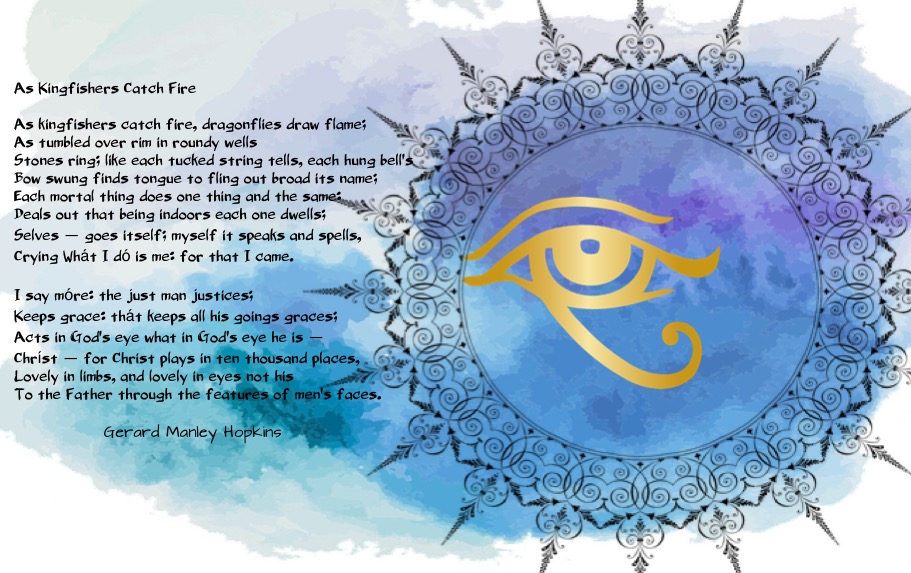
(Look for an extra prayer about “The Eye of God” in another post today.)


However, our psalm alerts us that this deeply personal dimension is only part of relationship with God.

When the just cry out, the LORD hears them,
    and from all their distress he rescues them.
The LORD is close to the brokenhearted;
   and those who are crushed in spirit he saves.

To be seen and heard by God, one must be part of the just community. To be close to God, one must feel the brokenheartedness of the poor. We come to the psalmist’s exuberant praise only by walking with suffering, either in our own lives, or beside others who bear distress.

From all their distress
God rescues the just.

Psalm 34 teaches us that our personal relationship with God is interdependent with our relationship with the whole community. David calls his community to share in his praise-song because they- together -recognize God’s mercy and share it in concern for one another.

The LORD has eyes for the just,
    and ears for their cry.


Our Gospel today confirms that a personal love for God thrives only within a communal love. The prayer Jesus shares is not “My Father”. It is “Our Father”. We come to the depths of God’s merciful heart with our sisters and brothers.


Poetry: An Inclusive Lord’s Prayer – Author unknown

Loving God, 
in whom is heaven, 
may Your name be honored everywhere.
May Your Mercy reign.
May the desire of Your heart for the world 
be done, 
in us, by us and through us.
Give us each and all
the bread we need for the day.
Forgive us.
Free us to forgive others.
Keep us from all anxiety, fear, and selfishness.
For You reign in the power that comes from love 
which is Your glory
forever and ever.
Amen.

Music: Our Father – Joe Wise

Psalm 25: Grace through Prisms

First Sunday of Lent

February 21, 2021

Today, in God’s Lavish Mercy, we pray with Psalm 25, a prayer full of humility, thanksgiving, and hope.

Your ways, O LORD, make known to me;
    teach me your paths,
Guide me in your truth and teach me,
    for you are God my savior.

Psalm 25: 4-5

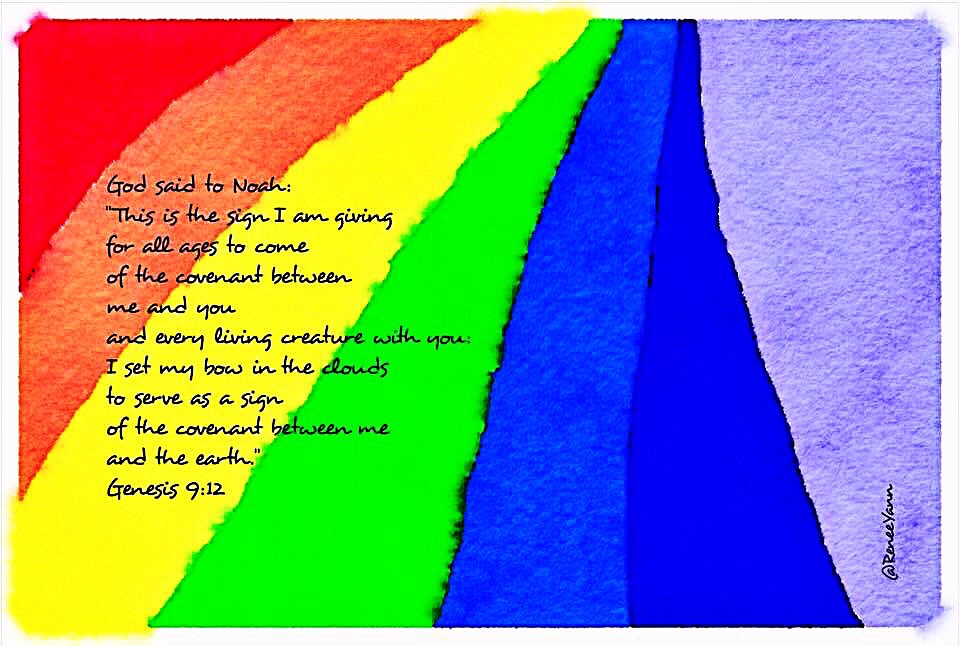
Genesis 9:12

On this First Sunday of Lent, the psalm is set between the wonderful Noah story, its interpretation by Peter, and the proclamation of Christ’s redemptive mission.

Like Noah, humankind has come through the storm of an ages-long messianic longing. Jesus is the Rainbow rising out of that darkness. His Light passes into us through the prismed waters of our Baptism. Indeed, as our Psalm declares:

Good and upright is the LORD,
    showing sinners the way.
God guides the humble to justice,
    and teaches the humble the godly way.

Psalm 25: 8-9

When our psalmist first begins to pray, the light within seems shadowed and the vibrancy of his soul perhaps fractured. At times, we have felt the same way. 

But the psalmist’s sincere and humble prayer catches God’s Light, allowing the passage from shadows to to the full rainbow of Mercy. May it be so for all of us as well as we journey with Jesus through Lent.

Poetry: on a separate post today due to its length — but so worth the time to read and savor.


Music: Rainbow by Robert Plant – Let God sing this song to you, perhaps the way God sang in Noah’s heart when he was delivered from the flood.

I found a lucky charm
I dressed it up with love
I crossed the Seven Seas to you
Will it be enough?

And I will be a rainbow
Oh, now your storm is gone
And I will bring the song for you
And I will carry on
Ooh Ooh Ooh
Ooh Ooh Ooh

I'm reachin' for the stars
In the sky above
Oh, I will bring their beauty home
The colors of my love

And I will be a rainbow
Now your storm is gone
And I will bring my song to you
And I will carry on
(Hummed interlude)

Love is enough
Though the world be a wind
And the woods have no voice but the voice of complaining

My hands shall not tremble, my feet shall not falter
The voyage shall not weary, the fish shall not alter
Hmm, It's rainbow, oh it's rainbow
Oh, can't you see the eyes are the eyes of a lover

Pocket full of hearts
A world that's filled with love
A love that carries all before
The passion and the flood

I lie beneath the rainbow
Now your tears have gone
And I will sing my song for you
And I will carry on
(Repeated interlude)

Psalm 86: Lean to Me, Lord

Saturday after Ash Wednesday

February 20, 2021


INCLINE!

Today, in God’s Lavish Mercy, we pray with Psalm 86, a very personal prayer. The kingdom, the nation, the people are not mentioned. It is a plea from one aching heart to its merciful God.

Each one of us has been that person on occasion. We may not have employed the exact words of Psalm 86, but we have prayed its sentiments in our own way.

HARKEN!

For me, that prayer is grounded in two powerful verbs, intimate requests made to a God Who might otherwise seem distant in our times of trouble.

Incline and Harken

Let’s just walk and talk with our listening God today. Feel God bend near to listen. Listen in return.


Poetry: Listen, can you hear it? by Rabindranath Tagore

Listen, can you hear it?
God’s bamboo flute speaks
the pure language of love.
The moon enlightens the trees,
the path, the sinuous River.

Oblivious of the jasmine's scent
I stagger around,
disheveled heart bereft of modesty,
eyes wet with angst and delight.

Tell me, dear friend, say it aloud:
is God not my own Dark Lord?
Is it not my name God’s flute pours
into the empty evening?

For eons I longed for God,
I yearned to know the Holy One.
That's why God has come to me now,
deep emerald Lord of my breath.

O Lord, whenever your faraway flute thrills
through the dark, I say your name,
only your name, and will my body to dissolve
in your luminous River.

Hear me, Lord, in this moment.
What's stopping you?
The earth drowns in sleep.
Let's go. I'll walk with you, talk with you.

Music: O Lord, Hear My Prayer – Taize

Psalm 1: Aligned to God

Thursday after Ash Wednesday

February 18, 2021


Today, in God’s Lavish Mercy, we pray with Psalm 1, a familiar reminder of what a working relationship with God looks like:

Blessed the one who follows not
    the counsel of the wicked
Nor walks in the way of sinners,
    nor sits in the company of the insolent,
But delights in the law of the LORD
    and meditates on God’s law day and night.

Psalm 1:1-2

The phrases in that little verse are so powerful! 

We have seen all too clearly what happens when people “follow the counsel of the wicked”. We know how easily we can be infected by the negativity of “the insolent”. There is a spiritual distemper in us when these fractious humors fill the atmosphere.

Instead, we seek the peace and delight of being right with God. We embrace God’s law as a support and inspiration to guide us.


When we think of God’s Law, we might rightly think of the Commandments, the Beatitudes, the Torah, the Gospel – those places where we find the Law codified in words.

But we might also think of God’s Law as that silent omnipotent force that lifts the sun from darkness and sets it down again, that holds the seas in their global bowl, that lights the night with fiery stars.

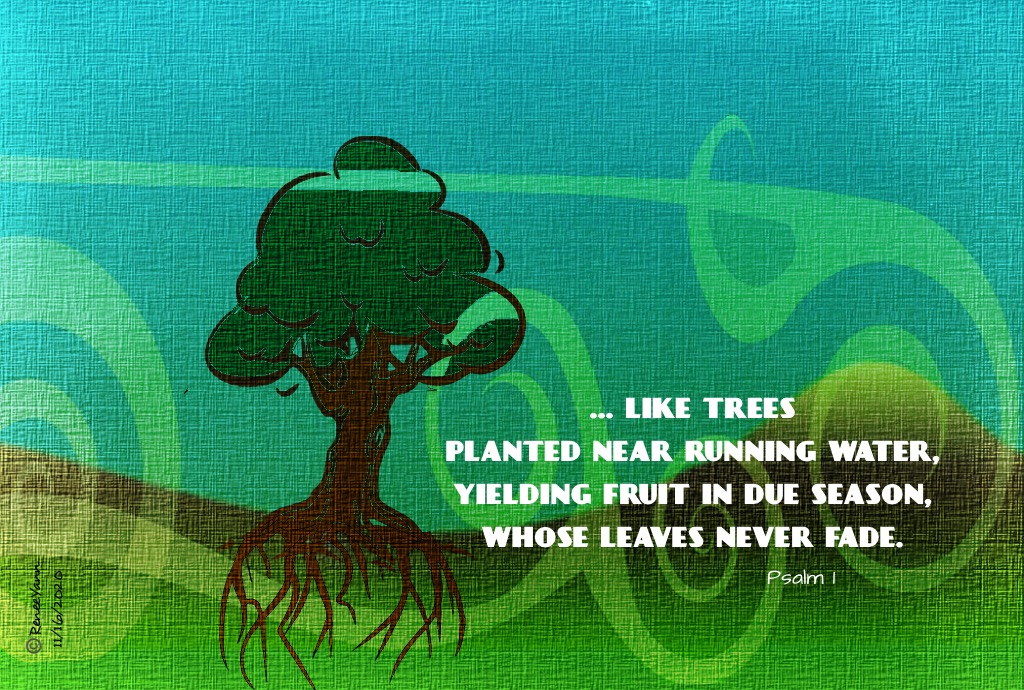
Affinity with God’s Law is that loving practice which, by intrinsic prayer and reflection, gives over every moment of our lives to God’s order. That alignment, rooting us in God’s “due season”, allows goodness to blossom in us like a fruitful tree – an unfading, abundant harvest …

Like a tree
    planted near running water,
That yields its fruit in due season,
    and whose leaves never fade,
    ever prospering.

Psalm 1:3

Poetry: Onto a Vast Plain – Rainer Maria Rilke

Listen.
You are not surprised at the force of the storm—
you have seen it growing.
The trees flee. Their flight
sets the boulevards streaming. And you know:
he whom they flee is the one
you move toward. All your senses
sing him, as you stand at the window.

The weeks stood still in summer.
The trees’ blood rose. Now you feel
it wants to sink back
into the source of everything. You thought
you could trust that power
when you plucked the fruit:
now it becomes a riddle again
and you again a stranger.

Summer was like your house: you know
where each thing stood.
Now you must go out into your heart
as onto a vast plain. Now
the immense loneliness begins.

The days go numb, the wind
sucks the world from your senses like withered leaves.

Through the empty branches the sky remains.
It is what you have.
Be earth now, and evensong.
Be the ground lying under that sky.
Be modest now, like a thing
ripened until it is real,
so that he who began it all
can feel you when he reaches for you.

Music: How Deep, How Simple – Kathryn Kaye

Psalm 51: Even now…

February 17, 2021

Today, in God’s Lavish Mercy, as we begin the Holy Season of Lent, we pray with Psalm 51. It is an elegiac summons the Lord offers to those who hunger for restoration, for those on hope’s last shore.

Blow the trumpet in Zion!
    proclaim a fast,
    call an assembly;
Gather the people,
    notify the congregation;
Assemble the elders,
    gather the children
    and the infants at the breast;
Let the bridegroom quit his room
    and the bride her chamber.


Perhaps there is something that dramatic in your life that you will want to bring to God’s Mercy. But for many of us, Lent is a time to stop ignoring the little things in our lives that cripple our full redemption.

Those:

  • unforgiven hurts 
  • unresolved angers
  • petty jealousies
  • unloving criticisms
  • unkindnesses
  • petty cynicisms.

It is a time to face up to our failures to
pray, listen, hope, encourage,
witness, truth-tell, bless.

It is a time to:

  • become poor in spirit
  • mourn our suffering world
  • be meek before the power God’s Word
  • deepen in hunger and thirst for righteousness
  • be merciful
  • be pure of heart
  • be peacemaking
  • befriend persecuted

Lent reminds us that it’s not good enough to be good enough. Lent is about the “whole heart” thing. Is there anything keeping us from it?

Even now, says the LORD,
    return to me with your whole heart,
    with fasting, and weeping, and mourning;
Rend your hearts, not your garments,
    and return to the LORD, your God.


Psalm 51 gives us a time-tested formula for a transformative Lent:

  • acknowledge sinfulness
  • ask forgiveness
  • act on God’s Grace
  • give thanks for God’s mercy

It’s a cycle we should repeat daily, but during Lent it’s time to take it up a notch.


Poetry: Marked by Ashes – Walter Brueggemann

Ruler of the Night, Guarantor of the day
This day — a gift from you.
This day — like none other you have ever given, or we have ever received.
This Wednesday dazzles us with gift and newness and possibility.
This Wednesday burdens us with the tasks of the day, for we are already halfway home
     halfway back to committees and memos,
     halfway back to calls and appointments,
     halfway on to next Sunday,
     halfway back, half frazzled, half expectant,
     half turned toward you, half rather not.

This Wednesday is a long way from Ash Wednesday,
   but all our Wednesdays are marked by ashes —
     we begin this day with that taste of ash in our mouth:
       of failed hope and broken promises,
       of forgotten children and frightened women,
     we ourselves are ashes to ashes, dust to dust;
     we can taste our mortality as we roll the ash around on our tongues.

We are able to ponder our ashness with
   some confidence, only because our every Wednesday of ashes
   anticipates your Easter victory over that dry, flaky taste of death.

On this Wednesday, we submit our ashen way to you —
   you Easter parade of newness.
   Before the sun sets, take our Wednesday and Easter us,
     Easter us to joy and energy and courage and freedom;
     Easter us that we may be fearless for your truth.
   Come here and Easter our Wednesday with
     mercy and justice and peace and generosity.

We pray as we wait for the Risen One who comes soon.


Music: Tears at Bedtime – Grundman

Be Kindled

Tuesday of the Sixth Week of Easter

May 19, 2020

Click here for readings

Today, in Mercy, Jesus counsels the disciples as they grieve his impending departure. He assures them that they will be consoled and animated by the Holy Spirit whom he will send to them.

Jn16_7 spiritJPG

We all understand how the disciples feel. They love Jesus. They have been through hell and high water with him. They are comfortable with him. They have learned to be brave with him beside them.

All in all, they can’t imagine going on without him by their side.

Jesus, as he has so often had to tell them, says “You don’t quite get it!”. He explains that there will be no vacuum – that the Divine Presence will forever be with them in the form of the Holy Spirit. They are about to catch fire with the Love between Jesus and the Father! They should rejoice!

Balance Plus Minus

But, you know, it took these disciples three years of see-saw living with Jesus to fully embrace his Presence. It’s going to take more than a speech to kindle in them the full wonder of the Holy Spirit. It’s going to take a lifetime. It’s going to take thousands of little matches striking again and again in their hearts.

Decision by decision, action by action, they must now allow the Spirit to bring God’s Presence to life within them.


Slide1

When Catherine McAuley, the first Sister of Mercy, died, her beloved sisters kneeling at her bedside felt a lot like the disciples in today’s Gospel. How would they carry on the works of mercy without Catherine beside them? But as those of us who never knew Catherine realize, she left a living Spirit burning within those sisters which has descended to all her followers for nearly 200 years.

Within Catherine, as within all faithful disciples of Jesus, the Holy Spirit inspires, generates, and sustains the Presence of God for the sanctification of all Creation. The Spirit pours out over the world in our works of mercy toward all who hunger for Life.


Like the early disciples, we may wish Jesus would come along and cook us a beach breakfast so we could just sit down and talk to him in the flesh. But Jesus tells us today, as he told his disciples:

But I tell you the truth, it is better for you that I go.
For if I do not go, the Advocate will not come to you.
But if I go, I will send the Spirit to you.

Let us ask for the kind of faith that can believe, see, and sit down with that Holy Spirit in our hearts, catching Her fire, lighting the world with Mercy.

Music: Holy Spirit, Living Breath of God – The Gettys
(with Gabriel’s Oboe from the movie  “The Mission”)

Spy Wednesday

Wednesday of Holy Week

April 8, 2020

Click here for readings

holy wednesdayJPG

Today, in Mercy, the betrayal of Jesus continues, as does his mounting courage to endure its consequences.

In our first reading, the experience of the prophet Isaiah foreshadows that of Jesus. We can hear Jesus praying in Isaiah’s words:


We hear Christ’s transcendent openness to the Father’s accompaniment:

Morning after morning
God opens my ear that I may hear;
And I have not rebelled,
have not turned back.


We hear Christ’s courage to face what life unfolds before him:

I gave my back to those who beat me,
my cheeks to those who plucked my beard;
My face I did not shield
from buffets and spitting.


We hear Christ’s utter commitment, despite suffering, to the Father’s Presence:

The Lord GOD is my help,
therefore I am not disgraced;
I have set my face like flint,
knowing that I shall not be put to shame.


As we pray with Jesus today, may we:

  • hear God’s purpose in our lives.
  • see grace unfold in all our circumstances
  • set our hearts, like flint, upon faith and trust in God

passover

As our Jewish sisters and brothers begin the Passover celebration, their rich faith heritage inspires always to find God in the journey, no matter where it leads us.

In the Gospel’s Passover moment, Jesus walks toward the painful experience of Gethsemane. He invites us to come and receive the reassuring blessing of his Father even as the night shadows fall.

Music: I Come to the Garden Alone – Sean Clive 

I come to the garden alone
while the dew is still on the roses,
And the voice I hear falling on my ear,
The Son of God discloses

And He walks with me and He talks with me,
And He tells me I am his own;
And the joy we share as we tarry there,
None other has ever known

He speaks, and the sound of his voice is so sweet
The birds hush their singing,
And the melody that He give to me
Within my heart is to ringing.

And He walks with me and He talks with me,
And He tells me I am his own;
And the joy we share as we tarry there,
None other has ever known

I stay in the garden with Him,
Though the night around me is falling.
But He bids me go; through the voice of woe
His voice to me is calling.

And He walk with me and He talks with me,
And He tells me I am His own;
And the joy we share as we tarry there,
None other has ever known.