Today, in God’s Lavish Mercy, we pray with verses from Psalm 33, the whole of which is the steadfast prayer of a person convinced of God!
As we read through Psalm 33, there is no hem and haw, no grey! It’s about God as the center of the psalmist’s, and the nation’s, life:
Know that the LORD is God; Who made us, Whose we are; God’s people, the flock God tends.
Our first reading grows from a similar conviction. Paul tells the Corinthians that our rootedness in God is not about spiritual eloquence, knowledge or holy detachment. He allows that it’s a little bit about faith and hope. But, over all things, it’s about love.
Lesson: We can’t be like the Gospel’s marketplace children. There should be but one song in our hearts – the same one Love sang as Love created each one of us in Her image.
For upright is the word of the LORD, and all his works are trustworthy. He loves justice and right; of the kindness of the LORD the earth is full.
Poetry: Great Heart of God – (Nicholas) Vachel Lindsay (1879 – 1931), an American poet who is considered a founder of modern singing poetry, as he referred to it, in which verses are meant to be sung or chanted.
O great heart of God,
Once vague and lost to me,
Why do I throb with your throb to-night,
In this land, eternity?

O little heart of God,
Sweet intruding stranger,
You are laughing in my human breast,
A Christ-child in a manger.

Heart, dear heart of God,
Beside you now I kneel,
Strong heart of faith. O heart not mine,
Where God has set His seal.

Wild thundering heart of God
Out of my doubt I come,
And my foolish feet with prophets' feet,
March with the prophets' drum.
Music: Coulin – James Last – just a lovely instrumental to pray with today. ❤️
Today, in God’s Lavish Mercy, I must put our Psalm in the background and refer to an earlier post for this Feast.
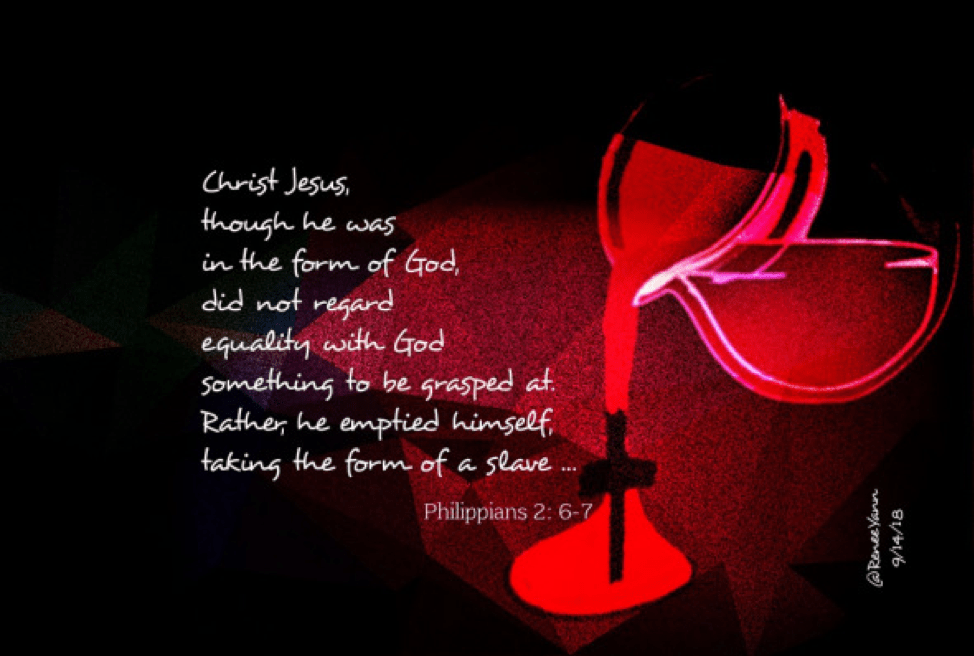
On this Feast of the Exaltation of the Holy Cross, our readings include the sublime Philippians Canticle.
To me, this is the most beautiful passage in the Bible – so beautiful that nothing else needs to be said about it.
As we read it lovingly and prayerfully today, may we take all the suffering of the world to Christ’s outstretched arms – even our own small or large heartaches and longings.
Poetry: God’s Love for Us – Julian of Norwich (1342-1416)
The love of God most High for our soul is so wonderful that it surpasses all knowledge. No created being can fully know the greatness, the sweetness, the tenderness, of the love that our Maker has for us. By his Grace and help therefore let us in spirit stand in awe and gaze, eternally marvelling at the supreme, surpassing, single-minded, incalculable love that God, Who is all goodness, has for us.
from Revelations of Divine Love
Music: Philippians Canticle ~ John Michael Talbot
And if there be therefore any consolation And if there be therefore any comfort in his love And if there be therefore any fellowship in spirit If any tender mercies and compassion
We will fulfill His joy And we will be like-minded We will fulfill His joy We can dwell in one accord And nothing will be done Through striving or vainglory We will esteem all others better than ourselves
This is the mind of Jesus This is the mind of Our Lord And if we follow Him Then we must be like-minded In all humility We will offer up our love
Though in the form of God He required no reputation Though in the form of God He required nothing but to serve And in the form of God He required only to be human And worthy to receive Required only to give
Today, in God’s Lavish Mercy, we pray with Psalm 95, a favorite of liturgists, and one we have met several times before. What different light might it offer us today as we pray?
The psalm today serves as a bridge between powerful readings about neighborly love and fraternal correction. These readings tell us to listen for God’s heartbeat in our world and to enter its rhythm.
They also tell us to love our neighbor enough that, if she or he is out of synch with God’s rhythm, we help align them by our counsel and example.
Have you ever tried to do that? It’s really tough!
First of all, we have to be so vigilant about the purity of our own intentions. We can’t instruct our friends in righteousness out of our own confusion. So often, our desire for others to “improve” grows out of our opinionated self-interest. You might remember what Jesus said about extracting the plank from our own eye before removing the splinter from our neighbor’s!
Next we really have to love our sister or brother and sincerely want their good. We have to forgive them any hurt they have caused us. We have to be bigger than most of us, speaking for myself, are inclined to be.
As the psalm tells us, we can’t have hard hearts. As we approach our sister or brother, our hearts must be softened by listening, patience, understanding, humility and hope. We have to be sure the “voice” we’re sharing comes from God not self.
Harden not your hearts as at Meribah, as in the day of Massah in the desert, Where your fathers tempted me; they tested me though they had seen my works.
And the flip of all this, of course, is that when we are the one out of rhythm, we receive loving correction in the same spirit of openness.
Lots of Grace is needed on both sides of this dance! May we learn and receive it!
Poetry: The Gift by Li-Young Lee
To pull the metal splinter from my palm
my father recited a story in a low voice.
I watched his lovely face and not the blade.
Before the story ended, he’d removed
the iron sliver I thought I’d die from.

I can’t remember the tale,
but hear his voice still, a well
of dark water, a prayer.
And I recall his hands,
two measures of tenderness
he laid against my face,
the flames of discipline
he raised above my head.

Had you entered that afternoon
you would have thought you saw a man
planting something in a boy’s palm,
a silver tear, a tiny flame.
Had you followed that boy
you would have arrived here,
where I bend over my wife’s right hand.

Look how I shave her thumbnail down
so carefully she feels no pain.
Watch as I lift the splinter out.
I was seven when my father
took my hand like this,
and I did not hold that shard
between my fingers and think,
Metal that will bury me,
christen it Little Assassin,
Ore Going Deep for My Heart.
And I did not lift up my wound and cry,
Death visited here!
I did what a child does
when he’s given something to keep.
I kissed my father.
Today, in God’s Lavish Mercy, we pray again with Psalm 33, this time with one different verse from a few days ago:
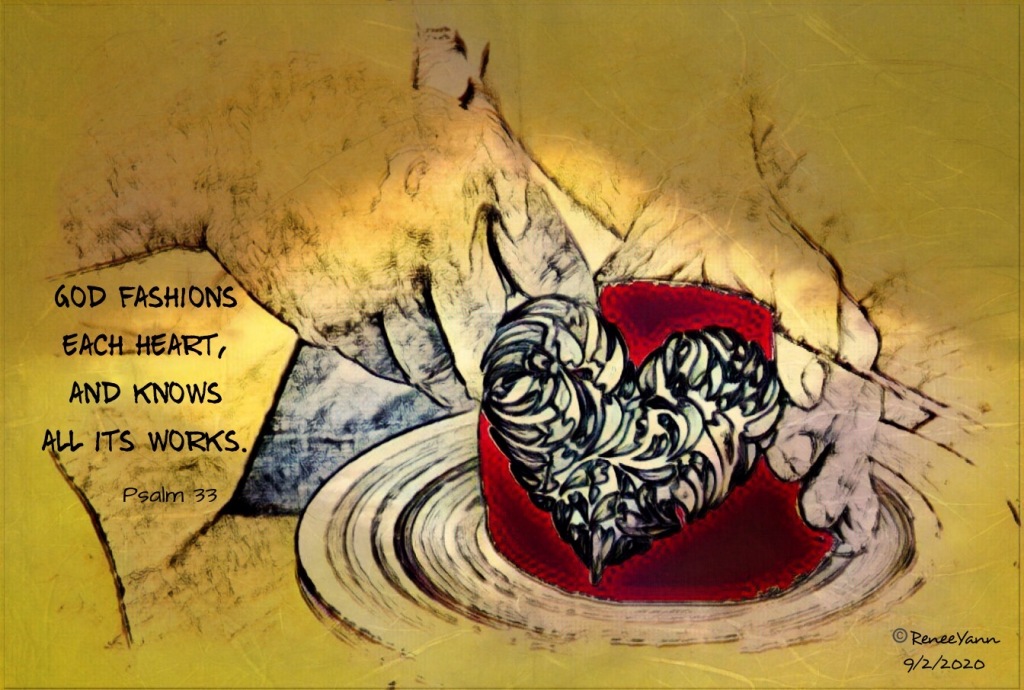
From heaven’s fixed throne God beholds all who dwell on the earth, God Who fashions each heart and knows all its works.
Think of that: God fashions each heart.
The phrase has special meaning for me today because, yesterday, we welcomed a precious new baby girl into our family.
I look at her newborn innocence and realize that she is the freshest, most hopeful breath of God, still so wrapped in the heavenly air from Whom we all receive life.
We all received that Breath once and it lives eternally within us. Every one of us has received a heart fashioned in God’s own image.
Sometimes that reality is hard to believe about ourselves and others, as it seems to have been for the Corinthians in today’s first reading. Sometimes we make a real mess of the gift we have been given!
Nevertheless, the gift is true and remains true despite our worst efforts!😉
Reflecting on today’s Gospel, there may be “various diseases” and dysfunctions that we wish to bring to the healing hands of Jesus today – for ourselves and for our world. We ask God to restore our innocence and hope throughout our lives and world.
In order to remember and live within the sacred truth that God breathed us into being, we might repeat today’s psalm refrain throughout our day:
Blessed are we, chosen to be God’s own.
Poetry: Two poems today to bless our dear new child Claire:
Songs of Innocence - William Blake
Little Lamb who made thee
Dost thou know who made thee
Gave thee life & bid thee feed.
By the stream & o’er the mead;
Gave thee clothing of delight,
Softest clothing wooly bright;
Gave thee such a tender voice,
Making all the vales rejoice!
Little Lamb who made thee?
Dost thou know who made thee?

Little Lamb, I’ll tell thee;
Little Lamb, I’ll tell thee:
He is called by thy name,
For He calls Himself a Lamb
He is meek, and He is mild,
He became a little child.
I a child, and thou a lamb,
We are called by His name.
Little Lamb, God bless thee!
Little Lamb, God bless thee!


Christina Rossetti - Holy Innocents
Sleep, little baby, sleep;
The holy Angels love thee,
And guard thy bed, and keep
A blessed watch above thee.
No spirit can come near
Nor evil beast to harm thee:
Sleep, sweet, devoid of fear
Where nothing need alarm thee.
The love which doth not sleep,
The eternal Arms around thee:
The shepherd of the sheep
In perfect love hath found thee.
Sleep through the holy night,
Christ-kept from snare and sorrow,
Until thou wake to light
And love and warmth to-morrow.
Indeed, Mary herself was a song of hope to God, sung for us and for all generations. That passionate song opened her heart to receive the Word and to carry its redeeming power to each of us.
She was the greatest prophet of all time who not only proclaimed God but enfleshed him.
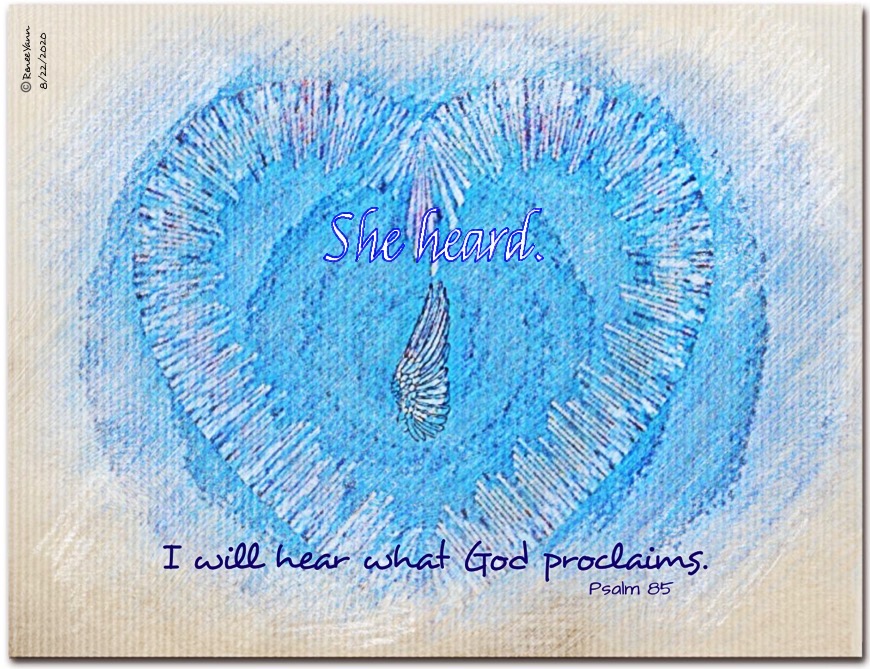
I will hear what God proclaims; the LORD– Who proclaims peace. Near indeed is salvation to those who fear God, glory dwelling in our land.
As we pray to Mary today, let us ask for listening hearts and hope-filled spirits. Let us ask to enflesh love and hope in our lives in imitation of her. Let us ask to believe as she did:
The LORD himself will give his benefits; our land shall yield its increase. Justice shall walk before him, and salvation, along the way of his steps.
Poetry: Annunciation – Denise Levertov
Annunciation
_________________________________________
‘Hail, space for the uncontained God’From the Agathistos Hymn, Greece, 6th century
_________________________________________
We know the scene: the room, variously furnished,
almost always a lectern, a book; always
the tall lily.
Arrived on solemn grandeur of great wings,
the angelic ambassador, standing or hovering,
whom she acknowledges, a guest.
But we are told of meek obedience. No one mentions
courage.
The engendering Spirit
did not enter her without consent.
God waited.
She was free
to accept or to refuse, choice
integral to humanness.
____________________
Aren’t there annunciations
of one sort or another
in most lives?
Some unwillingly
undertake great destinies,
enact them in sullen pride,
uncomprehending.
More often
those moments
when roads of light and storm
open from darkness in a man or woman,
are turned away from
in dread, in a wave of weakness, in despair
and with relief.
Ordinary lives continue.
God does not smite them.
But the gates close, the pathway vanishes.
____________________
She had been a child who played, ate, slept
like any other child–but unlike others,
wept only for pity, laughed
in joy not triumph.
Compassion and intelligence
fused in her, indivisible.
Called to a destiny more momentous
than any in all of Time,
she did not quail,
only asked
a simple, ‘How can this be?’
and gravely, courteously,
took to heart the angel’s reply,
the astounding ministry she was offered:
to bear in her womb
Infinite weight and lightness; to carry
in hidden, finite inwardness,
nine months of Eternity; to contain
in slender vase of being,
the sum of power–
in narrow flesh,
the sum of light
Then bring to birth,
push out into air, a Man-child
needing, like any other,
milk and love–
but who was God.
This was the moment no one speaks of,
when she could still refuse.
A breath unbreathed,
Spirit,
suspended,
waiting.
____________________
She did not cry, ‘I cannot. I am not worthy,’
Nor, ‘I have not the strength.’
She did not submit with gritted teeth,
raging, coerced.
Bravest of all humans,
consent illumined her.
The room filled with its light,
the lily glowed in it,
and the iridescent wings.
Consent,
courage unparalleled,
opened her utterly.
Today, in God’s Lavish Mercy, we pray with Psalm 107, a chant of gratitude to God’s Mercy from the lost who have been found.
There are all kinds of “lost”.
There are small “losts” like when I misinterpret my GPS and keep hearing “Recalculating route…”.
Then there are huge “losts” like when a beloved dies and our life’s anchor breaks.
This morning’s psalm and reading are speaking of a particular kind of “lost”, one that comes from wandering away from Love, for whatever reason that happens to us.
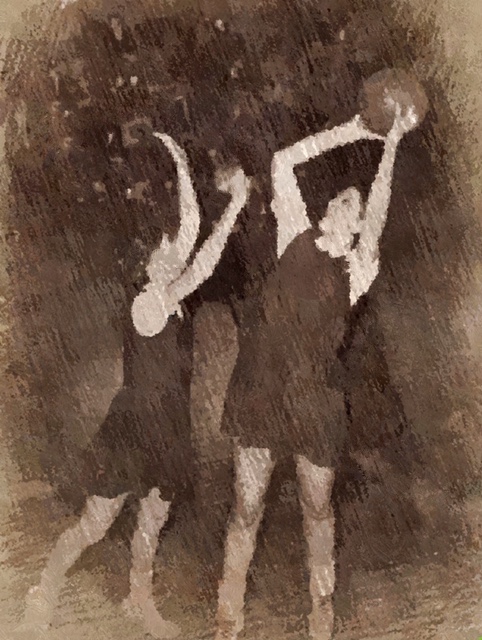
As I pray these readings, the face of a good high school friend comes to mind. Judy was a super basketball player. Everything about her was vigor, coordination, and that all-American beauty that needed no makeup to impress anybody.
After graduation, I went into the silence of the pre-Vatican II convent and Judy disappeared into her future. When our five-year reunion rolled around, I looked forward to reconnecting with her.
When I saw her, my heart broke. She was a shadow of herself, emaciated, listless, and lightless. She silently shouted a refrain like today’s verse from Ezekiel:
Our bones are dried up, our hope is lost, and we are cut off.
We were both twenty-three years old. I was just beginning to grow into my hopes. Judy was already divorced, alone, and the mother of a father-starved child.
That kind of “lost” feels almost irredeemable.
But Psalm 107 assures us that, in faith, no loss, no alienation is irredeemable.
They cried to the LORD in their distress; from their straits God rescued them. And led them by a direct way to the healing of community.
Judy and I stayed in touch for a few years. Despite her troubles, she kept faith. That was the key.
She did the hard work to find herself again with the help of family, friends, counselors, and a supportive faith community. Eventually, she remarried and was happy the last time I saw her before she moved to the west coast.
This morning, I see such apparent parallels between Israel’s and Judy’s story. That helps me look back over my own life for the same, perhaps not so dramatic, parallels and to be grateful for the many times God found me.
Let them give thanks for God’s Mercy and wondrous deeds to us, Because God has satisfied the longing soul and filled the hungry heart with good things.
Desolate and lone All night long on the lake Where fog trails and mist creeps, The whistle of a boat Calls and cries unendingly, Like some lost child In tears and trouble Hunting the harbor’s breast And the harbor’s eyes.
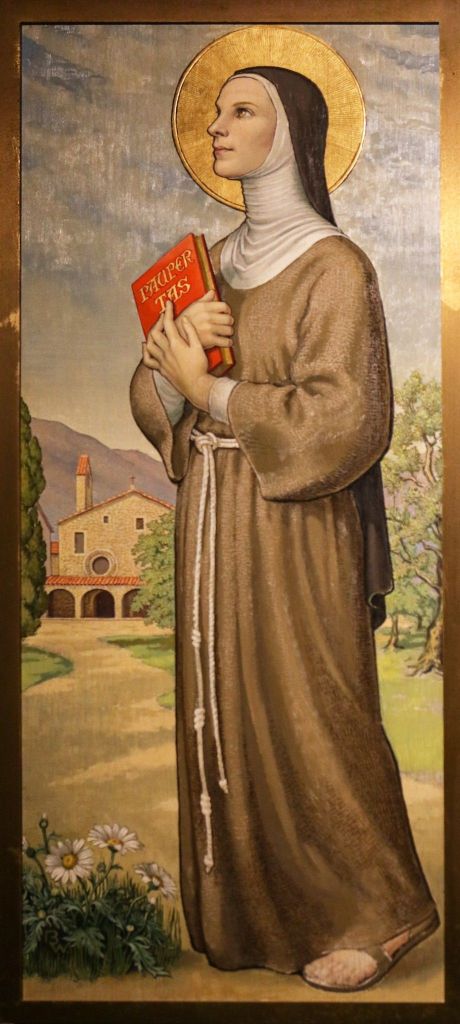
Today, in God’s Lavish Mercy, on this feast of the beautiful St. Clare, we pray with Psalm 119. How perfect is the response phrase from our psalm!
How sweet to my taste is your promise!
Last night, we watched an old Colombo movie in which one of the characters was a vintner who had developed a peerless taste for fine wine. He could identify every detail – year, grape, region, price. He was the consummate connoisseur.
As I prayed this morning’s psalm, it struck me that through the intentional practice of prayer, we become connoisseurs of the spirit. We are able to discern ever more delicately those realities which carry grace to our souls.
How sweet to my palate are your promises, sweeter than honey to my mouth!
As we deepen in spirit, we purify our taste from all that is not peace, goodness, justice, mercy, and charity. We let go of things that distract our souls from Love.
The law of your mouth is to me more precious than thousands of gold and silver pieces.
By our choices for what is truly precious, we build a legacy of sacred joy which sustains us throughout our lives:
Your decrees are my inheritance forever; the joy of my heart they are.
from National Shine, Detroit
Poetry: from Clare of Assisi
We become what we love
and who we love shapes what we become.
If we love things, we become a thing.
If we love nothing, we become nothing.
Imitation is not a literal mimicking of Christ,
rather it means becoming the image of the beloved,
an image disclosed through transformation.
This means we are to become vessels
of God's compassionate love for others.
Music: Mirror of Eternity (Clare of Assisi) – sung by John Michael Talbot
Place your mind before the mirror of eternity!
Place your soul in the brilliance of glory!
Place your heart in the figure of the divine substance!
And transform your whole being into the image of the Godhead Itself
through contemplation!
So that you too may feel what His friends feel
as they taste the hidden sweetness
which God Himself has reserved
from the beginning
for those who love Him~ Clare of Assisi
Today, in God’s Lavish Mercy, we pray with Psalm 63, a perfect prayer for the Feast of Saint Mary Magdalen, who longed for and loved God with all her heart.
My soul is thirsting for you, O Lord my God.
Psalm 63, in the verses quoted today, is a love song. The psalmist longs for God, body and soul. Experience has taught her that without God her whole being is a desert.
O God, you are my God whom I seek; for you my flesh pines and my soul thirsts like the earth, parched, lifeless and without water.
And so she fixes her eyes on God, her heart on God. She looks for God’s Presence in the sanctuary of her life, in the temple of her soul.
Thus have I gazed toward you in the sanctuary to see your power and your glory, For your kindness is a greater good than life; my lips shall glorify you.
The psalmist promises to bless God – to be grateful and attentive to God’s affectionate grace in all the circumstances of her life:
Thus will I bless you while I live; lifting up my hands, I will call upon your name. As with the riches of a banquet shall my soul be satisfied, and with exultant lips my mouth shall praise you.
In her serene and confident prayer, she is like the fragile hatchling, protected under her Divine Mother’s wing. She clings to God’s merciful hand, no doubt kissing it in a prayer of grateful love.
You are my help, and in the shadow of your wings I shout for joy. My soul clings fast to you; your right hand upholds me.
Poetry:The Living Flame Of Love – St. John of the Cross Some find John of the Cross’s poetry challenging, if not shocking because, as well as being deeply mystical, it is often clearly erotic. But we are both mystical and erotic human beings made so by God in Whom Love has infinite dimensions. John channeled all his mystical erotic power into his profound love for God. His poems may help us to open that holy power to God as well.
Songs of the soul in the intimate communication of loving union with God.
O living flame of love
that tenderly wounds my soul
in its deepest center! Since
now you are not oppressive,
now consummate! if it be your will:
tear through the veil of this sweet encounter!

O sweet cautery,
O delightful wound!
O gentle hand! O delicate touch
that tastes of eternal life
and pays every debt!
In killing you changed death to life.

O lamps of fire!
in whose splendors
the deep caverns of feeling,
once obscure and blind,
now give forth, so rarely, so exquisitely,
both warmth and light to their Beloved.

How gently and lovingly
you wake in my heart,
where in secret you dwell alone;
and in your sweet breathing,
filled with good and glory,
how tenderly you swell my heart with love.
Music: Living Flame of Love – John Michael Talbot
Oh, Living Flame of Love Tenderly wound my soul To its deepest inner heart Without oppression!
Come consumate our love Tear through the veil of our union If it be your will, come and rend The veil of the temple!
Oh, lamps of fire In deep caverns of feeling Once obscured and blind Are now leading In the warmth and the passion Of your love (x2)
Yet gently Your hand does wound As You rend through the veil of my temple Come and take this life that I give So that I might come to live in this our dying
Oh, Living Flame of Love Tenderly wound my soul To its deepest inner heart Without oppression!
Today, in God’s Lavish Mercy, we pray once again with Psalm 16. Verses 1-10 strike me as a perfect “nighttime” prayer.
In his musical Phantom of the Opera, Andrew Lloyd Weber lyricizes about the “beauty of the night”.
It’s a soulful song, and in itself could be used for prayer, especially when we pray in times of spiritual darkness or unknowing. In many ways, it reminds me of John of the Cross’s poem, “The Dark Night”. (Verses below for our poetry today).
All of us have times when our prayer seems to echo back to us without a response from God. Our faith may be tested and our trust stretched very thin. God seems so distant that we wonder what happened to cloud the relationship! We linger in a spiritual darkness that is dry and disconcerting.
Christ of St. John of the Cross by Salvador Dali (1951) – Kenmore Art Gallery, Glasgow
These times in the spiritual life were experienced and described by writers like John of the Cross and the author of “The Cloud of Unknowing”. They are times when our experiences and prayer invite us to a new and deeper understanding of God. They ask us to let go of our intellectual certainties and abandon ourselves to God without demands.
Recently, while describing how disappointed he was in God, a friend told me that he had “lost” his faith long ago. Well, obviously, he hadn’t because he still held expectations of the “God” who was disappointing him. I told him that I had lost my faith a few times too, and that every time I got it back, it was new and deeper than the one I had lost. My “septuagenarian God” is very different from the one I came to follow when I was eighteen!
Our minds and souls are so small next to God’s Infinity. But slowly, through a life of prayerful fidelity and loving service, God stretches our capacity to know and return a Love which is beyond reason.
But the stretching times can be dark – times when Psalm 16 is a comforting prayer.
Unnamable God, I feel you with me at every moment. You are my food, my drink, my sunlight, and the air I breathe. You are the ground I have built on and the beauty that rejoices my heart.
I give thanks to you at all times for lifting me from my confusion, for teaching me in the dark and showing me the path of life.
I have come to the center of the universe; I rest in your perfect love. In your presence there is fullness of joy and blessedness forever and ever.
Music: Path of Life – The Dameans
Poetry: The Dark Night – Stanzas Of The Soul
( Some people find John of the Cross surprising, if not strange or shocking, in his imagery. He was a grace-filled mystic and poet whose images of God expanded beyond the boundaries we might be accustomed to. And that very extravagance is John’s beauty — he invites us to a place we might not otherwise think to go.)
1. One dark night,
fired with love’s urgent longings
— ah, the sheer grace! —
I went out unseen,
my house being now all stilled.
2. In darkness, and secure,
by the secret ladder, disguised,
— ah, the sheer grace! —
in darkness and concealment,
my house being now all stilled.
3. On that glad night,
in secret, for no one saw me,
nor did I look at anything,
with no other light or guide
than the one that burned in my heart.
4. This guided me
more surely than the light of noon
to where he was awaiting me
— him I knew so well —
there in a place where no one appeared.
5. O guiding night!
O night more lovely than the dawn!
O night that has united
the Lover with his beloved,
transforming the beloved in her Lover.
6. Upon my flowering breast
which I kept wholly for him alone,
there he lay sleeping,
and I caressing him
there in a breeze from the fanning cedars.
7. When the breeze blew from the turret,
as I parted his hair,
it wounded my neck
with its gentle hand,
suspending all my senses.
8. I abandoned and forgot myself,
laying my face on my Beloved;
all things ceased; I went out from myself,
leaving my cares
forgotten among the lilies.
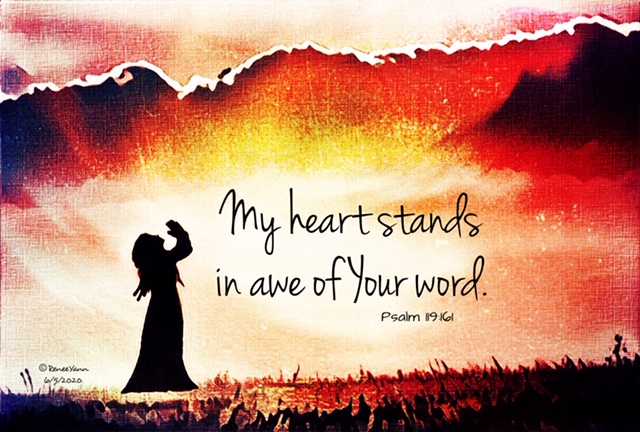
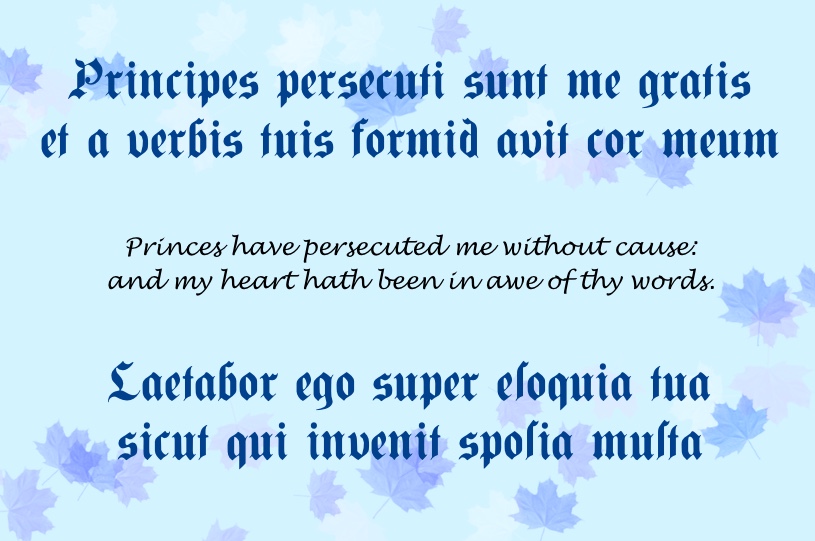
Today, in God’s Lavish Mercy, we pray with Psalm 119 which is considered a hymn psalm, meant for offering praise for God’s handiwork.
This psalm, the longest in the Bible, is an extended string of delight in God’s beauty, power, and tenderness. It reminds me of a mockingbird’s lovely, tireless song, lilting up into the morning or evening sky.
Though long, the psalm is a very simple yet profound prayer. Seeing its length, we might tend to set it aside for a shorter psalm. Instead, don’t tackle the whole thing. Pick one verse that speaks to you. Sit down beside it. Let it crawl into to your lap like a small child. Cradle it and let your soul hum with it.
I remember, as a young novice, learning to pray this beautiful psalm in Latin. Its innocent clarity echoed my desire simply to deepen in God’s ways. Psalm 119 has been one of my favorites for nearly sixty years now, carrying God’s Word to me in myriad ways.
Today in our prayer, we might want to contemplate what single word God is speaking most clearly to us in this moment. The words vary over the course and circumstances of our lives. Let us listen and respond to what we hear today in quiet prayer.















 Lavish Mercy