You have been present to me, God
like light to flame,
like heat to flame
like fluid movement
and energy of shape to flame.
The wax of my life
is consumed in such Presence.
Shall I simply be content
that it burn,
or shall I seek the Transparency
to which it disappears?
Kairos
All the ages that have loved You
sometimes rush into me
like the white falls of a river,
and Your engagement of the earth
from all antiquity
is caught in a great gasp
by the walls of my soul.
In every creature that has ever been
or ever will be, You and I
have been loving each other.
All that treasure swells
in me for a moment
before it thins again into the Chronos
where I seek You in its shadows.
For a second, split in light
I may have held your still
eternal soul within my own.
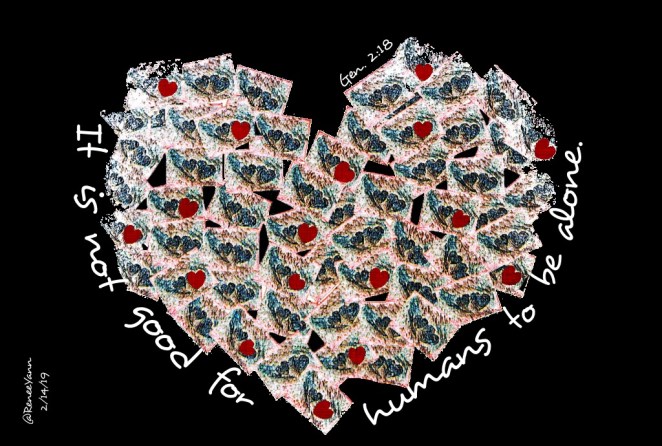
Today, in Mercy, our reading from Genesis tells of the creation of Eve to be Adam’s companion.Theological volumes are written to interpret this passage. But for today’s prayer, let’s draw out one small phrase:
The LORD God said:
“It is not good for this human being to be alone.
God, Who lives in the community of the Trinity, exists within relationship. God knows that is the only way that any life can exist. This leads us to realize that:
We were created from Love for Love
We were meant to learn love in one another’s company.
Our learning with one another is modeled on the perfect triune love of God.
On Valentine’s Day, our culture romanticizes the notion of love (and makes a lot of money doing so!) But it might also be a good day for us to consider what and whom we have fallen in love with all throughout our lives.
The late Father Pedro Arrupé, now being considered for sainthood, was once the superior general of the Jesuit community. Understanding what it meant to be in love with God and God’s Creation, Arrupé wrote this:
Nothing is more practical than finding God, that is, than falling in love in a quite absolute, final way. What you are in love with, what seizes your imagination, will affect everything. It will decide what will get you out of bed in the morning, what you will do with your evenings, how you will spend your weekends, what you read, who you know, what breaks your heart, and what amazes you with joy and gratitude. Fall in love, stay in love and it will decide everything.
(I’ll be sending two of my love poems to God in a later email.I hope you find them helpful to your prayer.)
Music: Love Changes Everything ~ Andrew Lloyd Webber, Charles Hart, Don Black
Today, in Mercy, we celebrate the lovely feast of Our Lady of Lourdes, commemorating Mary’s appearance to St. Bernadette Soubirous in Lourdes, France, and her subsequent presence in the life of the faithful through devotion and miracles.
Therefore, today’s feast raises before us two important elements of our faith: our devotion to Mary, and our understanding of miracles.
MIRACLES Scripture and tradition are replete with miracles, occurrences when some extraordinary reality points us clearly to God. Michael O’Neill in his book, Exploring the Miracles, writes this:
“No matter how strong we think our faith is or want it to be, we always want to know that God is there for us, and miracles are that sort of element that bridges the gap between our faith and our connection with God.”
The Catholic Encyclopedia offers an extensive and erudite definition of miracles for those interested. But, leaving a theological discussion of miracles aside, I would offer this quote for our consideration:
“There are only two ways to live your life: as though nothing is a miracle, or as though everything is a miracle.” ~ Albert Einstein
MARY As we pray with Mary today, specifically in her role as loving intercessor for us, we reflect on Mary’s total openness to grace. Free from the “original sin” that limits all humanity, Mary possessed a faith without shadow of doubt, a hope without burden of uncertainty, a love without taint of self-interest. She was the means through which Divine Breath was restored to us in Jesus Christ.
Some of you may be familiar with the book “The Reed of God” described on Amazon this way: Caryll Houselander’s beautiful and profound mediation, The Reed of God, depicts the intimately human side of Mary, Mother of God, as an empty reed waiting for God’s music to be played through her. Houselander shares her insightful and beautiful vision of Mary on earth, Mary among us, Mary as a confused but trusting teenager whose holiness flowered with her eternal “Yes”.
Houselander says this about Mary, and it seems to capture perfectly Mary’s appearance to the world at Lourdes:
In the world as it is, torn with agonies and dissensions, we need some direction for our souls which is never away from us; which, without enslaving us or narrowing our vision, enters into every detail of our life. Everyone longs for some such inward rule, a universal rule as big as the immeasurable law of love, yet as little as the narrowness of our daily routine. It must be so truly part of us all that it makes us all one, and yet to each one the secret of his own life with God.
To this need, the imitation of Our Lady is the answer; in contemplating her we find intimacy with God, the law which is the lovely yoke of the one irresistible love.”
Music: Tota Pulchra Es is an ancient Catholic prayer, written in the fourth century. The title means “You are completely beautiful” (referring to the Virgin Mary). It speaks of her immaculate conception. It takes some text from the book of Judith and other text from Song of Songs. (Latin and English lyrics below.)
Tota pulchra Es Tota pulchra es, Maria. Et macula originalis non est in Te. Tu gloria Ierusalem. Tu laetitia Israel. Tu honorificentia populi nostri. Tu advocata peccatorum. O Maria, O Maria. Virgo prudentissima. Mater clementissima. Ora pro nobis. Intercede pro nobis. Ad Dominum Iesum Christum.
You are all beautiful, Mary,
and the original stain of sin is not in you.
You are the glory of Jerusalem,
you are the joy of Israel,
you give honour to our people.
You are an advocate of sinners.
O Mary,
Virgin most prudent,
Mother most merciful.
Pray for us,
Plead for us,
To the Lord Jesus Christ.
Today, in Mercy, we celebrate the feast of St. John Bosco, Priest and Teacher. He is a saint I would not have paid much attention to except for someone very special to me.
St. John Bosco was the patron saint of Sister Mary Giovanni, my sponsor when I entered the Sisters of Mercy over fifty years ago.She was my high school teacher and my later friend.
Like her patron saint, she was humble, honest, loving and uncomplicated. Her quiet humor, evenness and easy acceptance of others inspired me.She motivated me to want to be good and do good.
Sister Giovanni with Three Musketeers from the Class of 1963
In reading Hebrews today, I thought of her immediately. Verse 10:24 reads:
We must consider
how to rouse one another
to love and good works.
That’s what she did for me. She wasn’t preachy.She wasn’t bossy. She didn’t even obviously try to influence me. But her humble, honest, loving care for people wowed me. I wanted to live life the way she did.
This is what Paul is talking about in our first reading today. We need one another’s faith, goodness, and example to energize our Spirit life.
Certainly, teachers have a great opportunity for this kind of influence in shaping a person’s life. But so do we all – with youngsters and those not so young 😊!
Let’s try to be that kind of person today.
Let’s give thanks for the gift of those persons in our lives.
Music: In Your Hands ~ Ron Hiller and Judy Millar
While directed toward teachers, this song can motivate us all to think about how we “teach” with our lives. It can remind us of the many kinds of “teachers” who have blessed us.
You choose to own me
despite and within everything,
in a place
at the core of my life,
both removed and essential.
At that wordless
unwordable pool,
I bless You, singular
and whole,
and bow before Love as
it laps at the edges of my soul,
as it breaks
in pure revelation
that holiness
exceeds any act of will;
that grace is a desirous God
who possesses me there.
Union
Still ourselves, we are more one
than separate now,
Heart over heart, heart within Heart,
like a word’s meaning
caressed within its sound.
I drink from that union
like the verdant earth drinks
from its deep reserve of water.
It is Your color that flushes the shape
of every blossom sprung from me.
But that water, once tasted
precludes satiety by any other water.
There is no return for me now
to a season not fed by you.
What I have given you, then
is the whole seed of my life.
Now, my mother done her dying,
I come back again to my own life
that I had taken off,
the way you take a coat off
and hang it on a hook behind the door
when seasons change,
sometimes forgetting where it is
until you feel the cold again.
When word that she was ill
fell like a wounded bird
into time’s tranquil pool,
I just ignored the cold.
I walked out into night
to take her hand as she
left quickly for its distant edge.
Through four cold months, we pulled
stars down to light that edge,
blue-hot stars we’d fired
in long years of love.
Family, friends and names that
dozed like dormant flowers in a field
flew up in such a rush of love
around us that November turned to May.
Then, one icy day in January,
I cleared our sidewalk of a heavy snow,
in brief, staccatoed intervals,
lest leaving her too long, the
fragile thread would break
without my benediction.
It was Tuesday, I remember,
but time was caught behind
a wall of silence. It moved
at half-speed. Within its womb
that birthed my mother to another life,
I was timeless, still, unborn again.
When my mother died, she did it
just as I had left my life
four months before, with
love and not a glance behind,
no brief regret to do
what faith required her to do.
She drew that thin last breath
from air we shared, as my cheek
laid tenderly on hers, I whispered,
“Go on … and I love you.”
Music: Halleluia – Leonard Chen – played here by:
Violin: Leonardo Barcellos: Cello: Daniel Enache; Guitar: Leonardo Barcellos
Today, in Mercy, we have the beautiful letter from Paul to Timothy, filled with tenderness, encouragement, hope and the sweet suggestion of loving memories.
When we travel life’s road, what an indescribable blessing to have even one companion who loves us the way Paul loved Timothy — to care for our whole life, our whole soul, and our whole “forever”.
In his letter, Paul reveals that Timothy has been immensely blessed with such love.Timothy’s mother and grandmother, Eunice and Lois have already – for many years –tendered Timothy in the faith.
In this lovely letter, Paul notes that he prays for Timothy daily.
Do we pray for those who have blessed us and loved usin our lives? Do we tell them so, if they are living? Do we thank and remember them if they have gone home to God?
Paul closes this part of his letter with such beautiful words to Timothy:
For this reason,
I remind you to stir into flame
the gift of God that you have through the laying on of my hands.
Many people have rested their hands on your spirit, on your heart.Be filled with love and gratitude for them today and everyday. For those who have done otherwise, forgive them and let them go.
I remember in a special way today my mother who died on this date thirty-one years ago.In a separate email, I share a poem I wrote after Mom’s death.It is a little sad in tone, but it may touch and help some of you, my readers, who are experiencing grief.
Stay with your grief, beloveds, long enough to find the blessing within it.
Some meditative music: for your remembering prayer: James Last – Coulin
Today, in Mercy,Acts paints a detailed picture of Saul’s conversion and call on the road to Damascus. It’s a colorful and dramatic account befitting the biography of thegreat “Apostle to the Gentiles”.
Think about this. Almost all the very first Christians (and Christ himself) were Jews. Early Christian ritual grew out of Jewish ritual. In the immediate post-Resurrection period, there were few, of any, Gentile Christians.
This is one of the reasons Paul is such a big deal. As a Roman citizen and a devout Jew, he lived with a foot in two worlds, as opposed to the Jewish fishermen who composed the original Twelve. They were local guys with minimal exposure to the non-Jewish world.
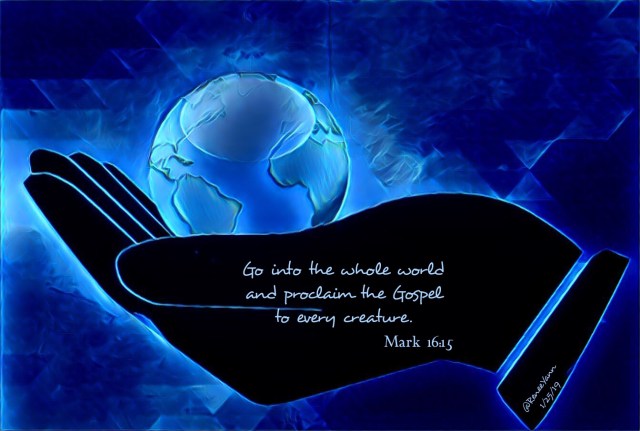
When the original Twelve (eventually Eleven) heard Jesus’s Apostolic Commission, “Go out to all the world and tell the Good News…”, they may have felt that world was confined to Israel’s borders! Paul, the post-Resurrection Apostle, demonstrated otherwise.
Paul traveled over 10,000 miles proclaiming the gospel of Jesus Christ. His journeys on land and sea took him primarily through present day Israel, Syria, Turkey, and Greece. (from Loyola Press. See website for great summary of Paul’s journeys.
How encompassing is our vision of “the whole world”, that world which hungers for the message, mercy and love of Christ?
Our Gospel today impels us with the same apostolic call as these early disciples. God’s love and fullness of life belong to all. What can I do to make that a greater reality?
Music:Facing a Task Unfinished-~ Lyrics:Frank Houghton. Performed by the Gettys
Today, in Mercy, our Gospel tells of a memorable event – so memorable that it is described in detail.
Jesus preaches from a neighborhood living room. Every access point to the house is blocked with excited listeners and miracle-seekers. Jesus has been corralled by the enthusiastic faithful.
Then some latecomers arrive carrying their paralyzed friend. It is easy to imagine that these are young guys, because Jesus later calls the paralytic “Child”. Perhaps their friend was injured in a soccer game or diving accident in which they all had participated. Perhaps, as well as carrying him, they are carrying the burden of “survivor guilt”.
Whatever the situation, these friends are determined that the young man shall see Jesus. Confronted with the barricading crowd, they climb up on the roof, opening the turf plates to make an entry point. Jesus had to laugh as he saw to rooftop disappearing above him!
Would that we had such a wild desire to be in God’s Presence – to know God face to face, and heart to heart!
Can we peel away the many barricades to such relationship? We have only our limited human images of God. While these can help us pray, they can also box God.
Faulty theology and exaggerated ritual can, believe or not, put a lid on God’s power!
It is important to read, listen, and grow within good theology. One measure of that value is the degree of limitation any “theology” puts on God. A theology that limits God to male, white, Catholic (or whatever religion)- that kind of false theology limits us as well.
A theology that is used as validation for political, economic, or moral domination distorts God, making God an idol of our own greed and selfishness. Such ”theologies” have, for centuries, made excuses for slavery, apartheid, pogroms, wars and holocausts.
Let’s try to “take the roof off” our theology today. Let’s be sure our tightly held perceptions and beliefs are really leading us to the absolute freedom of a God Who cherishes all Beings, all Creation.
Today, in Mercy, we again read from the epistle to the Hebrews and the Gospel of Mark. We will be doing this for the next month or so.
Hebrews is unique in that it was written rather specifically for Jews who had become Christians. They were people who were steeped in the spirituality and expectations of the Old Testament. They had been waiting for a militant Messiah who would deliver them from earthly suffering by a display of power and might.
During the first century of Christianity, as the nascent Church experienced persecution, that hope for delivery re-emerged. Although they had accepted a Resurrected Christ, the community’s own present suffering fixated them on the Passion and death of Jesus. They questioned how that anguished man could really be the One foretold in their Hebrew Scriptures, and how he could transform their lives.
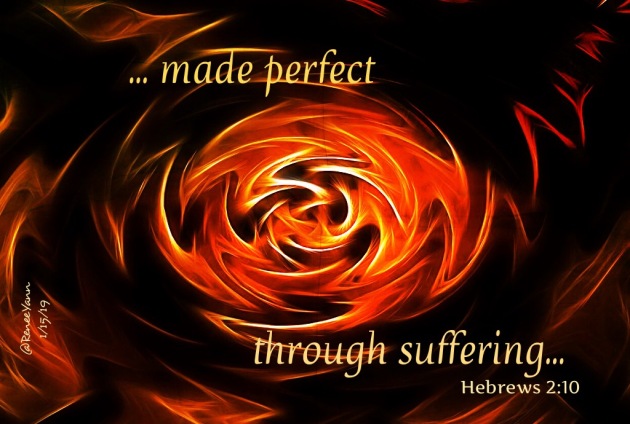
Can’t we empathize with those early Judea-Christians? The mystery of suffering and death still haunts us. Don’t we sometimes question why Jesus had to die like that – why we have to die, why the people we love have to die? Don’t we feel at least some resistance to this overwhelming mystery?
The author of Hebrews tries to address those doubts by showing that the majesty of Christ resides not just in his divine nature, but in his loving willingness to share our human nature. By doing so, Jesus demonstrated in his flesh the path we must take to holiness. He leads the way through our doubts if we put our faith in him.
This is the core mystery of our faith: that God brings us to eternal life not by a path outside our human experience. Rather, Jesus shows us how to pattern our lives on the profound sacrificial love which is the lavish Mercy of God. The path to eternal life is not around our human frailties but through them.
Mark gives us just one Gospel example of that love today in the healing of the man with the unclean spirit. That spirit was one of resistance to the Word of God, screaming out as Jesus began to preach a Gospel of love, faith, and forgiveness.
As we pray these scriptures today, let us put before God’s healing touch any resistance in our hearts to Jesus’s call to be merciful love in the world.
Music:Crown Him with Many Crowns, an 1851 hymn with lyrics written by Matthew Bridges and Godfrey Turing and sung to the tune ‘Diademata‘ by Sir George Job Elvey.
This majestic hymn reflects how mid-19th century theology attempted to embrace the Redemptive mystery. Still, many of its suggestions, though cast in an earlier idiom, are well worth reflection.








 Lavish Mercy