Isaiah’s Psalm

Friday of the Fifteenth Week in Ordinary Time

July 17, 2020

Today, in God’s Lavish Mercy, we pray with Isaiah 38 as our Responsorial Psalm.

Although the verses are under Isaiah, they are actually the words of Hezekiah, a king of Israel during Isaiah’s time. Our first reading relates the story of Hezekiah’s mortal illness and the prophetic role Isaiah plays in his recovery.

Our psalm reemphasizes the power and mercy of God who delivers Hezekiah from death. Hezekiah’s vibrant images reveal the depth of his desperation:

Once I said,
“In the noontime of life I must depart!
To the gates of the nether world I shall be consigned
for the rest of my years.”


We all know what the prayer for deliverance feels like. It rises from the depths of our souls and repeats itself in a constant, “Please…”. We can think of nothing else but the favor we are praying for. We linger in our begging, sometimes for years.

Hezekiah stretches into the full extent of his pain with these striking metaphors:

My dwelling, like a shepherd’s tent,
is struck down and borne away from me;
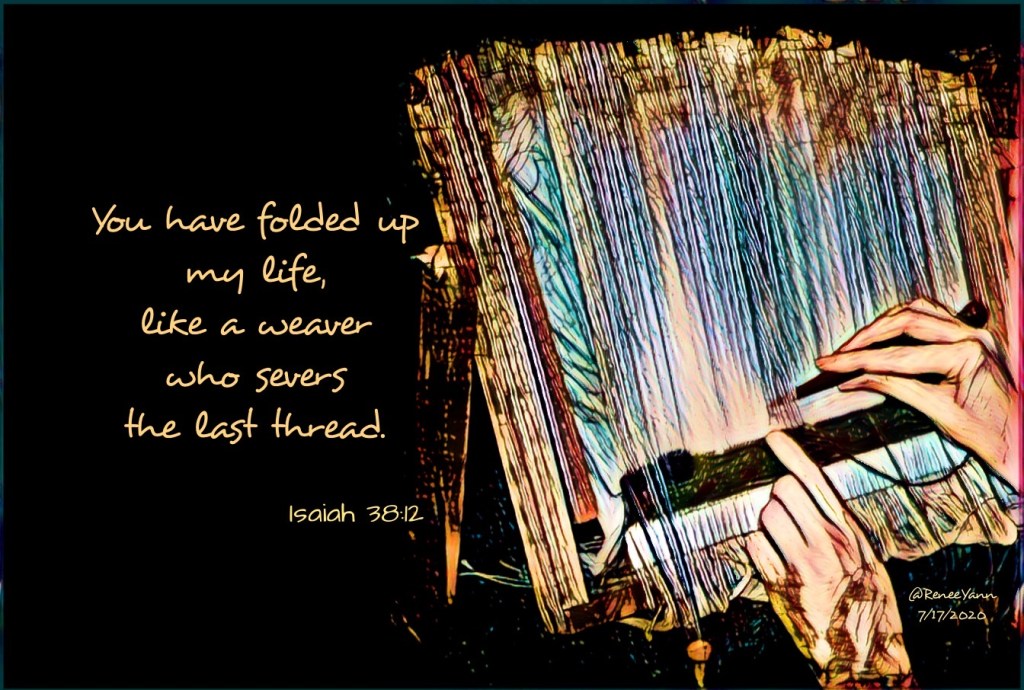
You have folded up my life, like a weaver
who severs the last thread.


Deliverance is that condition in which we, having lost all personal power to effect change, must be carried by another hand to life and well-being. If we can do that in faith, our prayer will be answered.

When it is, by either a merciful “Yes” or “No”, we will understand. It will be as if we have fallen from hanging by our fingernails into the enveloping caress of a feathered bed.

Those live whom the LORD protects;
yours is the life of my spirit.
You have given me healing and life.


Poetry: For Deliverance from a Fever by Anne Bradstreet (1612 – 1672),  the most prominent of early English poets of North America and first writer in England’s North American colonies to be published. She is the first Puritan figure in American Literature.

When sorrows had begirt me round, 
And pains within and out, 
When in my flesh no part was found, 
Then didst Thou rid me out.

My burning flesh in sweat did boil, 
My aching head did break, 
From side to side for ease I toil, 
So faint I could not speak.

Beclouded was my soul with fear 
Of Thy displeasure sore, 
Nor could I read my evidence 
Which oft I read before.

“Hide not Thy face from me!" I cried, 
"From burnings keep my soul. 
Thou know'st my heart, and hast me tried; 
I on Thy mercies roll." 

“O heal my soul," Thou know'st I said, 
"Though flesh consume to nought, 
What though in dust it shall be laid, 
To glory t' shall be brought." 

Thou heard'st, Thy rod Thou didst remove 
And spared my body frail 
Thou show'st to me Thy tender love, 
My heart no more might quail.

O, praises to my mighty God, 
Praise to my Lord, I say, 
Who hath redeemed my soul from pit, 
Praises to Him for aye. 

Music: You Will Redeem It All – Travis Cottrell

You were there at the 
loss of all the innocence
You were there at the 
dawn of all the shame 
You were there, felt the
weight of all the helplessness 
put Yourself into the agony and pain


Nothing is hidden from Your eyes 
You flood the darkness with Your light 
I have this hope
as an anchor for my soul
You will redeem it all, redeem it all
Out of the dust into something glorious
You will redeem it all, redeem it all


You are here in the middle of my circumstance
You are here bringing purpose out of pain 
You are here restoring every broken path
Speaking life, You raise me once again
Nothing is hidden from Your eyes 
Out of the ashes I will rise  
 
Hallelujah in the waiting
Hallelujah even then  
Hallelujah for the healing
You will make a way again 


Hallelujah in the waiting
Hallelujah even then  
Hallelujah for the healing
You will make a way again 


Hallelujah my Redeemer
You redeem me by Your blood
Hallelujah! What a Savior
You turn evil back for good 
 Hallelujah! What a Savior!
Hallelujah! My Redeemer!
My Redeemer!     

Psalm 65: Word-Seed

Fifteenth Sunday in Ordinary Time
July 12, 2020

From 2017:

Today, in Mercy, we pray with the powerful and mysterious readings of today’s liturgy. They tell us that God breathes eternal inspiration into us and all Creation. The gift, like seed, is intended to bear fruit that is returned to God in love and praise. By participating in that return, we become children of God. May the seed of God’s Word fall on good ground in our spirits.

Today, in God’s Lavish Mercy, we pray with Psalm 65, a song poem probably written to celebrate the harvest season. The psalm describes an abundantly fruitful earth, filled with life and produce.

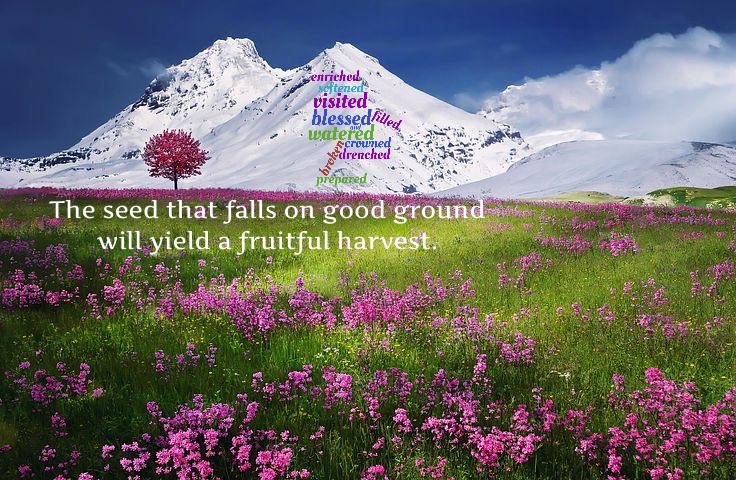
Though humans labor for these blessings, God is the bounty’s true agent. The power of that agency is found in the array of words used to describe God’s actions.

God has: 

  • visited 
    • watered
      • enriched
        • filled
          • prepared
  • drenched
    • broken up
      • softened
        • blessed and
          • crowned

What is it that has drawn all this intervention from God? Our readings tell us. It is the Word-Seed which is God’s own life.

Just as from the heavens
the rain and snow come down….
so shall my Word be. (Isaiah 55)
For creation awaits with eager expectation
the revealing Word of the children of God… (Romans 8)
The seed sown on rich soil
is the one who hears the Word and understands it,
who indeed bears fruit and 
yields a hundred or sixty or thirtyfold. (Matthew 13)

By our dedicated prayer with scripture and trusted spiritual reading, the Word works on our spirits just as the psalm describes.  Our understanding, too, is visited, watered, enriched, filled, prepared, drenched, broken up, softened and ultimately blessed and crowned.

As we pray with Psalm 65 today, we can picture David looking out from hilltop over the abundance of his fields. His heart is filled with awe and praise for God’s generosity.

We all want to live in a spiritual landscape akin to the psalm’s bountiful picture. Inviting God’s Word, in humility, gratitude, and awe is a true path to such blessing.


Poetry: A Word Is Dead – Emily Dickinson


Music: Aria by Secret Garden

Psalm 51: Secret Heart

Friday of the Fourteenth Week in Ordinary Time

July 10, 2020

Today, in God’s Lavish Mercy, we pray with Psalm 51, a deeply moving plea for a pure heart and a right spirit. Psalm 51 is a penitential psalm known by its Latin name, Miserere (Have Mercy). You, dear readers, may remember a reflection on this beautiful psalm from just about a month ago.


As I prayed with Psalm 51 today, I asked myself how my spirit has been doing in the intervening month. May I challenge you all with the same question?

Corona time is not easy on the Spirit. Confinement, uncertainty, suffering and loss have impacted all of us in some way. Restrictions away from friends, family, and community deplete us. Social unrest and political lunacy unsettle us.

On the other hand, some of us have been able to embrace this time as a long retreat from “the way things were”. It has been a time of washing our hearts down to their bare muscle. We have sat in the quiet with questions like “What is it that I most love,  most trust, most need, most believe in, most hope for?”.


It is such an appropriate time to pray Psalm 51, to be with God in our “secret heart” – that place where no one else ever hears our rawest thoughts and purest prayers:

  • to acknowledge any sin or guilt we carry
  • to name our desire for healing and clarity
  • to listen to the whispering of Wisdom within us
  • to find our strength by finding our rootedness in God
  • to reclaim joy even in the midst of difficulty
  • to make our heart at home in praise
  • to be righted by Mercy

Let’s pray with and for one another as we cherish this Psalm.


Poetry: The Place Where We Are Right – Yehuda Amichai

From the place where we are right
Flowers will never grow
In the spring.
The place where we are right
Is hard and trampled
Like a yard.
But doubts and loves
Dig up the world
Like a mole, a plow.
And a whisper will be heard in the place
Where the ruined
House once stood.

Music: Wisdom in the Secret Heart – Shane and Shane

Psalm 105: Seek God’s Face

Wednesday of the Fourteenth Week in Ordinary Time

July 8, 2020

Today, in God’s Lavish Mercy, we pray with Psalm 105:2-7, a hymn to God’s omnipotent fidelity. The same hymn, with minor variations, appears in the First Book of Chronicles where it is attributed to David after the Ark of the Covenant, which had been lost during battle, was brought home to the tabernacle.


Psalm 105 is also a companion piece to Psalm 106, the first recounting God’s wondrous mercies; the second lamenting Israel’s ungrateful response.

Our passage today is really a call to remember God’s goodness to us and to our communities.

Look to the LORD who is Strength;
seek to serve God constantly.
Remember the wondrous deeds God has wrought,
the signs, and the judgments God has spoken.

The second line here is very important. If we do remember, we will “seek to serve”, to respond by being at one (obedient) to God’s hope for us.


As we pray today, we might want to take a walk down memory lane with God, noticing all the blessings of our lives.  We might pay particular attention to the things we once resisted which eventually proved to be disguised benedictions.

Our psalm response today reminds us that God is in everything, even those dark places where God waits to lead us through. We pray for the spiritual insight to look for God in all things.


Poetry: The light shouts in your tree-top, and the face – Rainer Maria Rilke

The light shouts in your tree-top, and the face
of all things becomes radiant and vain;
only at dusk do they find you again.
The twilight hour, the tenderness of space,
lays on a thousand heads a thousand hands,
and strangeness grows devout where they have lain.
With this gentlest of gestures you would hold
the world, thus only and not otherwise.
You lean from out its skies to capture earth,
and feel it underneath your mantle’s folds.
You have so mild a way of being.
They
who name you loudly when they come to pray
forget your nearness. From your hands that tower
above us, mountainously, lo, there soars,
to give the law whereby our senses live,
dark-browed, your wordless power.

Music: Remember Mercy – The Many

Psalm 115: Not To Us

Tuesday of the Fourteenth Week in Ordinary Time

July 7, 2020

Today, in God’s Lavish Mercy, we pray with Psalm 115. The first verse, not included in today’s passage, is perhaps the most familiar:

Not to us, LORD, not to us
but to your name give glory
because of your mercy and faithfulness.

This verse sets the tone for the whole psalm by establishing that it is only in humility that we will experience God’s faithful mercy.


The psalm sections offered today show how hard it is to keep humble attention on God in a world full of idols. While the psalmist mocked these idolatrous gods and their worshippers, his descriptions indicate the significant space they occupy in his own imagination.

There are lots of distracting “gods” in our world too. As a matter of fact, it is sometimes difficult to find the real God because our culture cloaks God in its own distorting devices. 

For example, we encounter ideologies which promote a “god” who:

  • loves America more than other nations
  • loves white people more than black and brown people
  • loves war as long as we are the victors
  • loves my prosperity over other people’s justice
  • tolerates, or even blesses, violence for the sake of superiority
  • isolates, stereotypes, and discriminates over who deserves blessings

Some of these idolatries work to convince us that we are more important to God if we are white, rich, male, heterosexual, healthy, armed, not too old, and American – because these deifications paint their “god” with those strokes.

The more we match up with this “god” – the molten image of a greedy, elitist, militaristic culture – the more we tend to take glory to ourselves. And the more others might legitimately question, “Where is their God?”.

This becomes all the more disorienting when influencers who benefit from such misguided idolatry and fundamentalism use them to promote themselves and their personal and political agendas.


Psalm 115 says, “Stop that!”.


Our Gospel shows us what God is really like — Jesus, who:

  • sought out those suffering
  • loved the poor and abandoned
  • was moved with pity for others’ pain
  • taught, proclaimed and healed in the name of God’s Mercy

Living in the light of this merciful God both humbles and exalts us so that we may wholeheartedly proclaim by our lives:

Not to us, LORD, not to us
but to your name give glory

because of your mercy and faithfulness.

Non nobis, Domine, non nobis ; 
sed nomini tuo da gloriam,
super misericordia tua et veritate tua.


Poetry: Non Nobis Domine! – Rudyard Kipling
(Written for “The Pageant of Parliament,” 1934)

NON nobis Domine!—
    Not unto us, O Lord!
The Praise or Glory be
    Of any deed or word;
For in Thy Judgment lies
    To crown or bring to nought
All knowledge or device
    That Man has reached or wrought.
And we confess our blame—
    How all too high we hold
That noise which men call Fame,
    That dross which men call Gold.
For these we undergo
    Our hot and godless days,
But in our hearts we know
    Not unto us the Praise.
O Power by Whom we live—
    Creator, Judge, and Friend,
Upholdingly forgive
    Nor fail us at the end:
But grant us well to see
    In all our piteous ways—
Non nobis Domine!—
    Not unto us the Praise

Music: Non Nobis Domine

Psalm 85: The Kiss

Saturday of the Thirteenth Week in Ordinary Time

July 4, 2020

Today, in God’s Lavish Mercy, we pray with Psalm 85, a testament to hope for the future. Couldn’t we all use a dose of the right now?

Glancing through Twitter last night, I came across a tweet asking for prayers because the writer had “begun to lose hope in the future”. I thought of and prayed for that person this morning when I read Psalm 85, a song of unmitigated hope and trust.


Despite the destruction of the Temple and their exile into Babylonian captivity, the Israelites remained convinced that God had promised them a future of blessedness.

I will hear what God proclaims;
the LORD–for he proclaims peace to his people.

Near indeed is his salvation to those who fear him,
glory dwelling in our land.

Trusting in God’s fidelity, they are freed to imagine and wait for that future’s slow and mysterious fulfillment. Note the future tense of the verbs in these verses:

Mercy and truth shall meet;
justice and peace shall kiss.
Truth shall spring out of the earth,
and justice shall look down from heaven.

Early 16th C. depiction of the Four Daughters of God: Mercy, Truth, Justice, and Peace (Angel in the middle)

The Israelites trusted God’s desire and will for their good. They so strongly believed in a blessed future that they were able to access it even in the midst of a disappointing present.

By faith, we too enter the timelessness of God’s love, finding – even in life’s challenges – the path to joy and peace. The “shalls” in the above verse are achieved through our belief in, and action for them. This is the power of the covenant between God and us.


Our faithful lives invite: 

  • God’s kiss of justice and peace
  • God’s springing forth in truth
  • God’s gaze of justice and mercy over Creation

God and we walk beside one another on the way to a sacred future where the journey is also the destination.

The LORD himself will give his benefits;
our land shall yield its increase.
Justice shall walk before him,
and salvation, along the way of his steps.


May we be given
the grace to believe
that we already live
within the wholeness of God.
May our life be
a hopeful and joyful witness
to that wholeness.


Poetry: Grace – Wendell Berry

Even though written as an autumn poem, these verses fit today’s reflection. Wendell Berry’s thoughts grace evoke a sense of hope and patience.

The woods is shining this morning.
Red, gold and green, the leaves
lie on the ground, or fall,
or hang full of light in the air still.
Perfect in its rise and in its fall, it takes
the place it has been coming to forever.
It has not hastened here, or lagged.
See how surely it has sought itself,
its roots passing lordly through the earth.
See how without confusion it is
all that it is, and how flawless
its grace is. Running or walking, the way
is the same. Be still. Be still.
“He moves your bones, and the way is clear.”

Music:  Mercy Like Rain, written by Rory Cooney, sung here by Alma deRojas

Let me taste your mercy like rain on my face;
here in my life, show me your peace.
Let us see with our own eyes your day breaking bright.
Come, O Morning; come, O Light!
 
What God has spoken I will declare:
Peace to the people of God everywhere.
God's saving presence is close at hand:
glory as near as our land!
 
Here faithful love and truth will embrace;
here peace and justice will come face to face.
God's truth shall water the earth like a spring,
while  justice will bend down and sing.
 
God will keep the promise indeed;
our land will yield the food that we need.
Justice shall walk before you that day,
clearing a path, preparing your way.
 
Let me taste your mercy like rain on my face;
here in my life,  show me your peace.
Let us see with our own eyes your day breaking bright.
Come, O Morning; come, O Light!

Psalm 89: Hopeful Complaining

Thirteenth Sunday in Ordinary Time

June 28, 2020

I realized that I have never written a reflection on this Sunday’s readings. Here is a link to a wonderful weekly reflection by a Sister of St. Joseph of Carondolet from the National Catholic Reporter.


Today, in God’s Lavish Mercy, we pray with Psalm 89, as we did last week, but this time with earlier verses.

Psalm 89 is long and complex. It is significant to an overall understanding of the Book of Psalms because within 89 the entire cycle of Israel’s prayer life is reflected.


How we pray depends on how we see God. In our lives, as in Israel’s, external circumstances can shape that perception of God. 

How we feel physically, mentally; how we love and are loved; whether we are afraid or secure; how we succeed or fail – these and so many other realities put a face on God for us.


Psalm 89 reflects a time of oppression and confusion in Israel’s life. They had been flying high when David built the Temple. Its presence confirmed for them the truth of God’s promise to Abraham. But now, the Temple lay in ruins and the people enslaved in a foreign land. What did all that say about God and God’s Promise? What had happened to the loving face of God?

Contrary to expectation, the psalmist does not begin to pray from a position of lament or complaint. Instead, Psalm 89 begins by remembering and blessing “the good times”.

The promises of the LORD I will sing forever,
through all generations my mouth shall proclaim your faithfulness.

For you have said, “My kindness is established forever;”
in heaven you have confirmed your faithfulness.


Woman at the Well by Angelika Kauffman

It’s like Israel is sitting down beside God and saying, “You know, times are rough right now. But You’ve always been good to me, and I won’t forget that no matter what. So show me where You are taking me in these present circumstances.”

Reminds me of Jesus’ conversation with the woman at the well.

What a great way to begin a sorrowful prayer! Such an attitude opens our heart to God’s ever-present Mercy which will come to us — disguised even in our sorrow.


The saints among us never give up on God – and we are all called to be saints. Psalm 89 helps us understand how God is with us and we can be with God even when our specific “prayers” seemed ignored or rejected.

For ever I will sing the goodness of the Lord.
Blessed the people who know the joyful shout;
in the light of your Face, O LORD, they walk.


Poetry: A Psalm of Life – Henry Wadsworth Longfellow

For me, the poem voices Longfellow’s philosophy for dealing with adversity which is primarily self-reliance and bravado. I think prayer is a good deal more effective!😃

“A Psalm of Life” became a popular and oft-quoted poem, such that Longfellow biographer Charles Calhoun noted it had risen beyond being a poem and into a cultural artifact…
Calhoun also notes that “A Psalm of Life” has become one of the most frequently memorized and most ridiculed of English poems, with an ending reflecting “Victorian cheeriness at its worst”. Modern critics have dismissed its “sugar-coated pill” promoting a false sense of security…
Nevertheless, Longfellow scholar Robert L. Gale referred to “A Psalm of Life” as “the most popular poem ever written in English”.
Wikipedia
And, besides, I like it.🤓 Hope you all do.

————————————————————-

A Psalm of Life
Henry Wadsworth Longfellow

What the Heart of the Young Man Said to the Psalmist

Tell me not in mournful numbers  
Life is but an empty dream!
For the soul is dead that slumbers  
And things are not what they seem.
 
Life is real! Life is earnest!
And the grave is not its goal; 
Dust thou art to dust returnest  
Was not spoken of the soul.
 
Not enjoyment and not sorrow  
Is our destined end or way;
But to act that each to-morrow 
Find us farther than to-day.
 
Art is long and Time is fleeting  
And our hearts though stout and brave  
Still like muffled drums are beating
Funeral marches to the grave.
 
In the world's broad field of battle  
In the bivouac of Life  
Be not like dumb driven cattle! 
Be a hero in the strife!

Trust no Future howe'er pleasant! 
Let the dead Past bury its dead! 
Act, — act in the living Present! 
Heart within and God o'erhead! 

Lives of great men all remind us
We can make our lives sublime  
And departing leave behind us 
Footprints on the sands of time; 

Footprints that perhaps another  
Sailing o'er life's solemn main
A forlorn and shipwrecked brother  
Seeing shall take heart again.
 
Let us then be up and doing  
With a heart for any fate; 
Still achieving still pursuing
Learn to labor and to wait.
 

Music: Show Me Your Face – Don Potter

Psalm 74: Listen to me!

Saturday of the Twelfth Week in Ordinary Time

June 27, 2020

Today, in God’s Lavish Mercy, we pray with Psalm 74 which complements Psalm 79 in the intensity of its lament. It too reflects the devastation of Israel at the destruction of the Temple and, with it, a whole way of life.

Praying these psalms doesn’t make for a light and happy morning! There is no dawning sunrise or birdsong woven through these verses. To tell the truth, I’d be inclined to avoid 47 if I could.

To deepen the umbra, our first reading comes from the Book of Lamentations, five anguished poems of wrenching bereavement.


But what these doleful songs remind me of this morning is that there is profound misery in the world, even if – thank God – I am not experiencing it personally. There are people who need my prayers, my awareness of their suffering, my attention, and my action for their easement. I am reminded that even if I am filled with contentment, these suffering people are irrevocably connected to me.

Psalm 74 reminds me that God needs instruments to heal the misery of the world. I am called – as you are – to be one of them. In small or large ways, in global or very personal efforts, we are the means by which God answers this plea:

Look to your covenant, Lord,
for the hiding places in the land and the plains are full of violence.
May the humble not retire in confusion;
may the afflicted and the poor praise your name.

In this verse, the psalmist asks God to look at his world’s suffering, believing that if God only sees, God will heal.

The psalm calls us to look too…

  • to not be impervious to the pain right before us nor at a distance from us
  • to hear the cry under appearances
  • to become a safe “hiding place” for those fleeing violence in its many forms – from bullying to genocide
  • to be Mercy in the world

Poetry: The poem today is Quaking Conversation by Lenelle Moïse. It looks at the world’s darkness through the tragedy of the earthquake in Haiti. The poem is a modern Psalm 74, asking the reader to “sit down” and listen to its pain.

Quaking Conversation

i want to talk about haiti.
how the earth had to break
the island’s spine to wake
the world up to her screaming.
how this post-earthquake crisis
is not natural
or supernatural.

i want to talk about disasters.
how men make them
with embargoes, exploitation,
stigma, sabotage, scalding
debt and cold shoulders.
talk centuries
of political corruption
so commonplace
it's lukewarm, tap.

talk january 1, 1804
and how it shed life.
talk 1937
and how it bled death.
talk 1964.  1986.  1991.  2004.  2008.
how history is the word
that makes today
uneven, possible.
talk new orleans,
palestine, sri lanka,
the bronx and other points
or connection.
talk resilience and miracles.

how haitian elders sing in time
to their grumbling bellies
and stubborn hearts.
how after weeks under the rubble,
a baby is pulled out,
awake, dehydrated, adorable, telling
stories with old-soul eyes.
how many more are still
buried, breathing, praying and waiting?
intact despite the veil of fear and dust
coating their bruised faces?

i want to talk about our irreversible dead.
the artists, the activists, the spiritual leaders,
the family members, the friends, the merchants
the outcasts, the cons.
all of them, my newest ancestors,
all of them, hovering now,
watching our collective response,
keeping score, making bets.

i want to talk about money.
how one man's recession might be
another man's unachievable reality.
how unfair that is.
how i see a haitian woman’s face
every time i look down at a hot meal,
slip into my bed, take a sip of water,
show mercy to a mirror.
how if my parents had made different
decisions three decades ago,
it could have been my arm
sticking out of a mass grave

i want to talk about gratitude.
i want to talk about compassion.
i want to talk about respect.
how even the desperate deserve it.
how haitians sometimes greet each other
with the two words “honor”
and “respect.”
how we all should follow suit.
try every time you hear the word “victim,”
you think “honor.”
try every time you hear the tag “john doe,”
you shout “respect!”
because my people have names.
because my people have nerve.
because my people are
your people in disguise

i want to talk about haiti.
i always talk about haiti.
my mouth quaking with her love,
complexity, honor and respect.
come sit, come stand, come
cry with me. talk.
there’s much to say.
walk. much more to do.

Musi: God of the Poor – Graham Kendrick

Psalm 48: You Are a Holy City

Tuesday of the Twelfth Week in Ordinary Time

June 23, 2020

Today, in God’s Lavish Mercy, we pray with Psalm 48 which is tied to today’s first reading from the Book of Kings. You may wish to refer to that reading, or the story is recounted in our poem today. In both these accounts, we read a war diary in which God miraculously intervenes for the beloved Holy City Jerusalem.

While, indeed, Jerusalem is the Holy City of the Old Testament, there are other ways to pray with this symbol as we consider Psalm 48.


Paul, in writing to the Hebrews, uses the “Holy City” symbol to describe the majesty of their new-found faith. The passage can remind us too of the glorious gift of being part of the Body of Christ.

You have come to Mount Zion, to the Holy City of the living God, the heavenly Jerusalem. You have come to thousands upon thousands of angels in joyful assembly, to the church of the firstborn, whose names are written in heaven. You have come to God, the Judge of all, to the spirits of the righteous made perfect, to Jesus the mediator of a new covenant, and to the sprinkled blood that speaks a better word than the blood of Abel.
Hebrews 12:22-24


That “City” is made holy by the presence of God in the Temple. In his letter to the Corinthians, Paul says that God abides in us and makes us a holy temple, a city where the Spirit dwells.

Do you not know that you are God’s temple and that God’s Spirit dwells in you? If anyone destroys God’s temple, God will destroy him. For God’s temple is holy, and you are that temple.
1 Corinthians 3: 16-17


Today, let us rejoice with the psalmist that the Spirit of God dwells among us and within us.  Let us pray for one another in this communion of saints which is the Holy City. With the psalmist, may we ponder, praise, and reach for that just and merciful hand – for the sake of our beautiful suffering cities and world.

O God, we ponder your mercy
within your temple.
As your name, O God, so also your praise
reaches to the ends of the earth.
Of justice your right hand is full.


Poetry: The poem for today is the story Sennacherib’s attempt to destroy Jerusalem. You can work hard and find some spiritual meaning in it. But I put it here because it’s just a wonderfully cadenced poem that retells today’s first EXCITING reading. Notice the fabulous sense of color Lord Byron had!

The Destruction of Sennacherib
by Lord Byron

The Assyrian came down like the wolf on the fold,
And his cohorts were gleaming in purple and gold;
And the sheen of their spears was like stars on the sea,
When the blue wave rolls nightly on deep Galilee.

Like the leaves of the forest when Summer is green,
That host with their banners at sunset were seen:
Like the leaves of the forest when Autumn hath blown,
That host on the morrow lay withered and strown.

For the Angel of Death spread his wings on the blast,
And breathed in the face of the foe as he passed;
And the eyes of the sleepers waxed deadly and chill,
And their hearts but once heaved, and for ever grew still!

And there lay the steed with his nostril all wide,
But through it there rolled not the breath of his pride;
And the foam of his gasping lay white on the turf,
And cold as the spray of the rock-beating surf.

And there lay the rider distorted and pale,
With the dew on his brow, and the rust on his mail:
And the tents were all silent, the banners alone,
The lances unlifted, the trumpet unblown.

And the widows of Ashur are loud in their wail,
And the idols are broke in the temple of Baal;
And the might of the Gentile, unsmote by the sword,
Hath melted like snow in the glance of the Lord!

Music:  The Holy City – written by Michael Maybrick, and sung by the magnificent tenor Stanford Olsen with the Mormon Tabernacle Choir. I have always loved this gloriously uplifting hymn. The song has an interesting history which you might enjoy reading as well.

Last night I lay asleeping
There came a dream so fair
I stood in old Jerusalem
Beside the temple there.
I heard the children singing
And ever as they sang,
Methought the voice of Angels
From Heaven in answer rang.

“Jerusalem, Jerusalem!
Lift up your gates and sing,
Hosanna in the highest.
Hosanna to your King!”

And then methought my dream was chang’d
The streets no longer rang
Hushed were the glad Hosannas
The little children sang.
The sun grew dark with mystery
The morn was cold and chill
As the shadow of a cross arose
Upon a lonely hill.

“Jerusalem, Jerusalem!
Hark! How the Angels sing,
Hosanna in the highest,
Hosanna to your King!”

And once again the scene was changed
New earth there seemed to be
I saw the Holy City
Beside the tideless sea
The light of God was on its streets
The gates were open wide
And all who would might enter
And no one was denied.

No need of moon or stars by night
Or sun to shine by day
It was the new Jerusalem
That would not pass away

“Jerusalem! Jerusalem
Sing for the night is o’er
Hosanna in the highest
Hosanna for evermore!”

Psalm 60: Punch Drunk with Troubles

Monday of the Twelfth Week in Ordinary Time

June 22, 2020


It has been suggested that I make it easier to find previous reflections on the readings for the day, just in case you would like to pray with the First Reading or Gospel. I’ll try to remember to do that.


Today, in God’s Lavish Mercy, we pray with Psalm 60, and it’s a doozy. It is a hard Psalm to pray with because it contains many layers of meaning. But, in the end, I think it is worth the effort.

The Psalm emerges from a time filled with violence. David struggles to keep control both within and outside his kingdom. His own son and nephew turn against him. His nephew wreaks unspeakable mayhem in Israel’s name. Everything in David’s world is in violent disarray. He actually whines to God about the mess:

  • O God, you have rejected us and broken our defenses …
  • You have rocked the country and split it open …
  • You have made your people feel hardships …
  • You have given us stupefying wine…

Like many of you, I read these verses in the wake of another divisive political rally, in a country riven by fearful hatred, racism, biased brutality, political corruption, and poisonous propaganda. I am so tempted to immediately tie Psalm 60 to these current realities.

But I think that, when we pray the psalms, we must let them first teach us about ourselves. Once that conversion or enlightenment occurs, it may then be possible to apply their wisdom to our world.


King David by Matthias Stom

What is it that makes Psalm 60 a prayer and not a political manifesto? We find the answer in verse 7:

Help us with your right hand, O Lord, and answer us.

David realizes that he is completely out of whack. He has just put all the responsibility for his chaos in God’s lap when it is really David’s own self-serving choices that have caused the problem. 

David’s selfish, short-sighted, and sinful decisions have blinded him like “stupefying wine”. One might say he has drunk his own kool-aid. He needs God’s justice to detoxify him … that divine “right hand” which created a perfectly balanced world.

Each of David’s previously mentioned “whines” is completed with a sincere and contrite plea:

  • rally us!
  • repair the cracks in the country
  • give us aid against the foe

Once we realize, like David:

  • that the “country” is our own heart,
  • that the “foe” is any residue there of injustice, 
  • and that the “rally” must be of our own merciful love,

… only then might we be ready to pray for our fractured country and our broken, weeping world.


Poetry: Manifesto: The Mad Farmer Liberation Front – Wendell Berry’s inspired poem about conversion and recovery of the soul in a soul-killing culture.

Love the quick profit, the annual raise,
vacation with pay. Want more 
of everything ready-made. Be afraid 
to know your neighbors and to die.

And you will have a window in your head. 
Not even your future will be a mystery 
any more. Your mind will be punched in a card 
and shut away in a little drawer.
 
When they want you to buy something 
they will call you. When they want you 
to die for profit they will let you know. 
So, friends, every day do something 
that won't compute. Love the Lord. 
Love the world. Work for nothing. 
Take all that you have and be poor. 
Love someone who does not deserve it.

Denounce the government and embrace 
the flag. Hope to live in that free 
republic for which it stands. 
Give your approval to all you cannot
understand. Praise ignorance, for what man 
has not encountered he has not destroyed.

Ask the questions that have no answers. 
Invest in the millenium. Plant sequoias. 
Say that your main crop is the forest 
that you did not plant, 
that you will not live to harvest.

Say that the leaves are harvested 
when they have rotted into the mold.
Call that profit. Prophesy such returns. 
Put your faith in the two inches of humus 
that will build under the trees 
every thousand years.

Listen to carrion — put your ear 
close, and hear the faint chattering 
of the songs that are to come. 
Expect the end of the world. Laugh. 
Laughter is immeasurable. Be joyful 
though you have considered all the facts. 
So long as women do not go cheap 
for power, please women more than men.

Ask yourself: Will this satisfy 
a woman satisfied to bear a child? 
Will this disturb the sleep 
of a woman near to giving birth? 

Go with your love to the fields. 
Lie down in the shade. Rest your head 
in her lap. Swear allegiance 
to what is nighest your thoughts.

As soon as the generals and the politicos 
can predict the motions of your mind, 
lose it. Leave it as a sign 
to mark the false trail, the way 
you didn't go.

Be like the fox 
who makes more tracks than necessary, 
some in the wrong direction. 
Practice resurrection.

Music: Be Still My Soul – Exultate Singers