Psalm 63: The Longing

Twenty-second Sunday in Ordinary Time

August 30, 2020

Today, in God’s Lavish Mercy, we pray with the magnificent Psalm 63 which captures the soul’s deep longing for God.

It is a longing that, once released in the heart, must be satisfied.


In our first reading, Jeremiah experiences it akin to an addiction, the power of it consuming his life:

I say to myself, I will not mention him,
I will speak in his name no more.
But then it becomes like fire burning in my heart,
imprisoned in my bones;
I grow weary holding it in, I cannot endure it.

Jeremiah 20:9

Paul, in his letter to the Romans, says not to resist the longing, but to let ourselves be consumed by it like a sacrificial offering:

I urge you, brothers and sisters, by the mercies of God,
to offer your bodies as a living sacrifice,
holy and pleasing to God, your spiritual worship. 

Romans 12:1

Jesus, in our Gospel, is the One who surrenders himself fully to that holy longing. He calls us to imitate him:

For whoever wishes to save his life will lose it,
but whoever loses his life for my sake will find it.


These are profound readings calling us a place that words cannot describe, a place where the Cross intersects with the truth of our lives. May we have the grace to hear and believe.


Poetry: The Longing – Rumi

There is a candle in your heart,
ready to be kindled.
There is a void in your soul,
ready to be filled.

You feel it, don't you?
You feel the separation
from the Beloved.

Invite Love to quench you,
embrace the fire.

Remind those who tell you otherwise that 
Love
comes to you of its own accord, 
and the longing for it cannot be learned in any school.

Music: The Prayer – Montserrat Cabalé

Psalm 33: Unfailing Trust

Memorial of the Passion of Saint John the Baptist

August 29, 2020

Today, in God’s Lavish Mercy, we pray again with Psalm 33. Today’s verses console us with the reminder that God is watching over us, as individuals and as communities.

Blessed the nation whose God is the LORD,
the people chosen for God’s own inheritance.
From heaven the LORD looks down;
seeing all humanity.

You know, sometimes I wonder! How can God see some of the things going on in the world and not intervene? How can God let innocence suffer? The psalm seems to promise that intervention, but does it really?

But see, the eyes of the LORD are upon those who fear God,
upon those who hope for God’s kindness,
To deliver them from death
and preserve them in spite of famine.

That last line is the zinger. It doesn’t say there will be no famine. It simply says that the God-fearing will be preserved despite the famine.


Hasn’t your life taught you that? We’ve all been through lots of things that we asked God to take away – pain, sadness, fear, loss. Probably most, if not all, of those burdens remained with us until we worked through them. 

By faith and God’s Grace, we came through the other side stronger, deeper, more faithful. If we can trust God, “wait on the Lord”, the way comes to us – a way that leads us more deeply into God’s freedom and joy.

Our soul waits for the LORD,
who is our help and our shield,
For in God our hearts rejoice;
in God’s holy name we trust.

Let’s pray for that kind of faith and trust for ourselves and for our beloveds. Let’s pray for the courage to learn it by unfailing prayer and practice.


Poetry: In Memoriam A. H. H. OBIIT MDCCCXXXIII: 54
by Alfred Lord Tennyson

Oh, yet we trust that somehow good 
         Will be the final end of ill, 
         To pangs of nature, sins of will, 
Defects of doubt, and taints of blood; 

That nothing walks with aimless feet; 
         That not one life shall be destroy'd, 
         Or cast as rubbish to the void, 
When God hath made the pile complete; 

That not a worm is cloven in vain; 
         That not a moth with vain desire 
         Is shrivell'd in a fruitless fire, 
Or but subserves another's gain. 

Behold, we know not anything; 
         I can but trust that good shall fall 
         At last—far off—at last, to all, 
And every winter change to spring. 

So runs my dream: but what am I? 
         An infant crying in the night: 
         An infant crying for the light: 
And with no language but a cry. 

Music: The Passion of John – Johann Sebastian Bach

This piece is not about John the Baptist. It is an excerpt from two hour meditation of the Passion narrative in John the Evangelist’s Gospel.

However, this beautiful excerpt fits so well with today’s reflection.

Psalm 145: Prayer Answered

Memorial of Saint Monica

August 27, 2020


Today, in God’s Lavish Mercy, on this feast of St. Monica, we pray with Psalm 145.

We can almost picture the psalm’s sentiments pouring out in Monica’s prayer. For years, she had prayed for her son Augustine’s conversion. She was canonized for the level of her persevering prayer – a prayer blessed with the amazing answer of St. Augustine’s holy life.

Every day will I bless you,
and I will praise your name forever and ever.
Great is the LORD and highly to be praised;
his greatness is unsearchable.

Like the answer to most prayers, Monica’s came after the long working of God’s mysterious ways. Her own life was shaded by suffering and loss. But, she was steadfast in her hope over the nearly two decades it took to see Light dawn in Augustine.


Generation after generation praises your works
and proclaims your might.
They speak of the splendor of your glorious majesty
and tell of your wondrous works.


As we reflect on the generations of our own families, and the decades of our own lives, there are many “Monica-Augustine” stories. Whenever we pray for life to lead us and our beloveds to God, we pray like Monica.

Today, let’s bring our own “Augustines” to God in hopeful prayer. And let’s thank God for any “Monica” who has done this loving service for us over our lives.

I think this morning of my mother’s well-worn prayer book. The little devotional volume had been fattened with a number of prayer cards stuffed in its thin pages. One day, just before my mother died, I noticed this one: Prayer for My Daughter, a Nun. I can’t say I was exactly surprised by it. I supposed Mom prayed for me. But the card blessed me in a vey tender way and made me confident that my life would continue to be blessed.


Discovering the card also made me aware of my responsibility to pray daily for my family, friends, and community. They are my “Augustines” in whatever challenges they may face in life – just as I hope I am somebody’s too. Because, friends, we belong to one another in the Communion of Saints, and our “family” is fed not by blood, but by the Spirit.

The generations discourse of the power of your awesome deeds
and declare your greatness.
They publish the fame of your abundant goodness
and joyfully sing of your justice.


Poetry: St. Augustine and Monica by Charles Tennyson Turner

Her weeping kiss – for years, her sorrow flowed
At last into his wilful blood; he owed
To her his after-life of truth and bliss:
And her own joy, what words, what thoughts could paint!
When o’er his soul, with sweet constraining force,
Came Penitence – a fusion from remorse –
And made her boy a glorious Christian saint.
Oh ye, who tend the young through doubtful years
Along the busy path from birth to death,
Parents and friends! forget not in your fears
The secret strength of prayer, the holy breath
That swathes your darlings! think how Austin’s faith
Rose like a star upon his mother’s tears!


Music: (something for opera fans among us) La Conversione di Sant Agostino, Oratorio by Johann Adolph Hasse

Hasse begins La Conversione di Sant’ Agostino with an orchestral introduction that establishes the work‘s tonal center in the key of B-flat major, with most arias composed within related keys. From the grandeur and dynamic intensity of the Introduction comes the first vocal entrance of the oratorio. The listener acts as a voyeur into a conversation between Simpliciano (tenor), a priest, and Monica (soprano), the mother of Saint Augustine of Hippo, in which Monica expresses her fears that her son may never change his wicked ways. This urgent desire becomes the core dramatic theme throughout the oratorio with Alipio (alto), the friend, and Navigio (bass), the brother, serving to intensify the desperate desire for conversion. The role of Saint Augustine (alto) is secondary to that of his mother, Monica. Saint Augustine only has two arias, both dealing with his desire to find release from his sinful ways. His conversion is explicitly stated in the Part Two aria in which he begs God to look upon him with compassion following the censure of his own heart.

Psalm 51: Begin Again

Memorial of Saint Bernard, Abbot and Doctor of the Church

August 20, 2020

Today, in God’s Lavish Mercy, we pray with Psalm 51 in which God promises refreshment to our parched and hardened hearts.


Let’s talk about “parched”. Early in the pandemic, a dear friend gifted us with a vigorous basil plant. A practical culinary addition to our meager garden, it really was so much more. It became a symbol of hope over these pandemic days that can be cloudy in more than meteorological terms!

I have taken good care of the plant. But last week! I got distracted by something., something so important I have forgotten what it was! In my distraction, my little basil became parched.


Our souls become parched too, often because we let ourselves become distracted from their care. Like beautiful plants, our spirits have to be tended daily, nurtured with prayer, silence, gratitude and charity.

Psalm 51 reminds me that God is patient with our “distractions”. God will refresh and renew even the most neglected garden.

Give me back the joy of your salvation,
and a willing spirit sustain in me.


Our first reading from Ezekiel offers a further encouragement that anything gnarled or hardened in our hearts can be resurrected by God’s Mercy.

I will sprinkle clean water upon you
to cleanse you from all your impurities,
and from all your idols I will cleanse you.
I will give you a new heart and place a new spirit within you,
taking from your bodies your stony hearts


Poetry: Houseplants in Winter by Eamon Grennan

Their survival seems an open question:
I make a mess of watering, prune
without discretion, grieve over the leaf
whose borders burn and curl. Their
fresh petals a perpetual surprise – 
minute coral hearts, magnesium stars. 

I've lined them up on the table
I work and eat at, facing the small window
that faces almost south, placing myself
under the pale sway of their silence.
They play their deaths and resurrections out
in our cramped common quarters.

I gave the rose-geranium too much water:
its roots grew bog-black, sodden, and
nothing could keep its sweetness
in our lives. The jade, for all its
early promise and parakeet-green shoots,
won't root: it bows its leathery heads. 

The rest seem busy getting by. Removed
to the margins of our noisy mealtimes
when my children visit, they grow used
to the smell of bread frying in goosefat
for breakfast, small talk, the after-
dinner pungency of a peeled tangerine.

The speechless life they lead is Greek
to me: when live flowers rise
out of dead heads, I reckon it's as much,
for the moment, as I need to know.
The light that falls on them
strikes me too, till I feel as rooted

as I'll ever be in this home
from home. Look at us, they seem to say,
flourishing under straitened circumstances:
you see we make do with your handfuls
of earth, your cups of water, these daily
visitations of winter light that cast our
impeccable shadows on your razed page.

Music: Psalm 51 – Shuv Creative
from their website: This worship video sung in Biblical Hebrew directly from the Scriptures is a powerful tool to open the heart for repentance.

Hot Potato Psalm

Tuesday of the Twentieth Week in Ordinary Time

August 18, 2020


Today, in God’s Lavish Mercy, we pray with a little more Deuteronomy. Coupled once again with Ezekiel’s excoriations and with the Gospel warnings, today’s Responsorial Psalm is a hot potato!

To tell you the truth, I’ve pretty much had enough of it, but I trust there’s a treasure buried in its hard words.

You will come to appreciate the full force & magnetic beauty of Deuteronomy only as you read its pages….Nothing in literature matches the majesty of its eloquence. Nothing in the Old Testament has any more powerful appeal for the spiritual life. No book in all the Word of God pictures better the life that is lived according to God’s will & the blessings showered upon the soul who comes into the richness & fullness of spiritual living along the rugged pathway of simple obedience…If you want a taste of heaven on earth, become familiar with Deuteronomy.

Henrietta Mears in her book “What the Bible Is All About” (over 3 million copies sold)

Taken together, today’s passages remind me that it is so easy to get full of ourselves and our comforts, ultimately forgetting our dependence on God.

Ezekiel gives this divine judgement to the people:

By your wisdom and your intelligence
you have made riches for yourself;
You have put gold and silver
into your treasuries.
By your great wisdom applied to your trading
you have heaped up your riches;
your heart has grown haughty from your riches–
therefore thus says the Lord GOD:
Because you have thought yourself
to have the mind of a god,
Therefore I will bring against you
foreigners, the most barbarous of nations.


Deuteronomy 32 warns us:

You were unmindful of the Rock that begot you,
you forgot the God who gave you birth.
The LORD saw and was filled with loathing,
provoked by his sons and daughters.


And in our Gospel, Jesus gives us that classic zing which makes all of us wonder if we’re sleek enough to be saved:

Again I say to you,
it is easier for a camel to pass through the eye of a needle
than for one who is rich to enter the Kingdom of God


I don’t think we need a road map to find the message in these readings. God wants to be our one, true God. The love of wealth, power, and self obscures that Truth. It can even fool us into thinking that we are like gods in control of our lives.

The corrective, as our Alleluia Verse indicates, is to imitate Jesus:

Jesus Christ became poor although he was rich
So that by his poverty you might become rich as he is.


Poetry: Salvation by Stephen Dunn

Finally, I gave up on obeisance,
and refused to welcome
either retribution or the tease
of sunny days. As for the can’t-be-
seen, the sum-of-all-details,
the One—oh, when it came
to salvation I was only sure
I needed to be spared
someone else’s version of it.
The small prayers I devised
had in them the hard sounds
of split and frost.
I wanted them to speak
as if it made sense to speak
to what isn’t there
in the beaconless dark.
I wanted them to startle
by how little they asked.

Music: My Own Little World – Matthew West

Moses’ Psalm: Light and Dark

Monday of the Twentieth Week in Ordinary Time

August 17, 2020

Today, in God’s Lavish Mercy, we pray once again with Deuteronomy 32, the Psalm of Moses. Today’s verses describe an angry God who decides to take vengeance a faithless people. 

To pray with these verses is not easy. Taken in isolation, they paint a God who contradicts our larger experience of mercy and tenderness. But the Psalm, like the jarring first reading from Ezekiel, has a lesson for us.

Ezekiel from Biblical Images by James Padgett

In that reading, Ezekiel suffers the sudden death of his beloved wife. The experience opens his prophetic spirit to more fully understand God’s relationship with Israel. He allows his life to be a witness for the people that God expects their repentance and faithfulness.

Like many Old Testament readings, these portray God by way of human analogy because that is the only context we have available to us. Therefore, the temptation when reading these passages might be to think of God solely in human terms playing tit-for-tat with us when we stray from the Law. But God is infinitely greater than any capacity we, or the scripture writers, have to describe Divinity.


The narrative provided by this prophetic book is not one of comfort; its merciless accusations and its violent imagery do not make it an easy scroll to swallow (Ezek 2:8–3:3). While much of Ezekiel’s language, imagery, and reasoning will appear foreign to modern readers, his narrative would have been clearly intelligible to his contemporaries—even though presumably it would have been hard to accept. The exile, according to this narrative, is both inevitable and deserved; it is portrayed as God’s judgement for the constant and complete failure of God’s people.

At the same time, it is not God’s last word. While resisting both optimism and despair, Ezekiel offers a narrative that sheds light on his present and arrives at an original, if peculiar, imagination of hope, founded solely on theological conviction.

Janina M. Hiebel – Hope in Exile: In Conversation with Ezekiel

So then, what might we take from today’s dark readings? For me, it is this:

God is always Light.
It is we who get caught in darkness.


God does speak to us in our circumstances, as God did to Ezekiel and Moses. By faithful prayer and sincere desire, we can deepen in our love and understanding of God through every experience of our lives, even the painful ones. When we live with that kind of faith and hope, our lives witness to God’s fidelity and love.


Poetry: two offerings today

Motto – Bertold Brecht

In the dark times 
Will there also be singing? 
Yes, there will also be singing.
About the dark times.

Light – Alice Jones

The morning when I first notice
the leaves starting to color,
early orange, and back-lit,
I think how rapture doesn't
vanish, merely fades into
the background, waits for those
moment between moments.

I think this and the door pens,
the street takes on its glistening
look, Bay fog lifting, patches of sun
on sycamore -- yellow sea.
I am in again, and swimming.

Music: Lavender Shadows – Michael Hoppé

Psalm 67: Bless Us All!

Twentieth Sunday in Ordinary Time
August 16, 2020

Today, in Mercy, we read the story of the Canaanite woman whom Jesus first meets with a sarcastic banter. The banter however serves to expose some of the alienating prejudices of Jesus’s time which he then dissolves in a sweeping act of mercy and inclusion. His actions signify a new culture of divine justice offered to all people. The reading challenges us to confront our own prejudices and any limitations we place on who belongs to the Kingdom of God.

from this Sunday’s Reflection – 2017

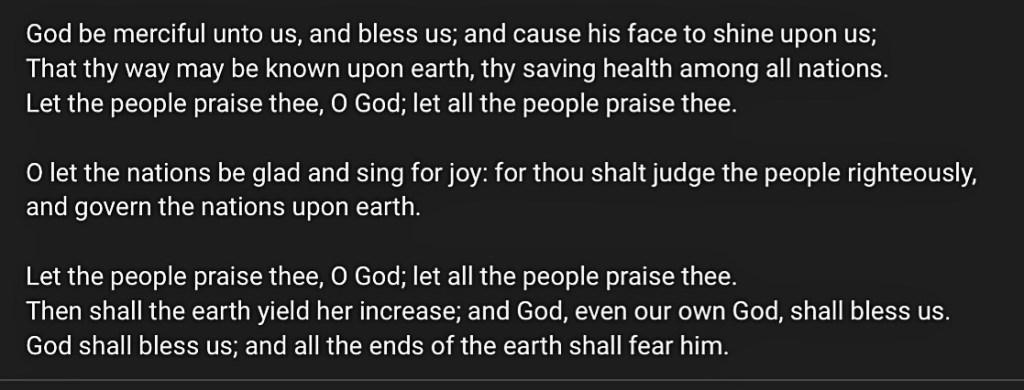
Today, in God’s Lavish Mercy, we pray with Psalm 67, a call to God for universal blessing on all Creation. Written to invoke a benediction on the land’s harvest, the Psalm blossoms into a generous prayer for the whole world to bask in God’s abundance.

May the nations be glad and rejoice;
for you judge the peoples with fairness,
you guide the nations upon the earth.

What if we prayed like that for all our brothers and sisters worldwide! What if we acted toward them with a justice that would make their abundance possible as well as our own! This is the Gospel mandate Jesus entrusted to us.

Psalm 67 shows the maturing of a nation from its own legitimate self-interests into its responsibility within all Creation.


In the USA, as our pre-election political awareness heightens, let’s learn from Psalm 67. Let’s broadly educate ourselves to the fundamental moral issues underlying various partisan platforms. 

For a religious person, voting is hard. There are profound moral issues on all sides of the question. A single issue approach does not work. An adamant stance on a single issue is the easy but inadequate approach. 


Even Jesus, in today’s Gospel, can be moved to a new way of thinking. The outcast Canaanite woman prevails on Jesus to broaden his kingdom. He opens his heart to another way of bringing mercy to all those longing for it.


Voting is a moral act. How we choose demonstrates the God we believe in.


May the peoples praise you, God;
may ALL the peoples praise you!


Poetry: Selah by Honoreé Fannane Jeffers

“The past few weeks were very hopeful for me, as an African-American. I saw images of young Black people out in the streets protesting, to make this country a better place. As an older person who stayed inside while these young folks put their bodies on the line, I wanted to celebrate them. I wrote this poem as a spiritual exaltation of Black faith, that our hoped-for change for our country is coming.”

Honoreé Fanonne Jeffers

Selah
after Margaret Walker’s “For My People”


The Lord clings to my hands
             after a night of shouting. 
                           The Lord stands on my roof 
             & sleeps in my bed. 
Sings the darkened, Egun tunnel— 
             cooks my food in abundance, 
                           though I was once foolish 
             & wished for an emptied stomach. 
The Lord drapes me with rolls of fat 
             & plaits my hair with sanity. 
                           Gives me air, 
             music from unremembered fever. 
This air
                            oh that i may give air to my people 
                            oh interruption of murder 
                                         the welcome Selah
The Lord is a green, Tubman escape. 
             A street buzzing with concern, 
                           minds discarding answers. 
             Black feet on a centuries-long journey.
The Lord is the dead one scratching my face, 
             pinching me in dreams. 
                           The screaming of the little girl that I was, 
             the rocking of the little girl that I was— 
the sweet hush of her healing. 
             Her syllables 
                           skipping on homesick pink. 
             I pray to my God of confused love, 
a toe touching blood 
             & swimming through Moses-water. 
                           A cloth & wise rocking. 
             An eventual Passover, 
outlined skeletons will sing 
             this day of air 
                           for my people—
                                         oh the roar of God 
                                         oh our prophesied walking

Music: Charles Ives – Psalm 67

Isaiah Sings!

Memorial of Saint Maximilian Kolbe, Priest and Martyr

August 14, 2020


Today, in God’s Lavish Mercy, we pray with a passage from the poet-prophet Isaiah in which he calls the people to rejoice at their deliverance.

Sing praise to the LORD for his glorious achievement;
let this be known throughout all the earth.
Shout with exultation, O city of Zion,
for great in your midst
is the Holy One of Israel!


Isaiah 12 is one of a number of hymns found outside the Book of Psalms in the Old Testament. Other examples are Exodus 15:1-18, 21 and Amos 4:13; 5:8-9; 9:5-6 (Craddock, Hayes, Holliday, Tucker: Preaching through the Christian Year)

For an excellent graphic overview of these “songs”, click here. I enjoyed studying this chart.


Isaiah’s first eleven chapters center on God’s judgement for Israel’s infidelity. But Isaiah is never without hope. Chapter 12 is a joyful and grateful hymn celebrating that hope.

Isaiah’s hymn hit the right chord for me today. I think hope is a little hard to come by in these pandemic days, don’t you? 

Besides Covid, there are quite a few others “stabs” out there as we try to float the hope’s balloon – unemployment, business uncertainty, climate concerns, natural disasters, political irresponsibility, leadership failures just to reference a few. For some, these issues are so oppressive that they, “feel like it’s the end of the world”.


Isaiah is the guy when we feel even a little bit like this. Isaiah was profoundly convinced that God is with us in all our experiences and will ultimately resolve them for our good.

God indeed is my savior;
I am confident and unafraid.
My strength and my courage is the LORD,
and he has been my savior.
With joy you will draw water
at the fountain of salvation.


Poetry: To Go into the Dark by Wendell Berry

To go into the dark with a light
is to know the light.
To know the dark, go dark,
go without sight.
And find
that the dark too
blooms and sings
and is traveled by dark feet and dark wings.

Music:  Winter Cold Night – John Foley, SJ

Yes, this is a Christmas song, but I think it carries the perfect feeling for today’s reflection. Indeed, Jesus Christ is our Hope. May his Light be born in us daily.

Dark, dark, the winter cold night. Lu-lee-lay.
Hope is hard to come by. Lu-lee-lay.
Hard, hard, the journey tonight. Lu—lee-lay.
Star, guide, hope, hide our poor, winter cold night.
And on earth, peace, good will among men.
Lean, lean, the livin' tonight. Lu-lee-lay.
Star seems darker sometimes. Lu-lee-lay.
Unto you is born this day a Savior.
Pain, yes, in the bornin' tonight. Lu lee—lay.
Star, guide, hope, hide our poor, winter cold night.

Psalm 78: It’s Harsh

Thursday of the Nineteenth Week in Ordinary Time

August 13, 2020

Today, in God’s Lavish Mercy, we pray with Psalm 78, one of the twelve “Psalms of Asaph”. These psalms have a common theme of God’s judgement relative to Israel’s faithlessness to the Law.

Psalm 78 is the second longest psalm, the whole of which reads a lot like a history lesson. It recounts God’s enduring faithfulness even in the face of Israel’s fickleness.

They tempted and rebelled against God the Most High,
and kept not his decrees.
They turned back and were faithless like their fathers;
they recoiled like a treacherous bow.


The psalm fits well with today’s readings. Poor Ezekiel is commanded by God to act out the impending Assyrian devastation of the kingdom. He has to pack up, dig through a wall, hide his face, and escape into the night — just as Israel will have to do when the conquerors besiege them. All this, because God is passing judgement on Israel’s infidelities and God wants them to recognize it.

They angered him with their high places
and with their idols roused his jealousy.
God heard and was enraged
and utterly rejected Israel.


Psalm 78 remembers this history and retells it for the instruction of the generations. It is a reminiscence not unlike one that we all practice, I think.

Sometimes, especially in prayer or retreat, don’t we look back over our lives to rediscover how God was with us even in difficulty and darkness? Even in our poorest choices and most stupid sins? Aren’t we gratefully surprised that God’s Mercy was the ultimate fruit of such trials? When we face new challenges, don’t we remind ourselves of these things for the sake of our future courage and hope?

That’s what Psalm 78 is doing. Israel messed up, suffered judgement, and was made new in Mercy. The psalmist wants future generations never to forget.


Each of us, both as individuals and within our communities, experience such cycles of sin and redemption. Each turn should make us stronger, grateful, more faithful. Our witness to God’s abiding mercy should be shared for the sake of the generations… our personal Psalm 78 – written not in words, but in the fidelity of our lives.

Psalm 78 is not pretty or easy. Life isn’t always that way either. In our Gospel, Jesus assures us that God is a generous Creator who wants to redeem us in Mercy. But we have to do our part too, or we could wind up like the unfaithful servant – defeated by our own selfish choices.


Poetry: Mercy by David Baker

Small flames afloat in blue duskfall, beneath trees
anonymous and hooded, the solemn trees—by ones
and twos and threes we go down to the water's level edge
with our candles cupped and melted into little pie-tins
to set our newest loss free. Everyone is here.

Everyone is wholly quiet in the river's hush and appropriate dark.
The tenuous fires slip from our palms and seem to settle
in the stilling water, but then float, ever so slowly,
in a loose string like a necklace's pearls spilled,
down the river barely as wide as a dusty road.

No one is singing, and no one leaves—we stand back
beneath the grieving trees on both banks, bowed but watching,
as our tiny boats pass like a long history of moons
reflected, or like notes in an elder's hymn, or like us,
death after death, around the far, awakening bend.

Music:  Mercy – Amanda Cook

Psalm 119: Sweet Word

Memorial of Saint Clare, Virgin

August 11, 2020


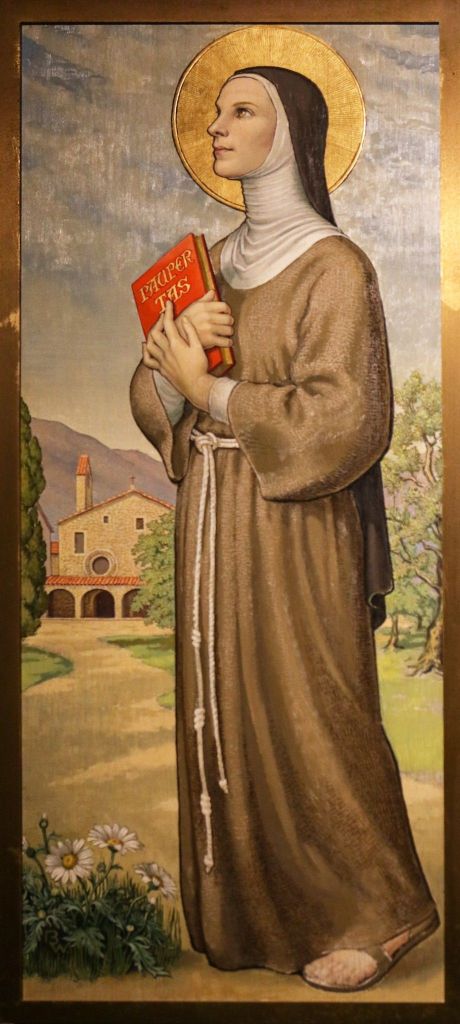
Today, in God’s Lavish Mercy, on this feast of the beautiful St. Clare, we pray with Psalm 119. How perfect is the response phrase from our psalm!

How sweet to my taste is your promise!


Last night, we watched an old Colombo movie in which one of the characters was a vintner who had developed a peerless taste for fine wine. He could identify every detail – year, grape, region, price. He was the consummate connoisseur.

As I prayed this morning’s psalm, it struck me that through the intentional practice of prayer, we become connoisseurs of the spirit. We are able to discern ever more delicately those realities which carry grace to our souls.

How sweet to my palate are your promises,
sweeter than honey to my mouth!


As we deepen in spirit, we purify our taste from all that is not peace, goodness, justice, mercy, and charity. We let go of things that distract our souls from Love.

The law of your mouth is to me more precious
than thousands of gold and silver pieces.


By our choices for what is truly precious, we build a legacy of sacred joy which sustains us throughout our lives:

Your decrees are my inheritance forever;
the joy of my heart they are.


from National Shine, Detroit

Poetry: from Clare of Assisi 

We become what we love 
and who we love shapes what we become. 
If we love things, we become a thing. 
If we love nothing, we become nothing. 
Imitation is not a literal mimicking of Christ, 
rather it means becoming the image of the beloved, 
an image disclosed through transformation. 
This means we are to become vessels
of God's compassionate love for others.

Music: Mirror of Eternity (Clare of Assisi) – sung by John Michael Talbot

Place your mind before the mirror of eternity!
Place your soul in the brilliance of glory!
Place your heart in the figure of the divine substance!
And transform your whole being into the image of the Godhead Itself
      through contemplation!
So that you too may feel what His friends feel
      as they taste the hidden sweetness
      which God Himself has reserved
      from the beginning
      for those who love Him
~ Clare of Assisi