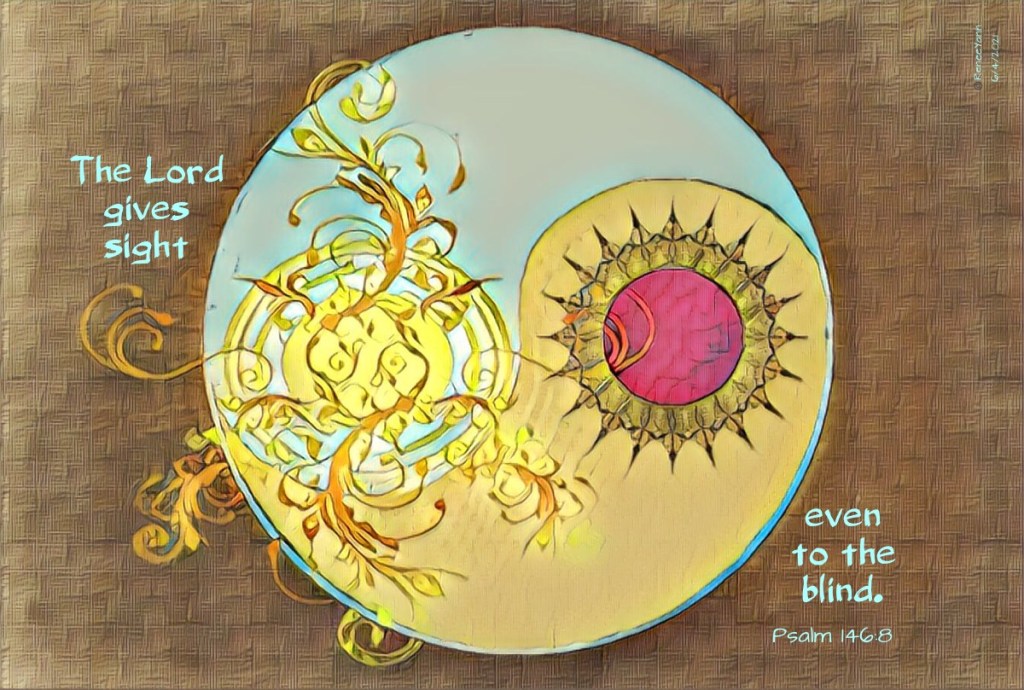
Today, in God’s Lavish Mercy, we pray with Psalm 146, a song of uninhibited delight and thanksgiving to God.
Coming after our reading from Tobit, we see just what such utter delight looks like.
That “angelic fish gall” re-lit the world for Tobit in a way he had never imagined before!
Sometimes we too have to experience a profound blindness before we really begin to see rightly. Let’s be honest: haven’t we all been blind a few times in our lives.
Blessings unrecognized
Friendships taken for granted
Kindnesses overlooked
People misjudged
Needs ignored
Expectations unsurrendered
Biases unexamined
Opportunities bypassed
Perhaps even responsibilities shirked
Praying with Psalm 146, we might take note of those whom the Lord favors:
the oppressed, the hungry. captives, those who are bowed down; the just, strangers, orphans and widows
These favored of God share a common trait – a vulnerability learned through suffering.
None of us seeks suffering in our lives. But we all will encounter it personally at least to some degree. Further, all in the community of faith are called to share the sufferings of others by our works of mercy.
In both instances, can we allow suffering to let us see the world differently, to lift the scales of any blindness in our hearts? Because here is the beautiful mystery: the God of Mercy is with us in our lights and shadows — and is always Light.
Praise the LORD, O my soul; I will praise the LORD all my life; I will sing praise to my God while I live.
Psalm 146:1
Poetry: God Pours Light – Hafiz
God pours light into every cup, quenching darkness. The proudly pious stuff their cups with parchment and critique the taste of ink while God pours light and the trees lift their limbs without worry of redemption, every blossom a chalice. May I seduce those withered souls with words that wet their parched lips as light pours like rain into every empty cup set adrift on the Infinite Ocean.
Today, in God’s Lavish Mercy, we pray with Psalm 25, a heartfelt expression of how to traverse life’s challenges with persevering faith.
Set between our two anguished readings today, Psalm 25 is a solace. Could poor Tobit run into more trouble! His allegorical life, which mirrors Israel’s historic troubles, is a real melodrama.
Then our Gospel recounts the Sadducees’ approach to troubles similar to Tobit’s. They get all up in their heads rather than open their minds to faith.
But Psalm 25 gives us the formula for the practice of such faith:
TRUST IN GOD
In you I trust; let me not be put to shame, let not my enemies exult over me. No one who waits for you shall be put to shame; those shall be put to shame who heedlessly break faith.
LEARN GOD’S WAYS
Your ways, O LORD, make known to me; teach me your paths, Guide me in your truth and teach me, for you are God my savior.
REFLECT ON GOD’S FAITHFULNESS
Remember that your compassion, O LORD, and your kindness are from of old. In your kindness remember me, because of your goodness, O LORD.
BE HUMBLE AND JUST
Good and upright is the LORD; thus showing sinners the way. God guides the humble to justice, and teaches the humble the way.
Today, as we pray Psalm 25, we might reflect on our experience and practice of these attitudes in our own lives.
Poetry: Let Your God Love You – Edwina Gately
Be silent.
Be still.
Alone.
Empty
Before your God.

Say nothing.
Ask nothing.
Be silent.
Be still.
Let your God look upon you.

That is all.
God knows.
God understands.
God loves you
With an enormous love,
And only wants
To look upon you
With that love.

Quiet.
Still.
Be.

Let your God—
Love you.
Today, in God’s Lavish Mercy, we pray with Psalm 112, a hymn deeply rooted in the biblical concept of law and justice.
Blessed the one who fears the LORD, who greatly delights in God’s commands. That person’s posterity shall be mighty upon the earth; the upright generation shall be blessed.
Psalm 112:1-2
In our first reading, as Tobit and Anna share a familiar type of marital spat, we see that there are many perspectives from which one can approach the concept of justice. Anna knows her actions to be just from experience. Tobit analyzes the situation from judgement and law.
But in our Gospel, the wily Pharisees try to manipulate the law in order to ensnare Jesus:
Teacher, we know that you are a truthful man and that you are not concerned with anyone’s opinion. You do not regard a person’s status but teach the way of God in accordance with the truth. Is it lawful to pay the census tax to Caesar or not?
Mark 12:14
Jesus, who is the essence of Truth, is not trapped. After examining the coin which was given him:
Jesus said to them, “Repay to Caesar what belongs to Caesar and to God what belongs to God. They were utterly amazed at him.”
Mark 12:15
Our psalm tells us that understanding God’s law is grounded in the transparency of our own truth:
The just one’s heart is firm, trusting in the LORD. It is steadfast and fearless. From its abundant confidence, such a heart lavishly gives to the poor; with a generosity that shall endure forever, standing firm to glorify God.
Psalm 112: 7-9
Our readings give us a lot to think about. And if nothing else, a delightful story from Tobit. 🤗
Poetry: Truth by Rumi
The truth was a mirror in the hands of God. It fell, and broke into pieces. Everybody took a piece of it, and they looked at it and thought they had the truth.
Today, in God’s Lavish Mercy, we celebrate the Feast of the Visitation, when a newly-pregnant Mary travels to be with her shockingly pregnant older cousin, Elizabeth. Although a universal feast, it is certainly a feast for women to treasure.
The Carmignano Visitation, a unique masterpiece by one of sixteenth-century Italy’s greatest painters, Jacopo da Pontormo (1494-1557)
The Gospel is replete with the quiet but powerful understandings women share with one another:
the haste to support one another
the blessing and bolstering of each other’s faith
the shared joy to cause a baby’s leap in the womb
the desire for mercy and justice for the suffering
the “staying with” until need’s end
Of course, men too experience many of these holy sensibilities, but today most certainly invites women to celebrate the gifts of God within their bodies, minds and spirits.
Perhaps we might pray on these things while watching this movie clip of the imagined scene:
Poetry: Two poems to honor the two blessed women of this scene
The Visitation by Joyce Kilmer (For Louise Imogen Guiney)
There is a wall of flesh before the eyes Of John, who yet perceives and hails his King. It is Our Lady’s painful bliss to bring Before mankind the Glory of the skies. Her cousin feels her womb’s sweet burden rise And leap with joy, and she comes forth to sing, With trembling mouth, her words of welcoming. She knows her hidden God, and prophesies. Saint John, pray for us, weary souls that tarry Where life is withered by sin’s deadly breath. Pray for us, whom the dogs of Satan harry, Saint John, Saint Anne, and Saint Elizabeth. And, Mother Mary, give us Christ to carry Within our hearts, that we may conquer death.
Visitation Villanelle by Sarah O’Brien
She came to me, the mother of my Lord, and grinned with amazement at the sight. All creation with me seemed to roar.
Grey haired, belly swollen like a gourd, I stood to kiss her in the morning light. She came to me, the mother of my Lord.
Her voice, as she crossed the threshold of my door, rang through my womb – from a great height, all creation with me seemed to roar.
The baby leapt – tethered only by the cord. The joy coursing through us! I shouted outright. She came to me, the mother of my Lord.
Already she faced her share of the sword She who believed all God said would be, might – All creation with me seemed to roar.
Blessed one! With your yes you moved us toward the home we long for, and all things made right. She came to me, the mother of my Lord. All creation with me seemed to roar.
Music: Also two selections for this wonderful Feastday:
Ave Maria (Schubert) sung in German, as Schubert wrote it, by the incomparable Marian Anderson
Magnificat (Bach) Imagine composing this powerful first movement based on only a single word: “Magnificat”
Today, in God’s Lavish Mercy, we celebrate the Solemnity of the Most Holy Trinity, one of the most profound mysteries of our faith.
The first reading shows us that human beings have been trying to understand this Mystery ever since the time of Moses!
The readings from both Romans and Matthew describe the power of God’s triune love in those who believe. But none of the readings really explain the Holy Trinity.
And that’s the whole point. “Mystery” cannot be explained. We fumble around with human words in an attempt to capture a reality beyond words, beyond analysis – but not beyond faith. Mystery can only be encountered in humble and undemanding faith.
Today, as Christians, we profess our belief in a God Who is incomprehensible Infinite Love creating, redeeming and sanctifying all Creation.
This Infinite Love is so pure and complete that, within its Unity, it both embraces and frees the three Persons of the Trinity.
Pope Francis has said, “The Christian community, though with all its human limitations, can become a reflection of the communion of the Trinity, of its goodness and beauty.”
Our prayer today is to grow in our capacity to love in imitation of the Trinity. May we, as individuals and as a Church, increase in that merciful inclusivity and wholeness which reflect the triune love of God, at once embracing and freeing all that we love.
Poetry: TO LIVE WITH THE SPIRIT – Jessica Powers
To live with the Spirit of God is to be a listener. It is to keep the vigil of mystery, earthless and still. One leans to catch the stirring of the Spirit, strange as the wind’s will.
The soul that walks where the wind of the Spirit blows turns like a wandering weather-vane toward love. It may lament like Job or Jeremiah, echo the wounded hart, the mateless dove. It may rejoice in spaciousness of meadow that emulates the freedom of the sky.
Always it walks in waylessness, unknowing; it has cast down forever from its hand the compass of the whither and the why.
To live with the Spirit of God is to be a lover. It is becoming love, and like to Him toward Whom we strain with metaphors of creatures: fire-sweep and water-rush and the wind’s whim. The soul is all activity, all silence; and though it surges Godward to its goal, it holds, as moving earth holds sleeping noonday, the peace that is the listening of the soul.
Today, in God’s Lavish Mercy, we pray with Psalm 19, full of beautiful words for us to pluck and relish.
The sublime British writer and theologian C.S. Lewis says this about Psalm 19 and how the ancient Israelite may have appreciated it:
“Law” … must have shone with an extraordinary radiance. Sweeter than honey; or if that metaphor does not suit us who have not such a sweet tooth as all ancient peoples (partly because we have plenty of sugar), let us say like mountain water, like fresh air after a dungeon, like sanity after a nightmare. But, once again, the best image is in a Psalm, the 19th. I take this to be the greatest poem in the Psalter and one of the greatest lyrics in the world. Most readers will remember its structure; six verses about Nature, five about the Law, and four of personal prayer.
C.S. Lewis, Reflection on the Psalms
As we pray today with the verses about God’s Law, we may consider each word as a facet of the Holy Spirit’s gifts given at Pentecost and at our Confirmation:
The precepts of the Lord are:
perfect refreshing trustworthy wise right joy giving clear enlightening pure enduring true just precious sweet
Meditating on the virtues, wouldn’t we like to fill our days with their peace, beauty, and wisdom?
The writer of Sirach surely wanted to, whose simple and profound prayer is the perfect complement to our psalm.
I thank the LORD and I praise him; I bless the name of the LORD. When I was young and innocent, I sought wisdom openly in my prayer I prayed for her before the temple, and I will seek her until the end, and she flourished as a grape soon ripe. My heart delighted in her, My feet kept to the level path because from earliest youth I was familiar with her.
Sirach 51: 12-15
Praying with these readings may lead us to be awed by the Spirit’s power in our lives and open us to its transformative presence.
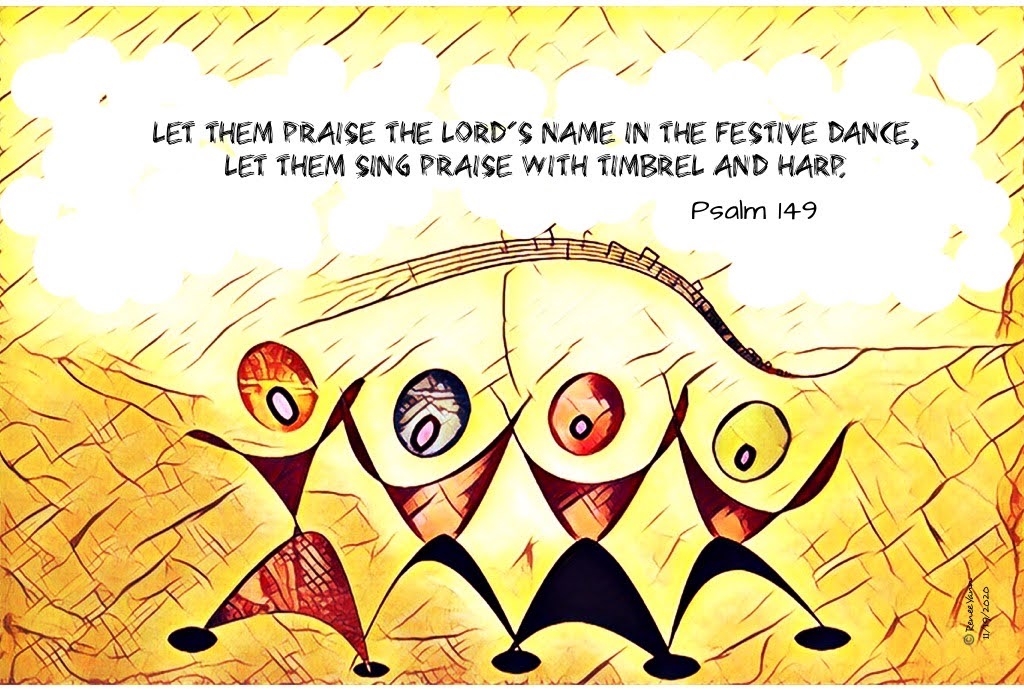
Today, in God’s Lavish Mercy, we pray with Psalm 149 exhorting us to praise God out loud. And we can do that. We’ve all been part of that kind of glorious praise with the help of our wonderful choirs, musicians, and praise dancers.
However, the psalm today is set between two intriguing readings that may cause us to think more deeply about our “praise”.
Sirach offers a cryptic description of who might be remembered as a godly person, ultimately saying it is the one whose virtues are unforgettable.
So the practice of virtue is presented as the most important act of praise.
Yet these also were godly persons whose virtues have not been forgotten; Their wealth remains in their families, their heritage with their descendants;
Sirach 14: 10-11
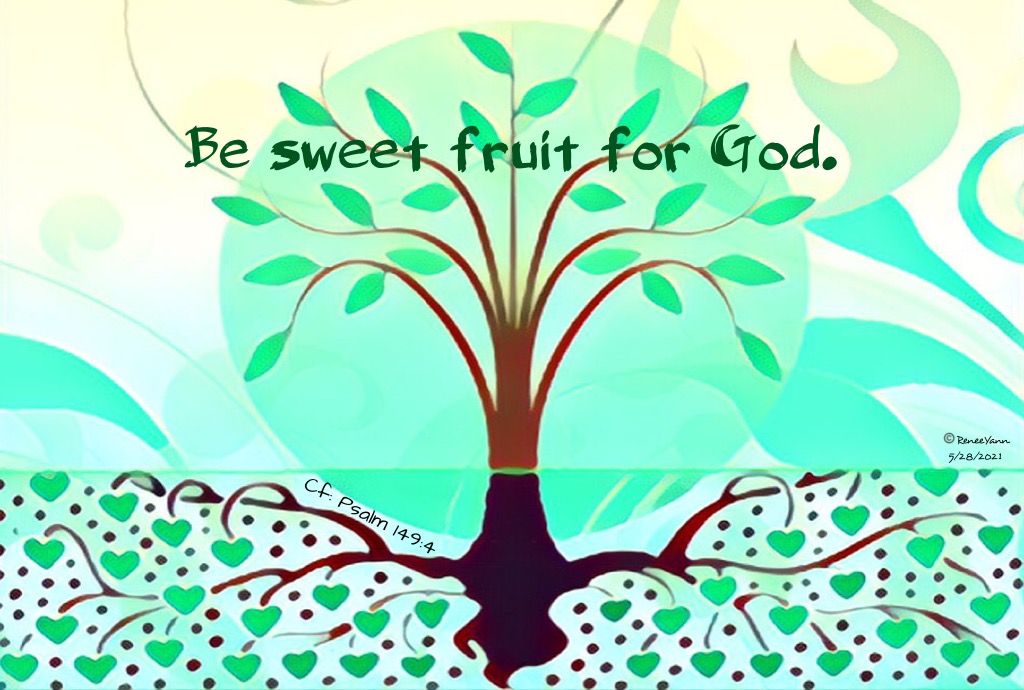
In our Gospel, we meet what at first might appear as a moody, frustrated Jesus. Hungry one morning, he curses a figless fig tree. We might be inclined to focus on the poor zapped tree, but that would be to miss the point.
The leafy yet fruitless tree is a symbol of a wordy “faith” without accompanying works. It describes people who, like the Pharisees in the Temple, shout praise without practicing charity and mercy.
Together, the readings help us see true praise in a clear light – as beautiful waving leaves on a tree full of sweet, loving fruitful actions.
Poetry: Judgement Day – R.S. Thomas
Yes, that’s how I was,
I know that face,
That bony figure
Without grace
Of flesh or limb;
In health happy,
Careless of the claim
Of the world’s sick
Or the world’s poor;
In pain craven –
Lord, breathe once more
On that sad mirror,
Let me be lost
In mist for ever
Rather than own
Such bleak reflections,
Let me go back
On my two knees
Slowly to undo
The knot of life
That was tied there.
Today, in God’s Lavish Mercy, as we return to “Ordinary Time”, we pray with Psalm 50.
Gather my faithful ones before Me, those who have made a covenant with me by sacrifice. And the heavens proclaim the Lord’s justice; for God is the judge.
Psalm 50: 5-6
It’s been quite a journey, hasn’t it?
We left Ordinary Time in mid-February to walk the annual road of the Paschal Mystery. Throughout Lent, Holy Week, and Eastertide, we assiduously laid the pattern of Christ’s life over our own experience, praying to be stretched into its redemptive wholeness.
Now we enter a new time as new people. Our readings restart with a few weeks of:
advice from Sirach,
some stories from the delightful apocryphal Book of Tobit,
and the middle of Mark’s Gospel during the journey to Jerusalem
These passages invite us to return to a graced dailyness which realizes that nothing is ever really “ordinary”.
Psalm 50, particularly as it is interpreted here by Christine Robinson, inspires us to carry the grace of Pentecost to our ordinary tasks:
Spirit is everywhere
   In the eternal circle of sunrise and sunset
   In the beauty of the earth and in the power of her storms
   In the laws that are written in our hearts, and
in the voice of conscience that marches us to goodness.

God is spirit.
We may need ritual, but what God wants is
Our hearts
open in gratitude, or in a cry for help, or
   in willingness to treat our neighbors decently
  seek the truth
  live in love.

These ways bring us to God.
So, in our prayer today, let’s reignite this “ordinary time” with the insight of Abraham Heschel who wrote:
Our goal should be to live life in radical amazement. ….get up in the morning and look at the world in a way that takes nothing for granted. Everything is phenomenal; everything is incredible; never treat life casually. To be spiritual is to be amazed.
Poetry: Morning – Mary Oliver
Salt shining behind its glass cylinder.
Milk in a blue bowl. The yellow linoleum.
The cat stretching her black body from the pillow.
The way she makes her curvaceous response to the small, kind gesture.
Then laps the bowl clean.
Then wants to go out into the world
where she leaps lightly and for no apparent reason across the lawn,
then sits, perfectly still, in the grass.
I watch her a little while, thinking:
what more could I do with wild words?
I stand in the cold kitchen, bowing down to her.
I stand in the cold kitchen, everything wonderful around me.
Today, in God’s Lavish Mercy, we pray with Psalm 87, allowing it to focus us on Mary, the Mother of Christ and thus of the Church.
With her “Yes”, Mary engaged the Spirit of God and, like the ancient Holy City, became a dwelling place of Grace.
Glorious things are said of you, O city of God! And of Zion they shall say: “One and all were born in her; And the One who has established her is the Most High LORD.”
Psalm 87
In her book “Truly Our Sister”, theologian Elizabeth Johnson helps us to understand Mary as a companion, guide, and inspiration:
One fruitful approach to the theology of Mary, historically the mother of Jesus, called in faith the Theotokos or God-bearer, is to envision her as a concrete woman of our history who walked with the Spirit.
As I pray with Mary today, I picture her sitting with the young disciples after the mind-blowing experience of Pentecost. The whiff of Divine Electricity still pervades the room, still jars their senses to an indescribable timbre!
Mary is stilled with a silent understanding. From the abundance of her wisdom, gained in her daily presence with Jesus, Mary gently focuses, calms and directs these new evangelists for the task before them.
Mary is someone who has had her own “visitation by the Spirit”, many years before. Pentecost, for Mary, is a kind of “second Annunciation “. She knows what the willing reception of the Spirit will mean for one’s life.
Indeed, this moment – and their response, like hers so long ago – will bear God’s life into their world.
We call on Mary today, as Church and as individuals, to be with us as we are re-fired in the Holy Spirit. As we reflect on her and the way she opened her life to God, may we grow in faith and desire to open our own lives to the Spirit’s transformative power.
Elizabeth Johnson encourages us:
“to relate to Miriam of Nazareth as a partner in hope in the company of all the graced women and men who have gone before us; to be encouraged by her mothering of God to bring God to birth in our own world; to reclaim the power of her dangerous memory for the flourishing of suffering people; and to draw on the energy of her memory for a deeper relationship with the living God and stronger care for the world.”
Poetry: Annunciation – Denise Levertov
We know the scene: the room, variously furnished, almost always a lectern, a book; always the tall lily. Arrived on solemn grandeur of great wings, the angelic ambassador, standing or hovering, whom she acknowledges, a guest.
But we are told of meek obedience. No one mentions courage.
The engendering Spirit did not enter her without consent. God waited.
She was free to accept or to refuse, choice integral to humanness.
____________________
Aren’t there annunciations of one sort or another in most lives? Some unwillingly undertake great destinies, enact them in sullen pride, uncomprehending. More often those moments when roads of light and storm open from darkness in a man or woman, are turned away from
in dread, in a wave of weakness, in despair and with relief. Ordinary lives continue. God does not smite them.
But the gates close, the pathway vanishes.
____________________
She had been a child who played, ate, slept like any other child–but unlike others, wept only for pity, laughed in joy not triumph. Compassion and intelligence fused in her, indivisible.
Called to a destiny more momentous than any in all of Time, she did not quail, only asked a simple, ‘How can this be?’ and gravely, courteously, took to heart the angel’s reply, the astounding ministry she was offered:
to bear in her womb Infinite weight and lightness; to carry in hidden, finite inwardness, nine months of Eternity; to contain in slender vase of being, the sum of power– in narrow flesh, the sum of light.
Then bring to birth, push out into air, a Man-child needing, like any other, milk and love–
but who was God.
This was the moment no one speaks of, when she could still refuse.
A breath unbreathed, Spirit, suspended, waiting. ____________________
She did not cry, ‘I cannot. I am not worthy,’ Nor, ‘I have not the strength.’ She did not submit with gritted teeth, raging, coerced. Bravest of all humans, consent illumined her.
The room filled with its light, the lily glowed in it, and the iridescent wings. Consent, courage unparalleled, opened her utterly.
Music: Vespro Della Beata Vergine – Claudio Monteverdi
From the baroque period, Monteverdi praises Mary in his masterpiece, Vespro Della Beata Vergine commonly referred to as Vespers of 1610. The work is monumental in scale and difficult to perform, requiring two large choirs who are skillful enough to cover up to 10 voice parts accompanied by an orchestral ensemble. Here is just an excerpt.
Lauda, Jerusalem, Dominum: lauda Deum tuum, Sion. Quoniam confortavit seras portarum tuarum: benedixit filiis tuis in te. Qui posuit fines tuos pacem: et adipe frumenti satiat te. Qui emittit eloquium suum terræ: velociter currit sermo ejus. Qui dat nivem sicut lanam: nebulam sicut cinerem spargit. Mittit crystallum suam sicut buccellas: ante faciem frigoris ejus quis sustinebit? Emittet verbum suum, et liquefaciet ea: flabit spiritus ejus, et fluent aquæ. Qui annunciate verbum suum Jacob: justitias et judicia sua Isræl. Non fecit taliter omni nationi: et judicia sua non manifestavit eis. Gloria Patri et Filio et Spiritui Sancto. Sicut erat in principio, et nunc, et semper, et in sæcula sæculorum. Amen
Praise the Lord, O Jerusalem; praise thy God, O Zion. For he hath strengthened the bars of thy gates; he hath blessed thy children within thee. He maketh peace in thy borders, and filleth thee with the finest wheat. He sendeth his commandment to the earth; his word runneth swiftly. He giveth snow like wool; he scattereth hoar frost like ashes. He casteth forth his ice like morsels; before his cold who can stand? He sendeth out his word, and melteth them; his spirit blows, and the waters flow. He sheweth his word unto Jacob, his statutes and judgements to Isræl. He hath not dealt so with any nation; and his judgments he hath not made manifest. Glory be to the Father and to the Son and to the Holy Spirit. As it was in the beginning, is now, and ever shall be, without end. Amen.
Today, in God’s Lavish Mercy, we pray with Psalm 11, inviting us to enter the eye of God:
The just will gaze on your face, O Lord.
Psalm 11:7
To rest in someone’s loving gaze is the greatest of blessings. Such a look carries understanding, acceptance, hope, encouragement, and a rainbow of other gifts.
We easily look at newborns and young children with such unconditional regard. As people age though, it may become more complex always to see them in such positive light. Life’s big and little dramas block our sight, right?
But, as Psalm 11 assures us, God will never look at us without that kind of love. Wow!
God’s eyes behold us; God’s searching glance wraps us round with love.
Psalm 11: 4-5
For our prayer today, we may just want to let God look at us. And we might want to look back with that mutual glance that sings, “Beloved”.
Poetry: Beloved – by Rumi
All through eternity
Beauty unveils His exquisite form
in the solitude of nothingness;
He holds a mirror to His Face
and beholds His own beauty.
he is the knower and the known,
the seer and the seen;
No eye but His own
has ever looked upon this Universe.

His every quality finds a Word:
Eternity becomes the verdant field of Time and Space;
Love, the life-giving garden of this world.
Every branch and leaf and fruit
Reveals an aspect of His perfection-
The cypress give hint of His majesty,
The rose gives tidings of His beauty.

Whenever Beauty looks,
Love is also there;
Whenever beauty shows a rosy cheek
Love lights Her fire from that flame.
When beauty dwells in the dark folds of night
Love comes and finds a heart
entangled in tresses.

Beauty and Love are as body and soul.
Beauty is the mine; Love is the diamond.
They have been together
since the beginning of time-
Side by side, step by step.

I swear, since seeing Your face,
the whole world is fantasy.
The garden is bewildered as to what is leaf
or blossom. The distracted birds
can’t distinguish the birdseed from the snare.
A house of love with no limits,
a presence more beautiful than Venus or the moon,
a beauty whose image fills the mirror of the heart.










 Lavish Mercy