Today, in Mercy, our passage from Genesis concludes the story of Abraham.
Like any good drama, the passage ties the plot with a final ribbon, but leaves a little thread to suggest an ensuing story.
Sarah dies and Abraham negotiates a deal to bury her in the “promised”, but as yet unowned, land. So, in essence, Sarah’s grave is the first parcel of this Promised Land.
Soon after, Abraham prepares for his own death by assuring the future of Isaac, both to remain in the Promised Land, and to have a wife from his own people. To secure these things, Abraham commissions his faithful, unnamed, senior servant who travels back to Assyria and finds Rachel. She becomes Isaac’s wife, the mother of the next generation of The Promise.
The two main themes for us to pray with are these: the land and the promise secured for the future
Certainly these themes might lead us to consider what promise we cherish, and where we have set the stakes of our “residence”. In other words, where do our heart and soul live in this world?
Lord, you alone are my portion and my cup; you make my lot secure. The boundary lines have fallen for me in pleasant places; surely I have a delightful inheritance. (Psalm 15:5-6)
But I also cannot pray these verses without thinking of the many immigrants and refugees who have left their homes on the hope and promise of a more secure life.
So many languish in a place of unfulfillment and outright suffering. So many see their posterity taken from them by death or human cruelty. As we think of them today, where does our prayer lead us in compassion and Christian love?
(P.S. Look for a second post today of an old favorite, for those who may never have seen it, or those who might like to read it again. Thanks!)
Music:When We Go Home, We Go Together – Pure Heart Ensemble
Today, in Mercy, Abram and Sarai fall back into a struggle with God’s promise. God tarries with fulfillment and has not yet removed Sarai’s barrenness. The aging couple become impatient.
So, as we all sometimes do when God appears deaf to our prayers, Sarai comes up with her own strategy, clearly outside God’s outlined promise. They will use their slave Hagar to bear Abram’s heir.
The passage doesn’t mean that we should not work hard to fulfill our lives. It isn’t intended to contradict that old wisdom:
Work as if everything depended on you. Pray as if everything depended on God.
Or as St. Ignatius puts it in a more precise way:
I consider it an error to trust and hope in any means or efforts in themselves alone; nor do I consider it a safe path to trust the whole matter to God our Lord without desiring to help myself by what he has given me; so that it seems to me in our Lord that I ought to make use of both parts, desiring in all things his greater praise and glory, and nothing else.
What this reading does hold up before us is the quality of our faith, the depth of our relationship with God.
Do I consider every aspect of my experience in the light of prayer, sharing it with God, listening for God’s voice?
Do I inform my spirit through scripture and spiritual reading, (with what I like to call “a holy culture”), so that I can trust my discernment and be patient for its fulfillment?
Do I seek the counsel and companionship of those who strengthen the resolve of my spirit?
Abram was making good progress with these stepping stones, then Sarai threw him a curve with the offer of Hagar as his concubine. But don’t just blame Sarai. Good old Abram caught the curve and ran with it!🙂
Life pitches us all a lot of curves. It can be hard to catch God’s Voice as the curve buzzes by us!
Let’s pray today to let this story teach us whatever we need to learn about our own faith, discernment, patience, and “holy culture”.
Today, in Mercy,Jesus addresses the confounding problem of spiritual schizophrenia.
No one can serve two masters. He will either hate one and love the other, or be devoted to one and despise the other. You cannot serve God and mammon.
Mammon (μαμωνᾷ), a concept that is rather simplistically translated as “money”, actually connotes a much more complex meaning. Strong’s Concordance of the Bible offers related words that help enrich our understanding of the word “mammon”:
Excess
Dis-ease
Unrighteousness
Imbalance
This is the dissonance Jesus speaks to in today’s Gospel. “Money”, or possessions, – like good wine – in excess can dehumanize us. We can become entangled, addicted and covetous of it. We can forget who we truly are when we allow ourselves to drown in it. We can lose connection to the community in which we exist.
But we need “money”, don’t we? Very few people desire real material poverty. How does Jesus guide us to face this internal dichotomy?
Jesus says that our FIRST concern must be the Kingdom of God. Motivated by that core intention, the rest of our concerns will fall into proper place.Pope Francis reiterates this truth for our times in the encyclical “Laudato Sì”. Let’s pray with it today:
Christian spirituality proposes an alternative understanding of the quality of life, and encourages a prophetic and contemplative lifestyle, one capable of deep enjoyment free of the obsession with consumption. We need to take up an ancient lesson, found in different religious traditions and also in the Bible. It is the conviction that “less is more”. A constant flood of new consumer goods can baffle the heart and prevent us from cherishing each thing and each moment. To be serenely present to each reality, however small it may be, opens us to much greater horizons of understanding and personal fulfilment. Christian spirituality proposes a growth marked by moderation and the capacity to be happy with little. It is a return to that simplicity which allows us to stop and appreciate the small things, to be grateful for the opportunities which life affords us, to be spiritually detached from what we possess, and not to succumb to sadness for what we lack. This implies avoiding the dynamic of dominion and the mere accumulation of pleasures. (223)
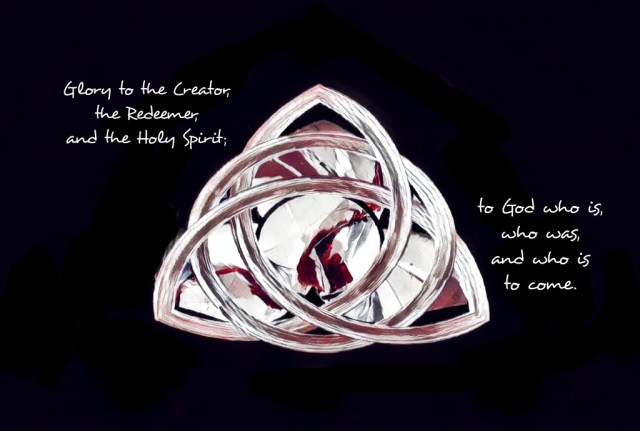
Today, in Mercy, we celebrate the feast of the Blessed Trinity, a mystery of our faith beyond full human comprehension. Clearly realizing this, John Wesley, founder of the Methodist religion said this:
Bring me a worm that can comprehend a man, and then I will show you a man that can comprehend the Triune God.
Still, as we pray, we have some limited conceptualization of this Divine Mystery. We reshape it into human terms we can relate to:
Father, Son, Spirit Creator, Redeemer, Sanctifier
These give us some insight into the heart of the Triune God, but only from the limits of our human perspective. It is a mystery so infinite that even in heaven we may not plumb its depths.
Many theologians and philosophers have tried to stretch our perspectives. The great Swiss Catholic theologian Hans Urs von Balthasar writes:
The One, the Good, the True, and the Beautiful, these are
what we call the transcendental attributes of Being,
because they surpass all the limits of essences
and are coextensive with Being.
It may be helpful in our prayer to think of the Trinity in these terms- The Good, The True, and the Beautiful. These concepts, while we can experience them clearly in an individual or an object, far surpass that one particular presence or circumstance.
So it is with the nature of the Trinity. We perceive it simply in glimpses. Though Its totality far surpasses our comprehension, perhaps these glimpses are enough:
C.S. Lewis puts it this way:
Any patch of sunlight in a wood will show you something about the sun
which you could never get from reading books on astronomy.
These pure and spontaneous pleasures are ‘patches of Godlight’
in the woods of our experience.
What does all this mean in our daily spirituality? How can we find a Trinitarian spirituality in our daily encounter with God? How can we find the “patches of Godlight”?
Pope Francis brings it down to our experience of family:
All of the love that God has in Himself,
all the beauty that God has in Himself,
all the truth that God has in Himself,
He gives to the family.
So, in the sincere love – given and received – of a family or community, we find the reflection of this immense mystery.
And St. Catherine of Siena confidently prays about this truth in this way:
You, Eternal Trinity, are my Creator,
and I am the work of Your hands,
and I know through the new creation
which You have given me in the blood of Your Son,
that You are enamored of the beauty of Your workmanship.
Music: Amazing Love – Billy Martin, Peggy Dequesnel, Steve Hall
1.
All day up and down the shore the
fine points of the waves keep on
tapping whatever is there: scatter of broken
clams, empty jingles, old
oyster shells thick and castellated that held
once the pale jewel of their bodies, such sweet
tongue and juice. And who do you
think you are sauntering along
five feet up in the air, the ocean a blue fire
around your ankles, the sun
on your face on your shoulders its golden mouth whispering
(so it seems) you! you! you!
2.
Now the afternoon wind
all frill and no apparent purpose
takes her cloud-shaped
hand and touches every one of the
waves so that rapidly
they stir the wings of the eiders they blur
the boats on their moorings; not even the rocks
black and blunt interrupt the waves on their
way to the shore and one last swimmer (is it you?) rides
their salty infoldings and outfoldings until,
peaked, their blue sides heaving, they pause; and God
whistles them back; and you glide safely to shore.
3.
One morning
a hundred pink and cylindrical
squid lay beached their lacy faces,
their gnarls of dimples and ropy tentacles
limp and powerless; as I watched
the big gulls went down upon
this sweetest trash rolling
like the arms of babies through the
swash—in a feathered dash,
a snarl of delight the beaks fell
grabbing and snapping; then was left
only the empty beach, the birds floating back over the waves.
4.
How many mysteries have you seen in your
lifetime? How many nets pulled
full over the boat’s side, each silver body
ready or not falling into
submission? How many roses in early summer
uncurling above the pale sands then
falling back in unfathomable
willingness? And what can you say? Glory
to the rose and the leaf, to the seed, to the
silver fish. Glory to time and the wild fields,
and to joy. And to grief’s shock and torpor, its near swoon.
5.
So it is not hard to understand
where God’s body is, it is
everywhere and everything; shore and the vast
fields of water, the accidental and the intended
over here, over there. And I bow down
participate and attentive
it is so dense and apparent. And all the same I am still
unsatisfied. Standing
here, now, I am thinking
not of His thick wrists and His blue
shoulders but, still, of Him. Where, do you suppose, is His
sage and wonderful mind?
6.
I would be good—oh, I would be upright and good.
To what purpose? To be shining not
sinful, not wringing out of the hours
petulance, heaviness, ashes. To what purpose?
Hope of heaven? Not that. But to enter
the other kingdom: grace, and imagination,
and the multiple sympathies: to be as a leaf, a rose,
a dolphin, a wave rising
slowly then briskly out of the darkness to touch
the limpid air, to be God’s mind’s
servant, loving with the body’s sweet mouth—its kisses, its words—
everything.
7.
I know a man of such
mildness and kindness it is trying to
change my life. He does not
preach, teach, but simply is. It is
astonishing, for he is Christ’s ambassador
truly, by rule and act. But, more,
he is kind with the sort of kindness that shines
out, but is resolute, not fooled. He has
eaten the dark hours and could also, I think,
soldier for God, riding out
under the storm clouds, against the world’s pride and unkindness,
with both unassailable sweetness, and tempering word.
8.
Every morning I want to kneel down on the golden
cloth of the sand and say
some kind of musical thanks for
the world that is happening again—another day—
from the shawl of wind coming out of the
west to the firm green
flesh of the melon lately sliced open and
eaten, its chill and ample body
flavored with mercy. I want
to be worthy—of what? Glory? Yes, unimaginable glory.
O Lord of melons, of mercy, though I am
not ready, nor worthy, I am climbing toward you.
Today, in Mercy, Paul, follows on yesterday’s magnificent passage about
the Gospel of the glory of Christ, who is the image of God.
The power of this Gospel is the “treasure” about which Paul writes in today’s first reading.
In this passage, Paul describes the miracle of contradiction in us who believe. We carry theinfinite light of God’s Glory in the fragile, imperfect vessels of our existence. By the power of God, the omnipotent sublime shines from within the ordinary.
We see, in these lines, Paul the humble and tested preacher. He has grown in his deep understanding of himself as God’s imperfect instrument.
All of us who want to live the Gospel are called to experience a deepening like Paul’s. The poet Mary Oliver reflects such a transformation in her poem On Thy Wondrous Works I Will Meditate (Psalm 145). Here is the last delightful stanza, which may inspire our prayer today. (I will send the full poem a little later.)
Every morning I want to kneel down on the golden cloth of the sand and say some kind of musical thanks for the world that is happening again—another day— from the shawl of wind coming out of the west to the firm green flesh of the melon lately sliced open and eaten, its chill and ample body flavored with mercy. I want to be worthy—of what? Glory? Yes, unimaginable glory. O Lord of melons, of mercy, though I am not ready, nor worthy, I am climbing toward you.
For this beautiful Feast, let us simply savor the words of the Pentecostal Sequence.
Let us not be hesitant to pray with the Holy Spirit Who lives in our hearts! Alleluia!
Sequence: Veni, Sancte Spiritus
Come, Holy Spirit, come!
And from your celestial home
Shed a ray of light divine!
Come, Father of the poor!
Come, source of all our store!
Come, within our bosoms shine.
You, of comforters the best;
You, the soul’s most welcome guest;
Sweet refreshment here below;
In our labor, rest most sweet;
Grateful coolness in the heat;
Solace in the midst of woe.
O most blessed Light divine,
Shine within these hearts of yours,
And our inmost being fill!
Where you are not, we have naught,
Nothing good in deed or thought,
Nothing free from taint of ill.
Heal our wounds, our strength renew;
On our dryness pour your dew;
Wash the stains of guilt away:
Bend the stubborn heart and will;
Melt the frozen, warm the chill;
Guide the steps that go astray.
On the faithful, who adore
And confess you, evermore
In your sevenfold gift descend;
Give them virtue’s sure reward;
Give them your salvation, Lord;
Give them joys that never end.
Amen.
Alleluia.
May the Holy Spirit fill your hearts with hope, courage and joy!
Today, in Mercy, Jesus asks the quintessential question of Peter, “Do you love me more than these?”
The setting is by the morning-dappled sea. Jesus has just cooked his disciples breakfast. Ordinary enough, right?
What is extraordinary is that Jesus has already died, risen from the dead, and is sitting with his buddies once again by their old fishing boats!
In other words, these disciples now know clearly what the love of God means. They have seen, firsthand, what that kind of love does to a life! Mercy, Passion, Death and Resurrection lived out in everyday human experiences.
So Jesus’s question to Peter might really be asking:
After all you’ve seen,
after all is said and done,
do you have the “more”
that it will take to follow me?
Our spiritual life is all about growing to the “more” that will let us live and love in God.
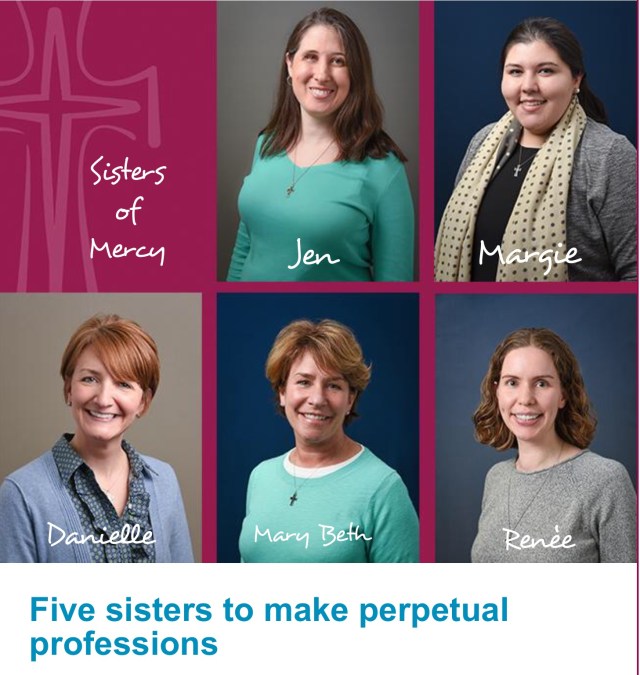
This Saturday, in our Merion chapel, four young women make their perpetual profession of vows as Sisters of Mercy. On July 13th, a fifth woman will make her final profession in the Mid-West Community.
We rejoice that these women have chosen to find their “more” as Sisters of Mercy. Will you join us in prayers of thanksgiving and benediction for them as they take this sacred step?
Let us too have the courage, as we pray today, to listen to Jesus ask us about our love. Let us answer sincerely, and ask for all we need to give the “more” in whatever way God asks of us.
Music: Love Like Jesus – Pawn Shop Kings (This one will wake you up!😀)
Today, in Mercy, Jesus continues to pray. What a blessing it is to be able to place ourselves next to Jesus and listen to his prayer!
The flow of this prayer shows clearly that it is part of an ongoing and continual conversation. Jesus is always in a relationship of presence with the Father. He just allows us to listen in John 17.
By our listening, we may grow in the depth of our own prayer. Jesus prays:
for God to be glorified
for all to be one in God
for the wholeness and perfection of all Creation
for eternal, Trinitarian life for his followers
for God’s love to live in our hearts
These requests are the same things the Father wants. These are the reasons the Father sent Jesus into the world. So, in his prayer, Jesus is praying for God’s Will of love and wholeness in the world. He is praying for oneness with the Father.
We can grow in this kind of prayer by opening our minds and spirits to God’s heartbeat in our lives. St. Teresa of Avila said it like this:
“Through a truth glimpsed fleetingly in a state of prayer he calls to us.
No matter how halfhearted such insights may be, God rejoices
whenever we learn what he is trying to teach us.” – The Interior Castle
and
“Let the truth be in your hearts, as it will be if you practice meditation,
and you will see clearly what love we are bound to have for our neighbors.”– The Way of Perfection
Through intention and practice, and responsive to grace, there comes a point in our spiritual life when we are never unaware of the Presence of God. The intensity of this awareness will vary, like the volume in a beautiful piece of music, but the Divine music is still always there, even in its necessary rests.
( Rests are intervals of silence in pieces of music, marked by symbols indicating the length of the pause. Each rest symbol and name corresponds with a particular note value, indicating how long the silence should last.)
Whether we are in a “rest” or a full, resounding note, let us become aware of God’s Presence in us and our presence in God.
Music: My TOP favorite piece of music. ( P.S. Whoever is in charge, please play this at my funeral.)
Messe solennelle en l’honneur de sainte Cécile: Sanctus – Jessye Norman
Today in Mercy, we experience both Paul and Jesus praying for their followers. They each use similar words.
Paul: And now I commend you to God and to that gracious word of his that can build you up and give you the inheritance among all who are consecrated.
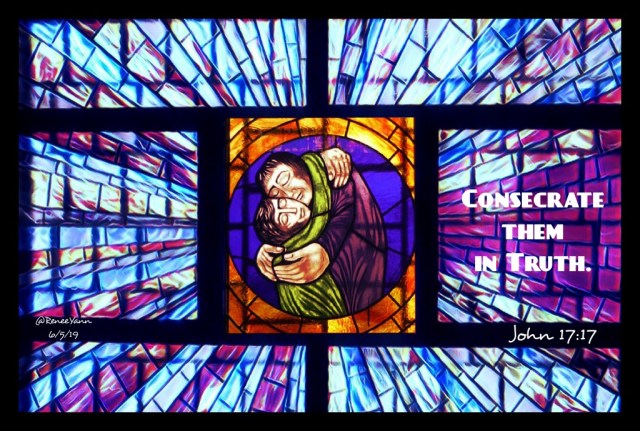
Jesus: Consecrate them in the truth. Your word is truth. As you sent me into the world, so I sent them into the world. And I consecrate myself for them, so that they also may be consecrated in truth.
Do you pray for others? To protect those you love? To change those who are bound in Spirit? To alleviate those who suffer? To awaken those that are caught in the vortex of selfishness or self-destruction? To increase the blessings of the generous?
Perhaps the greatest prayer we can offer for another is one like that of Paul and Jesus – a plea for the other to stand Blessed in the Truth of who they are in God — CONSECRATED by their Creaturehood, their Baptism, their faith, and their infinite power for Life in the Holy Spirit.
Today, we might pray like this for our Beloveds, and for those we might like to love better; for those who are unloved, and those unaware of how much they are loved.








 Lavish Mercy