The Bitter Root

Wednesday, February 6, 2019

Click here for readings

Today, in Mercy, we taste the “bitter root”. 

Heb12_15 bitter root

Paul writes to the Hebrews:

See to it that no one
be deprived of the grace of God,

that no bitter root spring up and cause trouble,
through which many may become defiled.

In our Gospel, Luke writes to his community

So Jesus was not able to perform any mighty deed in his hometown,
… He was amazed at their lack of faith.

So what is this bitter root that robs a heart of faith, forgiveness, trust, hope and love?

Think of the things we humans bury deep in our souls, before they can be seen, named and confronted. Naïvely, we think that hiding them will make them disappear.
We bury our:

word cloud

These buried irritants never disappear. They thicken under the surface, choking the possibility of new life — of Grace. These “bitter roots” steal our spiritual health and cripple the Holy Spirit within us. They deprive the community of our vigor and life. 

It is so necessary and important for us to bring these tangled undergrowths to light! It is so necessary and important for us to be the loving community that offers understanding, healing, listening and love.

How do we uncover and release these hidden poisons? Prayer, of course, can help us, and the gentle discipline of honesty with ourselves; the natural self-revelation of a trusted friendship, the insights of spiritual direction and retreat, and, sometimes, the professional accompaniment of a counselor.

Mary Oliver, beloved poet, describes a buried darkness in her own life in this poem “The Uses of Sorrow”:

Someone I loved once gave me a box full of darkness.
It took me years to understand that this too, was a gift.

As part of the faith community, we need to contribute to that place of trust and friendship that invites others to work through their darknesses. Healing is not magic. It comes through the tenderness, patience, honesty, awareness and encouragement of the surrounding community, as well as through our own courage. We need that community ourselves, and we need to be that community for others.

Music: Ubi Caritas (Where Charity and Love prevail, there is God.)

 

Prayer to Honor a Beautiful Sunset

(Because the sunset was so magnificent tonight,
I thought I might share this prayer I wrote many, many years ago.)

sunsetJPG

Degreeing Prayer
(To Yield Graciously to Life by Degrees – Like the Sun)

O God, my Beginning and my End,
I do not choose to “rage into the night”.
I choose to bleed into it,
graciously, as
Jesus bled…

by willing peace in face of curdled power,
by willing love in face
of irrational hate,
by willing acquiescence in the face of
time’s inexorable demand.

I want to be that strong…
to be so gentle, because
I think that
Jesus looked into the Dark
and saw Your Face
to learn antithesis of violence.

You are the Yielding One,
eschewing power for the sake of love.

You are Creator, granting
freedom in the will of those to whom
You bind Yourself by love.

You are the Contradiction
of control.

You are the Silent Source
of all
ennobled dying,
by those grafted to your Mystery
in the constant dark.

Absorb me,
as I near the forward edge of night.

Grade me,
like the colors of a yielding spectrum,
to softly welcome Your deepest darkness.

Music: Beyond the Sunset

Get Back in the Game!

Friday, February 1, 2019

Click here for Readings

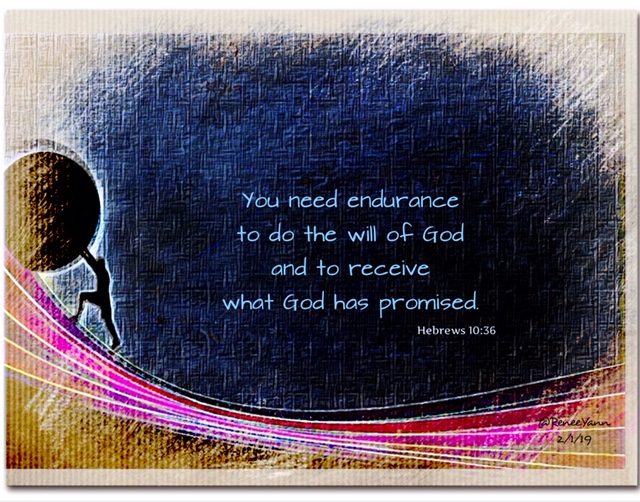
hebres10_36endurance

Today, in Mercy, Paul reminds his listeners of all the sufferings they endured when they first embraced the Christian faith. He goes on to encourage them to persevere, even in the midst of ongoing challenges:

… do not throw away your confidence;
it will have great recompense.

It’s a speech with all the overtones of a great pep talk. At first it reminded me of our old coach Miss Weed (seriously), back in the days when I played basketball. She never gave up; never gave in.

cast

During one game, I called time out because I was pretty sure I had just broken my finger blocking a shot. Miss Weed unsympathetically told me, “No time outs! No broken bones! Get back in and finish the game!” Later, waiting to get my hand casted at the clinic, I reflected on what I had learned.

Maybe that’s the way Paul’s community felt as they read this passage. “Time out, Coach! This Christian stuff is tough!”

But Paul had an amazing caveat that Miss Weed didn’t have. Paul held up before his audience the promise of eternal life. Things comparable to broken fingers pale in that Light!

So today, let’s get back in the game with all our hearts – living our life in Christ with gusto and joy. Often it is not easy. But always look to the Light. And …

… do not throw away your confidence;
it will have great recompense.

Music: We’ve Got This Hope – Ellie Holcomb (Lyrics below)

We’ve got this hope
We’ve got a future
We’ve got the power of the resurrection living within
We’ve got this hope
We got a promise
That we are held up and protected in the palm of His hand
And even when our hearts are breaking
Even when our souls are shaking

Oh, we’ve got this hope

Even when the tears are falling
Even when the night is calling

Oh, we’ve got this hope

And we’re not alone
Our God is with us
We can approach the throne with confidence
Cause He made a way
When troubles comes
He’ll be our fortress
We know that those who place their hope in Him will not be ashamed

And even when our hearts are breaking
Even when our souls are shaking

Oh, we’ve got this hope

Even when the tears are falling
Even when the night is calling

Oh, we’ve got this hope

Our hope is grounded in an empty grave
Our hope is founded on the promise that He made

Rouse One Another to Good

Thursday, January 31, 2019

Click here for readings

Today, in Mercy, we celebrate the feast of St. John Bosco, Priest and Teacher. He is a saint I would not have paid much attention to except for someone very special to me.

hebrews10_24 inspire

St. John Bosco was the patron saint of Sister Mary Giovanni, my sponsor when I entered the Sisters of Mercy over fifty years ago.  She was my high school teacher and my later friend. 

Like her patron saint, she was humble, honest, loving and uncomplicated. Her quiet humor, evenness and easy acceptance of others inspired me.  She motivated me to want to be good and do good.

gio_graduation
Sister Giovanni with Three Musketeers from the Class of 1963

In reading Hebrews today, I thought of her immediately. Verse 10:24 reads:

We must consider
how to rouse one another
to love and good works.

That’s what she did for me. She wasn’t preachy.  She wasn’t bossy. She didn’t even obviously try to influence me. But her humble, honest, loving care for people wowed me. I wanted to live life the way she did.

This is what Paul is talking about in our first reading today. We need one another’s faith, goodness, and example to energize our Spirit life.

Certainly, teachers have a great opportunity for this kind of influence in shaping a person’s life. But so do we all – with youngsters and those not so young 😊!

Let’s try to be that kind of person today.

Let’s give thanks for the gift of those persons in our lives.

Music: In Your Hands ~ Ron Hiller and Judy Millar

While directed toward teachers, this song can motivate us all to think about how we “teach” with our lives. It can remind us of the many kinds of “teachers” who have blessed us.

Ears to Hear

Wednesday, January 30, 2019

Click here fro readings

Today, in Mercy,  we hear the very familiar parable of the sower and the seed, teaching us that God’s grace needs to fall on a fertile heart in order to bear fruit.

It seems like a pretty straightforward lesson although, according to the passage, many listeners missed the point. The situation begs the question of why Jesus used parables if some people wouldn’t understand them.

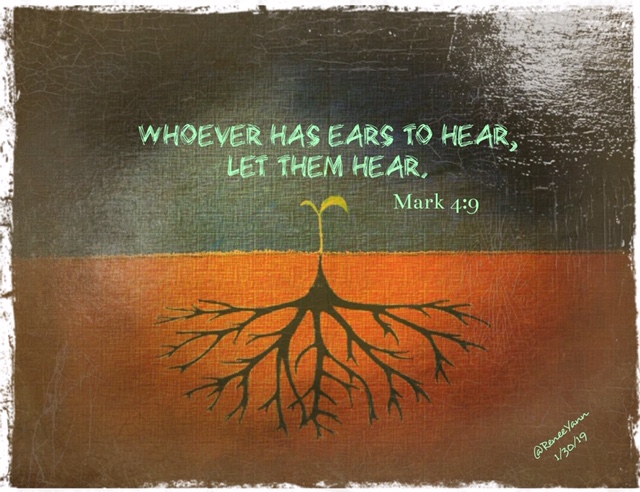
ears

A parable is like a poem. Both say so much more than the words that comprise them.

Jesus is teaching his listeners truths that go beyond language. Each parable will live beyond its time to bring fresh insights down through the generations.

But the key is having the “ears to hear”.

These are ears of the heart and soul, ears that listen always for God’s silent conversation running under all reality. These “ears” are a metaphor for the contemplative spirit which trains itself in wordless prayer to find the Word in all experience.

We will have innumerable conversations today with ourselves and others. We use the many languages of human interaction: business jargon, friendly banter, diplomatic dialogues, lover’s whispers, profound heart-to-hearts, body language, and even pregnant silence. 

Running under each exchange is a level of divine engagement where God speaks, revealing the true meaning of our human experience.  Our whole life – every moment of it – is a parable of God’s infinite love for us and all Creation. Our whole life is a conversation with God!

Let those who have ears to hear, hear!

(Speaking of “words” and “poems” today, I thought I would share a few of my poems on occasion for those who might enjoy them.  I have chosen two that are about contemplative prayer. They will come in a separate email. I hope you enjoy them)

Music: Will You Not Listen?~ Michael Card

No Explanation Necessary

Monday, January 28, 2019

Click here for readings for St. Thomas Aquinas Liturgy

Today, in Mercy, we  celebrate the Memorial of Saint Thomas Aquinas, Priest and Doctor of the Church.

theology

The influence of Aquinas on Catholic theology and resultant culture cannot be overstated.  He is considered by many to be the foremost articulator of the Catholic tradition of reason and of divine revelation. For centuries, his thought became the underlying curriculum for priestly and religious training, universally influencing Catholic education, preaching, and theology.

Thomistic thought has been a great blessing to the Church. On the other hand, there are concerns about those who enshrine 13th century concepts without ongoing theological examination and development.

St. Anselm, outstanding theologians of the 11th century said, “Theology is faith seeking understanding.” It is trying to know all we can about God, but it always falls short of knowing God.

Many modern theologians develop emerging thought using Aquinas as their foundation, while deconstructing the unhelpful medieval constrictions of his work. Elizabeth Johnson, CSJ is one of my favorites. She has been noted as offering “new ways to think and speak about God within the framework of traditional Catholic beliefs and motifs.

As well as his immense body of theology, Thomas Aquinas was the composer of many treasured hymns. You might enjoy this one today.

Music: Adorote Devote ~ Thomas Aquinas 

See below for both Latin and English lyrics

1. Adoro te devote, latens Deitas,
Quae sub his figuris vere latitas;
Tibi se cor meum totum subiicit,
Quia te contemplans, totum deficit. 

2. Visus, tactus, gustus in te fallitur,
Sed auditu solo tuto creditur;
Credo quidquid dixit Dei Filius,
Nil hoc verbo veritatis verius. 

3. In Cruce latebat sola Deitas.
At hic latet simul et humanitas:
Ambo tamen credens, atque confitens,
Peto quod petivit latro paenitens. 

4. Plagas, sicut Thomas, non intueor,
Deum tamen meum te confiteor:
Fac me tibi semper magis credere,
In te spem habere, te diligere. 

5. O memoriale mortis Domini,
Panis vivus vitam praestans homini:
Praesta meae menti de te vivere,
Et te illi semper dulce sapere. 

6. Pie pellicane Iesu Domine,
Me immundum munda tuo Sanguine:
Cuius una stilla salvum facere
Totum mundum quit ab omni scelere. 

7. Iesu, quem velatum nunc aspicio,
Oro, fiat illud, quod tam sitio,
Ut te revelata cernens facie,
Visu sim beatus tuae gloriae.
Amen.

1.Godhead here in hiding, whom I do adore,
Masked by these bare shadows, shape and nothing more,
See, Lord, at thy service low lies here a heart
Lost, all lost in wonder at the God thou art.

2. Seeing, touching, tasting are in thee deceived:
How says trusty hearing? that shall be believed;
What God’s Son has told me, take for truth I do;
Truth himself speaks truly or there’s nothing true.

3. On the cross thy godhead made no sign to men,
Here thy very manhood steals from human ken:
Both are my confession, both are my belief,
And I pray the prayer of the dying thief.

4. I am not like Thomas, wounds I cannot see,
But can plainly call thee Lord and God as he;
Let me to a deeper faith daily nearer move,
Daily make me harder hope and dearer love.

5. O thou our reminder of Christ crucified,
Living Bread, the life of us for whom he died,
Lend this life to me then: feed and feast my mind,
There be thou the sweetness man was meant to find.

6. Bring the tender tale true of the Pelican;
Bathe me, Jesu Lord, in what thy bosom ran—
Blood whereof a single drop has power to win
All the world forgiveness of its world of sin.

7. Jesu, whom I look at shrouded here below,
I beseech thee send me what I thirst for so,
Some day to gaze on thee face to face in light
And be blest for ever with thy glory’s sight.
Amen.

Word

Sunday, January 27, 2019

Click here for readings

Today, in Mercy, our readings focus on Scripture as the revealed Word of God.

lk1_scroll word

Ezra, from our first passage, lived almost 500 years before Christ during the Babylonian captivity, a time when much of the population of Judea was deported to what is modern day Iraq. When the Persian King Cyrus the Great conquered Babylon, the Jews were permitted to return to Judea.

During the sixty-year enslavement, many Jews lost touch with their culture, language and religion. Our reading describes Ezra’s efforts to restore the Jewish character of the community by reintroducing them to the Torah. He has to read to them, translating the Hebrew for those who no longer speak it.

In a gesture foretelling the liberating ministry of Jesus, Ezra unrolls the scroll – symbolic of bringing to light that which has been hidden or buried.

In our Gospel, Jesus too unrolls the scroll. In doing so, Jesus reveals the heart of faith which had been buried within the Law. Jesus preaches in a new “language” – the language of God’s all-inclusive mercy, forgiveness, and love.

For us who believe, the holy scriptures are a Living Word which, through thoughtful prayer, will continually reveal God’s heart to us. It is worth our time and attention to become friends with these sacred messages.

Many of you, dear readers, will be familiar with the ancient prayer practice of “lectio divina”. In her book “Too Deep for Words”, Sister Thelma Hall describes the practice:

… a wholistic way of prayer which disposes, opens, and “in-forms” us for the gift of contemplation God waits to give, by leading us to a place with him at our deepest center … It begins this movement by introducing us to the power of the Word of God in scripture to speak to the most intimate depths of our hearts …

Sister Thelma Hall’s Book, a classic, is available on Amazon for those who might enjoy exploring Lectio Divina. I highly recommend it. My copy, nearly 30 years old, is beginning to show its age, but then again, so am I! 😂 I would never part with it. 

Click here for Amazon

Music:  Word of God Speak ~ Mercy Me

To Life!

Tuesday, January 22, 2019

Click here for readings

Today, in Mercy, our passage from Hebrews is a strong encouragement for its readers to stay faithful to the hope that has been given us through our call.

eph1_17 call
from today’s Responsorial Psalm

Paul traces the evolution of that call by reminding his readers of Abraham who trusted God’s promise and patiently waited for its fulfillment. Paul says that God not only promised Abraham, God swore an oath to bless and multiply Abraham’s life.

This promise and oath of God’s faithful covenant is the root of our Christian hope, and the “anchor” of our life.

Green Rope

On this day, when the Church prays for the protection of unborn children, let us be conscious that the “right to life” extends beyond the womb, from “cradle to grave”.

Let us pray to honor and reverence all life and all Creation – those who are troubled, poor, sick, different from us, homeless and seeking refuge. Let us pray for political and economic systems that protect both unborn and born children, resident and refugee, privileged and marginalized … nourishing their right to life, freedom and the happiness of well-being.

Beloveds, let us give thanks for the life and faith we have been given, and let us share it generously.

Music: You Are Life ~ Hillsong Worship

There is No Wine

Sunday, January 20, 2019

Readings: http://www.usccb.org/bible/readings/012019.cfm

Today, in Mercy, we read about Jesus’s first public miracle at Cana. It is a story that has always fascinated me, mostly because of what is left unsaid – what is written between the lines.

jn2_1 can

The Gospel begins by telling of a wedding and “the mother of Jesus was there”. The suggestion is that Mary had been staying at the wedding site and that she had a special role in the preparations. Perhaps she was the aunt or good friend of the bride or groom. Whatever the case, Mary seems to have had some unique responsibility for the ceremony’s success.

This responsibility motivates her to solicit Jesus’s help when she notices the wine is running out. Did she expect a miracle in return for her remark? We don’t know. Perhaps she just wanted Jesus and his young friends to run down to the local wine store for replenishments.

It was Jesus who decided to turn the request into an occasion for a miracle. Why? It seems like a frivolous miracle when there were sick to be cured and dead to be raised!

The final lines of this pericope might help answer that question

Jesus did this as the beginning of his signs at Cana in Galilee
and so revealed his glory,
and his disciples began to believe in him.

Jesus decided to first reveal his glory at a wedding feast, a party, an ordinary celebration of life and love. The dramatic, life-saving miracles would come – demons grabbing pigs and diving headlong into the sea.

But this first one, the one his closest family and friends would especially remember, was all about joy, dancing, music, friendship – the divine strength of our shared and graced humanity.

Probably most of us don’t expect to encounter a really eye-popping miracle in our lives. But maybe in our challenges we, like Mary, could walk up behind Jesus and whisper, “This situation needs your touch”.

Oh, how Jesus might surprise us!

Music: Everyday Miracles ~ Sara Groves

At the River Clarion ~ Mary Oliver

river

1.

I don’t know who God is exactly.
But I’ll tell you this.
I was sitting in the river named Clarion, on a water splashed stone
and all afternoon I listened to the voices of the river talking.
Whenever the water struck a stone it had something to say,
and the water itself, and even the mosses trailing under the water.
And slowly, very slowly, it became clear to me what they were saying.
Said the river I am part of holiness.
And I too, said the stone. And I too, whispered the moss beneath the water.
I’d been to the river before, a few times.
Don’t blame the river that nothing happened quickly.
You don’t hear such voices in an hour or a day.
You don’t hear them at all if selfhood has stuffed your ears.
And it’s difficult to hear anything anyway, through all the traffic, the ambition.

2.

If God exists he isn’t just butter and good luck.
He’s also the tick that killed my wonderful dog Luke.
Said the river: imagine everything you can imagine, then keep on going.
Imagine how the lily (who may also be a part of God) would sing to you if it could sing,
if you would pause to hear it.
And how are you so certain anyway that it doesn’t sing?
If God exists he isn’t just churches and mathematics.
He’s the forest, He’s the desert.
He’s the ice caps, that are dying.
He’s the ghetto and the Museum of Fine Arts.
He’s van Gogh and Allen Ginsberg and Robert Motherwell.
He’s the many desperate hands, cleaning and preparing their weapons.
He’s every one of us, potentially.
The leaf of grass, the genius, the politician, the poet.
And if this is true, isn’t it something very important?
Yes, it could be that I am a tiny piece of God, and each of you too, or at least
of his intention and his hope.
Which is a delight beyond measure.
I don’t know how you get to suspect such an idea.
I only know that the river kept singing.
It wasn’t a persuasion, it was all the river’s own constant joy
which was better by far than a lecture, which was comfortable, exciting, unforgettable.

3.

Of course for each of us, there is the daily life.
Let us live it, gesture by gesture.
When we cut the ripe melon, should we not give it thanks?
And should we not thank the knife also?
We do not live in a simple world.

4.

There was someone I loved who grew old and ill
One by one I watched the fires go out.
There was nothing I could do
except to remember
that we receive
then we give back.

5.

My dog Luke lies in a grave in the forest, she is given back.
But the river Clarion still flows from wherever it comes from
to where it has been told to go.
I pray for the desperate earth.
I pray for the desperate world.
I do the little each person can do, it isn’t much.
Sometimes the river murmurs, sometimes it raves.

6.

Along its shores were, may I say, very intense cardinal flowers.
And trees, and birds that have wings to uphold them, for heaven’s sakes–
the lucky ones: they have such deep natures,
they are so happily obedient.
While I sit here in a house filled with books,
ideas, doubts, hesitations.

7.

And still, pressed deep into my mind, the river
keeps coming, touching me, passing by on its
long journey, its pale, infallible voice
singing.

 “At the River Clarion” by Mary Oliver, from Evidence: Poems, Beacon Press.

Music to accompany your reading: Pachelbel ~ Canon