The Scripture of Our Lives

Monday, August 13, 2018

Readings: http://www.usccb.org/bible/readings/081318.cfm

Ez1 boing

Today, in Mercy,  in our first reading, Ezekiel signals that something really important has happened. He does this by means of a prophetic word formula – repeated and patterned phrases found throughout the Bible. 

One pattern that we’re accustomed to is, “Amen, Amen, I say to you..” Jesus used it to say, “Listen up! Important info to follow!”

Another pattern is the specific setting of time and place to mark an event as pivotal. One such beloved phrase: “It came to pass in those days, that Caesar Augustus issued a decree that a census should be taken of the entire Roman world.

Ezekiel’s formulaic phrase is a marker in his spiritual life: 

On the fifth day of the fourth month of the fifth year,
that is, of King Jehoiachin’s exile,
The word of the LORD came to the priest Ezekiel…

If we look back over our own lives, we will remember moments when God clearly entered our experience. We may not have realized it until long after. We may be surprised to remember a point in time as the opportunity God took to embrace us. But through reflective prayer, we begin to see that God is with us, even in our darkest moments, bringing the revelation of God’s infinite Love and Mercy.

What if we filled in the blanks in Ezekiel’s formula with our own life markers? What if we thanked God for each of them, dark or light – asking for the grace to understand their revelation?

Each of our lives is its own scripture, telling the story of God’s love and presence. Spend time with yours today.

Music: God of All My Days ~ Casting Crowns
Live in Love

Sunday, August 12, 2018

Readings: http://www.usccb.org/bible/readings/081218.cfm

Eph 5_1 live in love

Today, in Mercy, our readings capture the essence of life in God through Christ.

The first reading from Kings tells how Elijah, after eating the food God had provided him, was able to endure the long journey to God’s mountain.

In today’s Gospel passage, Jesus makes clear that no one makes that journey into the heart of God unless God calls us. But Jesus says that the invitation is given to all who believe. He says that, just as with Elijah, the Father gives us food – Jesus himself – the bread of life.

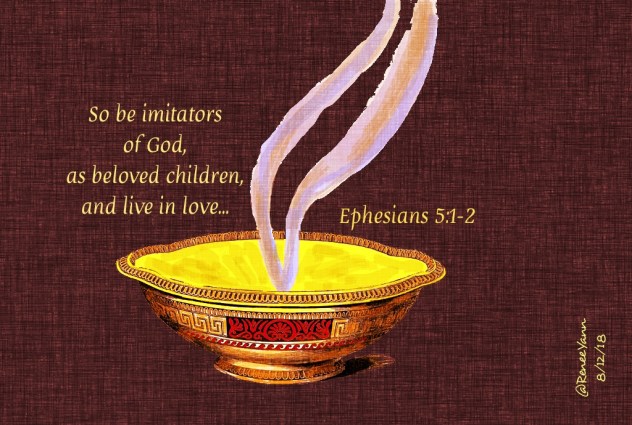
The second reading from Ephesians says that we have already “been sealed for the day of redemption through the Holy Spirit.” Paul says that, given this amazing gift, we have only one job:

So be imitators of God, as beloved children,
and live in love,
as Christ loved us and handed himself over for us
as a sacrificial offering to God for a fragrant aroma.

We are so accustomed to hearing these astounding passages that we may miss how astounding they really are. But Macrina Wiederkehr says:

When Jesus’ words begin to sound naive to our 21st century minds, let us look through the words, in between the words, underneath for a deeper truth.

Pierre Teilhard de Chardin, the great Jesuit mystical theologian, upon reading these passages,saw the mystery of the Body of Christ. He saw our call to be the heart of Christ in the world. He saw Christ’s promise to become one with us in Eucharist. He saw that, through this Infinite Love played out in our ordinary lives, God continues to redeem Creation.

In each soul,
God loves and partly saves the whole world
which that soul sums up
in an incommunicable and particular way.
~ The Divine Milieu ~

Music: Quintessence – Spencer Brewer

May this lovely instrumental piece help take us to a deeply prayerful place as we contemplate God’s gift in Jesus.

Ever Complain to God?

Saturday, August 11, 2018

Memorial of St. Clare

Readings: http://www.usccb.org/bible/readings/081118.cfm

Hab 2_2 write

Today, in Mercy, we have a rare appearance from the prophet Habakkuk, whose contribution to the Hebrew Scriptures is brief — three short chapters. The first two chapters are known as the First and Second Complaint of Habakkuk.

In his first complaint, Habakkuk is upset with the way the world is going. You know what he feels like. He saw the political infrastructure rife with corruption, enemies attacking the heart of Jewish religion, and economic deadlock. Habakkuk asks God to explain why this is happening.

God says that Habakkuk has to have faith, that ultimately God will work things out.

That doesn’t float with Habakkuk, so he complains again. He basically tells God that, as the all-Powerful One, God should be able to do better.

Have you ever talked to God like that in your prayer – just so frustrated with your life or the world situation that you pour it all out in one massive complaint?

The fullness of Habakkuk’s faith evolved over time, because God abided with him, telling Habakkuk to be patient:

Write down the vision
Clearly upon the tablets,
so that one can read it readily.
For the vision still has its time,
presses on to fulfillment, and will not disappoint;
If it delays, wait for it,
it will surely come, it will not be late.
The rash man has no integrity;
but the just man, because of his faith, shall live.

This passage is a good incentive to maintain a spiritual journal.  When we go back over past challenges, we are often amazed to see how God did, indeed, abide with us — just as God did with Habakkuk.

Ready for some haunting beautiful Gaelic? (English lyrics below.)

Music: Bi Thusa Mo Shuile (Be Thou My Vision)
( Be Thou My Vision is a traditional hymn from Ireland. The words are based on a Middle Irish poem often attributed to the sixth-century Irish Christian poet Dallán Forgaill. The best-known English version was translated by Eleanor Hull and published in 1912. Since 1919 it has been commonly sung to the Irish folk tune “Slane”.)

Be Thou my Vision, O Lord of my heart
Naught be all else to me, save that Thou art
Thou my best Thought, by day or by night
Waking or sleeping, Thy presence my light
Be Thou my Wisdom, and Thou my true Word
I ever with Thee and Thou with me, Lord
Thou my great Father, I Thy true son
Thou in me dwelling, and I with Thee one
Riches I heed not, nor man’s empty praise
Thou mine Inheritance, now and always
Thou and Thou only, first in my heart
High King of Heaven, my Treasure Thou art

Did You Say, “Die”?

Friday, August 10, 2018

Readings: http://www.usccb.org/bible/readings/081018.cfm

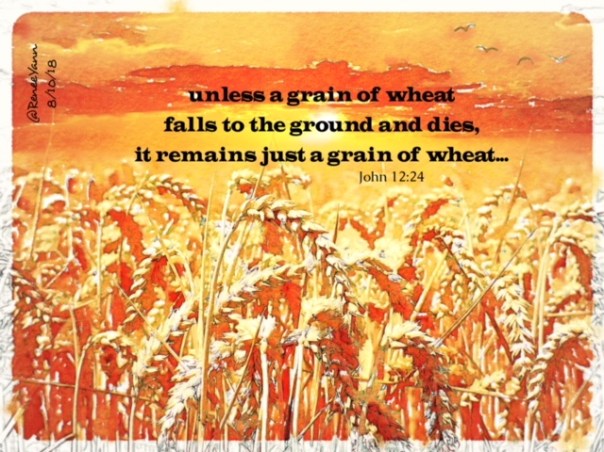
Today, in Mercy, on this feast of St. Lawrence, our readings are all about wheat. Then, again, they’re really not.

John 12_24 grain

The readings, of course, are about eternal life – lessons taught in symbols the listeners could relate to. The agrarian community of Jesus’ time understood clearly what happened to a grain of wheat when buried in the rich soil. They understood, too, how a single grain, fallen on the barn floor and lost underfoot, had no hope of life.

It is a powerful lesson about community, selflessness, and what we need to do to live a full and meaningful life. 

We have to die —  to our isolation, self-absorption, greed, objectification and domination over others, “me-firstness”. 

Basically, we have to resist the Seven Deadly Sins that make life “all about me”: 

  • Self-adulating pride
  • Vengeful anger
  • Depersonalizing lust
  • Ungrateful envy
  • Consumeristic gluttony
  • Mean Greed
  • Irresponsible laziness

To move beyond these sins, we must recognize, respect and care for others – all others – as children of God.

If we can do that, our grain of wheat will land in harmony with the faith community and will contribute to its abundant life – and to our own. That faith community might be as small as my family or as big as the world. But unless I live there in selflessness, I will never come to my full potential a human being.

Musical reflection: A Grain of Wheat ~ Torchbearers

Profession of Faith

Thursday, August 9, 2018

Readings: http://www.usccb.org/bible/readings/080918.cfm

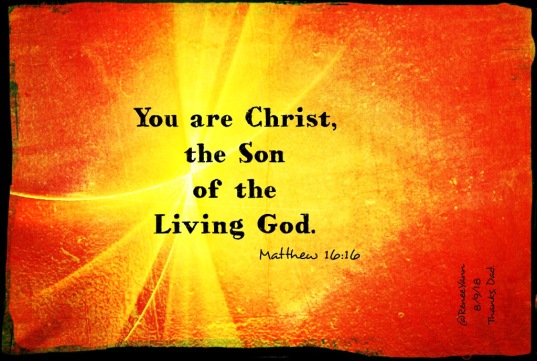
Today, in Mercy, our Gospel reading offers us Peter’s magnificent profession of faith. 

profession Mt16

This profession might cause us to consider our own faith and how we profess it in our daily lives.

I think about that today in the context of my father’s life. Today is his birthday.

My father, gone to God nearly forty years ago, would have been 103 years old today.

He was born in the midst of the World War — called only that, because we never expected a second one.

His 28- year-old mother died when he was just two years old.

He grew up into a Depression which caused  him to cease his schooling at 7th grade and work the farm with the uncle who raised him.

Dad

By the tragic Second World War, he had grown to a man and  would fight in the fields and cities of Europe. He came home with pictures in his head that he would never talk about. And he never traveled again, at least not beyond Wildwood, New Jersey.

With not even a grade school diploma, he was a self-educated man in the skills of plumbing, electricity, painting, paper-hanging, and cement work.  Don’t undervalue this unless you have attempted these tasks yourself!

He was a hard-working, blue collar, salt-of-the-earth man who never owned his home but raised a family whose hearts he owned completely.

He suffered a heart injury at work when he was in his 50s and eventually – despite a valiant struggle – became disabled. After several heart attacks, he died a relatively early death at age sixty-six. In the intervening years, he read, prayed, and loved my mother, brother and me without reservation. He never missed a Sunday or Holy Day at Church. He prayed his devotions and novenas every day. He never put a single person down by his words or actions.

Some may read this short synopsis of his life and think it a little tragic. I read it and remember an everyday saint. He was made so by his resolute faith and trust in God; by his honest, inclusive patriotism, by his immense selflessness, and by his abundant kindness. These traits characterized many of “The Greatest Generation”.  We should never underestimate the contribution of their character to our national historical wealth.

My Dad died completely fulfilled and happy, leaving a heritage of faith, loyalty, generosity and love. That was his profession of faith, and I take great joy in it today. I think in many ways, Dad was a lot like Peter and I like to think of him that way as I pray this morning .

My dear readers, in your own family trees, I hope you are blessed to have such people- rough, tender-hearted heroes who carried you into the fullness of your life. Think of them, learn from them, and bless them today. Be them – if you have the courage.

Dad loved music. Toward the end of his life, this free and beautiful melody was one of his favorites. You might enjoy it as you pray this morning.

Verde ~ Guido and Maurizio DeAngelis

This Ancient Love

Wednesday, August 8, 2018

Readings: http://www.usccb.org/bible/readings/080818.cfm

Today, in Mercy,  our readings focus on the infinite mercy of God — the Lavish Mercy of God.

ancient love Jer 31_3

Jeremiah speaks God’s voice to the ancient Israelites, forgiving them, consoling them, encouraging them. He promises that, delivered from their captivity, they will rejoice and “come streaming into the Lord’s blessings”.

In our Gospel, even an outcast woman receives the mercy of Jesus. She received this for two reasons: her faith was both extraordinary and unrelenting for her daughter.

Both Israel and the Canaanite woman are in desolate situations. They are bereft of nearly everything but hope and faith. We may have felt like that sometimes. Certainly there are people throughout our world who feel like that today.

As we pray today, we can place any desolation we are carrying, and the desolation of suffering people across the world, into the open arms of God. God has and will always love us and, even though unseen, is guiding us to the fullness of life. May our faith be extraordinary and unrelenting.

Music: This Ancient Love ~ Carolyn McDade

Keeping the Night Watch

Tuesday, August 7, 2018

Readings: http://www.usccb.org/bible/readings/080718.cfm

Do you ever have trouble sleeping at night? Or do you wake too early and fight to go back to sleep? 

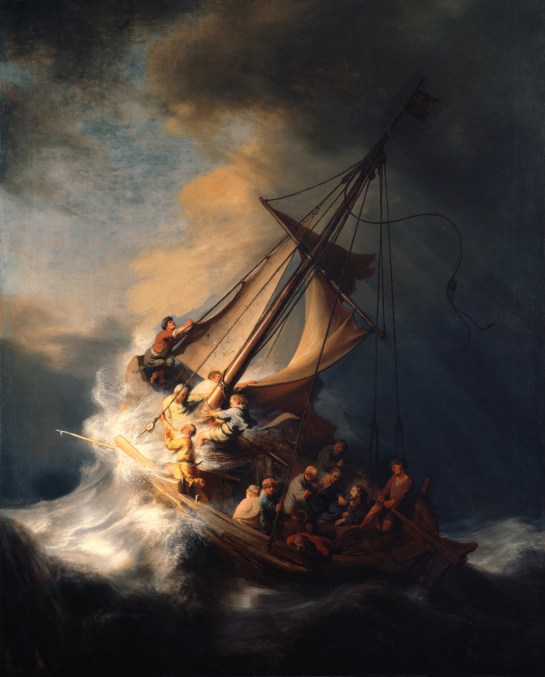
The disciples in today’s Gospel understand your plight. They had worked hard all day and were exhausted. Nestled in various of the boat’s nooks, each one settled to his own slumber. At first, the Sea of Galilee was gently rolling, almost like a lullaby of waves.
But …

Set in the hills of northern Israel, the Sea of Galilee is nearly 700 feet below sea level. … The sea’s location makes it subject to sudden and violent storms as the wind comes over the eastern mountains and drops suddenly onto the sea.” (Ray Vander Laan)

storm at sea

The Storm on the Sea of Galilee~ Rembrandt 

We’re not unlike these men. The storms of life come suddenly to disturb our sleep too. Sorrows, worries, frustrations, deadlines, aches and pains — all kinds of winds howl into our sleep during “the fourth watch of the night.”

What if, rather than resisting these little twisters, we looked deeply into them for the face of God. As we struggle with whatever it is disturbing us, God is always approaching us with a message of hope, courage and spiritual growth. Often, it is our resistance to that message which creates the storm.

That night, on the Sea of Galilee, the disciples sensed the rising winds of resentment against Jesus. The knew in their depths that the storm clouds were gathering in the dark hearts of Christ’s enemies. But they probably resisted their growing fears. 

Most of them had not witnessed the Transfiguration. But they too, like Peter, James and John, needed some bolstering! Walking across the water, Jesus brings each of them a blessed assurance that He has the storms in hand.

In our own night watches, God is waiting to calm and assure us. Let us be still in the darkness and trust God.


Music:  Holy Darkness sung by John Michael Talbot

The Prophet is Never Welcome

Friday, August 3, 2018

Readings: http://www.usccb.org/bible/readings/080318.cfm

ordinary miracles

Today, in Mercy,  Jesus returns to his hometown to speak with his neighbors in the synagogue.  We can imagine the scene – maybe a few buddies who grew up with Jesus, kicking a ball around the dusty streets of Nazareth. Maybe there were neighbor ladies who went to the well daily with Mary., or a few older guys who had exchanged the secrets of woodworking with Joseph.

They might have come to the synagogue expecting little but to hear the old scriptures interpreted in the old way. They could live with that.  They had become entrenched in their ordinary lives and, despite its drudgeries, it was comfortable for them.

We can understand these people. In many ways, we might be like them.  We might go to church on Sunday and pray everyday, but we don’t want our faith to get too mixed up in our lives. We certainly don’t want some preacher telling us we have to change our comfortable ways because “the Kingdom of God is at hand”.

But that’s what Jesus did that Sabbath in the hometown synagogue.

You see their reaction. “Who the heck is this guy to tell us what to do? Isn’t he merely one of us?”

Their defenses and prejudices bar them from hearing the liberating word of Jesus.  He asks them to break open their ordinary lives to find the call to grace hidden within. He doesn’t want them to abandon their lives. He wants them to transform their lives by recognizing the presence of God in the everyday miracles of human life, love, mercy and forgiveness. He challenges them to welcome the same miracles in the poor, the stranger, even the enemy. Now wait a minute!!!!

There may have been some who heard and responded to him that day. But their voices were drowned out by those whose souls had atrophied with comfort, selfishness, ignorance and fear.

We don’t have to go too far to find such scenes today.  It may be at a church, a political event, a family conversation, an exchange among friends. These situations may confront us with the stark difference, in ourselves and in others, between truth and opinion, between faith and religion, between justice and law. 

In these common situations of our lives, can we find the miracles God is offering us? Can we listen beyond the words with a faith-filled heart and hear God’s Word? Can we allow our thinking to be transformed by the challenging graces of our ordinary lives? Can we ask ourselves sincerely, “If Jesus were here for this moment, what would he want to happen in my heart and actions?”

Music: Word of God Speak by MercyMe

The Work of God’s Hands

Thursday, August 2, 2018

Readings: http://www.usccb.org/bible/readings/080218.cfm

Today, in Mercy, Jeremiah provides us with the memorable image of the potter and the clay.

If you have ever worked in ceramics or sculpting, you know how the artist becomes one with her work. A shapeless lump of earth takes on an identity within your hands. Ever so delicately, you work to find the potential beauty in the clay. We might begin over and over until we find the perfect dynamic between our hands and the malleable clay.

Jer18_5 potter

Just the right touch, the perfect pressure, and something new – never here before – emerges. The new creation, while existing itself, holds the Potter’s character. It embodies her effort and hope. It is a physical testimony to her dream.

In this scripture passage, God is telling Jeremiah that this is how it is with Israel (and in place of Israel, we can read our own names.) Through the circumstances and opportunities of our lives, God is shaping his dream – the Divine hope for a loving creature who reflects the beauty of God.

As we deepen in our spiritual life, we become more sensitive to God’s touch, more aware of God’s creative presence in our lives. God reworks us, offering us the perfection of grace over the course of our lifetimes. May we have the wisdom to yield to God’s intention in our lives – to make, as Mother Theresa says, “something beautiful for God”.

Music: Abba, Father ~ John Michael Talbot

How Does God Think We Are Doing?

Tuesday, July 31, 2018

Readings: http://www.usccb.org/bible/readings/073118.cfm

Today, in Mercy, the readings from Jeremiah and Matthew squarely place the reality of sin in our sight. Nobody likes to talk about sin, at least if they’re normal. We like to talk about fun, success, winning, freedom, prosperity. But when the distortion of these things get in the way of our relationship with God and neighbor, then we’re talking about sin.

Ps79 Deliver usJPG

How do you feel about our world today? The small area of my world is abundantly blessed and happy, as I hope yours is. The inhabitants of Jeremiah’s world felt the same way — until the devastation touched them! Then they realized that their “comfortable “ world was woefully out of line with God’s hope.

They had been blind to the sin around them, and their –  perhaps –  unwitting part in it. Ultimately, they were visited with destruction. We might read their plight and say, “Oh well, they worshipped false idols.  No wonder God was displeased with them.”

A better read might be:

  • Are there any false gods in my life? Who or what do I really worship above all things?
  • Are there false gods in our world? How do I respond to them- in the political arena, in the workplace, in my social sets?

The world is so much bigger than our  living rooms or offices. And we are called to be faithful witnesses to God in that bigger world. How are we doing? Today, Jeremiah and Jesus offer us an examination of conscience.

Today is also the feast of St. Ignatius Loyola. This is a version of the five-step Daily Examen that St. Ignatius practiced.

  1. Become aware of God’s presence.
  2. Review the day with gratitude. 
  3. Pay attention to your emotions.
  4. Choose one feature of the day and pray from it.
  5. Look toward tomorrow.

For more on Ignatian spirituality see:

Click here to go to Ignatian Spirituality website

Music: Take, Lord, Receive – The Prayer of St. Ignatius by John Foley