Memorial of St. Catherine of Siena

April 29, 2022

Today, in God’s Lavish Mercy, we meet Gamaliel, the revered rabbinical teacher and early mentor of St. Paul.

Rembrandt_-_Old_Rabbi_-_WGA19186
The Old Rabbi by Rembrandt

With his patient wisdom, Gamaliel famously intervened  to save Peter and John from the Sanhedrin’s wrath.

“Fellow children of Israel,
be careful what you are about to do to these men….
…I tell you,
have nothing to do with these men, and let them go.
For if this endeavor is of human origin,
it will destroy itself.
But if it comes from God, you will not be able to destroy them;
you may even find yourselves fighting against God.”

Acts 5: 35-38

Biblical scholars have interpreted Gamaliel’s intervention in various and even contradictory ways. Some see in him a hesitancy which will believe only that which is proven and successful. Others suggest that Gamaliel was already a believer who maintained his Sanhedrin position in order to assist the early Christians. In the Catholic canon, Gamaliel is venerated as a saint whose feastday is August 30.


Thinking about Gamaliel may lead us to the question, “What do I need in order to believe?” 

  • Do I, like the Sanhedrin, need to see proven success?
  • Do I, like some of the crowd fed in today’s Gospel, need miracles?
  • Do I, like the rich young man, need answers to all of my questions?
  • Do I, like Thomas, need to see and touch the Resurrected Christ?

In other words, am I looking for a faith that is a fail-proof blueprint, or is my faith a living journey with Christ, as was Peter’s and John’s?

John4_4 bread word

The Apostles’ faith and trust were so complete that they saw even persecution as evidence of God’s plan and power:

So the Apostles left the presence of the Sanhedrin,
rejoicing that they had been found worthy
to suffer dishonor for the sake of the name.
And all day long, both at the temple and in their homes,
they did not stop teaching and proclaiming the Christ, Jesus.

Acts 5: 41-42

When we are completely given to God in faith, all our life experiences bring us closer to God. All circumstances reveal God to the deeply believing heart.

May we grow every day in that kind of faith.


Today, as we celebrate the feast of the great Saint Catherine of Siena, a reflection in place of our usual poetry.

We can learn Catherine’s spiritual wisdom. Without formal education, she grew by grace into a Doctor of the Church.

Siena

She was born Catherine Benincasa on March 25, 1347, in Siena, Italy, and was a twin, the 24th child of 25. She only lived to the age of 33, dying of a stroke in Rome in 1380. Catherine of Siena, often referred to as “great Kate,” is well known for her expressive life of prayer shared in three major sources of writings: over 400 letters, 26 prayers, and The Dialogue of Divine Providence, which she referred to as “the book,” written in the format of a conversation between herself and God. She was noted for her style of learning, not acquired from formal education and degrees, but gained from an interior wisdom that came from lived experiences and a mystical life of prayer. ( https://www.hprweb.com/2020/02/the-trinitarian-theology-of-the-eucharist-according-to-st-catherine-of-siena/)


Here are two selections from Catherine’s extensive writings which reveal her ever-deepening relationship with God through the gift of the Bread of Life.


Eternal God, Eternal Trinity, You have made the Blood of Christ so precious through His sharing in your Divine Nature. You are a mystery as deep as the sea; the more I search, the more I find, and the more I find the more I search for You. But I can never be satisfied; what I receive will ever leave me desiring more. When You fill my soul I have an ever-greater hunger, and I grow more famished for Your Light. I desire above all to see You, the true Light, as you really are.


St. Catherine of Siena, Prayer 12, V 124–157

And by the light of most holy faith
I shall contemplate myself in you.
And I shall clothe myself in your eternal will,
And by this light I shall come to know
That you, eternal Trinity,
Are table
And food
And waiter for us.

You, eternal Father,
Are the table
That offers us as food
The Lamb, your only-begotten Son.

He is the most exquisite of foods for us,
Both in his teaching,
Which nourishes us in your will,
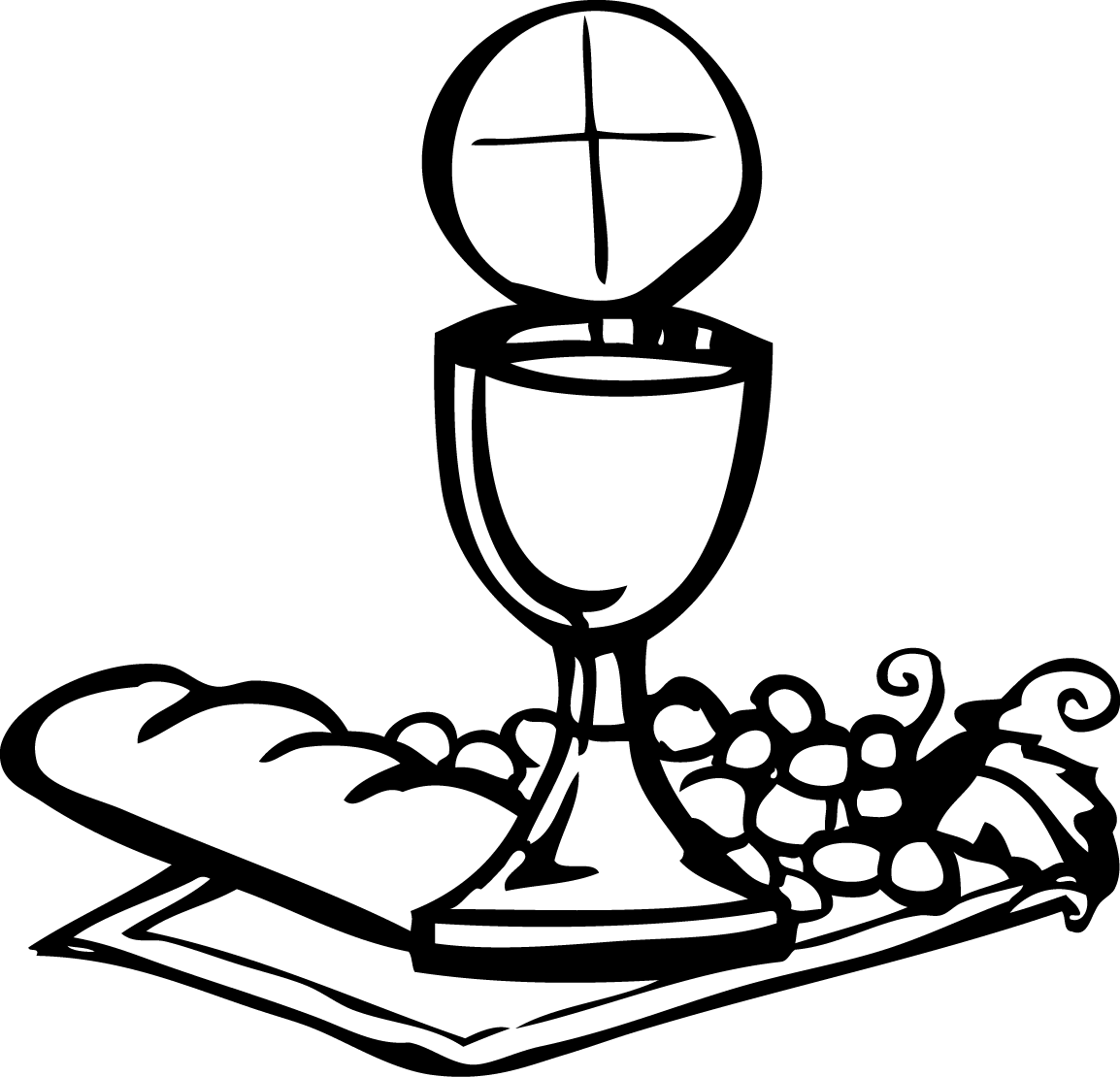
And in the sacrament
That we receive in Holy Communion,
Which feeds and strengthens us
While we are pilgrim travelers in this life.

And the Holy Spirit
Is indeed a waiter for us,
For he serves us this teaching
By enlightening our mind’s eye with it
And inspiring us to follow it.
And he serves us charity for our neighbors
And hunger to have as food
Souls
And the salvation of the whole world
For the Father’s honor

So we see that souls enlightened in you,
True light,
Never let a moment pass
Without eating this exquisite food
For your honor.


Music:  Ave Verum Corpus – words attributed to 14th century Pope Innocent VI, melody to Mozart

Thursday of the Second Week of Easter

April 28, 2022

Today, in God’s Lavish Mercy, our readings demonstrate how hard it is for some people to believe – because deepening belief usually requires a soul-change.

disputebeforesanhedrin1700
Fra Angelico, Dispute before Sanhedrin, Cappella Niccolina, Palazzi Pontifici, Vatican

In our first reading, the high priest and Sanhedrin just don’t get it. No matter how severe the oppression, Peter and the Apostles are not going to stop sharing the Good News. Even miracles and inexplicable prison escapes do not convince them that maybe the Apostles have some special blessing to offer them.

Why won’t the Sanhedrin listen? Why are they in such denial about what they are witnessing?

The Sanhedrin were members of a privileged class. They had things set up nicely to their material benefit. Jesus was a bombshell turning their comfortable world upside down. So they resorted to any tool possible to eradicate him: denial, oppression, persecution, even murder.

But the Good News of Jesus Christ is ineradicable.

Jn3_believe

In our Gospel, John minces no words about the fate of unbelievers:

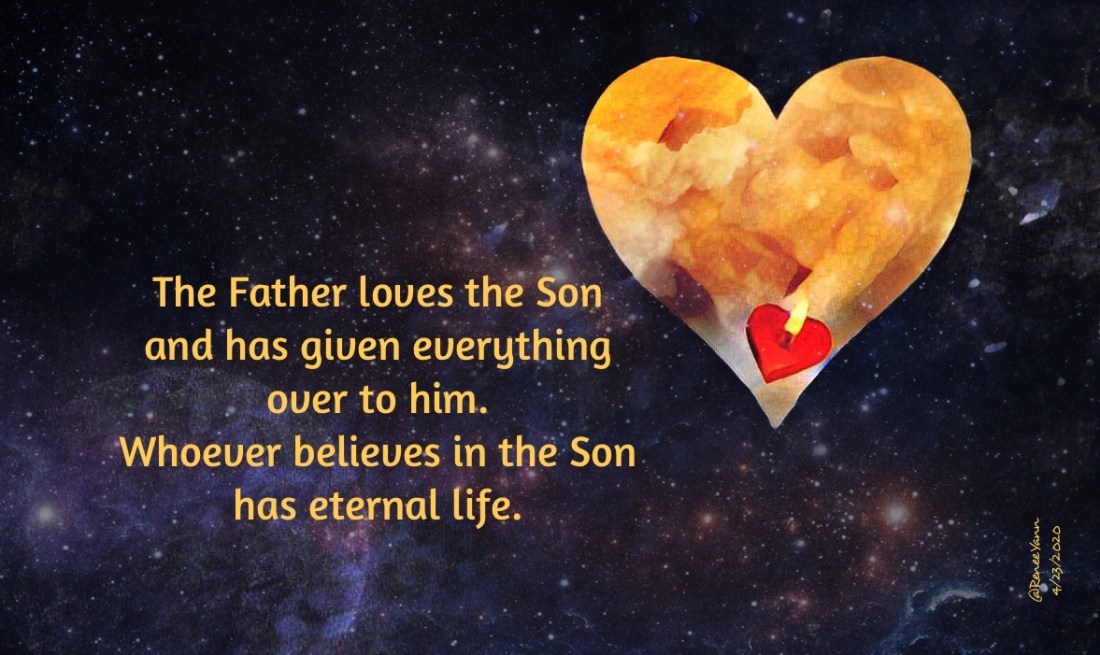
The Father loves the Son
and has given everything over to him.

Whoever believes in the Son has eternal life,
but whoever disobeys the Son will not see life,
but the wrath of God remains upon him.

John 3:35-36

When I look at our world, I see a lot of that “wrath”, don’t you? I see situations of war, pain, injustice, greed, and irreverence for Creation that could not exist in a truly believing world.

Seeing these things, I examine my own life for the places where faith has not converted me, for the kinds of resistant behaviors that prevented the Sanhedrin from receiving the greatest gift possible – a fully faithful and compassionate heart in the image of Jesus Christ.


Poetry: What We Need is Here – Wendell Berry

Horseback on Sunday morning,
harvest over, we taste persimmon
and wild grape, sharp sweet
of summer’s end. In time’s maze
over fall fields, we name names
that rest on graves. We open
a persimmon seed to find the tree
that stands in promise,
pale, in the seed’s marrow.
Geese appear high over us,
pass, and the sky closes. Abandon,
as in love or sleep, holds
them to their way, clear
in the ancient faith: what we need
is here. And we pray, not
for new earth or heaven, but to be
quiet in heart, and in eye,
clear. What we need is here.


Music: A Faithful Heart – Libera
(I imagine that this lovely song is usually interpreted as a marriage canticle, but I think it perfectly describes the sacred covenant between God and the faithful believer.)

Psalm 16: Easter Monday

Monday in the Octave of Easter

April 5, 2021


Today, in God’s Lavish Mercy, we pray with Psalm 16 in the light of our first reading from the Acts of the Apostles.

For the next seven weeks, our first readings will come from Acts, allowing us to journey with the early Church as it finds its way after Jesus’s Resurrection. At the same time, our Responsorial Psalms will enhance our spiritual understanding of the message of Acts. To support my prayer over these weeks, I will be using a book by scripture scholar William S. Kurz, SJ, Acts of the Apostles.


Kurz calls today’s passage, “Peter’s Argument from Scripture That Jesus Is the Christ (2:22–32)”. Peter structures this argument on two psalms, 16 and 110. He says that Psalm 16 is a foreshadowing of the Resurrected Messiah:

For David says of him:

    I saw the Lord ever before me,
        with him at my right hand I shall not be disturbed.
    Therefore my heart has been glad and my tongue has exulted;
        my flesh, too, will dwell in hope, 
    because you will not abandon my soul to the nether world,
        nor will you suffer your holy one to see corruption.
    You have made known to me the paths of life;
        you will fill me with joy in your presence.

Acts 2: 25-28 / Psalm 16: 8-11

Peter is instructing, proving, and convincing his audience that Jesus is indeed the promised Messiah who allows us all to conquer death with him. If we believe and live this Truth, all that is deathly has no power over us.

As we drink in the beauty of Spring blossoming all around us, let us place into the Easter Light any hint of fear, darkness or death we carry hidden in our hearts.


Poetry: Easter Wings – George Herbert (1593–1633)

Lord, Who createdst man in wealth and store,
        Though foolishly he lost the same,
              Decaying more and more,
                      Till he became
                        Most poore:
                        With Thee
                      O let me rise,
              As larks, harmoniously,
        And sing this day Thy victories:
Then shall the fall further the flight in me.
My tender age in sorrow did beginne;
  And still with sicknesses and shame
        Thou didst so punish sinne,
                  That I became
                   Most thinne.
                    With Thee
                Let me combine,
      And feel this day Thy victorie;
    For, if I imp my wing on Thine,
Affliction shall advance the flight in me.

Music: Christus – Franz Liszt

Lyrics: 

Christus vincit, Christus regnat,
Christus imperat in sempiterna saecula.
Hosanna in excelsis,
Halleluja.
Amen!

Christ conquers, Christ reigns,
Christ rules eternally.
Glory in the highest.
Alleluia!
Amen

Closing the Book

Saturday of the Seventh Week of Easter

May 30, 2020

Click here for readings

Today, in Mercy, on this day before Pentecost, we close the book on both Acts and John’s Gospel, companions we have been praying with since mid-April.

When I read a really great book, I hate it to end. The characters and their story linger in my mind. The places where I’ve pictured them seem real – as if I’ve visited there myself. And the core of their stories becomes part of me, a reference point for my own experience.

Hopefully, the same thing happens when we read and pray with scripture. 

bible


apostles

As we leave Acts today, we should feel like we know the early disciples better, especially Peter, Paul, Barnabas, Stephen, Lydia and others whose story might have touched us. We should better understand the ups and downs of the early Church, the passion for mission, and the evolution of faith – and how these speak to our own times.


Finishing John, we have a slightly different picture of Jesus from that of the Synoptic Gospels of Matthew, Mark, and Luke. We see a Jesus full of Light, his human existence described through the lens of his Divinity. Johannine scholar Raymond E. Brown describes the difference like this:

That Jesus is the center of John’s message is confirmed by even a hasty reading of the Gospel itself. The emphasis on the Kingdom of God, so prominent in the Synoptic Gospels, has yielded in John to an emphasis on Jesus as the embodiment of life, truth, and light. No more is the parabolic language introduced by “The kingdom of God is like,..”; rather we hear the majestic “I am ” Whereas it is the Kingdom that the Synoptic Gospels describe in terms of vineyard, wheat, shepherd and sheep, in John it is Jesus who is the vine, the bread, the shepherd, and the sheepgate.


shepherdvineeucharist


Today, in our prayer, we might want to glance back through these books, reminding ourselves of the words, phrases and stories that touched our own experience most deeply. 

John_I

Sketching such phrases – perhaps in a daily prayer journal –  is a good way to let our minds turn them over and over again in prayer, discovering new depths with each turn.


Music:  Cavalleria Rusticana: Easter Hymn – Pietro Mascagni, featuring Australian soprano Kiandra Howarth

I thought we’d close these two wonderful books, and the Easter Season, with a bang. (Lyrics and explanation below)


Click here to learn more about Cavalleria rusticana: The Easter Hymn

Lyrics:
LATIN AND ENGLISH:
CHORUS (within the church)
Regina coeli, laetare—Alleluia!
Quia, quem meruisti portare—Alleluia!
Resurrexit sicut dixit—Alleluia!

CHORUS (in the square)
We rejoice that our Saviour is living!
He all-glorious arose from the dead;
Joys of heaven the Lord to us giving,
All the sorrows of darkness are fled!
(The chorus goes out slowly)


ITALIAN:
CORO INTERNO (dalla Chiesa.)
Regina coeli, laetare—Alleluja!
Quia, quem meruisti portare—Alleluja!
Resurrexit sicut dixit—Alleluja!

CORO ESTERNO (sulla piazza.)
Inneggiamo, il Signor non è morto.
Ei fulgente ha dischiuso l’avel,
inneggiamo al Signore risorto
oggi asceso alla gloria del Ciel!
(il Coro esce lentamente)


Paul’s Great Sermon

Wednesday of the Sixth Week of Easter

May 20, 2020

Click here for readings

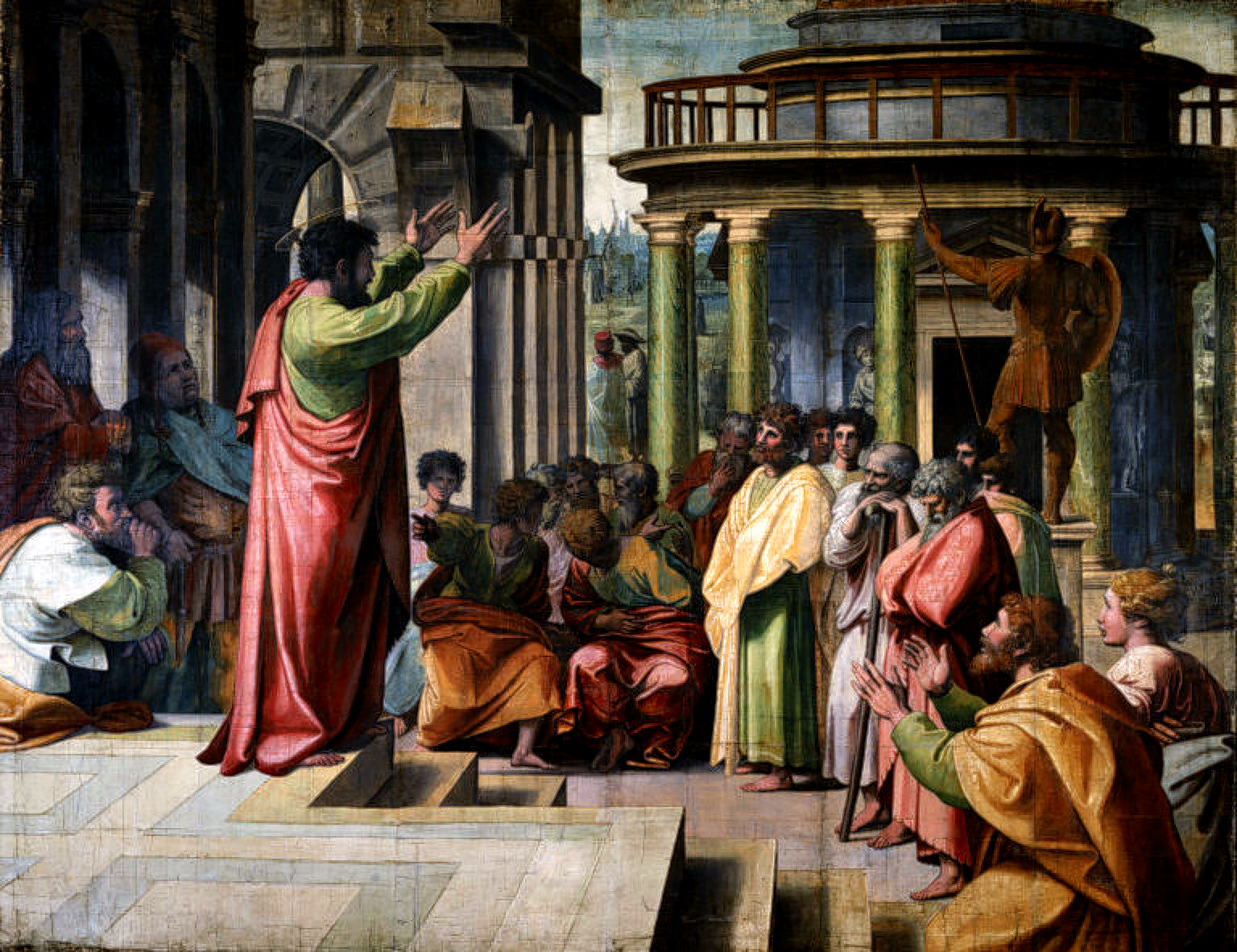
Today, in Mercy, Paul gives a magnificent oration at the Areopagus in Athens. It was a big deal billing!

V&A_-_Raphael,_St_Paul_Preaching_in_Athens_(1515)
St. Paul at the Areopagus by Raphael (c.1515)

Areopagus, earliest aristocratic council of ancient Athens. The name was taken from the Areopagus (“Ares’ Hill”), a low hill northwest of the Acropolis, which was its meeting place.

In pre-classical times (before the 5th century BC), the Areopagus was the council of elders of the city, similar to the Roman Senate. Like the Senate, its membership was restricted to those who had held high public office.

The Areopagus, like most city-state institutions, continued to function in Roman times, and it was from this location, drawing from the potential significance of the Athenian altar to the Unknown God that Paul is said to have delivered the famous speech, “Now what you worship as something unknown I am going to proclaim to you. The God who made the world and everything in it is the Lord of heaven and earth and does not live in temples built by hands.” (Wikipedia)


diamonds
The sermon has so many beautiful lines, like glorious diamonds that can be turned over and over in prayer. Here are a few that glistened for me:


God … does not dwell in sanctuaries made by human hands
(Instead, God dwells within us)


God is not served by human hands because God needs nothing.
(Instead, our everything comes from God)


God made from one the whole human race to dwell on the entire surface of the earth.
(We are all connected in the One Creation)


God fixed the ordered seasons and the boundaries of their regions,
so that people might seek God,
even perhaps grope for him and find him,
though indeed he is not far from any one of us.
(We do grope, sometimes in darkness.)


God has overlooked the times of ignorance,
but now he demands that all people everywhere repent…
(Without Christ, we were in shadows of unknowing. With Christ, we are in Light.)


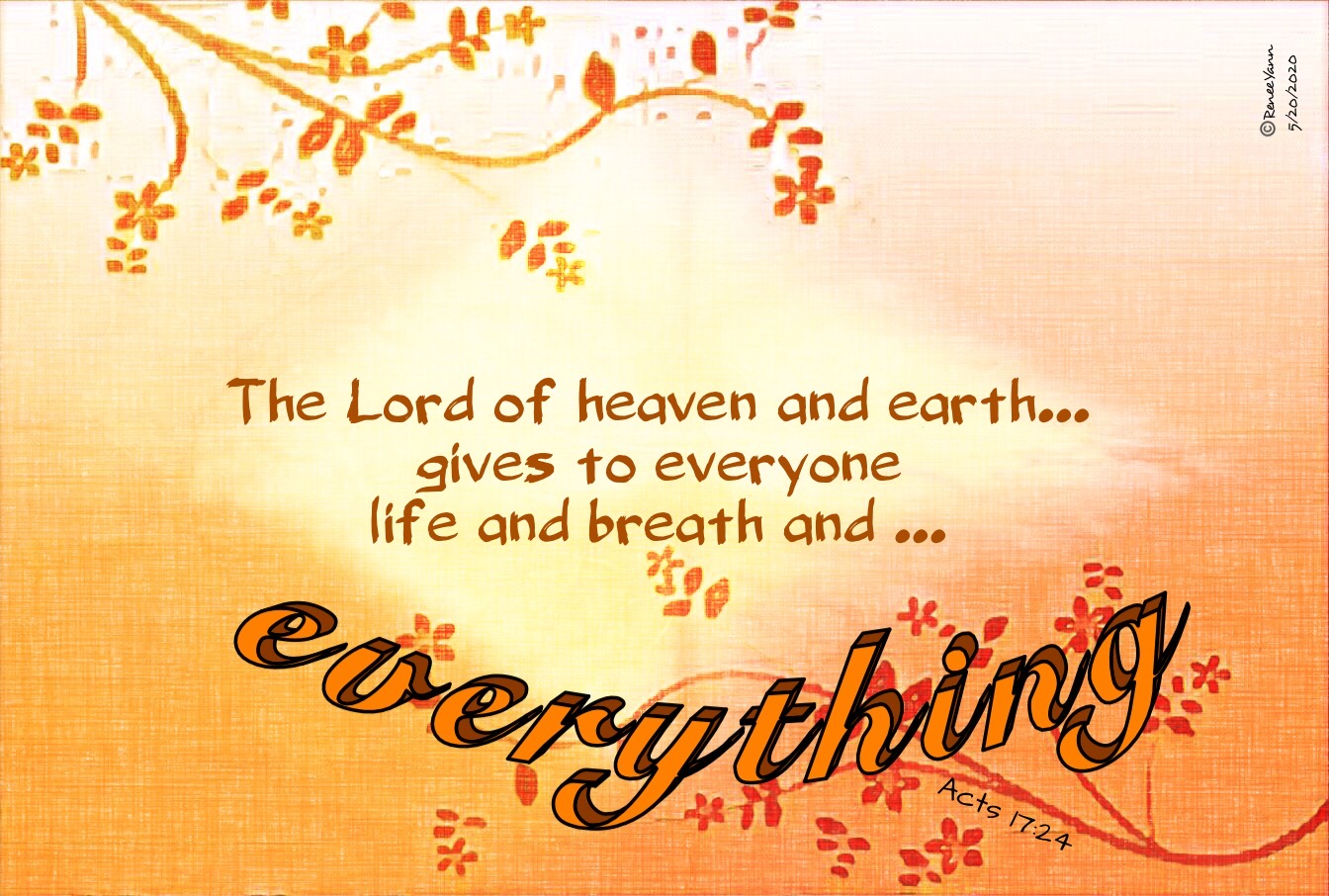
And my favorite:

Acts17_24 everything

What is the “everything” that God is giving you today? What is the abundance of grace, or hope, or longing in your heart as you pray today? Let God’s fullness embrace any emptiness as you offer God your silence and waiting.

Music: Everything – Lauren Daigle

Lydia, Shaded in Purple

Monday of the Sixth Week of Easter

May 18, 2020

Click here for readings

Today, in Mercy, Paul ventures for the first time into the area which is now modern Europe. He settles for a while in Philippi, the city which gives its name to my favorite epistle.

Pauls journeys

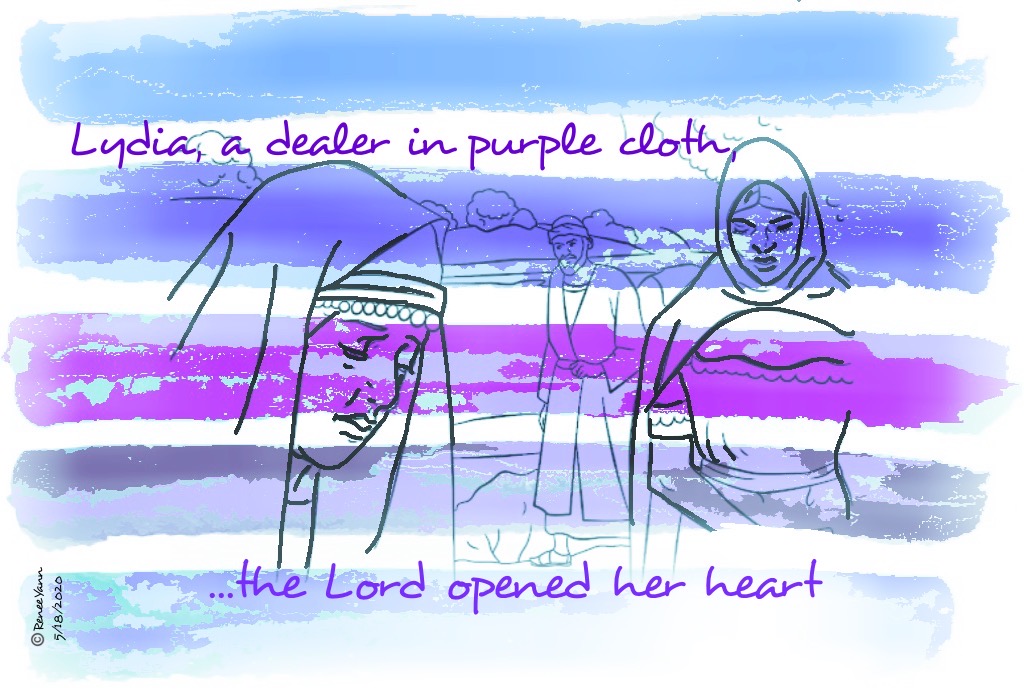
One morning, Paul, Silas and Timothy went down by the river to pray. There they met Lydia, one of the most influential yet mysterious women of the New Testament.

Lydia

Today’s verses are the only time she is mentioned in the scriptures, and there is no historical documentation about her. Yet, by her support and hospitality, she is likely responsible for the establishment of the Church in Europe and is considered its first convert.


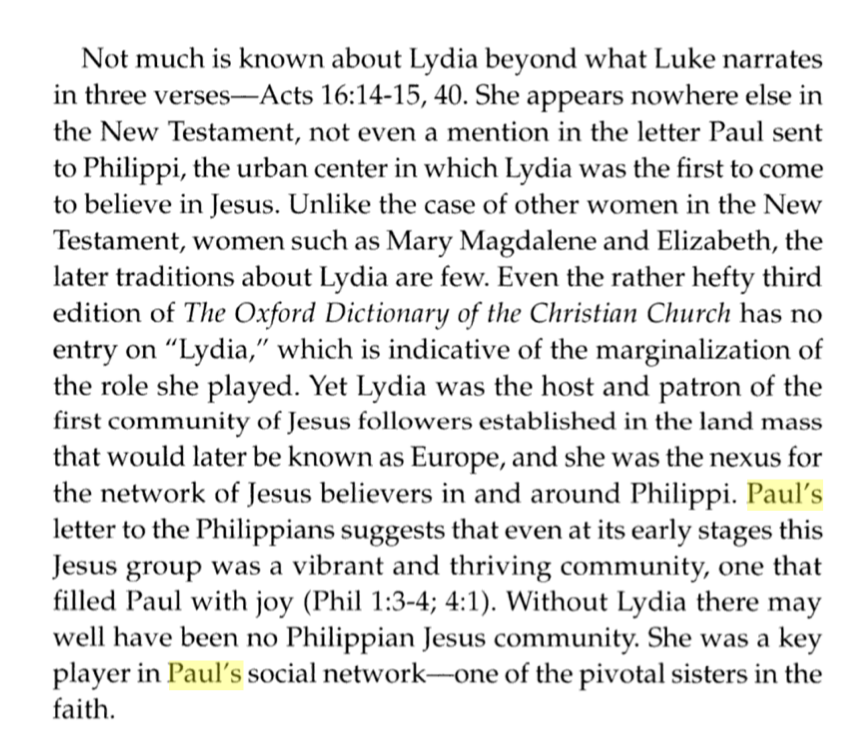
Despite the parcity of information about Lydia, Richard Ascough was able to write a book about her: Lydia: Paul’s Cosmopolitan Hostess

excerpt


Lydia, like many of our foremothers in faith, is hidden in the shadows of a patriarchal history. Sunlight briefly falls on Lydia in this engaging reading from Acts today.

I like to pray with this reading by imagining myself as one of Lydia’s companions, listening to her conversation with Paul, imagining her life as it unfolds into Christian leadership.

As we pray with Lydia today, let’s ask God to lead the Church to a clearer and more committed use of women’s gifts in Church life. Even Pope John Paul II made some small attempts in this direction:

“In this vast domain of service, the Church’s two-thousand-year history, for all its historical conditioning, has truly experienced the ‘genius of woman’; from the heart of the Church there have emerged women of the highest calibre who have left an impressive and beneficial mark in history.” 
John Paul II – “Letter to Women”

But our Church and its women need more than what has been. Let’s ask for women to be welcomed out of the shadows of ecclesial life into an appropriate equity in ministry.

Music: Patterns of Sun and Shade – Kathryn Kaye

Twelve Who Loved

Feast of Saint Matthias, Apostle

May 14, 2020

Click here for readings

12

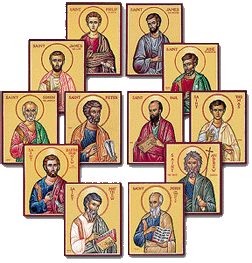
Today, in Mercy, Acts relates the story of Matthias and his inclusion as one of the Twelve. But besides Matthias, there was another man considered just as worthy of appointment, Justus. The lot did not fall on him and we never hear of him again.

So if there were two equally good men why didn’t they just widen the circle to thirteen Apostles?


This appointment of the twelfth apostle reflects the importance of the number twelve throughout Scripture. It is a number which signifies perfection, heritage, and strength.

Jacob 12
Jacob Blessing His Twelve Sons – T. Daziel (c.1893)

The Book of Genesis states there were twelve sons of Jacob and those twelve sons formed the twelve tribes of Israel. The New Testament tells us that Jesus had twelve apostles. According to the Book of Revelation, the kingdom of God has twelve gates guarded by twelve angels. 

So Matthias, the Twelfth, brought the circle of Apostles to wholeness.


JofCross
In our Gospel, Jesus tells us that he chooses us all to be his friends. It is a friendship built on imitation of him, proven by keeping his commandments. His commandments are clear:

          • Love God.
          • Love others as I have loved you.

Every day, by prayer and reflective living, we deepen in our love for God and neighbor. We learn Love within the revelation of our own lives.

joy

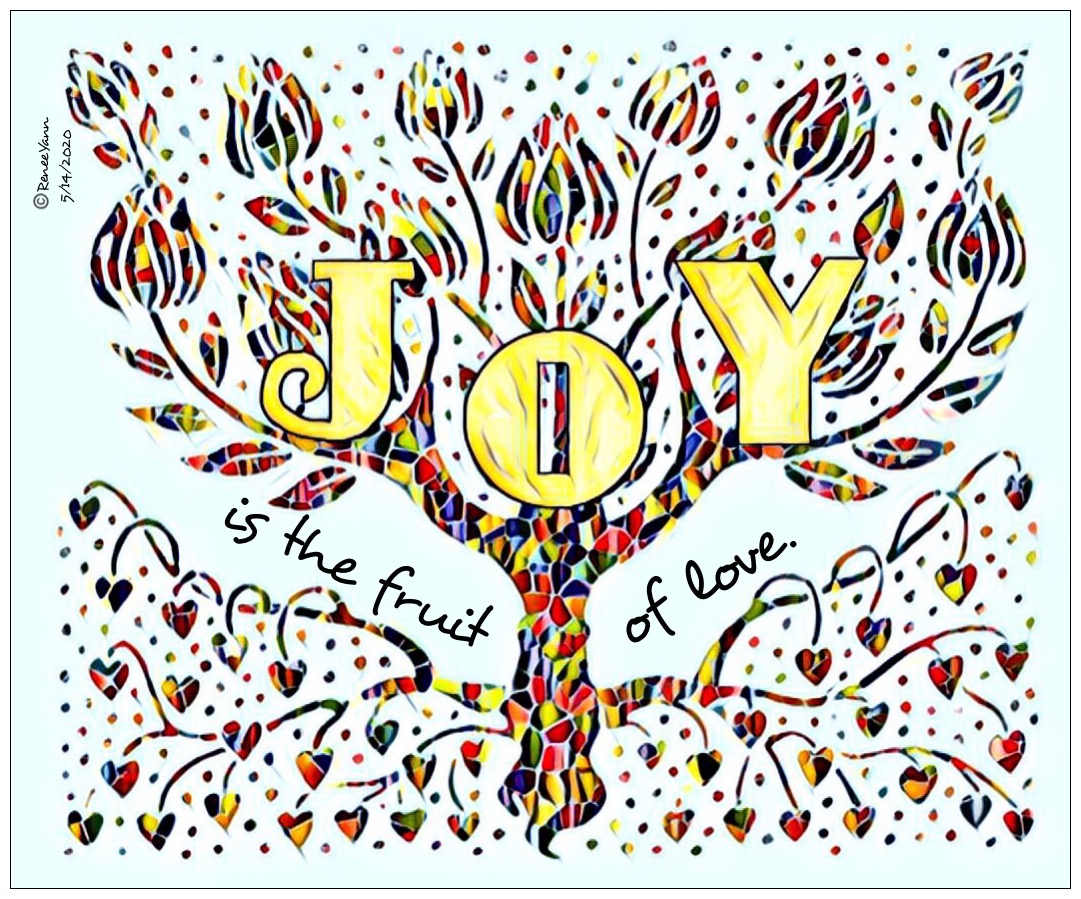
Jesus tells us that if we love like that our joy will be complete. May we be blessed by that holy joy.

Meditation: Instead of music today, a lovely meditation for those of us missing the celebration of Eucharist: No Longer Do I Call You Servants

Remain

Wednesday of the Fifth Week of Easter

May 13, 2020

Click here for readings

Today, in Mercy, Acts reveals the tensions in the Church between Jewish and Gentile believers. For the Jews, the ritual of circumcision was a key expression of covenantal faith. Some felt it was necessary for Gentile converts to undergo the ritual in order to become Christians.

Like all start-ups, the Church had many friction points which required decisions about what was essential and what was only customary. Those customs being thousands of years old, the decisions become even harder. Readings later this week describe more conflict points.

Nevertheless, under the guidance of the Holy Spirit, and despite the venerability of custom, the nascent Church was able embrace a new reality rooted in Christ’s inclusive love.

These kinds of philosophical and theological tugs-of-war have accompanied the Church down through history. Some of them have helped reveal deeper insights into our faith. But, as in all human communities, some of the tugs have been motivated by fear, greed, power, and other selfish interests.

Watching how the early Church handles their particular situation may give us hints about how we should handle them today.


In our Gospel, Jesus makes clear what is essential and inviolable to the faith:

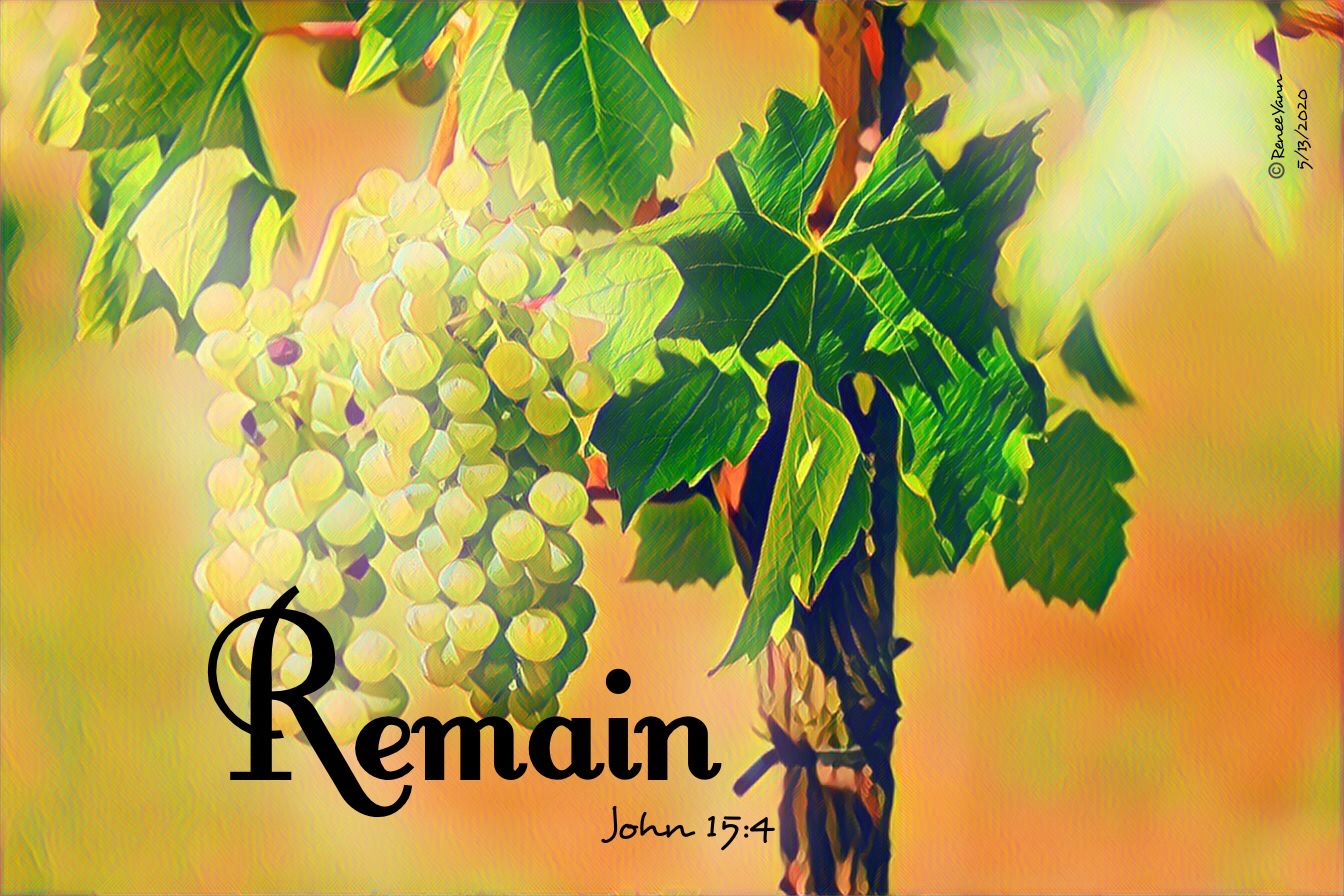
I am the vine, you are the branches.
Whoever remains in me and I in him will bear much fruit,
because without me you can do nothing.

John15_4 Remain

I think “Remain” is a beautiful word. In the dictionary, it will be defined as ‘stay’. But it connotes much more to me.  Re–main asks us not just to choose to stay with Jesus, but to choose it over and over – like reenlist, renew, recommit.

Remain means to endure with the Beloved Vine through every season – winter’s cold and summer’s heat, and all that’s in between.

Remain means “Love Me, stay beside me, even when others fall away.”

May we remain.


Music: I Am the Vine – John Michael Talbot

Lean on the Cornerstone

Fifth Sunday of Easter

May 10, 2020

Click here for readings

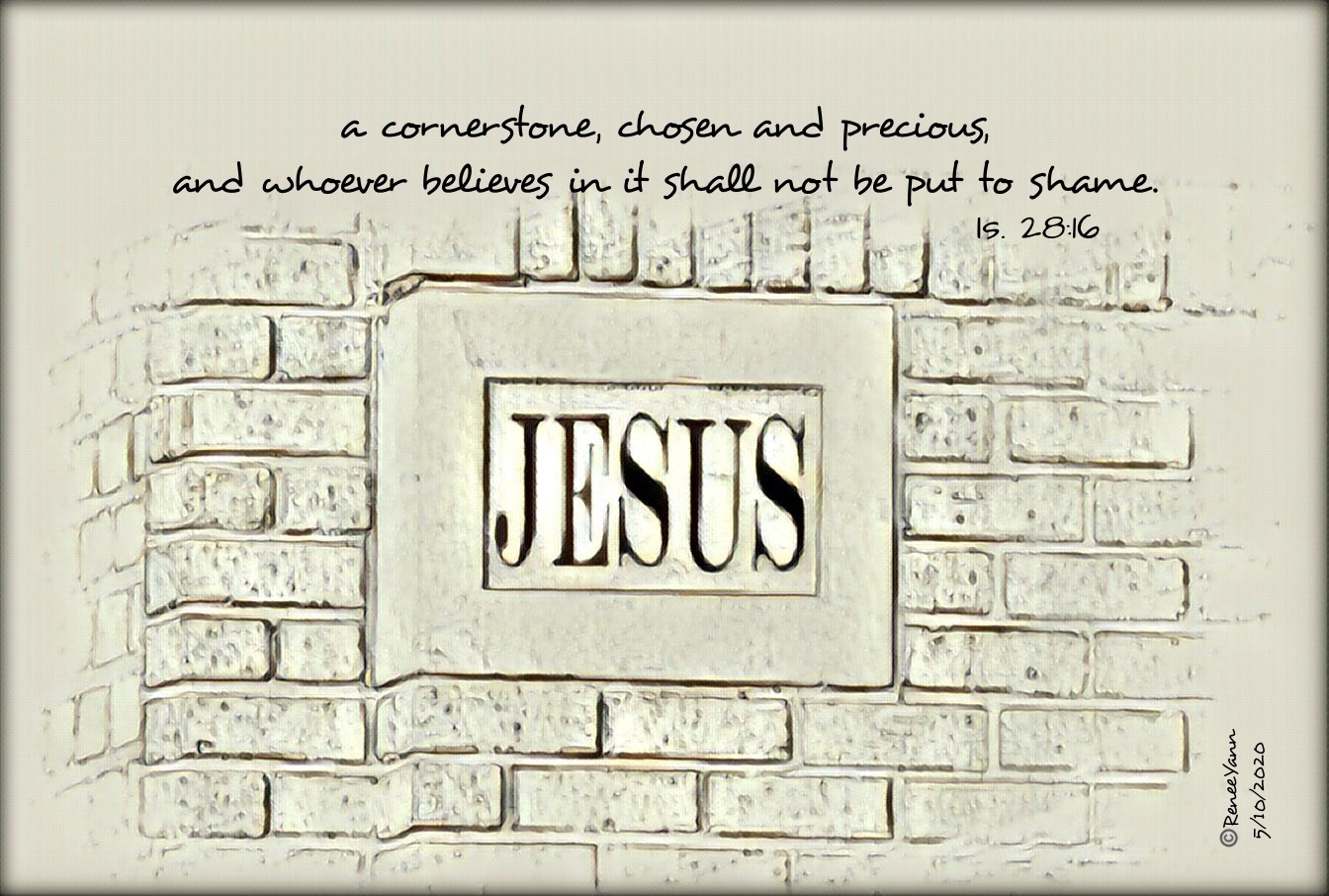
Today, in Mercy, our readings give us the powerful description of a growing Church built on the cornerstone of Jesus Christ.

Acts shows us how that young Church organizes itself on the pattern of Christ, its Foundation.

Our reading from Peter draws on Isaiah’s dynamic metaphor:

cornerstone

Jesus, too, describes a mansion, a sturdy dwelling place with God. It is not some ephemeral dream. That “mansion” is Christ himself who, by his death and Resurrection,  brings us home to our Original Love.


Such images help us to imagine the unimaginable, that God:

  • made us in the Divine Likeness
  • sent the Beloved to redeem us 
  • remains with us forever in the Holy Spirit
  • opens the doors of eternal life to us

This unimaginable grace is a trustworthy promise which we can rest on securely, as a magnificent building rests on its cornerstone.


When the exigencies of time and circumstance assail us, we need to go lean against that Rock. It will not move, even when everything else swirls around us.

Do not let your hearts be troubled.
You have faith in God; have faith also in me.
In my Father’s house there are many dwelling places…
…I will come back again and take you to myself,
so that where I am you also may be.


motherhouse early
19th century photo of Mercy Motherhouse from Lower Merion Historical Society

The beautiful buildings on our Motherhouse grounds are constructed of sixteen inch thick stones, chiseled by a 19th century stonemason. On a clear, late afternoon, one western wall heats up like a vertical oven, capturing all the final sunbeams of the day.  I like to lean against that wall, especially in winter, praying to the God Whose power it has absorbed. I ask that I too may absorb that power; that those for whom I pray may be wrapped in it.

Maybe today, you might find a stone like that to help you pray. Even hold a small one in your hand.

Such images can yield unexpected grace.

Music: Cornerstone – Hillsong ( Lyrics below)

My hope is built on nothing less
Than Jesus’ blood and righteousness
I dare not trust the sweetest frame
But wholly trust is Jesus’ name

My hope is built on nothing less
Than Jesus’ blood and righteousness
I dare not trust the sweetest frame
But wholly trust is Jesus’ name
Christ alone, Cornerstone

Weak made strong in the Savior’s love
Through the storm
He is Lord
Lord of all

When darkness seems to hide His face
I rest on His unchanging grace
In every high and stormy gale
My anchor holds within the veil
Christ alone, Cornerstone

Weak made strong in the Savior’s love
Through the storm
He is Lord
Lord of all
He is Lord
Lord of all, Christ alone
Christ alone, Cornerstone

Weak made strong in the Savior’s love
Through the storm
He is Lord
Lord of all
Christ alone, Cornerstone

Weak made strong in the Savior’s love
Through the storm
He is Lord
Lord of all

When he shall come with trumpet sound
Oh, may I then in Him be found
Dressed in His righteousness alone
Faultless, stand before the throne
Cornerstone

Oh, yeah, in the Savior’s love
He is Lord
Lord of all

Christ alone, Cornerstone
Weak made strong in the Savior’s love
Through the storm
He is Lord
Lord of all

The Power of the Name

Saturday of the Fourth Week of Easter

May 9, 2020

Click here for readings

Today, in Mercy, Paul and Barnabas make a final grand effort to speak to the hearts of the Jews in Antioch. The outcome is both bad news and good news.

The Jewish community resists the Word. But the Gentiles receive it with an open heart and the Gospel ignites “through the whole region”. The catechesis was so successful that resisters mounted the persecution and expulsion of the disciples from the neighborhood.

Then reminiscent of Jesus’s advice in Matthew 10:14:

dust

So they shook the dust from their feet
in protest against them
and went to Iconium.
The disciples were filled with joy and the Holy Spirit.


acts3_6 Name_Original

In our Gospel, Jesus instructs his disciples that He and the Father are one:

“If you know me, then you will also know my Father.
From now on you do know him and have seen him.”


Philip
Philip, like Thomas in yesterday’s Gospel, says he needs a little more to go on than that simple statement:

“Master, show us the Father,
and that will be enough for us.”

Jesus once again patiently reminds Philip and the others that all that they have experienced in Him is a revelation of the Father. He further tells them that they themselves are to be that ongoing revelation for the world:

“Amen, amen, I say to you,
whoever believes in me will do the works that I do,
and will do greater ones than these,
because I am going to the Father.
And whatever you ask in my name, I will do,
so that the Father may be glorified in the Son.
If you ask anything of me in my name, I will do it.”


As Christians, we believe that we too are commissioned in the Name of Christ to be his Presence in the world. Jesus tells us that whatever we ask in his Name will be accomplished.

That doesn’t mean that the name of Jesus is a magic formula to get what we want.

Instead, within the Holy Name, we come to trust the mercy, love, and abiding accompaniment of God. Such trust allows us to see the slow working of God’s loving Will in all things – just as Jesus did through his faithful life, heartbreaking death, and ultimately triumphant Resurrection.

Let us gently repeat that beloved Name in our prayer, asking that its sweet grace enlighten and transform us.

Music: In the Name of the Lord – Gloria Gaithersburg, Phil McHugh, and Sandi Patti