Today, in Mercy, our readings again visit the question, “Who belongs to family of God?”.
Peter, upon returning to Jerusalem from Joppa, faces the Jewish Christians who are only learning how to live their new faith. They don’t get it that Gentiles are invited too to this emerging faith community.
They, like many of us, find security in the categories we build into our lives. We separate those who belong and don’t belong – sometimes to assure ourselves that we belong in certain preferred categories. We decide who is OK and who is not. The Gentiles were not OK church members for the Jerusalem Christians.
Peter is very patient with these critics. Point by point, he explains how his own understanding was informed by the Holy Spirit, so that he saw clearly that Christ’s invitation was for all people.
This reading challenges us to examine our “categories”, our biases and prejudices. Who is OK in my book, and who is suspect or questionable? In my thinking, who has a “right” to certain goods, positions and privileges? Who would I not invite to my table based on my predetermined “categories”?
With Christ, there are no privileged categories. We are each the privileged child of God, universally redeemed in the blood of Christ.
As I pray with this thought today, how might my attitudes and choices be affected?
Today, in Mercy, our three readings make one thing very clear – we are ALL invited to membership in the Body of Christ. We are ALL welcome in the Beloved Community.
In our first reading,Paul and Barnabas preach to Jews, converts to Judaism and to Gentiles – to the effect that:
All who were destined for eternal life came to believe, and the word of the Lord continued to spread through the whole region.
In our second reading:
John, had a vision of a great multitude, which no one could count, from every nation, race, people, and tongue. They stood before the throne and before the Lamb.
And in our Gospel, Jesus says:
My sheep hear my voice; I know them, and they follow me. I give them eternal life, and they shall never perish.
These readings describe the family of God to which every human being has been given entrance through the Death and Resurrection of Christ.
Think about that:
when you look into people’s eyes today
when you see their stories on the news
when you people-watch at the airport or the mall
when you drive by a cemetery where lives are remembered in stone
when you look at your children, your friends, your foes
when you take that last look in the mirror tonight before you fall asleep
This person has been invited, with me, to the family of God. How might that thought influence my choices and actions each day?
All of us – ALL OF US- are welcome; all of us, equally loved.
Today, in Mercy,Acts describes Peter in the full energy of his discipleship. The infant Church was at peace, being built up by the power of the Holy Spirit.
Peter, completely filled with this sacred power, raises a woman from the dead. He does this in the Name of Jesus to Whom he has given his entire being.
Our Gospel describes the moment of Peter’s total commitment. Some have turned away from Jesus because of his teaching on the Eucharist. Jesus asks the Twelve if they to wish to go too.
Simon Peter answered him, “Master, to whom shall we go? You have the words of eternal life. We have come to believe and are convinced that you are the Holy One of God.
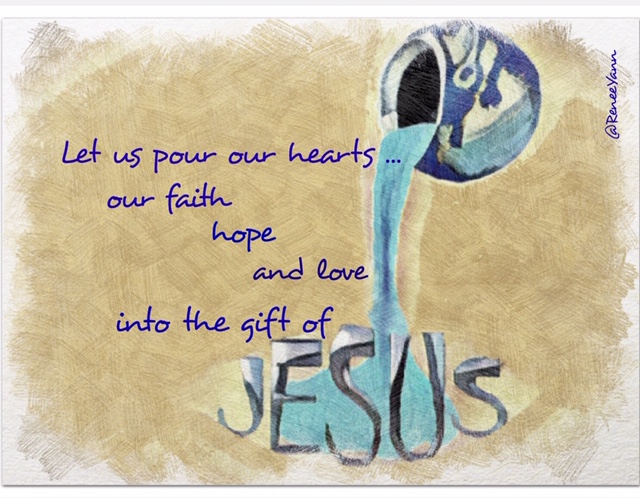
At pivotal points in our faith life, Jesus asks us the same question. May we always have the strength and insight to turn toward Christ. May we pour our hearts into the welcoming love of Jesus, just as Peter did.
Music: To Whom Shall We Go – Robin and Staci Calamaio – Father and daughter team
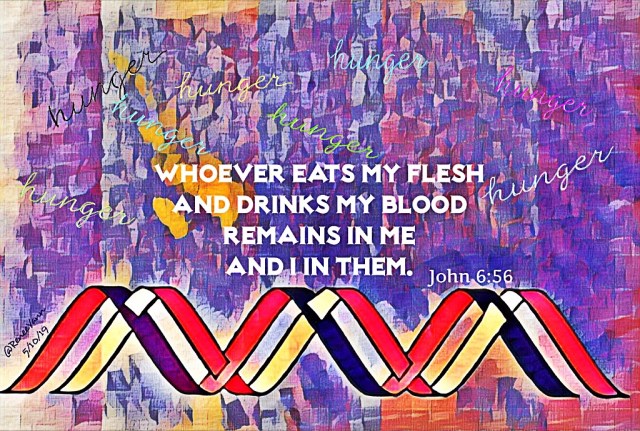
Today, in Mercy, John gives us the core teaching of the Eucharist.
For many, it is a hard teaching. How can Jesus give us his flesh and blood to nourish us? How can mere bread and wine embody this gift?
Have you ever been profoundly hungry? For most of us, probably not in a physical sense. But what about your heart and soul?
Have you ever longed to be loved, understood, accepted, or valued?
Have you ever felt famished for peace, rest, comfort, security, or solitude?
Have you ever longed to be delivered from gnawing anxiety, depression, fear, sorrow or loneliness?
Jesus recognizes all our hungers. He desires to enfold them in his Healing Mercy. He unites us to himself in the sacred reality of Eucharist, made visible to us in bread and wine.
In Eucharist , these fruits of the earth are not simply symbols pointing to another reality. By the power of God, they become sacraments embodying the reality themselves.
This mystery is one that must be embraced by the heart and soul, not one only to be analyzed by the mind. By opening the deep hungers of our spirit to the healing presence of Christ in Eucharist, we will be fed in ways we could never have imagined. In Mercy, we will become sources of nourishment for the broken world around us.
Music: Bread of the World in Mercy Broken – Reginald Heber
Today, in Mercy, Acts gives us the memorable story of Philip and the Ethiopian eunuch.
When I was novice (back in the Middle Ages), I loved a book called “Unless Some Man Show Me” written by Alexander Jones. It was one of the first books that opened my mind to the study of scripture. At that time, the Church itself was continuing to explore a new age of scriptural scholarship.
Those of a certain age, like myself, will recall that we did not read the Bible directly when we were young. In school, we had “Bible Study”, but most of us never handled a real Bible. Even at Mass, the Gospel was read in Latin. We followed along in an English missal if we were lucky enough to have one.
In 1943, Pope Pius XII had issued the encyclical Divino Afflante Spiritu (Inspired by the Holy Spirit). The letter called for new translations of the Bible into vernacular forms. In a huge shift, the Pope encouraged the use of the original languages for these translations, rather than the historically used Latin Vulgate.
This allowed for the removal of pietistical and dogmatic accretions which had been added over the many centuries of Vulgate interpretations. The eminent Catholic biblical scholar Raymond Brown describedthe encyclical as a “Magna Carta for biblical progress”.
How fortunate we were in the 1960s to be exposed to the opening of the Church to a new dimension. I remember, as a high schooler being taught the exquisite Gelineau Psalms, my first taste of pure scripture.
By 1966, scholars had published the magnificent Jerusalem Bible, originally translated to French from the root languages, and then to English. I cherished that Bible, gifted to me by my parents for my final profession that very year. It stills sits beside my chair and accompanies my morning prayer.
“ Unless someone show us…” we may not grow in our love for sacred scripture. We may not realize that this Word lives in our lives and works to bring us to God!
I encourage you today, if you are so inclined, to deepen yourselves in the love and understanding of holy scripture. Below are some of my favorite authors who, over the past 50 years, have led me to a deep love of God’s Word.
(Sorry for the delayed post today. I got caught down memory lane with some of these theologians!)
Music: Breathe – Michael W. Smith
Jean Daniélou
Daniel Harrington
Marie-Joseph Lagrange
Edward Schillebeeckx
Dietrich Bonhoeffer
Yves Congar
Hans Küng
Bernard Lonergan
Johann Baptist Metz
Mary Daly
Karl Rahner
Rosemary Radford Ruether
Elisabeth Schüssler Fiorenza
Marcus Borg
Walter Bruggemann
Thomas Berry
Leonardo Boff
Charles Curran
Elizabeth Johnson
Thelma Hall, RC
Karhryn Sullivan, RSCJ
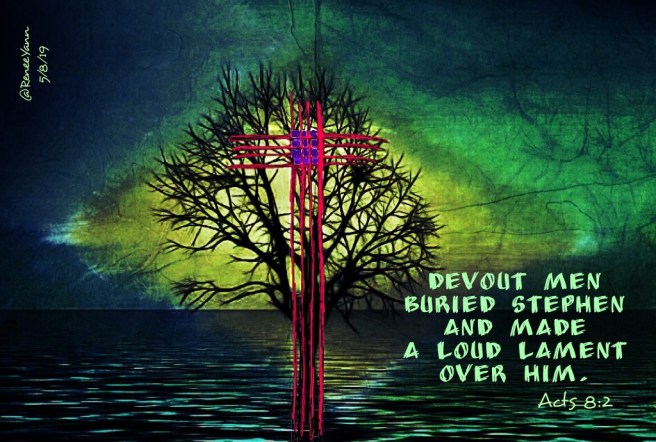
Today, in Mercy, the inevitable shadow falls over the early Christian community. Stephen is martyred – the first, the proto-martyr of many, down through the centuries, who will die for their faith.
This slaughter of innocence happened at the feet, and at the approbation, of Saul – yet untouched by the glorious grace of Christ.
How the community must have mourned beloved Stephen who, as our hymn describes him, was “bright with Love”:
Stephen, a man filled with faith and the Holy Spirit (Acts 6:5)
Stephen, filled with grace and power, was working great wonders and signs among the people (Acts 6:8)
All those who sat in the Sanhedrin looked intently at Stephen and saw that his face was like the face of an angel. (Acts 6:15)
Stephen, filled with the holy Spirit, looked up intently to heaven and saw the glory of God and Jesus standing at the right hand of God (Acts 7:8)
Stephen, as they were stoning him, called out, “Lord Jesus, receive my spirit. ( Acts 7:55)
What a treasure of a man! What a devastation to see his young, gracious life crushed by rejection, suffering and pain!
It is so hard to lose our prophets and saints!
I still remember, with great awe, the funeral of our Sister Mary Joanna Regan – one of the graced treasures of the Sisters of Mercy. Our Beloved Community was raw with her loss – as was the larger community of her love and influence.
Joanna’s dear friend, Father John Comey, SJ – now also of beloved memory – preached the sermon at her funeral liturgy. This was his first sentence:
How can such a woman die?
Dear Readers, haven’t we all felt that way in the face of some great loss? Whenever human frailty seems to bend to the powers of death, hatred, or oppression, our souls are crushed. We are astounded that life and goodness seem to yield. So was the early Christian Church when Stephen seemed to fall to hateful hands.
Nevertheless, they believed that there is an eternal life in God beyond that apparent yielding. They persisted in the ardent work of building up the reign of Christ.
Now those who had been scattered continued preaching the word. … and there was great joy in that city.
And the witness of Stephen impelled not only them, but twenty centuries of committed Christians who find their fullness of life in Jesus Christ.
Certainly our Church, with its many recent fractures and falls, needs a resilient, faithful community to lift it up and carry it forward. Let’s pray to St. Stephen today that we may be that community!
(English and Latin canticle today, plus lovely poem after them)
Music:Sancte Dei, Pretiose– sung by the Benedictine Monks of St. Michael’s de Laudes
Latin Version
Sancte Dei, pretiose,
Protomartyr Stephane,
Qui virtute caritatis
Circumfulsus undique,
Dominum pro inimico
Exorasti populo
Et coronae qua nitescis
Almus sacri nominis,
Nos, qui tibi famulamur,
Fac consortes fieri :
Et expertes dirae mortis
In die Judicii.
Gloria et honor Deo
Qui te flora roseo
Coronavit et locavit
In throno sidereo :
Salvet reos, solvens eos
A mortis aculeo. Amen.
English Version
Saint of God, elect and precious,
Protomartyr Stephen, bright
With thy love of amplest measure,
Shining round thee like a light;
Who to God commendest, dying,
Them that did thee all despite.
Glitters now the crown above thee,
Figured in thy honored name:
O that we, who truly love thee.
May have portion in the same;
In the dreadful day of judgment
Fearing neither sin nor shame.
Laud to God, and might, and honor,
Who with flowers of rosy dye
Crowned thy forehead, and hath placed thee
In the starry throne on high:
He direct us, He protect us,
From death’s sting eternally.
Poem: St. Stephen by Malcolm Guite
Witness for Jesus, man of fruitful blood,
Your martyrdom begins and stands for all.
They saw the stones, you saw the face of God,
And sowed a seed that blossomed in St. Paul.
When Saul departed breathing threats and slaughter
He had to pass through that Damascus gate
Where he had held the coats and heard the laughter
As Christ, alive in you, forgave his hate,
And showed him the same light you saw from heaven
And taught him, through his blindness, how to see;
Christ did not ask ‘Why were you stoning Stephen?’
But ‘Saul, why are you persecuting me?’
Each martyr after you adds to his story,
As clouds of witness shine through clouds of glory
Today, in Mercy, the crowd demands a sign from Jesus “that they may believe” in him. They refer to their ancestral memory of when God sent manna to their forebears in the desert – a miracle that restored their faith.
But although Jesus worked many wonders, he was not sent simply to be a “wonder worker”. The faith of the New Creation was not to be built on miracles but on sacrificial love.
Jesus tells the assembled crowd:
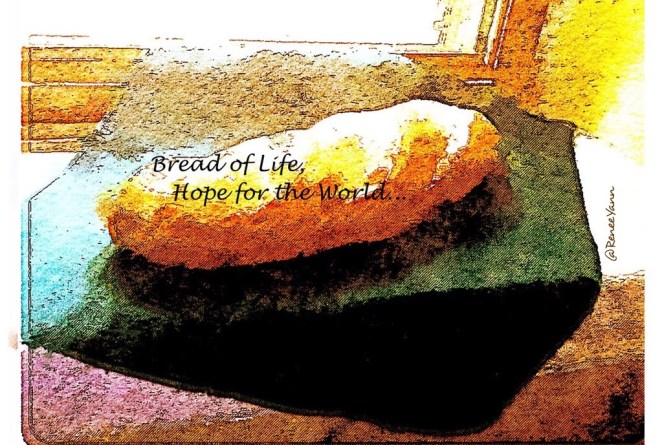
“ My Father gives you the true bread from heaven. For the bread of God is that which comes down from heaven and gives life to the world.”
He is talking about himself, the ultimate gift of God, feeding not just the body but the spirit – giving new life to all Creation.
The sacrament of the Eucharist embraces this mystery and extends it through the ages. Embodied in the Sacred Bread, this mystery is also incarnated in the People of God as they believe, hope and love God’s Presence into the world.
As with all sacred mysteries, we cannot simply choose to believe as a rational act. This faith is not willed by us, but rather gifted to us, as Jesus says:
“ You cannot come to Me unless the Father draw you.”
The crowd gathered around Jesus in today’s Gospel is asking him for a sign before they will believe. Let us instead ask God for the grace to open our hearts undemandingly to the deep gift of faith God wishes to give us.
Music: Bread of Heaven – Jessie Manibusan(Lyrics below)
Bread of heaven, Savior broken,
cup of life outpoured;
we your people thirst and hunger.
Come renew us, Lord;
come renew us, Lord.
From the mountain, blessing spoken
where we came to pray;
with the simple truth before us:
love them in my name;
love them in my name.
From the garden dark with sorrow,
from the tears you wept,
bloomed the flower of salvation:
new life born of death,
new life born of death.
From the hill where love was lifted
on the heavy wood,
flow the blood and streams of mercy
where your Mother stood,
where your Mother stood.
From the tomb that could not hold you
in the dark of night,
broke that morning of redemption,
raising us to life,
raising us to life.
A little note of gratitude to my followers on this blog. Several of you, whom I already know from FB and other spots, have joined recently. i really appreciate that! Thank you.
And thank you to all who take the time to hit the “Like” button. It helps me to understand if my efforts make a difference for you all. Love to you and thank you.
Please invite your friends to the blog if you think they might enjoy it. As of now, this blog had over 1000 followers all over the world! Imagine!
Your friends can just go to “lavishmercy.com” and click on the icon on the lower right corner to subscribe.
Blessings to you all, dear friends. Prayers for you, your families, and all your needs. ❤️
Sister Renee
(Remember, you can always reach me at renee.yann@gmail.com)
Today, in Mercy, Acts tells us more about Stephen, who was introduced in Saturday’s reading as “a man filled with faith and the Holy Spirit”.
Stephen is among the first group of Christians designated as deacons “to serve at table” – in other words, to do the administrative tasks that kept the community whole.
However, Stephen’s gifts went well beyond these services. Acts describes him like this:
Stephen, filled with grace and power, was working great wonders and signs among the people.
This man was radiant with Holy Spirit! He had so opened his soul to God’s grace and power that he was transformed even to the point that, when indicted:
All those who sat in the Sanhedrin looked intently at him and saw that his face was like the face of an angel.
That same grace and power that fired Stephen’s spirit are available to us. In this holy Eastertide, as we await the Holy Spirit on Pentecost, let us give sincere time and intention to praying for these gifts – for ourselves, for our faith communities, our communities of love, for our leaders, for our world.
This poem by Gerard Manley Hopkins might help us picture how the Holy Spirit waits to be welcomed into our hearts and lives:
God’s Grandeur
The world is charged with the grandeur of God. It will flame out, like shining from shook foil; It gathers to a greatness, like the ooze of oil Crushed. Why do men then now not reck his rod? Generations have trod, have trod, have trod; And all is seared with trade; bleared, smeared with toil; And wears man’s smudge and shares man’s smell: the soil Is bare now, nor can foot feel, being shod.
And for all this, nature is never spent; There lives the dearest freshness deep down things; And though the last lights off the black West went Oh, morning, at the brown brink eastward, springs— Because the Holy Ghost over the bent World broods with warm breast and with ah! bright wings.
(Gerard Manley Hopkins (1844–89). Poems. 1918.)
Music: J.S.Bach – Gedenk an uns mit deiner Liebe (Think of us with your Love)
– from Cantata BWV 29 – Wir danken dir, Gott, wir danken dir (Tranlations below)
Gedenk an uns mit deiner Liebe,
Schleuß uns in dein Erbarmen ein!
Segne die, so uns regieren,
Die uns leiten, schützen, führen,
Segne, die gehorsam sein!
Think of us with your love, enclose us in your pity! Bless those who govern us, those who guide, protect and lead us, bless those who are obedient!







 Lavish Mercy