Psalm 33: Unfailing Trust

Memorial of the Passion of Saint John the Baptist

August 29, 2020

Today, in God’s Lavish Mercy, we pray again with Psalm 33. Today’s verses console us with the reminder that God is watching over us, as individuals and as communities.

Blessed the nation whose God is the LORD,
the people chosen for God’s own inheritance.
From heaven the LORD looks down;
seeing all humanity.

You know, sometimes I wonder! How can God see some of the things going on in the world and not intervene? How can God let innocence suffer? The psalm seems to promise that intervention, but does it really?

But see, the eyes of the LORD are upon those who fear God,
upon those who hope for God’s kindness,
To deliver them from death
and preserve them in spite of famine.

That last line is the zinger. It doesn’t say there will be no famine. It simply says that the God-fearing will be preserved despite the famine.


Hasn’t your life taught you that? We’ve all been through lots of things that we asked God to take away – pain, sadness, fear, loss. Probably most, if not all, of those burdens remained with us until we worked through them. 

By faith and God’s Grace, we came through the other side stronger, deeper, more faithful. If we can trust God, “wait on the Lord”, the way comes to us – a way that leads us more deeply into God’s freedom and joy.

Our soul waits for the LORD,
who is our help and our shield,
For in God our hearts rejoice;
in God’s holy name we trust.

Let’s pray for that kind of faith and trust for ourselves and for our beloveds. Let’s pray for the courage to learn it by unfailing prayer and practice.


Poetry: In Memoriam A. H. H. OBIIT MDCCCXXXIII: 54
by Alfred Lord Tennyson

Oh, yet we trust that somehow good 
         Will be the final end of ill, 
         To pangs of nature, sins of will, 
Defects of doubt, and taints of blood; 

That nothing walks with aimless feet; 
         That not one life shall be destroy'd, 
         Or cast as rubbish to the void, 
When God hath made the pile complete; 

That not a worm is cloven in vain; 
         That not a moth with vain desire 
         Is shrivell'd in a fruitless fire, 
Or but subserves another's gain. 

Behold, we know not anything; 
         I can but trust that good shall fall 
         At last—far off—at last, to all, 
And every winter change to spring. 

So runs my dream: but what am I? 
         An infant crying in the night: 
         An infant crying for the light: 
And with no language but a cry. 

Music: The Passion of John – Johann Sebastian Bach

This piece is not about John the Baptist. It is an excerpt from two hour meditation of the Passion narrative in John the Evangelist’s Gospel.

However, this beautiful excerpt fits so well with today’s reflection.

Psalm 33:Love’s Design

Memorial of Saint Augustine, Bishop and Doctor of the Church

August 28, 2020


Today, in God’s Lavish Mercy, we pray with Psalm 33, a song of praise calling the people to rejoice in God’s justice and kindness.

In its attitude of trust and freedom, the Psalm might remind us of Robert Browning’s verse:

God’s in his heaven. All’s right with the world.

But neither in the psalmist’s time, nor in Browning’s, was everything really “all right” with the world. Things are never really “all right” with the world. There is always war, crime, hunger, disease, natural disasters, and a slew of other troubles brewing somewhere.

So how can the psalmist or any other preacher invite us to trust, believe, and rejoice like this?

Exult, you just, in the LORD;
praise from the upright is fitting.
Give thanks to the LORD on the harp;
with the ten-stringed lyre chant his praises.


Keywords in this verse give us a clue: those who are just and upright will see the pattern of God’s mercy which lies deeper than the troubles of this world. They will trust and be comforted by God’s transcendent faithfulness to us in all things. Their faith and joy in the face of suffering will confound the faithless.


Calling us to the full meaning of Christ’s sacrificial love, Paul reiterates this mysteriously contradictory truth in our first reading :

For the foolishness of God is wiser than human wisdom,
and the weakness of God is stronger than human strength.

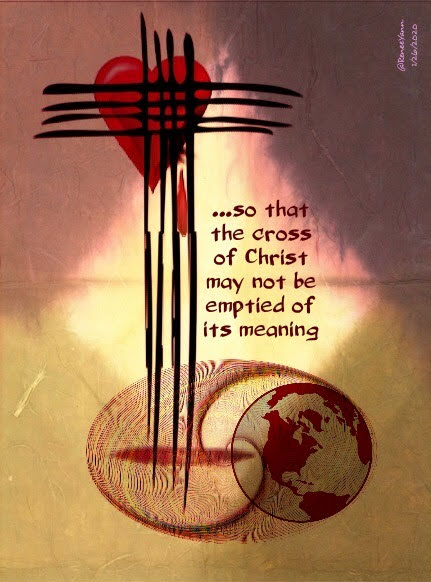
For Christians, the Cross is the ultimate symbol of this profound wisdom and strength. It is a mystery too deep for our understanding, but by faith we may slowly become immersed in its Truth.


The message of the cross is foolishness to those who are perishing, 
but to us who are being saved it is the power of God.

1 Corinthians 18

As we pray with Psalm 33 today, let us be aware of the cause of our joy – a holy joy deeply rooted in God, trusting God’s Will for our salvation in the pattern of Jesus Christ.


For upright is the word of the LORD,
and all God’s works are trustworthy.
The LORD loves justice and right;
of the kindness of the Lord the earth is full.


Poetry: Primary Wonder – Denise Levertov

Days pass when I forget the mystery.
Problems insoluble and problems offering
their own ignored solutions
jostle for my attention, they crowd its antechamber
along with a host of diversions, my courtiers, wearing
their colored clothes; cap and bells.
                                                        And then
once more the quiet mystery
is present to me, the throng’s clamor
recedes: the mystery
that there is anything, anything at all,
let alone cosmos, joy, memory, everything,
rather than void: and that, O Lord,
Creator, Hallowed One, You still,
hour by hour sustain it.

Music: Your Cross Changes Everything – Matt Redman

Psalm 96: Singing in the Rain

 Tuesday of the Twenty-first Week in Ordinary Time

August 25, 2020

Today, in God’s Lavish Mercy, we pray with Psalm 96 which calls the people to praise God in music and dance because they have been chosen and confirmed as God’s People. 

The psalm may have been composed by David to mark the return of the Ark of the Covenant to Jerusalem. At that time, Israel had a sense of great victory, restoration, and security as David assumed kingship at God’s command.

But today’s particular verses have an eschatological tone. They turn the attention of the praise singer to the overarching fact that God is infinitely larger than any present small victory. They imply that the only true victory and restoration are found in complete abandonment to God’s power in our lives no matter our situation.

Say among the nations: The Lord is king.
God has made the world firm, not to be moved;
God governs the peoples with equity.


That Divine Power is easy enough to sing about when things go well for us, as they were for Israel at that time. But can we still praise God’s dominion and power when things seem bleak, when we don’t feel in control of our reality?

Psalm 96 invites us to that deep abandonment of self into God’s unfailing Mercy, no matter our life’s weather.

Declare among the nations: The LORD is king.
The world will surely stand fast, never to be shaken.
God rules the peoples with fairness.

When we struggle to find that kind of holy equanimity, Psalm 96 suggests we look to nature, and to its persistent return to Divine Balance, even after upheaval. So too will any unbalance in us be restored within the infinite arc of God’s abiding love. And that is the real reason to always sing God’s praise!

Let the heavens be glad and the earth rejoice;
let the sea and what fills it resound;
let the plains be joyful and all that is in them!
Then shall all the trees of the forest exult.

Before the Lord Who comes;
Who comes to rule the earth.
God shall rule the world with justice
and the peoples with constancy.

Poetry: To Him Who Is Feared by Eleazar Ben Kalir
Translated by Lady Katie Magnus
from the Liturgy for Rosh Hashana

To Him who is feared a Crown will I bring.
Thrice Holy each day acclaim Him my King;
At altars, ye mighty, proclaim loud His praise,
And multitudes too may whisper His lays.
Ye angels, ye men, whose good deeds He records—
Sing, He is One, His is good, our yoke is the Lord’s!
Praise Him trembling to-day, His mercy is wide—
Ye who fear for His wrath—it doth not abide!
Ye seraphim, high above storm clouds may sing;
Men and angels make music, th’ All-seeing is king. 
As ye open your lips, at His Name they shall cease—
Transgression and sin—in their place shall be peace;
And thrice shall the Shophar re-echo your song
On mountain and altar to whom both belong. 

Music: O Sing Unto the Lord – Handel

Psalm 107: Lost Then Found

Memorial of Saint Pius X, Pope

August 21, 2020

Today, in God’s Lavish Mercy, we pray with Psalm 107, a chant of gratitude to God’s Mercy from the lost who have been found.

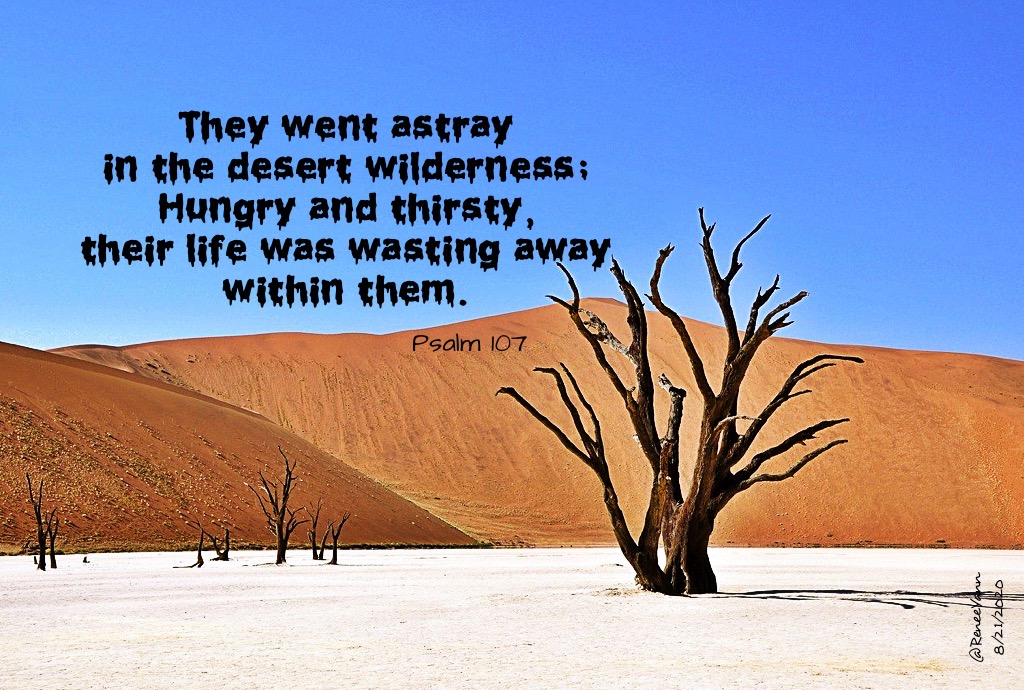
There are all kinds of “lost”. 

There are small “losts” like when I misinterpret my GPS and keep hearing “Recalculating route…”. 

Then there are huge “losts” like when a beloved dies and our life’s anchor breaks.

This morning’s psalm and reading are speaking of a particular kind of “lost”, one that comes from wandering away from Love, for whatever reason that happens to us.


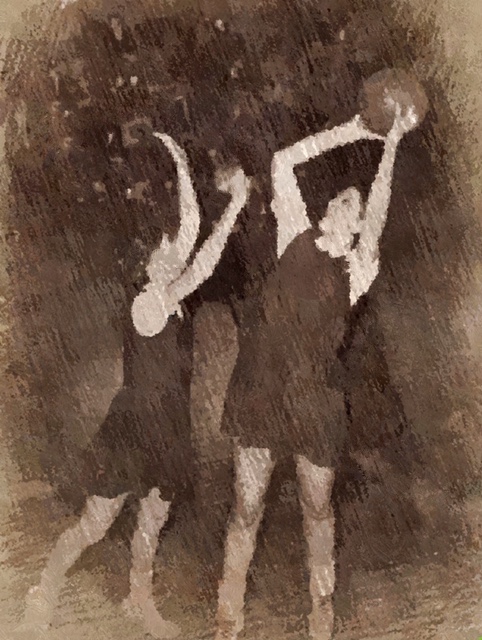
As I pray these readings, the face of a good high school friend comes to mind. Judy was a super basketball player. Everything about her was vigor, coordination, and that all-American beauty that needed no makeup to impress anybody.

After graduation, I went into the silence of the pre-Vatican II convent and Judy disappeared into her future. When our five-year reunion rolled around, I looked forward to reconnecting with her.

When I saw her, my heart broke. She was a shadow of herself, emaciated, listless, and lightless. She silently shouted a refrain like today’s verse from Ezekiel:

Our bones are dried up,
our hope is lost, and we are cut off.

We were both twenty-three years old. I was just beginning to grow into my hopes. Judy was already divorced, alone, and the mother of a father-starved child.

That kind of “lost” feels almost irredeemable. 


But Psalm 107 assures us that, in faith, no loss, no alienation is irredeemable.

They cried to the LORD in their distress;
from their straits God rescued them.
And led them by a direct way
to the healing of community.


Judy and I stayed in touch for a few years. Despite her troubles, she kept faith. That was the key.

She did the hard work to find herself again with the help of family, friends, counselors, and a supportive faith community. Eventually, she remarried and was happy the last time I saw her before she moved to the west coast.


This morning, I see such apparent parallels between Israel’s and Judy’s story. That helps me look back over my own life for the same, perhaps not so dramatic, parallels and to be grateful for the many times God found me.

Let them give thanks for God’s Mercy
and wondrous deeds to us,
Because God has satisfied the longing soul
and filled the hungry heart with good things.


Photo by Markus Spiske on Pexels.com

Poetry: Lost – Carl Sandburg

Desolate and lone 
All night long on the lake 
Where fog trails and mist creeps, 
The whistle of a boat 
Calls and cries unendingly, 
Like some lost child 
In tears and trouble 
Hunting the harbor’s breast 
And the harbor’s eyes. 


Music: Amazing Grace – Sean Clive

Psalm 67: Bless Us All!

Twentieth Sunday in Ordinary Time
August 16, 2020

Today, in Mercy, we read the story of the Canaanite woman whom Jesus first meets with a sarcastic banter. The banter however serves to expose some of the alienating prejudices of Jesus’s time which he then dissolves in a sweeping act of mercy and inclusion. His actions signify a new culture of divine justice offered to all people. The reading challenges us to confront our own prejudices and any limitations we place on who belongs to the Kingdom of God.

from this Sunday’s Reflection – 2017

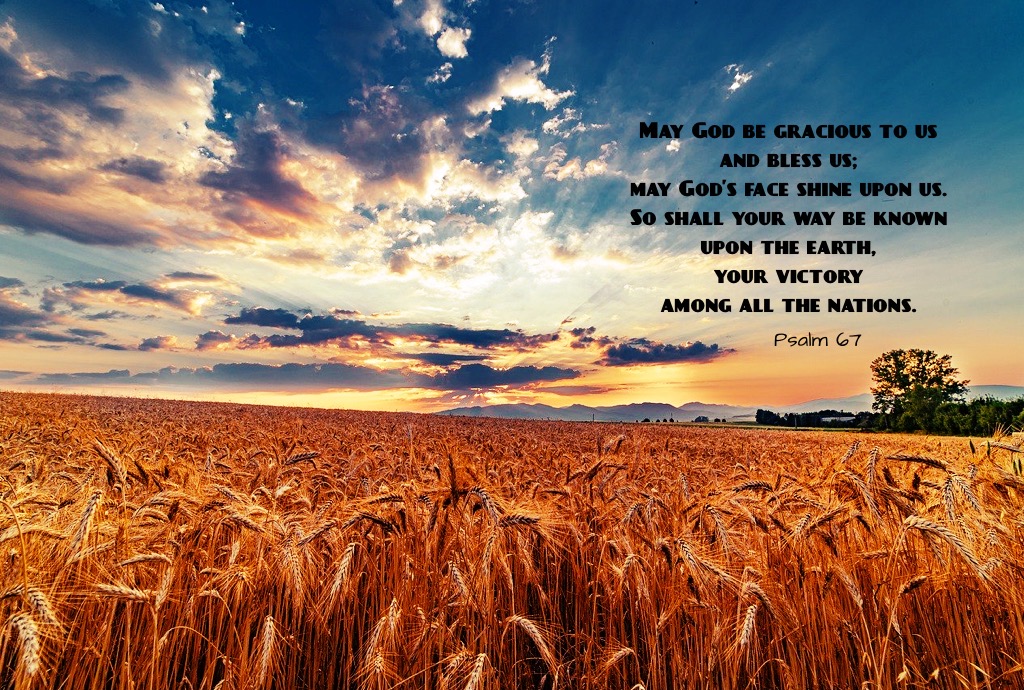
Today, in God’s Lavish Mercy, we pray with Psalm 67, a call to God for universal blessing on all Creation. Written to invoke a benediction on the land’s harvest, the Psalm blossoms into a generous prayer for the whole world to bask in God’s abundance.

May the nations be glad and rejoice;
for you judge the peoples with fairness,
you guide the nations upon the earth.

What if we prayed like that for all our brothers and sisters worldwide! What if we acted toward them with a justice that would make their abundance possible as well as our own! This is the Gospel mandate Jesus entrusted to us.

Psalm 67 shows the maturing of a nation from its own legitimate self-interests into its responsibility within all Creation.


In the USA, as our pre-election political awareness heightens, let’s learn from Psalm 67. Let’s broadly educate ourselves to the fundamental moral issues underlying various partisan platforms. 

For a religious person, voting is hard. There are profound moral issues on all sides of the question. A single issue approach does not work. An adamant stance on a single issue is the easy but inadequate approach. 


Even Jesus, in today’s Gospel, can be moved to a new way of thinking. The outcast Canaanite woman prevails on Jesus to broaden his kingdom. He opens his heart to another way of bringing mercy to all those longing for it.


Voting is a moral act. How we choose demonstrates the God we believe in.


May the peoples praise you, God;
may ALL the peoples praise you!


Poetry: Selah by Honoreé Fannane Jeffers

“The past few weeks were very hopeful for me, as an African-American. I saw images of young Black people out in the streets protesting, to make this country a better place. As an older person who stayed inside while these young folks put their bodies on the line, I wanted to celebrate them. I wrote this poem as a spiritual exaltation of Black faith, that our hoped-for change for our country is coming.”

Honoreé Fanonne Jeffers

Selah
after Margaret Walker’s “For My People”


The Lord clings to my hands
             after a night of shouting. 
                           The Lord stands on my roof 
             & sleeps in my bed. 
Sings the darkened, Egun tunnel— 
             cooks my food in abundance, 
                           though I was once foolish 
             & wished for an emptied stomach. 
The Lord drapes me with rolls of fat 
             & plaits my hair with sanity. 
                           Gives me air, 
             music from unremembered fever. 
This air
                            oh that i may give air to my people 
                            oh interruption of murder 
                                         the welcome Selah
The Lord is a green, Tubman escape. 
             A street buzzing with concern, 
                           minds discarding answers. 
             Black feet on a centuries-long journey.
The Lord is the dead one scratching my face, 
             pinching me in dreams. 
                           The screaming of the little girl that I was, 
             the rocking of the little girl that I was— 
the sweet hush of her healing. 
             Her syllables 
                           skipping on homesick pink. 
             I pray to my God of confused love, 
a toe touching blood 
             & swimming through Moses-water. 
                           A cloth & wise rocking. 
             An eventual Passover, 
outlined skeletons will sing 
             this day of air 
                           for my people—
                                         oh the roar of God 
                                         oh our prophesied walking

Music: Charles Ives – Psalm 67

Isaiah Sings!

Memorial of Saint Maximilian Kolbe, Priest and Martyr

August 14, 2020


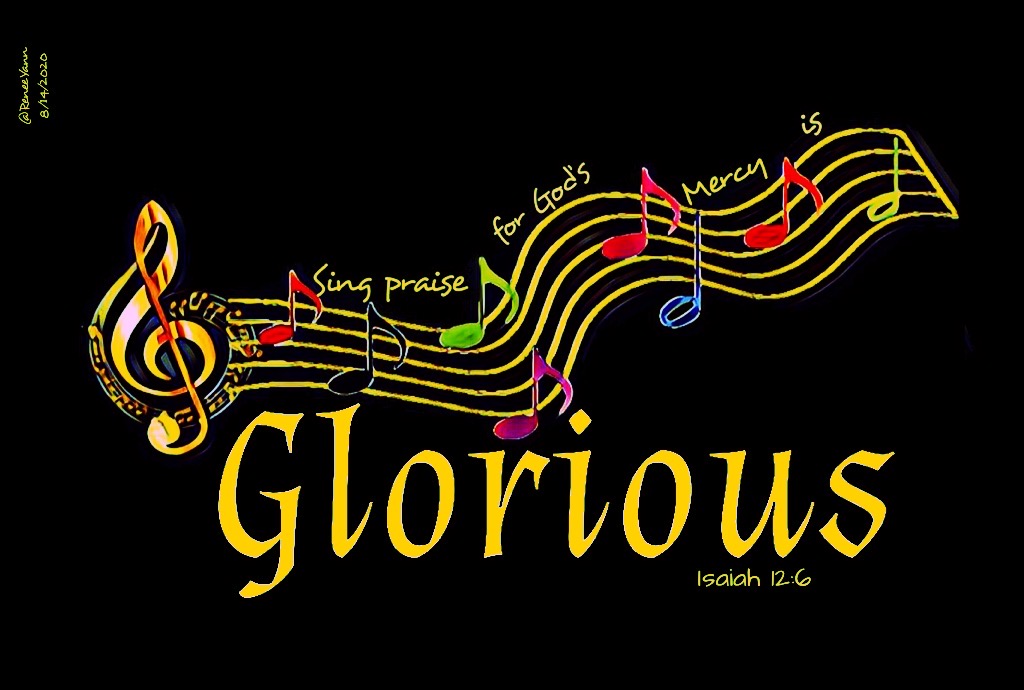
Today, in God’s Lavish Mercy, we pray with a passage from the poet-prophet Isaiah in which he calls the people to rejoice at their deliverance.

Sing praise to the LORD for his glorious achievement;
let this be known throughout all the earth.
Shout with exultation, O city of Zion,
for great in your midst
is the Holy One of Israel!


Isaiah 12 is one of a number of hymns found outside the Book of Psalms in the Old Testament. Other examples are Exodus 15:1-18, 21 and Amos 4:13; 5:8-9; 9:5-6 (Craddock, Hayes, Holliday, Tucker: Preaching through the Christian Year)

For an excellent graphic overview of these “songs”, click here. I enjoyed studying this chart.


Isaiah’s first eleven chapters center on God’s judgement for Israel’s infidelity. But Isaiah is never without hope. Chapter 12 is a joyful and grateful hymn celebrating that hope.

Isaiah’s hymn hit the right chord for me today. I think hope is a little hard to come by in these pandemic days, don’t you? 

Besides Covid, there are quite a few others “stabs” out there as we try to float the hope’s balloon – unemployment, business uncertainty, climate concerns, natural disasters, political irresponsibility, leadership failures just to reference a few. For some, these issues are so oppressive that they, “feel like it’s the end of the world”.


Isaiah is the guy when we feel even a little bit like this. Isaiah was profoundly convinced that God is with us in all our experiences and will ultimately resolve them for our good.

God indeed is my savior;
I am confident and unafraid.
My strength and my courage is the LORD,
and he has been my savior.
With joy you will draw water
at the fountain of salvation.


Poetry: To Go into the Dark by Wendell Berry

To go into the dark with a light
is to know the light.
To know the dark, go dark,
go without sight.
And find
that the dark too
blooms and sings
and is traveled by dark feet and dark wings.

Music:  Winter Cold Night – John Foley, SJ

Yes, this is a Christmas song, but I think it carries the perfect feeling for today’s reflection. Indeed, Jesus Christ is our Hope. May his Light be born in us daily.

Dark, dark, the winter cold night. Lu-lee-lay.
Hope is hard to come by. Lu-lee-lay.
Hard, hard, the journey tonight. Lu—lee-lay.
Star, guide, hope, hide our poor, winter cold night.
And on earth, peace, good will among men.
Lean, lean, the livin' tonight. Lu-lee-lay.
Star seems darker sometimes. Lu-lee-lay.
Unto you is born this day a Savior.
Pain, yes, in the bornin' tonight. Lu lee—lay.
Star, guide, hope, hide our poor, winter cold night.

Moses’s Psalm: Dark to Light

Friday of the Eighteenth Week in Ordinary Time

August 7, 2020

Today, in God’s Lavish Mercy, we pray once again with Deuteronomy 32, often referred to as the Psalm of Moses. And once again, our psalm links the heavy messages of our two main readings.

In our first reading from Nahum, the prophet describes Israel’s future restoration after the bloody destruction of Nineveh, chief city of the Assyrian conquerors.

In our Gospel, Jesus foretells his own Passion and Death, and the necessity that his disciples carry their own crosses.

The tenor of both readings is soberly captured in our psalm:

Learn then that I, I alone, am God,
and there is no god besides me.
It is I who bring both death and life,
I who inflict wounds and heal them.


Given the heavy, stormy morning here where I live, these readings are hitting me like a wet blanket! It’s hard to find the link to Light within them, but I believe there always is one – and I’ll suggest one subsequently. But first this.

Often in life, too, it’s hard to find the link to light. Harsh and insufferable realities can stubbornly darken our horizons.

Just this morning, I read about a podcast in which Michelle Obama had revealed a struggle with depression:

“These are not, they are not fulfilling times, spiritually,” Mrs Obama said. “I know that I am dealing with some form of low-grade depression. Not just because of the quarantine, but because of the racial strife, and just seeing this administration, watching the hypocrisy of it, day in and day out, is dispiriting.”


Mrs. Obama is describing her “Nineveh”.  Mine is pretty similar. What’s yours?
And how do we hold faith, even in the middle of “Nineveh”?

These assuring verses from Nahum offer the flicker of Light and the promise of Salvation. They encourage us to stay strong, remain faithful. We must keep lifting our eyes to the future that God dreams for all people, discerning its rising like the sun in a morning mist.

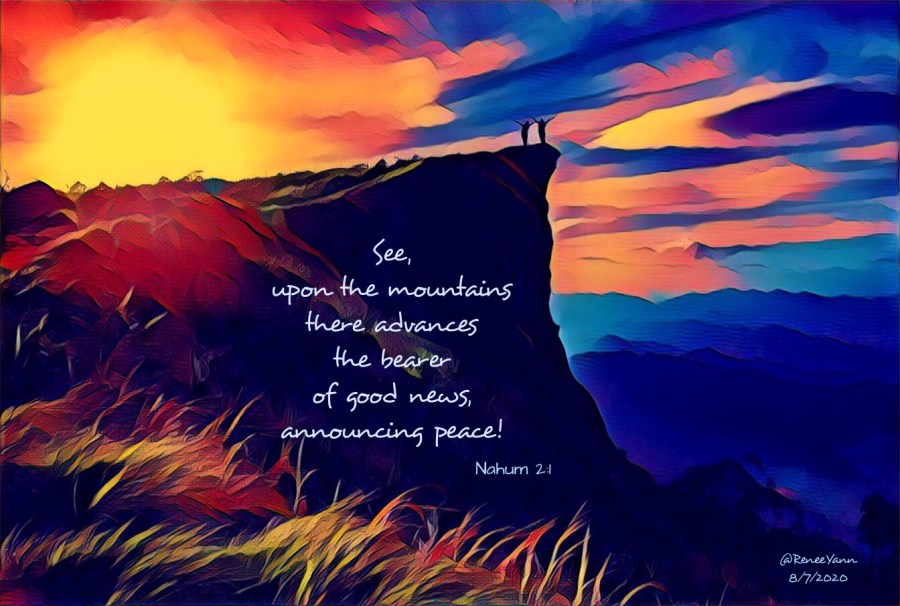
See, upon the mountains there advances
the bearer of good news, 
announcing peace!
Celebrate your feasts, O My people,
fulfill your vows!
…. The LORD will restore the beloved vine,
its hope, courage and strength …


Poetry: The Good God and the Evil God – Kahlil Gibran

The Good God and the Evil God 
met on the mountain top.
The Good God said, 
“Good day to you, brother.”
The Evil God did not answer.

And the Good God said, 
“You are in a bad humour today.”
“Yes,” said the Evil God, 
“for of late I have been often mistaken for you, 
called by your name, and treated 
as if I were you, and it ill-pleases me.”
And the Good God said, 
“But I too have been mistaken for you 
and called by your name.”

The Evil God walked away 
cursing the stupidity of humankind.

Music: How Beautiful – Joe Wise

Psalm 97: Majesty

Feast of the Transfiguration of the Lord

August 6, 2020

Today, in God’s Lavish Mercy, on this glorious Feast of the Transfiguration, we pray with Psalm 97 which prophesies the messianic era when God will reign supreme over the earth. Its verses announce God’s sovereignty, establishment of justice, and universal joy.

Transfiguration by Giovanni Bellini

Our Gospel describes the moment when Jesus gave his three disciples a glimpse of that future glory in order to sustain them through the sufferings to come.


As we pray Psalm 97 today, we might think of our experiences of God’s beauty, tenderness, and joy. Remembering and storing these small, accumulated revelations helps us to hold faith in times of darkness or trouble.

In Martin Luther King’s final speech the night before he was assassinated, he spoke of his own such transfiguring moments and the courageous faith they inspired in him:

Well, I don’t know what will happen now. We’ve got some difficult days ahead. But it doesn’t matter with me now. Because I’ve been to the mountaintop. And I don’t mind. Like anybody, I would like to live a long life. Longevity has its place. But I’m not concerned about that now. I just want to do God’s will. And He’s allowed me to go up to the mountain. And I’ve looked over. And I’ve seen the promised land. I may not get there with you. But I want you to know tonight, that we, as a people, will get to the promised land. And I’m happy, tonight. I’m not worried about anything. I’m not fearing any man. Mine eyes have seen the glory of the coming of the Lord.


Also in our prayer today, we are mindful of the 75th anniversary of the atomic bombings of Hiroshima and Nagasaki, an event which represents the complete inversion of God’s will for the Peaceful Kingdom. 

Majesty, turned inside out by our sin, becomes terror.

Robert Oppenheimer, one of the designers of the atomic bomb, reflecting on the bomb’s first test, said that as he watched the huge blast wave ripple out over the New Mexico desert, a line from the Hindu scripture Bhagavad Gita came to mind: “Now I am become Death the Destroyer of Worlds.


Psalm 97 reminds us that all Creation belongs to God:

The LORD is king; let the earth rejoice;
let the many islands be glad.
Clouds and darkness are round about him,
justice and judgment are the foundation of his throne.

If, by faith, we learn to see and reverence God’s glory in all things, we can be delivered from the terrors of war, racism, and every other deathly weapon which threatens us. As Psalm 97 so encouragingly closes:

You who love the LORD, hate evil,
God protects the souls of the faithful,
rescues them from the hand of the wicked.
Light dawns for the just,
and gladness for the honest of heart.
Rejoice in the LORD, you just,
and give thanks at the remembrance of his holiness.


Poetry: Origami by Joyce Sutphen 

In Hiroshima’s Peace Park there is a statue of Sadako Sasaki lifting a crane in her arms. Sadako was two years old when the atomic bomb was dropped; she was diagnosed with leukemia ten years later. The Japanese believe that folding a thousand origami cranes brings good fortune. Sadako spent the last months of her young life folding hundreds of paper cranes. She folded 644 before she died.


Origami

It starts
with a blank sheet,
an undanced floor,
air where no sound
erases the silence.

As soon as
you play the first note,
write down a word,
step onto the empty stage,
you've moved closer
to the creature inside.

Remember—
a square
can end up as frog, cardinal,
mantis, or fish.
You can make
what you want,
do what you wish.

Music: Our God Reigns – James Kilbane

How lovely on the mountains

Are the feet of him

Who brings good news,good news

Announcing peace, proclaiming

News of happiness.

Our God reigns; our God reigns!

Chorus:

Our God reigns!

Our God reigns!

Our God reigns!

Our God reigns!

He had no stately form;

He had no majesty,

That we should be

drawn to Him.

He was despised,

and we took no account of Him,

Yet now He reigns

With the Most High.

Out of the tomb He came

With grace and majesty;

He is alive, He is alive.

God loves us so see here His hands,

His feet, His side.

Yes, we know

He is alive.

Psalm 119: The Truth

Monday of the Eighteenth Week in Ordinary Time

August 3, 2020


Today, in Mercy, we pray for a persevering faith. Sometimes, it is very late into our prayer that the unexpected answer comes to us. May we recognize it and welcome it out of the darkness. We pray especially for those who have endured long years of prayerful waiting: for those with chronic illnesses, for the elderly, for widows and widowers, for those who want to believe but can’t.

from 2016

Today, in God’s Lavish Mercy, we pray with a return to Psalm 119. Set today between fascinating passages from both Jeremiah and Matthew, our psalm presents us with a particularly strong challenge:

Let my heart be perfect in your statutes,
that I be not put to shame.

In our first reading, the false prophet Hananiah tries to put Jeremiah to shame by preaching a rosy prophecy in contradiction to Jeremiah’s difficult but truthful “fire and brimstone” warnings. Hananiah eventually gets caught in his own lies.

In Matthew’s Gospel, Peter discovers another dimension of truth – that without faith, he cannot endure the storm


Psalm 119’s verses are a prayer to stay true to the Law, the Word, even in difficulty and storm. 

The psalmist recognizes our human propensity sometimes to create the world we want rather than face the one we have. We do it by lying to ourselves and others until, eventually, our alternative universe falls apart – just like Hananiah’s.

Because, like Peter, we focus on ourselves and our fears, we miss Jesus’s invitation to walk in faith over our life’s rough waters.


Our psalm today voices our prayer not to get twisted on life’s road, to have the courage to embrace the truth of ourselves, our environment, and our world. That truth is revealed when we love and live God’s Law by our justice and mercy toward all Creation.

From your ordinances I turn not away,
for you have instructed me.


Poetry: from Robert Frost

Two roads diverged in a yellow wood,
And sorry I could not travel both
And be one traveler, long I stood
And looked down one as far as I could
To where it bent in the undergrowth;

Then took the other, as just as fair,
And having perhaps the better claim,
Because it was grassy and wanted wear;
Though as for that the passing there
Had worn them really about the same,

And both that morning equally lay
In leaves no step had trodden black.
Oh, I kept the first for another day!
Yet knowing how way leads on to way,
I doubted if I should ever come back.

I shall be telling this with a sigh
Somewhere ages and ages hence:
Two roads diverged in a wood, and I—
I took the one less traveled by,a
And that has made all the difference.

Music: Long and Winding Road – Beatles song sung by David Archuleta

Psalm 69: Stuck!

Memorial of Saint Alphonsus Liguori, Bishop and Doctor of the Church

August 1, 2020

Today, in Mercy, we pray for the light of God’s Word in our hearts. God speaks to us in all things. Sometimes, all we need to do is ask God, “What are You saying to me in this circumstance?” Then listen for Love. The answer is always wrapped in Love – and Love is not always easy.

Thought from 2016, Friday of the 17th Week

Today, in God’s Lavish Mercy, we pray again with Psalm 69.  In today’s accompanying readings, Jeremiah and John the Baptist are living out the meaning.of the psalm.

Each of these great prophets has been ensnared by the civic evil of their times, personified in Old Testament princes and New Testament Herod and Herodias. The power structure surrounding each prophet stood in direct contradiction to their witness to God’s Word. Those structures, when confronted with a sacred truth, tried to overwhelm the messenger, like quicksand swallows an innocent traveler.

Rescue me out of the mire; may I not sink!
may I be rescued from my foes,
and from the watery depths.
Let not the flood-waters overwhelm me,
nor the abyss swallow me up,
nor the pit close its mouth over me.


The psalm raises to our prayer the reality that such struggles continue in our time. We live in a wonderful but still sinful world where every person decides, everyday, where he or she will stand in the contest between good and evil.

The decision is sometimes very clear. At other times, the waters are so muddied with lies, propaganda, greed, fear, bias. and unexamined privilege that we feel mired in confusion or resistance.

But I am afflicted and in pain;
let your saving help, O God, protect me.
I will praise the name of God in song,
and I will glorify him with thanksgiving.

Psalm 69 throws us a rescue line in today’s final verse:

See, you lowly ones, and be glad;
you who seek God, may your hearts revive!
For the LORD hears the poor,
and his own who are in bonds God spurns not.

The steady path to truth lies with those who seek God among the humble and poor. The humble are the ones through whom the Lord speaks. They are God’s own. Jeremiah and the Baptist understood this truth and preached it by their lives.

We might examine our lives today in the light of their witness and the message of this challenging psalm.


Poetry:  Beginners – Denise Levertov


‘From too much love of living,
Hope and desire set free,
Even the weariest river
Winds somewhere to the sea—‘


But we have only begun
to love the earth.
We have only begun
to imagine the fullness of life.
How could we tire of hope?
—so much is in bud.
How can desire fail?
—we have only begun
to imagine justice and mercy,
only begun to envision
how it might be
to live as siblings with beast and flower,
not as oppressors.
Surely our river
cannot already be hastening
into the sea of nonbeing?
Surely it cannot
drag, in the silt,
all that is innocent?
Not yet, not yet—
there is too much broken
that must be mended,
too much hurt we have done to each other
that cannot yet be forgiven.
We have only begun to know
the power that is in us if we would join
our solitudes in the communion of struggle.
So much is unfolding that must
complete its gesture,
so much is in bud.

Music:  The Cry of the Poor – John Foley, SJ