Today, in Mercy, the theme of our readings falls perfectly in step with Earth Day.
For my prayer this morning, I re-read Pope Francis magnificent encyclical Laudato Si’which instructs us and begs us to cherish the gift of our Common Home. – a world which God has so loved that God gave the only begotten Son that we should not perish.
This sacred document has become even more meaningful as a global pandemic exposes the fragmentations we have wrought upon the earth.
Here are two of my favorite sections from the encyclical, although I do encourage you to read the whole masterpiece if you have the time and desire.
In the Judaeo-Christian tradition,
the word “creation” has a broader meaning than “nature”,
for it has to do with God’s loving plan
in which every creature
has its own value and significance.
Nature is usually seen
as a system which can be studied,
understood and controlled,
whereas Creation can only be understood
as a gift from the outstretched hand of the Father of all,
and as a reality illuminated by the love
which calls us together into universal communion.
(Laudato Si’ paragraph 76)
The ultimate destiny of the universe is in the fullness of God, which has already been attained by the risen Christ, the measure of the maturity of all things. Here we can add yet another argument for rejecting every tyrannical and irresponsible domination of human beings over other creatures. The ultimate purpose of other creatures is not to be found in us. Rather, all creatures are moving forward with us and through us towards a common point of arrival, which is God, in that transcendent fullness where the risen Christ embraces and illumines all things. Human beings, endowed with intelligence and love, and drawn by the fullness of Christ, are called to lead all creatures back to their Creator.
(Laudato Si’ paragraph 83)
May these words bless and enlighten us today to become blessings for Earth, our Common Home.
Music: God So Loved the World – sung by the Mormon Tabernacle Choir
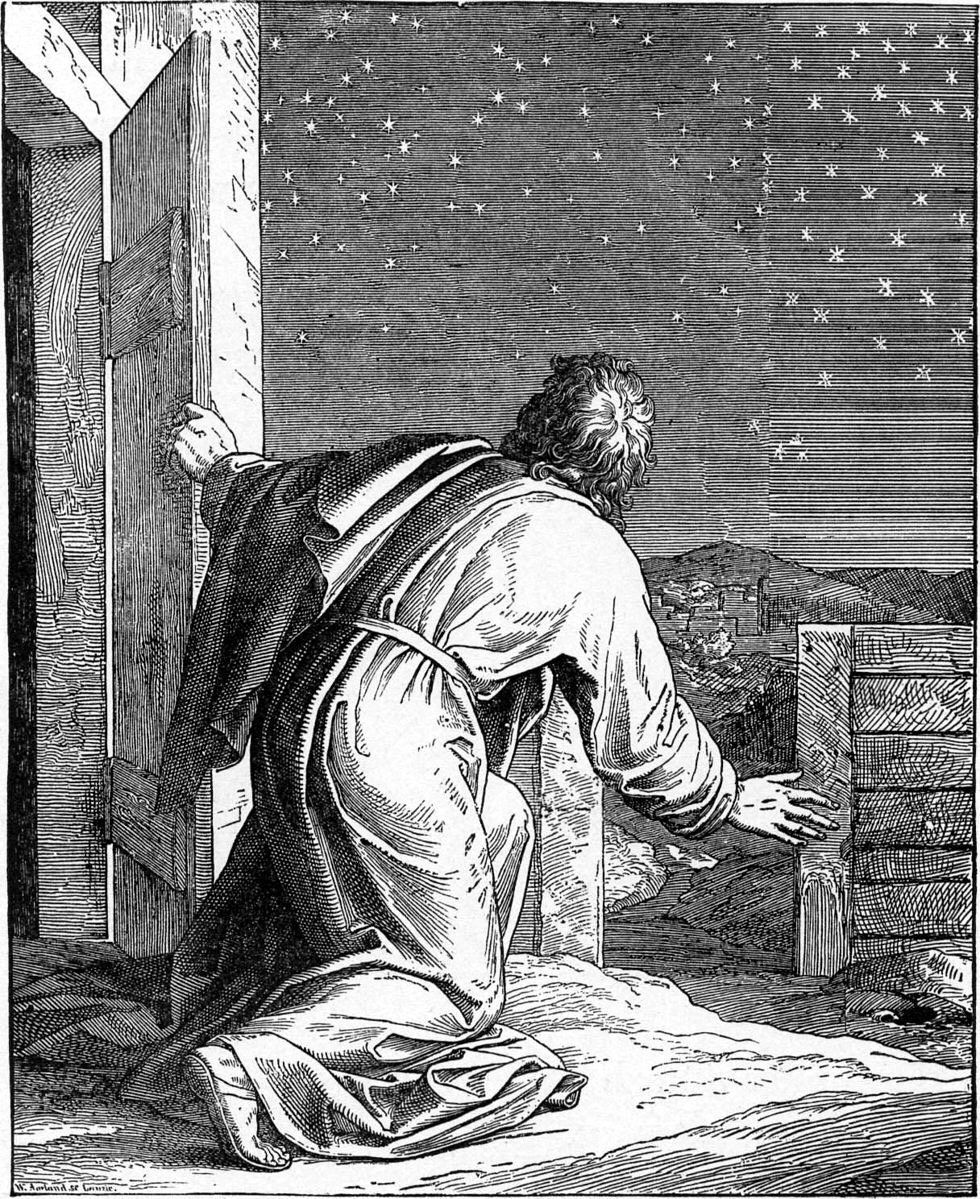
Abraham Looks to the Heavens from Bible Pictures by Charles Foster (1897)
Today, in Mercy, Yahweh is very clear with Abram that he is now in a life-changing situation:
My covenant with you is this: you are to become the father of a host of nations. No longer shall you be called Abram; your name shall be Abraham, for I am making you the father of a host of nations.
Having witnessed how young fathers are upended by the news of impending fatherhood, I can’t even imagine what Abraham felt like when he heard this:

I will render you exceedingly fertile; I will make nations of you; kings shall stem from you.
But aside from the practical ramifications of God’s promise, what Abraham is invited to is a whole new outlook on the world.God lays out before him a vision of the ages, infinitely beyond the confines of Abraham’s current understanding.
It is an existence beyond time and human definition. It is the infinite place of God’s timelessness, where we all exist, but forget when we are born. Our lifetime is a spiritual journey back to remembrance.
In our Gospel, Jesus uses a rather cryptic phrase as he challenges his listeners to look beyond their circumscribed perspectives:
Amen, amen, I say to you, whoever keeps my word will never see death…. Abraham your father rejoiced to see my day; he saw it and was glad.
By fully embracing his covenant with God, Abraham saw beyond death.The vision of heaven was opened to him and he lived his life by its power. He lived then within the Day of the Lord, not within any small confined reality.
Jesus offers us the same invitation. We can choose to see with God’s eyes, or with only our own. We can choose to live within God’s infinity, or in only our own earthbound borders.
In our current global situation, when time has lost its shape and days silently morph into one another, it may be a good time to remember the eternal character of our heart.It may be time to have a sit-down with God about our covenant, like the conversation God had with Abraham.
Today, in Mercy, our readings will challenge us in ways we might rather not hear.
In our first reading, feisty Amos lambastes the Israelites for their sumptuous lifestyle which is indifferent to the plight of those who are poor. He calls them “complacent”, “at ease” in their prosperous, privileged existence, a condition that has numbed them to the harrowing inequities from which others suffer.
In our second reading, Paul gives a final, impassioned charge to his dear protégé Timothy. He tells him not just to avoid, but to flee such complacency and the greedy materialism which feeds it. He outlines the elements of a Christian life, enjoining Timothy to “pursue righteousness, devotion, faith, love, patience, and gentleness”.
Paul gives Timothy the key to true Christian life:
Keep the commandment without stain or reproach …
…. “the commandment” being to love God above all, and love neighbor as self.
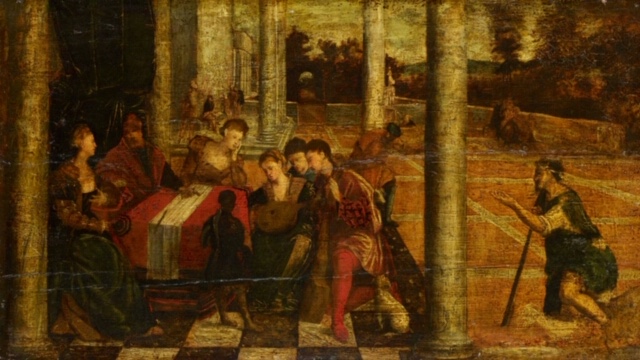
Dives and Lazarus by Bonifazio di Pitati The National Gallery – London
Our Gospel is, perhaps painfully, familiar to all of us – the story of Lazarus and Dives. It is a parable which puts the economic divide under the crystalline light of the Gospel, challenging us as to where we fit in it.
Most of us like comfort. We would rather be “haves” than “have nots”. But we struggle within our comfortable lives to discern our responsibility for others. We’re certainly not intentionally hard-hearted, “lying on ivory couches” and “drinking wine from bowls” while modern day Lazarus languishes right beside us.
We do try, in many ways, to respond to the call for charity and service. But don’t we still measure ourselves after hearing this Gospel? Don’t we still worry about any “Lazarus” unnoticed at our door?
Amos, Paul, and Jesus are charging us – just as they charged their immediate listeners – to live a life based in Biblical and Gospel justice. Justice seeks fullness of life for all the community. Jesus teaches us that “the community” is all Creation, and that how we treat the community is how we treat him.
Every day we might remind ourselves that, however hard we try, it is never enough. We must keep on peeling away any indifference or blindness we have to the injustices of our culture and times, our economic and political systems. And we too must flee them, running toward justice, righteousness, and mercy.
We must ask ourselves this hard question:
Does my “wealth” – however large or small, material or immaterial- nourish the community or only consume it?
Music: Five Variants of Dives & Lazarus – Ralph Vaughn Williams’s beautiful interpretation of the folk song “Dives and Lazarus”.
If you might be interested in the original song – a great example of folk art: Sung here by Maddy Prior (Lyrics below)
as it fell out upon one day
rich Diverus he made a feast
and he invited all his friends
and gentry of the best
then Lazarus laid him down and down
even down at Diverus’ door
some meat, some drink, brother Diverus
do bestow upon the poor
thou art none of mine, brother Lazarus
that lies begging at my door
no meat, no drink I’ll give to thee
nor bestow upon the poor
then Lazarus laid him down and down
even down at Diverus’ wall
some meat, some drink, brother Diverus
or with hunger starve I shall
thou art none of mine, brother Lazarus
that lies begging at my wall
no meat, no drink I’ll give to thee
but with hunger starve you shall
then Lazarus laid him down and down
even down at Diverus’ gate
some meat, some drink, brother Diverus
for Jesus Christ His sake
thou art none of mine, brother Lazarus
that lies begging at my gate
no meat, no drink I’ll give to you
for Jesus Christ His sake
then Diverus sent out his serving men
to whip poor Lazarus away
they had no power to whip one whip
and they threw their whips away
then Diverus sent out his hungry dogs
to worry poor Lazarus away
but they had no power to bite one bite
and they licked his sores away
as it fell out upon one day
poor Lazarus sickened and died
there came two angels out of Heaven
his soul thereto to guide
rise up, rise up brother Lazarus
come along with me
there’s a place for you in Heaven
sitting on an angel’s knee
as it fell out all on one day
Diverus sickened and died
there came two serpents out of Hell
his soul thereto to guide
rise up, rise up brother Diverus
come along with me
there is a place for you in Hell
sitting on a serpent’s knee
Diverus lifted up his eyes and he saw poor Lazarus blessed
a drop of water brother Lazarus
for to quench my flaming thirst
if I had as many years to live as there are blades of grass
I would make it in my will secure
that the Devil should have no power
Hell is dark, Hell is deep Hell is full of mice
it’s a pity that any poor sinful soul should be barred from our saviour Christ
Today, in Mercy, our readings challenge us to see things differently- to see with God’s eyes.
Paul invites us first with the glorious Colossians Hymn. No words can enhance it. Let us savor it in itself:
Christ Jesus is the image of the invisible God, the firstborn of all creation. For in him were created all things in heaven and on earth, the visible and the invisible, whether thrones or dominions or principalities or powers; all things were created through him and for him. He is before all things, and in him all things hold together. He is the head of the Body, the Church. He is the beginning, the firstborn from the dead, that in all things he himself might be preeminent. For in him all the fullness was pleased to dwell, and through him to reconcile all things for him, making peace by the Blood of his cross through him, whether those on earth or those in heaven.
Ancient wineskins were not like the fancy botas we see today. They were formed from the entire skin of the animal. As the new wine fermented inside, the skin expanded with the fermentation. It ultimately stretched beyond further use. – thus the necessity for new skins for new wine.
Jesus, in our Gospel, tells us we must become new wineskins in order to hold the vibrant gift of new life in Christ. He says the old ways, stiffened by pharisaical pretensions, have lost the elasticity of grace. He warns us to avoid the accretions of showy religious practice which may bury and inhibit sincere faith.
Jesus is the new wine of love and mercy, and our hearts must become his new wineskins.
As we pray, this poetic musical piece may inspire us. … in Him, all things hold together …
Today, in Mercy,in our reading from Judges, we meet two guys who are polar opposites of each other: Jotham and Abimelech.
Jotham was the youngest of the 70 sons of Gideon (yes, 70 – not a typo. Makes one think of The King and I.) Abimelech is his half-brother, son of Gideon’s Shechemite concubine.
To put the story in a nutshell, Jotham is the goodie and Abimelech is the baddie. Abimelech, lusting to be king, engages his Shechemite family to kill the 70 sons of Gideon. Only Jotham survives. So in our reading, Jothamprophesies by parable, warning the people that they have made a serious mistake in allowing Abimelech to grasp the kingship.
Praying with this reading, we may realize that some things never change. Human beings still jockey for political power and economic domination. Nations still slaughter and suppress other nations in that pursuit. Some leaders still commandeer control by deception and pretense. The voting populace still allows itself to be hoodwinked by tyrants in disguise.
Jotham doesn’t accept the old adage that religion and politics don’t mix (or however they may have phrased it in his day). He says true leadership must grow from the good faith of both leaders and followers. He says, in parable form, that leaders must be willing to set their own pursuits aside for the good of the people. Otherwise, an avaricious fire burns up the heart of the people.
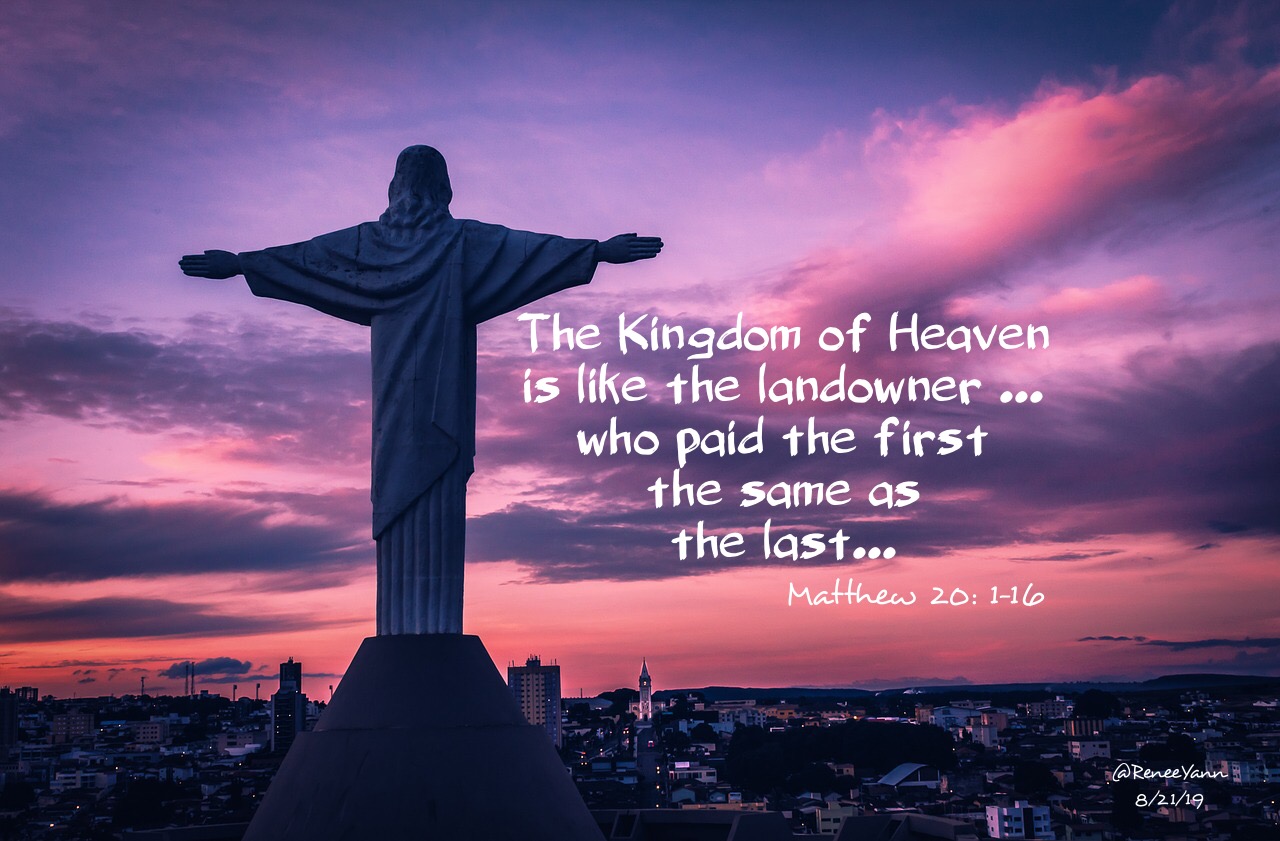
The landowner in Matthew’s Gospel is a leader in the pattern of God. He administers his charge in such a way that all find benefit. His methods are contradictory and irrational to anyone who fails to see the universal creaturehood of the human family. He reigns from mercy not merit, because he knows that all have full merit in God.
Certainly, my prayer leads me to consider how these principles affect my own leadership responsibilities whether within family, community, workplace, or world.
I am also led to consider how I must respond, just as Jotham did, to any leader or administration that stands in contradiction to these principles.
Faith and morality not only mix with politics, they are its core. Bereft of these, politics becomes nothing but a power game in which the poorest and weakest are the chips.
But, in this Gospel parable, Jesus says his “game” is just the opposite. At his table, the first shall be last and the last first.
These readings have much to offer us as we daily try to right our hearts with the God of infinite mercy.
Music: There’s a Wideness in God’s Mercy – written by Frederick Faber in 1862
Rendered here by Nate Macy
Today, in Mercy, our readings focus on “vanity” – its threats and remedies.
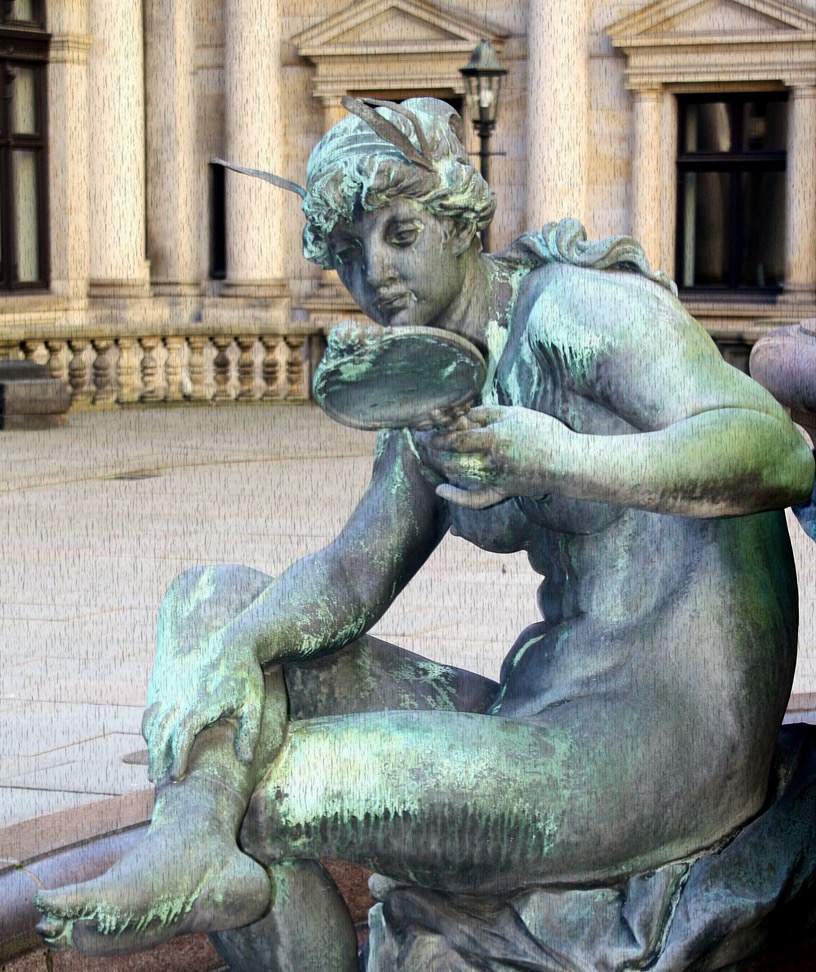
Often, we think of vanity as a physical emotion – that Narcissistic self-absorption that keeps us in front of a mirror for inordinate amounts of time. Our culture promotes this kind of vanity by working endlessly to convince us that without certain products we are “not enough” on our own.
Historically, this kind of rhetoric was directed primarily toward women, spawning a nearly $500 billion global cosmetic market! But men are catching up! The men’s market is forecasted to reach nearly $30 billion by 2023.
Several years ago, while flying home from a business trip, I was seated across from two young women. As we approached home, the one nearest me, began to prepare for landing. She initiated an elaborate cosmetic ritual that involved no fewer than ten brushes plus an array of tubes and compacts. At first, it struck me really funny. Then I realized how very sad it was.
This maturing child was no more than eighteen. She was naturally beautiful with the vigor of youth. But she had obviously spent a lot of money and time not believing in her natural beauty.
Society considers vanity as a kind of pride and pomposity. I think just the opposite. I think vanity is really fear, self-dissatisfaction, anxiety and pain because something has convinced us that we are inadequate.
Vanity damages souls as well as bodies. It makes us behave in greedy, self-absorbed and careless ways toward our neighbors. It makes us pretend we are more than we think we are. It saps us of the strength to be generous, trusting and hopeful.
Paul, in his letter to the Colossians, tells us to get over this kind of vanity:
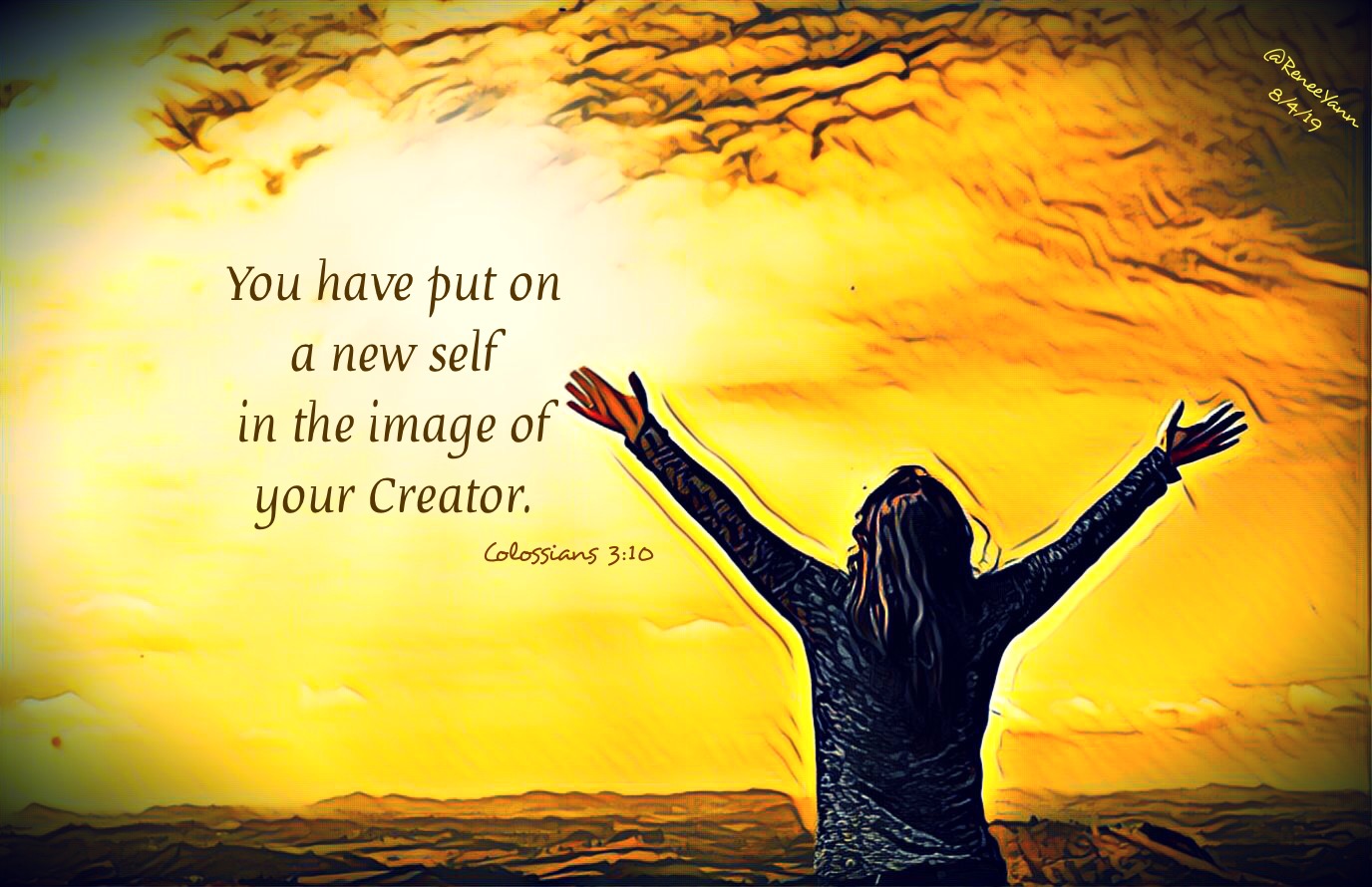
Put to death, then, the parts of you that are earthly: immorality, impurity, passion, evil desire, and the greed that is idolatry. Stop lying to one another, since you have taken off the old self with its practices and have put on the new self, which is being renewed, for knowledge, in the image of its creator.
What if that sweet girl on Flight 419 had been able to look in her mirror and see the image of her Creator? What if we could all do that? How might we spend our time and money differently if we were convinced of how beautiful we are to God?
Music: How Could Anyone Ever Tell You – Shaina Nell
I have added two versions of this beautiful song. Let God sing it to you in your prayer today.
Today, in Mercy, our reading from Leviticus may seem pastoral and peaceful in tone as it describes the days and years of rest and jubilee. Don’t let that tone fool you. This is perhaps one of the most radical, transformative passages in Scripture!
These verses from Leviticus describe and mandate an economic system based on respect and care for neighbor and earth. They require the community to take significant, reflective pauses in what might be an otherwise relentless drive to personal prosperity.
These commands are rooted in the understanding that God is the Creator, and therefore “owner” of all – people, animals, the land and its produce. We are to use these resources with reverent mutuality. If we do not, we become caught in an economy that inflates some at the expense of others – that is, an extractive economy.
In an extractive economy, those with power and money siphon resources from the weak and vulnerable. This cycle grows ever more greedy because the “haves” can never have enough. Eventually, both human and natural resources are exhausted and the faulty, actually sinful, economy fails.
Sabbath and Jubilee are meant to restore balance by causing us to reflect on and reverse the pitfalls of a greedy, extractive system.
The parallels to present day realities are stunning! We live in a world where everything is a commodity at the disposal of those who control money. Walter Brueggemann calls this “the oligarchy of concentrated wealth…the network of the wealthy and powerful in the U.S. and around the world who basically outflank or control governmental structures.”
This unmitigated imbalance eventually creates impoverished nations whose citizens are plagued by violence, who must flee their homeland simply to survive. It spawns a culture of “disposability” where even human beings are bought and sold into exploitation. It creates a system where you may be sold anything, even if it kills you like tobacco, opioids and carcinogenic products. You may buy anything, even if it kills the people who provided it, even if it kills the earth for future generations.
So we simply cannot read Leviticus today as an ancient writing meant to organize a long-ago agrarian society. This scripture is speaking to us, demanding that we pause to consider how we contribute to or stand against such systems.
The reading is asking us to develop a deep, sacred awareness of all human beings as “neighbor”, and to live, unflinchingly, out of that awareness.
Music: The Workingman’s Hymn – Joshua Davis (Lyrics below)
Some people hunger for the greenback bill
Some folks hunger for the top of the hill
Some people just tryin’ to get a decent meal
Well I know that we can turn it around
Some people sleepin’ in a fine feather bed
Some folks are dreamin’ of an old homestead
Some just need a place to lay their head
Well I know that we can turn it around
[Chorus]
I know that we can turn it around
There’s one thing that I’ve found
If there’s a force in the dim singin’ a workingman’s hymn
I know that we can turn it around
River bottom up to home on high
In the light of the endless sky
Jetsettin’ or just gettin’ by
I know that we can turn it around
[Chorus] [Bridge]
From the 9th Ward up to Patoka Lake
One man’s joy’s been another man’s pain
But the sun keeps shinin’ through the drivin’ rain
And I know that we can turn it around
Today, in Mercy, we begin a few days of reading Leviticus. The reading today provides a long list of when and how the community should gather to worship. It is a lexicon on how to honor the sacred presence in their lives. Such honoring includes aspects of celebration, decoration, sharing, remembering and hoping together.
While the particular enjoinments detailed in Leviticus might not pertain to us, their spirit does. It is a spirit that encourages us to cherish the gift of time – moments, days, years – as precious opportunities to encounter God.
Down through the ages, people seeking holiness have used various, ritualized practices to remember and honor God’s omnipresence in their lives. They include morning and nighttime prayers, Grace before Meals, the Blessing of the Hour, the Angelus at noontime, the great liturgical practices of Advent and Lent, and the Divine Office. Each of these spiritual practices helps us to be more intentional about the true meaning and purpose of our daily life.
Macrina Wiederkehr, a Benedictan monastic, has published a beautiful book to help people mark the hours of their day. She says this in Seven Sacred Pauses:
When I speak of “the hours” I am referring to those times of the day that the earth’s turning offers us: midnight, dawn, midmorning, noon, midafternoon, evening, and night. Although every hour is sacred, these special times have been hallowed by centuries of devotion and prayer…..
The daily and nightly dance of the hours is a universal way of honoring the earth’s turning as well as the sacred mysteries that flow out of our Christian heritage.
I think this is exactly what our Leviticus passage is doing as well. Our time is so precious and it flows so quickly! What a tragedy if we fail to stop and realize that it is the holy river on which we are meant to float to God!
Today, in Mercy, we finish our several weeks’ journey through Exodus. Like all great books, this one closes with a powerful final chapter – one that assures us that the story has not ended.
Have you ever read a book that you wish would never end? Of course, they all do – but bits of some live in us forever.
With sacred scripture, the Living Word remains with us by inspiring us to live out its spirit in our lives. That Holy Word bonds with the Spirit already dwelling within us through our Creation and Baptism.
For the Exodus community, this Indwelling was given visible expression in the tabernacle Moses built. God chose to fill that tabernacle with Abiding Presence.
Each one of us, and every human being, is a dwelling place of God’s love and hope for us. We are tabernacles of God’s Spirit, breathed into us in an act of divine desire for us to be God’s eternal beloved.
Pretty overwhelming, isn’t it!
So much so that, just as for the Israelites, our vision of God’s Presence is often clouded by the frenzy of our lives. It is only when we still our souls in worship that we recognize God living with and within us!
Music: This Alone – Tim Manion, SJ ( Photos are The Abbey of Mont-Saint-Michel / Normandy, in the Manche department in France.)
Today, in Mercy, our readings offer us a central question for our faith and spirituality: What do we really worship?
As we continue the Exodus story, Moses has been on the mountain receiving the Law from God. Meanwhile, back at the ranch, delegated leader Aaron is blowing his assignment. The Israelites tire of waiting for Moses. They want another god to lead them onward. Aaron comes up with idea of fashioning such a idol from all their molten jewelry.
When Moses descends the mountain with the newly-minted tablets in hand, he burns in anger at the scene, smashing the holy stones at his feet. More than a flared temper, this act symbolizes a fractured relationship with God.
The story suggests this for our prayer: we are in ever-deepening relationship with God through our own covenants – our creation, our baptism, our further professions of faith and commitment, our sacramental encounters. These are all living relationships, inviting us to new and deeper life in God.
Still, there may be times in our lives when our hearts lose focus on these covenants
when we try to move somewhere without God’s companionship
when we substitute old baubles for moral or spiritual truth
when we return to weakening comforts rather than grow into a challenging grace
when we just get really mixed up about what is most important in our lives
The calf-worshippers had a big fail in this regard. Exodus tells the story of a merciful God trying to deal with their disloyalty and refashion them as God’s chosen people.
Our Gospel shows us Martha, also a little off target in terms of her spiritual priorities. While she is no where near idol worship, she still allows needless distractions to keep her from fully enjoying relationship with God.
Gentle, merciful Jesus turns her eyes toward him and she understands. Maybe that beautiful grace is what we want to pray for today.