The Gentle Face of God

Feast of St. Joseph
March 19, 2026


Filial Piety is the virtue of deep respect and tenderness
for one’s parents, elders, mentors, and ancestors


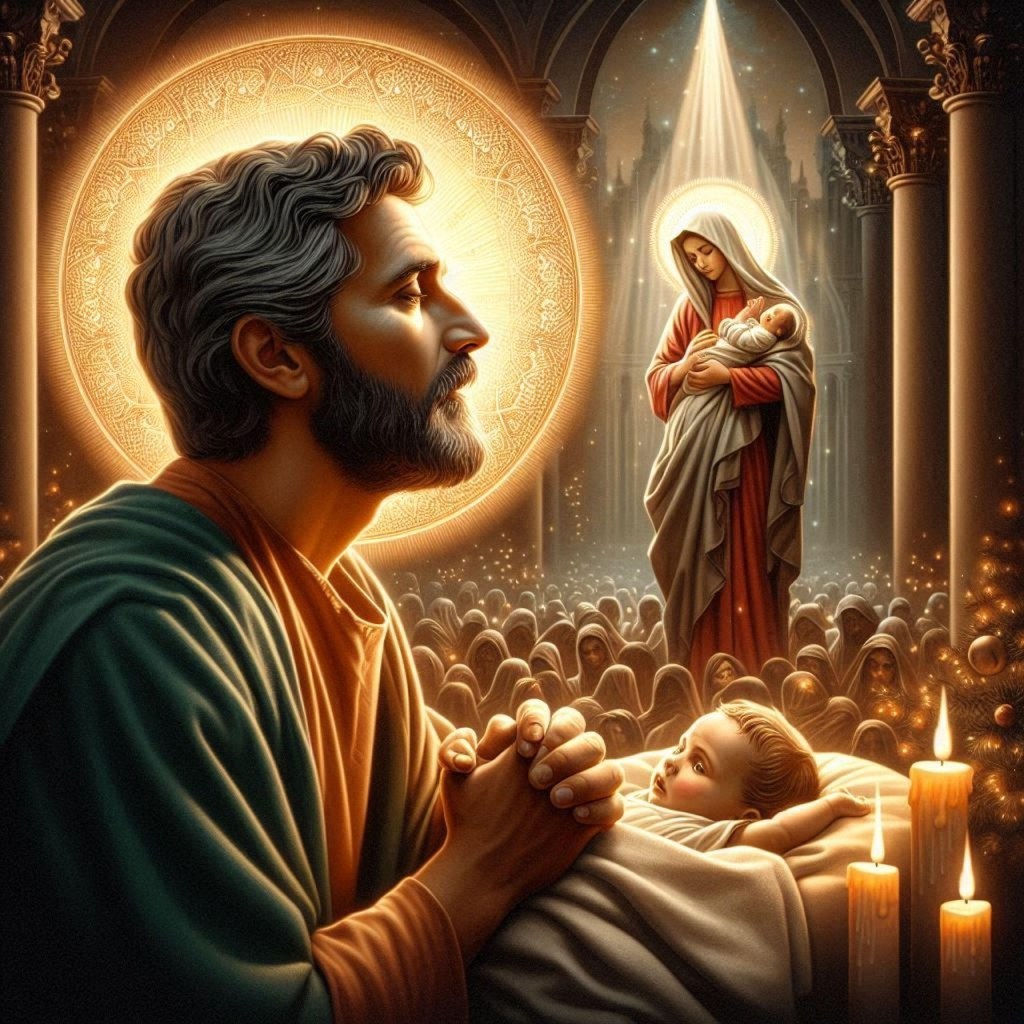
How Jesus must have loved Joseph – this man so holy that he gave his whole life over to the nurturing of God!

But Joseph’s choice was not easy.


The choice was confusing.

This is how the birth of Jesus the Messiah came about: His mother Mary was pledged to be married to Joseph, but before they came together, she was found to be pregnant through the Holy Spirit. Because Joseph her husband was faithful to the law, and yet did not want to expose her to public disgrace, he had in mind to divorce her quietly.

Matthew 1:18-19

The choice took courage.

When they had gone, an angel of the Lord appeared to Joseph in a dream. “Get up,” he said, “take the child and his mother and escape to Egypt. Stay there until I tell you, for Herod is going to search for the child to kill him.”

Matthew 2:13

The choice took patience.

After the festival was over, while his parents were returning home, the boy Jesus stayed behind in Jerusalem, but they were unaware of it. Thinking he was in their company, they traveled on for a day. Then they began looking for him among their relatives and friends. When they did not find him, they went back to Jerusalem to look for him. After three days, they found him in the temple courts, sitting among the teachers, listening to them and asking them questions. Everyone who heard him was amazed at his understanding and his answers. When his parents saw him, they were astonished. His mother said to him, “Son, why have you treated us like this? Your father and I have been anxiously searching for you.”

Luke 2:43-48

The choice took humility.

After the above incident in the Temple, we do not hear of Joseph again. We can assume that for the remaining decade before Jesus’s public ministry, he worked side by side with Joseph to sustain their little family. In the Divine Plan, it appears that Joseph’s role is humbly and silently concluded by a quiet death in Nazareth before Jesus turns thirty.


Most of all, the choice took immense and sustained faith.

Joseph’s faith sustained his life, protected and companioned Mary, taught and nurtured the Son of God. That was one extraordinary faith! Yet, in many ways, it is a faith we ordinary believers are also all called to:

  • to hear God’s call
  • to step into salvation history with trust and courage
  • to do what needs to be done without braggadocio
  • to end in quiet grace, acknowledging that it all belonged to God

Music: Hymn to St. Joseph

Christum Dei Filium qui putari
dignatus est filius Joseph:
Venite adoremus.
O come, let us adore Christ the Son of God,
Who deigned to be
thought to be the son of Joseph!
Blessed be the eyes that have seen what thou hast seen,
Blessed be the ears that have heard what thou hast heard.
Blessed be the arms that have held thy Creator.
Blessed be the hands that have labored for the Word.
Blessed is thy Heart all aflame with ardent love,
Chosen and Beloved by the Holy Trinity.
Blessed be thy Virgin spouse entrusted unto thee.
Bless all, dear Joseph, who love and honor thee.


For Your Reflection:

  • What feelings or reactions do I have after reading this reflection?
  • Do my feelings or reactions remind me of any passage or event in scripture, especially in the life of Christ? 
  • What actions might I take today because of my response to these readings?
I Am the Truth …

Fourth Sunday of Lent
March 15, 2026

Veracity is the virtue of being truthful in all things.


Recently, I heard our culture referred to as “The Post-Truth Age”. I found that statement to be both accurate and frightening. In a world completely entangled in lies, veracity is a lonely virtue. Jesus knew that. As he nears Jerusalem, it becomes increasingly apparent that those who live by the Lie will seek to exterminate him. But, in Jesus, Truth is eternal. Through his Resurrection, we are welcomed into that infinite Veracity.

Throughout this week, the Word of God is leading us – out of darkness, out of blindness, out of fear, out of all that inhibits the eternal life of grace within us. Time is drawing close to Calvary, when our faith will be tested. Jesus wants us to remember the miracles and words of this week so that our faith will not be shaken by the days to come.

Like Antonia, in the story below, Jesus wants us to find the Truth that supersedes circumstances. It is a Truth that rests in full and honest relationship with him.


“End stage melanoma,” the doctor pronounced, after Antonia requested complete honesty.

It seemed unfair to those who knew her: an ebony spot, unnoticed on her back, soon would bleed its ink across her death certificate. For Antonia, though, the irony lay not in her diagnosis, but in the thought that so few people really knew her or would care.

An unmarried, retired teacher, Antonia was an only child. With only distant cousins, she had made the parish her family. She was a daily communicant, a generous contributor, and a respected neighbor. Antonia knew this. But, for decades, she had still gone home each night to a lonely house and a solitary life.

How surprised she was when, during her final weeks in hospice, visitors came in waves to comfort her. Students spoke of her steady influence; neighbors of her charity. Colleagues remembered her patience. When one visitor lamented Antonia’s situation, she stopped him, mid-sentence. “I have never been happier,” she said. “I had no idea so many people loved me.”

Life’s circumstances can conspire to convince us that we are unimportant, unloved, even useless. Sometimes, these perceptions are self-imposed. At other times, they are pressed on us by hostile forces, as they were on Jesus at the end of his life. But Jesus assures us in this week’s readings: “The one who believes in me will never die.” He touches the blind man with light and the royal official’s son with resurrection. Jesus calls us to trust that we are infinitely loved. Believing it, we have the strength – even the joy- to go with him to Calvary.


Music: Jerusalem, My Destiny – Rory Cooney


Suggested Reading: Ephesians 5:8-14


For Your Reflection:

  • What feelings or reactions do I have after reading this reflection?
  • Do my feelings or reactions remind me of any passage or event in scripture, especially in the life of Christ? 
  • What actions might I take today because of my response to these readings?
Trinity in Session

January 11. 2026
The Baptism of the Lord


The theological virtues are the supernatural gifts of
faith, hope, and love
that are directly infused by God into the human soul
to enable a person to live in relationship with the Holy Trinity.


The Baptism Of Jesus
by Jeff Haynie
For purchase, see:
https://fineartamerica.com/featured/the-baptism-of-jesus-jeff-haynie.html

Today, in God’s Lavish Mercy, our Gospel invites us to the banks of the Jordan River. We sit in the midst of a crowd filled with avid believers and curious doubters. The Baptist passionately preaches on the muddy shore. Some listen intently. Some fiddle with their picnic baskets because they aren’t ready to hear. (They don’t have cell phones to fiddle with.)

Where are you, and what are you doing when the under-breath murmurs begin to rise in surprised chatter? Who is this man exuding mysterious power even as he quietly emerges from the bank’s far side – and why is he here?

Simply this:
Jesus came from Galilee
to John at the Jordan
to be baptized by him.


But Omnipotence reveals Itself in this simple act: Creator, Redeemer, and Spirit present in Divine Voice, Sacred Wing, Grace-drenched Redeemer.

After Jesus was baptized,
he came up from the water and behold,
the heavens were opened for him,
and he saw the Spirit of God descending like a dove
and coming upon him.
And a voice came from the heavens, saying,
“This is my beloved Son, with whom I am well pleased.”
Matthew 3:16-17

As you experience this miraculous revelation, are you still looking into your picnic basket? Or have you been changed right down to your roots?


Music: Behold the Lamb of God from Handel’s Messiah

For Your Reflection

  • What feelings or reactions do I have after reading this reflection?
  • Do my feelings or reactions remind me of any passage or event in scripture, especially in the life of Christ? 
  • What actions might I take today because of my response to these readings?

Suggested Scripture:

The Holy Lists

January 1, 2026

Jesus, Mary, and Joseph, please bless and guide us throughout 2026.

As we welcome the new year, I welcome each of you to Lavish Mercy 2026. As I did in 2025, I will offer a reflection about once a week, sometimes more often.


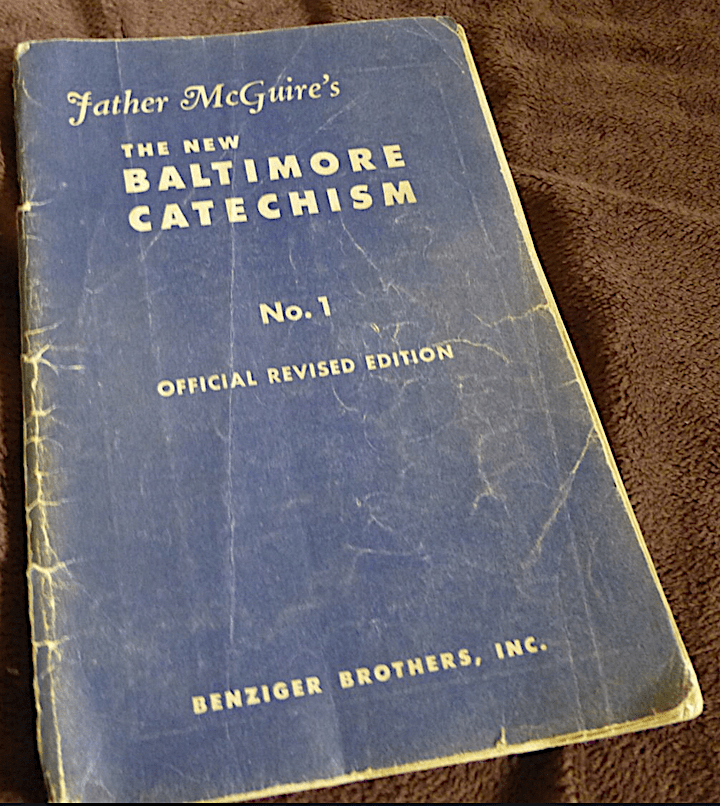
For 2026, I have chosen a theme that I nicknamed “The Holy Lists”. My Catholic friends who, like me, are of a “certain age” will remember the Baltimore Catechism. Though currently updated in language and attitude, that dear old 1945 version contained a mountain of incomprehensible truth condensed into manageable steps. Even though it provided scarce moral latitude, the book left me many unforgettable checklists that still influence my broader reflections and choices. They provided a roadmap for VIRTUE which could use a huge comeback in our morally tumultuous culture.


Who can forget the famous milk bottle by which one measured the level of their adolescent depravity?
Or the theological study questions with which even Thomas Aquinas might have struggled? e.g. (actual samples):

  1. Julius, an irreligious High School boy, claims we are forced to do all the things we do; he says that we are not free. Is this true? What is the reason for your answer?
  2. Leander wonders how it was possible for the prophets to describe the details of Our
    Lord’s passion and death many centuries before they took place.
    Can you explain this to Leander?

I deeply appreciate the wonderful religious instruction I received in the 1950s and 60s. But I think that even for Julius and Leander, some of those powerful lessons may have failed the leap into the 21st century.


So for 2026, I’d like to refresh some of those listed items by connecting them to the day’s reflection or readings. In a cultural and political climate so often disconnected from a moral compass, these virtues can serve a corrective purpose. They are valuable and, when offered in the modern vernacular, may inspire personal and cultural transformation.


Believe me, this is not an attempt to return to pre-Vatican II strictures. I am definitely an “aggiornamento” gal! Rather, I hope to provide an incentive to reclaim the quiescent markers of our faith – a faith that might be captured in a single virtue, or lost in a single fault. And I also think it might be fun!


St. Gregory of Nyssa inspires me with this statement:

The goal of a virtuous life
is to become like God.

Let’s give some time in 2026 to the pursuit of that virtuous life we all committed to at our Confirmation! God knows our world needs it!


See if you remember any of these once-memorized signposts :
• Gifts of the Holy Spirit
• Fruits of the Holy Spirit
• Cardinal Virtues
• Theological Virtues
• Moral Virtues
• Capital Virtues and their nemeses, the Deadly Sins
• Beatitudes
• Mysteries of the Rosary

And now, let’s begin…..

Our Saints

November 1, 2025

Often, we see someone more clearly in death than we do in life.

One Sunday, nearly 25 years ago, our religious community gathered to commemorate the precious life of our Sister Germaine Donohue. Germaine, who was more familiarly called Mercedes (Mercy), was one of our missionaries in Peru. She was vivacious, compassionate, holy, and too young to die. While ministering in our remote mountain home village of Pacaipampa, Peru, this marathon runner who loved to dance suffered an unexpected heart attack. By the time the neighboring villagers brought her down the eight-hour descent to Lima, she lived only a few more hours. It was All Saints Day.

At her funeral liturgy, the legacy of love she had quietly planted throughout her life blossomed like a field of vibrant wildflowers. Listening to stories that spanned the 40 years of her religious life, it was easy to see how consistently she chose to be with others in simplicity, honesty, and joy. It became clear that everything in her life had led her to a remote mountain village among the poor, who perfectly mirrored her deepest values. They were her heart’s companions.

Just like producing a prize-winning garden, bringing one’s life to such a degree of simplicity and beauty is no easy task. As human beings, we are constantly battling the weeds of self-interest and the complexity it breeds. But when, like Germaine, we choose to learn from those who are poor, we can grow in our capacity to trust a Power greater than ourselves to sustain our lives. We thus become freer to celebrate the beauty of others and of life around us.

For their first ten years in Pacaipampa, our Mercy community had been laboring — without success – to bloom roses in their tiny garden. When the sisters returned from Lima with Sister Germaine’s body to bury her among her beloved poor, they were greeted with the miracle of the first Pacaipampa rose. It blossomed there, a new life among the simple “pueblos jóvenes”. Perhaps they named that rose “Mercedes”.

I share the story of Sister Germaine’s passing because I hope it will offer you the gift it gave to me. The slow, daily, and sometimes frustrating work of building our lives around truly important values will — in the long run — transform and bless us. In everyday decisions, it is difficult to get enough perspective always to realize that. But when our lives are gathered someday in the story-telling of our children, our friends, and our communities, may we be fortunate enough to have left a legacy of beauty — our own miracle “rose”.


Music: El Condor Pasa

This song, popularized by Simon and Garfunkel, is actually drawn from a Peruvian folk song.

For Your Reflection

  • What feelings or reactions do I have after reading this reflection?
  • Do my feelings or reactions remind me of any passage or event in scripture, especially in the life of Christ? 
  • What actions might I take today because of my response to these readings?

Suggested Scripture: Proverbs 31 (Adaptation)

Who can find a merciful woman?
She is worth far more than rubies.
Her community has full confidence in her
and lacks nothing of value.
She brings them good, not harm,
all the days of her life.
She gets up while it is still night;
she provides food for her neighbors
and portions for the very poor.
She considers a field and buys it;
out of her earnings she plants a vineyard.
She sets about her work vigorously;
her arms are strong for her tasks.
She sees that her work is fruitful,
and her lamp does not go out at night.
In her hand she holds the distaff
and grasps the spindle with her fingers.
She opens her arms to the poor
and extends her hands to the needy.
When it snows, she has no fear for her household;
for all of them are clothed in scarlet.
She is clothed with strength and dignity;
she can laugh at the days to come.
She speaks with wisdom,
and faithful instruction is on her tongue.
She watches over the affairs of her beloved community
and does not eat the bread of idleness.
Her neighbors arise and call her blessed;
her family also praises her:
“Many women do noble things,
but you surpass them all.”
Charm is deceptive, and beauty is fleeting;
but a woman of mercy is to be praised.
Honor her for all that her hands have done,
and let her works bring her praise at the heavenly gate.

Snowball Man

Summer Haze – Andrè Aguado

Friends invited me out to a swanky dinner one night. Every menu item was presented in an elegant and appetizing manner. One offering particularly struck me. To clear the palate, the upscale restaurant offered “shaved ice infused with delicate essence“.

Immediately, my mind returned to a hot summer street in 1950 or so. The relative cool of evening had begun to fall over the broiled city. Families sat out on their steps or lawn chairs to catch whatever breeze might pass through the tight city streets. From the distance, a bicycle bell announced the impending arrival of the “Snowball Man”. He pedaled through the neighborhoods on a crudely cobbled cart, his newly purchased ice block tracing the watermarks of his passage.

Both nickel and dime portions were offered, with complimentary choices of flavoring from the half-dozen bottles which framed the precious ice block. There was no refrigeration. Of necessity, he journeyed quickly and a dawdling kid would be passed over for the next certain one in line.

The Snowball Man carried a transitory treasure which, in time, melted quickly into only memory. Yet it is in that memory where his jingling existence is preserved in a sweet array of colorful flavors.

That night, sixty years later, in a noisy, overpriced restaurant, the memory reminded me that so much of life is fleeting and fragile. Like the vendor’s ice block, our chance to offer sweet refreshment to the world will quickly melt away. Catherine McAuley, the first Sister of Mercy, expressed it this way: “Do all you can for God’s people for time is short.”

Today, when many around you are thirsty and parched, how will you share and flavor the precious refreshment within you?


Music: Time in a Bottle – Jim Croce

As you listen to this beautiful song, think about going through time with God and God’s People.

For Your Reflection:

  • What feelings or reactions do I have after reading this reflection?
  • Do my feelings or reactions remind me of any passage or event in scripture, especially in the life of Christ? 
  • What actions might I take today because of my response to these readings?
Suggested Scripture: Ecclesiastes 3:1-14

Easter Sunday

April 20, 2025

Hallelujah Chorus – Kim Hollingsworth

Isaiah Zagar is a noted mosaic artist whose artistic materials are primarily broken and discarded scraps. His unique genius lies in his ability to reshape unwanted fragments into inspiring art. Viewing one of his pieces, one considers the past existence of each remodeled element. What had that delft tile once adorned? Whose uniform had been secured by that battered brass button? That rose-colored glass, whom had is shaded?

We imagine each piece in its wholeness and wonder what fractured that former existence. We imagine the journeys carrying each particle to this new expression, locked now in harmony with every element surrounding it. We begin to discern what our own story might look like fragmented into so many parts. The effect is profound amazement that a wall plastered with debris can evoke such deep reflection.

Like these mosaic pieces, our Lenten journey has brought each of us to a new place. In the company of Christ, we have been broken, healed and lifted into new life. We share the astonishment of Christ’s disciples. Like so many of us, fragmented by our hectic lives, they had forgotten his promise. “I shall rise again,” he told them. Yet they go seeking him in an empty tomb.

Today, remade by Easter grace, we leave the vacant graves where our broken hearts may have lingered. We are new beings in the Resurrected Christ. The world’s disguise has been rolled away, like the boulder at the tomb. We see all creation anew as the expression of the Holy Spirit. With those first disciples, let us run rejoicing to our sisters and brothers. Let us assure them by our actions that Christ is indeed alive!


Music: Se impassibile, immortale – from La resurrezione by George by Frideric Handel

An Aria of Mary Magdalen at the tomb:

Se impassibile, immortale
sei risorto o Sole amato,
deh fa ancor ch’ogni mortale
teco sorga dal peccato.

If immovable and immortal
You are risen, oh beloved Sun,
ah, let all mortals rise with you
out of their sinful state.


For Your Reflection

  • What feelings or reactions do I have after reading this reflection?
  • Do my feelings or reactions remind me of any passage or event in scripture, especially in the life of Christ? 
  • What actions might I take today because of my response to these readings?

Suggested Scripture: John 20:11-18

Good Friday

April 18, 2025

Chopin: Nocturn in C Sharp Minor, played by Hauser. (Listen to it all – lovely.)

Calvary was a glass box where God,
confined, no longer touched the world.
It was a white plain, without sound,
not the groaning, blood-soaked hill
the scriptures leave us.

I know.
Calvary hewed itself inside me once
with the chisel of a long sorrow
that fell, persistent, merciless
like cold, steel rain.

It was a place bereft of feeling.
Only the anticipation and
the memory of pain are feelings.
Pain itself is a huge abyss,
bled by a silence that mimics death,
but is not as absolutely kind.

Calvary is the place where
all strength is given
to the drawing of a breath
to linger in it unfulfilled.

God, now I go quietly inside
where you are dying in a glass box, still.
I release all definitions
to pass through and companion you.
I watch the rain, itself like glass,
crashing to an unknown life 
beneath the earth. Where love roots
absolute, unbreakable, I cling to you
in a transparent act of will.           


Agios O Theos
Agios Ischyros
Agios Athanatos
Eleison Imas

Holy God
Holy Strong One
Holy Deathless One
Have Mercy On Us


For Your Reflection

  • What feelings or reactions do I have after reading this reflection?
  • Do my feelings or reactions remind me of any passage or event in scripture, especially in the life of Christ? 
  • What actions might I take today because of my response to these readings?

Suggested Scripture: Luke 23: 44-49

Holy Thursday’s Cup

April 17, 2025

Ubi Caritas – Taize Community

Life is change. Like a deep and vast ocean, life moves in waves and currents, never still even at its depths. It is the rhythmic flow of God, drawing all creation back and forth in its power. Yet, at the same time, life is constant. Its source is the eternal well of God which has neither beginning nor end.

These are the waters in which we swim. Whether theologian or kindergartner, each one of us lives this mystery every day of our lives. At times we move with great agility, dolphins dancing in the stream of grace. At other times, our stroke falters. We fall like shelled mollusks to the ocean floor, heavy with our imagined limitations.

This is what happened to twelve men on an April night in old Jerusalem. They had been swimming in the miracle of God’s Incarnation. They had even asked, just weeks before, to sit in eternal glory with Jesus. They wanted their current happiness never to change. They did not really absorb the challenge of Jesus’ counter-question: “Can you drink the cup that I will drink?”

But on this April night, this Holy Thursday, that promised cup was handed to them. The clear waters would turn to wine and the wine would turn to blood. The flow of days would sink now to the depths of their hearts. Could they abandon themselves to its tumultuous current? Could they trust so completely as to be buoyed by God alone? Could they accept the cost of such infinite freedom?

Every change in our lives offers us the same cup. The change may be as profound as death or as simple as a clock ticking. The invitation within each circumstance is the same: will you allow this moment to free you into God’s Heart?


Music: Adoro Te Devote – Gregorian Chant Academy

For Your Reflection

  • What feelings or reactions do I have after reading this reflection?
  • Do my feelings or reactions remind me of any passage or event in scripture, especially in the life of Christ? 
  • What actions might I take today because of my response to these readings?

Suggested Scripture: Matthew 26:17-30

Ash Wednesday

March 5, 2025

Make Me a Channel of Your Peace

Penance and self-denial are not generally popular concepts. Yet all major religions include them as means of spiritual enrichment. Why do you think that is? Here’s my take on it.

Most of us live within the illusion of many boundaries. We are bound by space, time, circumstances, choices, and perceived abilities or inabilities, to name a few. Sometimes we get terribly caught in our boundaries. We are afraid to try something new; to shed a dangerous but comfortable habit; to break a debilitating, co-dependent relationship; to choose a life-giving but challenging road. Too often, we say “no” to our graced potential.

But God is beyond boundaries. God is limitless, everlasting, infinite possibility and hope. Fasting and self-denial are human attempts to prove to ourselves that we can break through what binds us to live in God’s infinite “YES!”.

Giving up candy, smoking, or mindless TV is a small way of doing that. But attending to our tendencies for gossip, meanness, negativity, and self-centeredness is a great alternative way. Whatever our religious tradition, Ash Wednesday can remind us that God made us for freedom, unconditional love, and unending life. May our choices reflect that.


Music: Take These Ashes – Sarah Hart

For Your Reflection

  • What feelings or reactions do I have after reading this reflection?
  • Do my feelings or reactions remind me of any passage or event in scripture, especially in the life of Christ? 
  • What actions might I take today because of my response to these readings?

Suggested Scripture: Proverbs 6: 16-19