O, the Depths!

Wednesday of the Sixth Week of Easter

May 29, 2019

Click here for readings

Would you agree with this statement?

Nothing is ever completely what it seems to be.

The discrepancy is in us – in our limited capacity to access reality on its many levels.

iceberg

Like an iceberg, every story, every feeling, has an “understory” that we either miss, fear, or only incompletely comprehend.

Today, Jesus promises his faithful disciples the wondrous hope of the Holy Spirit Who, by Her profound gifts, will lead us to the depths of life in God. Descending ever more deeply into that Truth, we will see beyond the surface of our life into its sacred character. Our vision of the world, like a holy X-ray, will change radically. We will begin to see with the eyes of God.

This deepening is like a dance where the Spirit leads and we follow. By opening our eyes to each moment’s deeper truth, the Holy Spirit will invite us to live our lives in wisdom, understanding, counsel, fortitude, knowledge, piety, and awe of God.

Jn16_13

We can sense the dance in ourselves when we see the Holy Spirit’s fruits blossom in us: charity, joy, peace, patience, kindness, goodness, generosity, gentleness, faithfulness, modesty, self-control, purity of heart.

We have all been there at moments in our lives, dear friends — on the edge of God’s immense love for us and for all Creation — a starry evening on a deserted beach; a quiet, warm room during a winter storm; a friend’s generous embrace in our sorrow; a small awareness of all the Love God has for us. Think of your own moments when the Holy Spirit longed to love you beyond yourself. Ask for a re-run!

Those readers in the northern hemisphere are close to our summer season, with the fields yielding the abundant fruit of winter’s waiting. All of us, no matter our location, await the imminent outpouring of Pentecost. It is a good time to look at our own heart’s fields, to open them the the Holy Spirit’s astounding call and companionship.

Music: Who Has Known – John Foley, SJ

This is really an Advent/Christmas hymn, but I think it works well with today’s reflection. I hope you agree. (Lyrics below)

O the depth of the riches of God;
and the breadth of the wisdom and knowledge of God!
For who has known the mind of God?
To Him be glory forever.

A virgin will carry a child and give birth,
and His name shall be called Emanuel.
For who has known the mind of God?
To Him be glory forever.

The people in darkness have seen a great light;
for a child has been born, His dominion is wide.
For who has known the mind of God?
To Him be glory forever.

The New Jerusalem

The Sixth Sunday of Easter

May 26, 2019

Click here for reading

(I know you’re having a holiday weekend but, if nothing else, listen to today’s glorious song)

Today, in Mercy,  in our readings, we definitely get the sense of a young Church growing in its self-understanding.

The early Church leaders, most of whom are Jews, grapple with the question of whether new Gentile followers must first be circumcised in order to be baptized.

Over twenty centuries later, the answer seems obvious. But the question nagging the disciples shows us how they experienced their Christianity as emerging from Judaism. They had no concept of the call to Christianity coming in any other way.

It seems it was a huge shift for some of them to realize that God is not Jewish, that God is the God of all peoples – just as some of us today have trouble understanding that God is not Catholic, Protestant, Muslim, male, white, born again or any other human limitation we attach to the Divine.

Rev21_2 Jerusalem

Our second reading reveals how John dealt with navigating this shift. Still cemented in his Jewish symbols, he sees “Jerusalem” coming down out of heaven from God. But it was a new Jerusalem – one without the central symbol of Judaism, the Temple:

I saw no temple in the city
for its temple is the Lord God almighty and the Lamb.
The city had no need of sun or moon to shine on it,
for the glory of God gave it light,
and its lamp was the Lamb.

For John, the New Creation in Christ included, but exceeded the Jewish narrative.

In our Gospel, Jesus prepares his disciples for life without his physical presence. They, too, need to learn to let go. He encourages them to open their hearts to even greater graces:

The Advocate, the Holy Spirit,
whom the Father will send in my name,
will teach you everything
and remind you of all that I told you.

Jesus is reminding his disciples, and us, that the graces and learnings of the New Creation are infinite. If we can learn when to let go of our old practices, our material symbols, our impregnable sureties, the Holy Spirit will astound us, and re-shape our understanding of God, just as She did for Mary, Peter, Paul, John and all the many enlightened saints through the ages.

As Pentecost approaches, let us pray for such Enlightenment in ourselves and especially in our Church. For the world grows ever more resistant to the Holy Spirit Whose Gifts are wisdom, understanding, counsel, fortitude, knowledge, piety, and awe of God.

Let us pray for a New Jerusalem where all are one in God.

Music: If you do nothing else with this reflection, please allow yourselves the thrill of listening to the celestial voice of Miss Jessye Norman. (Always gives me goosebumps!)

If … then. Uh oh!

Saturday of the Fifth Week of Easter 

May 25, 2019

Click here for readings

Today, in Mercy, our readings challenge us.

Jn15_20JPG

Jesus talks about the kind of blowback his disciples can expect for living their faith in  an inimical world. He gives us some “if … then” statements:

  • If the world hates you, realize that it hated me first.
  • If you belonged to the world, the world would love its own; but because you do not belong to the world, and I have chosen you out of the world, the world hates you.
  • If they persecuted me, they will also persecute you.

Reading these verses makes me wonder if I am really living the Gospel, because I don’t feel all that persecuted.

And then I think that this is because I really live in two worlds. I live in first world comfort and security. But there is also a part of me that agonizes daily over the injustice rampant in our shared world. Today’s Gospel challenges me to live more intentionally in that second world.

Walter Brueggemann says this:

Faith is both the conviction
that justice can be accomplished
and the refusal to accept injustice.”
Interrupting Silence: God’s Command to Speak Out

Jesus was not persecuted simply because he did miracles and preached love. This loving, life-giving ministry confronted the dominant, government-generated culture which relied on the subjugation and despair of those they dominated.

Jesus, just like other prophets, was killed because he gave hope to a people whose freedom threatened the status quo comfort of the dominators. Just like  Martin Luther King, Gandhi, Oscar Romero , Deitrich Bonhoeffer, Wang Zhiming , the Blessed Martyrs of Nowogrodek  (All names are clickable to find more information.)

I don’t aspire to martyrdom. But I do want to be a true disciple of Jesus. The way available to us is to live and act with mercy and compassion for the poor, marginalized people Jesus so loves. We can do this by voting, advocating for, and sponsoring programs and agendas for social justice.  This link from the Sisters of Mercy is a help on how to do that:

Click here for Sisters of Mercy Advocacy page

Brueggemann also says this:

Compassion constitutes a radical form of criticism, for it announces that the hurt is to be taken seriously, that the hurt is not to be accepted as normal and natural but is an abnormal and unacceptable condition for humanness. In the arrangement of “lawfulness” in Jesus’ time, as in the ancient empire of Pharaoh, the one unpermitted quality of relation was compassion. Empires are never built or maintained on the basis of compassion.” (Prophetic Imagination)

May our hearts be moved by grace to the depth of compassion we have learned from Jesus.

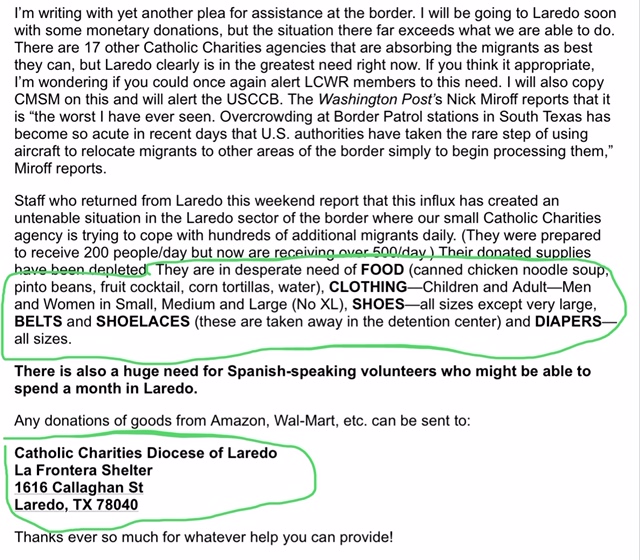
P.S. I know that many of you have responded to this request I placed on Facebook. Thank you. For those who don’t do Facebook, this is an urgent request for help for refugees at our southern border. It’s an easy way to do some good things.It was received from Sisters of Mercy Leadership Team in D.C.

Music for today is below this request. 


appeal


Music: Compassion- The Gettys 

Live in Christ

Wednesday of the Fifth Week of Easter 

May 22, 2019

Click here for readings.

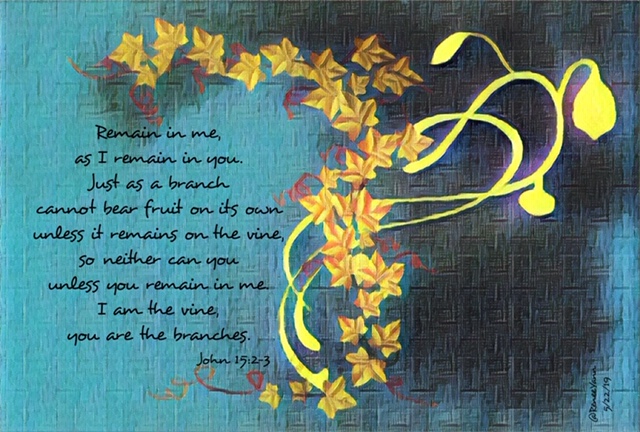
Today, in Mercy, our Gospel gives us the powerful metaphor of the Vine and the Branches.

John15_2 vine

How do we grow more deeply into God? Or how do we let God grow more deeply into us? Or do we even want those things to happen?

If our lives seem to be riding along on their own, we may not pay all that much attention to God’s Presence in our experiences. And that’s where we miss the opportunity to be grafted on to the Vine.

How unfortunate if we never learn to befriend our own souls, because that is the place where God speaks to us. St. Teresa of Avila put it this way:


What friends or kindred can be so close and intimate as the powers of our soul, which, whether we will or no, must ever bear us company?
— St. Theresa of Avila, The Interior Castle


Some practices to help that “befriending” are the appreciation of quiet, the routine of prayer, the love of scripture, the reverence of nature and humanity, and the practice of charity.

The Little Flower offers us great insight into friendship with God:


I understand and I know from experience that: ‘The kingdom of God is within you.’ Jesus has no need of books or teachers to instruct souls; He teaches without the noise of words. Never have I heard Him speak, but I feel that He is within me at each moment; He is guiding and inspiring me with what I must say and do. I find just when I need them certain lights that I had not seen until then, and it isn’t most frequently during my hours of prayer that these are most abundant but rather in the midst of my daily occupations.”
― St. Therese of Lisieux, The Story of a Soul – the Autobiography of St. Therese


Lest my men readers fear I’ve gone all girly with these women saints (and by the way, they were not girly.  They were powerhouses of spiritual dynamism!), try this from St. Ignatius Loyola, founder of the Jesuits:


Try to keep your soul always in peace and quiet, always ready for whatever our Lord may wish to work in you. it is certainly a higher virtue of the soul, and a greater grace, to be able to enjoy the Lord in different times and different places than in only one.
― Saint Ignatius, Letter to Francisco de Borja, Duke of Gandía


Summary of all this thought: God lives in us and we live in God, as branches live in the Vine. May we let ourselves absorb, cherish and celebrate this astounding Gift!

PS: Sending another personal thought on a little later this evening. 

Music: I Am the Vine- John Michael Talbot

Finding Peace

Tuesday of the Fifth Week of Easter

May 21, 2019

Click here for readings

Today, in Mercy, our Gospel offers us a profound message: what does it mean to live in the peace of God?

jn14_28 peace

So many things, from the monumental to the trivial, can make us unpeaceful. If we made a list, we might tire before we completed it! This lack of peace takes many forms in us – worry, anxiety, second guessing, distraction, self-doubt and myriad other forms of inner fragmentation.

For some of us, gaining inner peace is more difficult than for others. So much depends on the trust we have felt in our lives. For those who have felt betrayed by family, friends, or God, the journey to a peaceful heart can be a tortuous one.

But Jesus says we can do it because he showed us how.

Don’t you think he might have been confused and bewildered at times by what the Father was asking of him? Don’t you think he was disillusioned at times by the wavering faith of his disciples? Don’t you think he was frightened by the kind of death he faced?

So just how did Jesus grow to such a fullness of peace that he was able to bequeath it to us as our inheritance?

He said:

Not as the world gives peace do I give it to you.

The world gives peace by removing or dominating challenges. God gives peace by accompanying us through challenges.

Jesus came to the point, in his very human life, where he chose not to let his heart be troubled because he had found this accompaniment.

The willingness of Jesus to live, suffer, and die according to the Father’s Will gives us the pattern on which to build our peace.

Throughout the ages, many saints have found and lived this peace according to their own call from God. One of the many who inspire me is Julian of Norwich.  Julian was an English anchorite of the Middle Ages.  She wrote the earliest surviving book in the English language to be written by a woman, Revelations of Divine Love.

Julian was worried about the presence of sin in the world. It seems she wondered, like many of us might, why God didn’t just fix that!


“In my folly, before this time I often wondered why, by the great foreseeing wisdom of God, the onset of sin was not prevented: for then, I thought, all should have been well. This impulse [of thought] was much to be avoided, but nevertheless I mourned and sorrowed because of it, without reason and discretion.

But Jesus, who in this vision informed me of all that is needed by me, answered with these words and said: ‘It was necessary that there should be sin; but all shall be well, and all shall be well, and all manner of thing shall be well.’

These words were said most tenderly, showing no manner of blame to me nor to any who shall be saved.”


This also is a lovely quote from Julian to pray with:

“From the time these things were first revealed I had often wanted to know what was our Lord’s meaning. It was more than fifteen years after that I was answered in my spirit’s understanding. ‘You would know our Lord’s meaning in this thing? Know it well. Love was his meaning. Who showed it to you? Love. What did he show you? Love. Why did he show it? For love. Hold on to this and you will know and understand love more and more. But you will not know or learn anything else — ever.”

Music: Meg Barnhouse’s modern interpretation of Julian’s writing, which Meg has obviously studied.


A Reflection and A Heartfelt Request

Monday of the Fifth Week of Easter 

May 20, 2019

 Click here for readings

Today, in Mercy, our reading from Acts  shows that everything wasn’t always a bowl of cherries for the Apostles.  Paul recounts that both the change-resistant Jews and Gentiles wanted to attack and stone him and Barnabas. So they left and went to Lystra where Paul cured a paralyzed man. This won them approval to the point that the populace thought they were gods!

It seems that this was a time of “feast or famine” for Paul and the other disciples. They had to stay true to their mission while learning to balance the reactions and expectations of the people to whom they preached. 

They had to balance their own expectations too. Not everyone they encountered was able to receive the Word.

Our Gospel gives us an insight into how the Apostles might have felt when they met someone who was hard of heart and spirit. Jude, who has nothing but this to say in the whole Gospel, asks Jesus:

Master, then what happened
that you will reveal yourself to us

and not to the world?

In other words, why are we blessed with faith when others are not?

John14_23

Jesus’ answer is mysterious but simple:

Whoever loves me will keep my word,
and my Father will love him,
and we will come to him and make our dwelling with him.
Whoever does not love me does not keep my words.

John’s  phraseology, as usual,  is a little roundabout but the meaning is clear – love Me and do what I have asked of you, and your heart will open to My Truth.

We love Jesus by getting to know him intimately in Scripture and tradition, in ritual and sacrament, and in the faces of our sisters and brothers. If we do this, Jesus will reveal his heart to us.

Speaking of hearts, dear friends, my precious 3-year-old grandnephew will have surgery on Tuesday morning to repair a hole in his heart. My family and I would be so grateful for your prayers for his complete healing and for the skill of those who treat him. His name is Oliver and, of course, we love him beyond words. Thank you.

me_Ollie

Music today is an old come-all-ya, and the accompanying art is so saccharin, I know! But I still love this hymn and Daniel O’Donnell could sing me the ABCs and I’d be happy. As Ollie faces his surgery, the hymn is very comforting to me, and I hope to you in whatever needs you have.

Sweet Heart of Jesus – Daniel O’Donnell

Do You Have Your Housekey?

Friday of the Fourth Week of Easter

May 17, 2019

Click here for readings

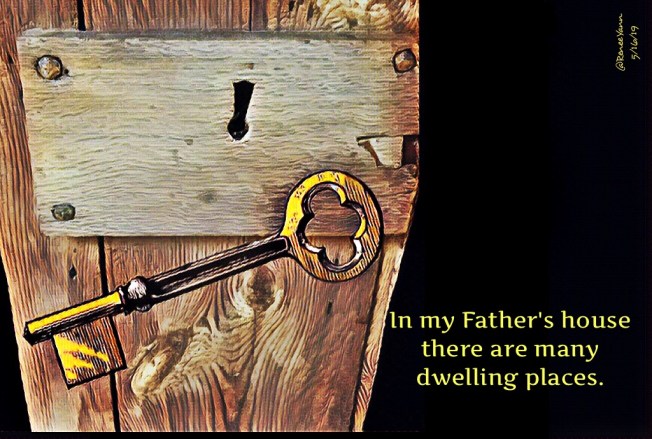
Jn14_2 dwelling

Today, in Mercy, Paul continues his preaching in Antioch. He delivers a very powerful, and condemnatory line about the inhabitants of Jerusalem and their leaders …

Though they found no grounds for a death sentence,
they asked Pilate to have Jesus put to death…

Being unable to accept the Truth that Jesus was, they conspired to destroy him.

Understanding, accepting and living within the Truth of God and of ourselves is the way to eternal life. In our Gospel, Jesus tells us that he is this Way, Truth and Life.

It sounds so straightforward and simple, doesn’t it? 

But in our world, truth has lost its definition. Its edges have been stretched beyond recognition by propaganda, moral convenience, political pretense, false advertising, manipulative social media, and other forms of self-serving deceit.

truthThe distortion of truth has become epidemic among us, infecting us all in one way or another.
Just as in the presence of any disease, we need to take precautions to keep ourselves healthy – true to God and to ourselves:

  • placing ourselves honestly before God in prayer
  • practicing a brief examination of conscience at the end of each day
  • discerning how we use power and advantage in terms of self-interest
  • living by self-respect and respect for others
  • evaluating our actions and choices in the light of the command to love one another

In the Father’s House there are many dwelling places. Truth is their entry key:

I am the way and the truth and the life, says the Lord;
no one comes to the Father except through me.

Music: Dwelling Place – John Foley, SJ

Open to the Light

Wednesday of the Fourth Week of Easter

Click here for readings

May 15, 2019

Today, in Mercy, Jesus calls himself the Light.

Jn12_46_Light

Surely he came to bring us out of darkness which is light’s polar opposite. Most of us receive that deliverance with gratitude, understanding it to be our redemption from sin and separation from God.

As we grow deeper in our spiritual life, we may realize that there are many degrees of opposition to the Light. We may not find ourselves in the deep darkness of habitual sin, but rather on those tantalizing edges of spiritual laziness that can halt our soul’s growth:

  • the fog of faithless religious practice
  • the clouds of unresolved hurts and failures in forgiveness
  • the shadows of our religious prejudices
  • the dusk of our early energy for charity and community
  • the eclipse of hope and confidence in God

May God give us the grace to see that Light, too, comes in many forms, beaming through the smallest openings in our spirit. Every act, every choice, every silent prayer made for the sake of Love allows that Light to grow. You may like to pray with that thought while appreciating this poem of Denise Levertov:

Bearing the Light

Rain-diamonds, this winter morning, 
embellish the tangle of unpruned pear-tree twigs; 
each solitaire, placed, it appears, with considered judgement, 
bears the light beneath the rifted clouds – 
the indivisible shared out in endless abundance.

Music: some beautiful instrumental music from Kathryn Kaye for your prayer time.

Anonymous in God

Tuesday of the Fourth Week of Easter 

May 14, 2019

Click here for readings

Matthias

Today, in Mercy, we celebrate the feast of St. Matthias, the one chosen by lot to take the place of Judas among the Twelve.

Matthias met the conditions for being an “Apostle” because he

… accompanied (the Apostles) the whole time
the Lord Jesus came and went among us,

beginning from the baptism of John
until the day on which he was taken up from us …

But there was another, upon whom the lot did not fall, who also met these conditions- Joseph Barsabbas Justus. This man was important enough to Luke, the writer of Acts, that his name is precisely recorded in history. But his name is all that we know of him. What he subsequently did for the spread of the Gospel remains folded in history’s shadows.

There are so many souls, down through these same shadows, who love and spread the Gospel but who remain relatively “anonymous in God”. I think of one such woman today, on what was once her Feastday.

Sister Mary Matthias Duggan was born in 1869 in the Irish Free State. She came to the United States in 1897. She joined the Sisters of Mercy as a lay sister, women who lacked the formal education to be teachers. Sister Matthias, and many others like her, cared for the household needs of the teaching sisters and resident students.

When I met Sister Matthias, she was in her nineties and lived on our infirmary wing. The trek from that wing to our Motherhouse chapel, though a skip and a jump for us novices, was a long journey on her cane for Sister Matthias. She carried ninety years of heavy work on her aged bones.

When any of us “youngsters” would come upon Sister Matthias or her peers on their chapel journey, we would offer an arm in accompaniment. Sister Matthias would give a lightly brogued “Thank you”, then begin a series of audible prayers for the accompanying novice. She always said, “These prayers are for your final perseverance.”

We will never know the blessed influence Joseph Barsabbas Justus had on the early Church. If it was anything near the Holy Gift that Sister Matthias quietly gave, then he too is a saint like she is.

Sister Mary Matthias Duggan, and all you Holy Women of Mercy, please continue to pray for us.

Music: For All the Saints

Open Your Heart’s Gate

Monday of the Fourth Week of Easter

May 13, 2019

Click here for readings

Today, in Mercy, our readings again visit the question, “Who belongs to family of God?”.

love like God

Peter, upon returning to Jerusalem from Joppa, faces the Jewish Christians who are only learning how to live their new faith. They don’t get it that Gentiles are invited too to this emerging faith community.

They, like many of us, find security in the categories we build into our lives. We separate those who belong and don’t belong – sometimes to assure ourselves that we belong in certain preferred categories. We decide who is OK and who is not. The Gentiles were not OK church members for the Jerusalem Christians.

Peter is very patient with these critics. Point by point, he explains how his own understanding was informed by the Holy Spirit, so that he saw clearly that Christ’s invitation was for all people.

This reading challenges us to examine our “categories”, our biases and prejudices. Who is OK in my book, and who is suspect or questionable? In my thinking, who has a “right” to certain goods, positions and privileges? Who would I not invite to my table based on my predetermined “categories”?

With Christ, there are no privileged categories. We are each the privileged child of God, universally redeemed in the blood of Christ.

As I pray with this thought today, how might my attitudes and choices be affected?

Music: We are Called – David Haas