Today, in Mercy, Jesus offers his good-byes as time approaches for him to return to the Father.
His friends are sad. Wouldn’t you be? What a guy to have known, and palled around with, and loved – in person! But now it’s time for Jesus to return to his role in the Blessed Trinity. And it is time for the Holy Spirit’s continuing role in the world to begin.
Jesus describes the Spirit’s role as one that will set things right by:
showing the world its mistake in rejecting Jesus
making clear that Jesus’s teaching was right and just
condemning any evil that denies Christ’s teaching
The Holy Spirit will do all this in a different way from Jesus. Jesus was beside his disciples showing them the way to live – and he still is. But the Holy Spirit in within the People of God, working through our communal love, mercy, and justice to transform all Creation.
So Jesus is telling us not to be sad. He is still with us in Scripture and Sacrament. But now our experience of being with God is enriched by the indwelling Spirit who breathes Life to the world through our faith.
What an astounding good-bye Gift! Do we appreciate it, respond to it — even realize we have received it? We are capable of so much more than a small understanding of God. Let us ask to be opened to that Power.
There are few things on which I am more conflicted than the concept of a patriotic war to save democracy.
One month before I was born, my mother’s nineteen-year-old brother died on the sands of Iwo Jima. He died on her birthday, and I felt the earthquake even in the womb. As I grew up, there was nothing left in our house of his life but a few photos, a high school yearbook, and the dress uniform sent home by the Marines. He was too young to have built much more of a legacy.
But how we treasured him, our hero who died, and our heroes who lived – my Dad, Uncle Jack, Uncle Joe. How I myself considered joining the Navy as a chaplain during the Vietnam War – this at the same time as being arrested for antiwar protests at the Federal Building!
Even today, as a confirmed pacifist, I deeply honor and respect our active military and veterans’ bravery, selflessness and patriotism. We are a family who grew up in a military tradition which both elated and confounded us.
But in my heart of hearts, I believe that war is an aberration of the human spirit, legitimized by avaricious old men who are too quick to send other people’s sons and daughters into oblivion; who have the inhuman capacity to see the “other” as completely unlike themselves; who are too lazy, or comprised, inept, or downright evil to find another way to coalition.
I believe that the real victims of war are helpless women, children and elderly who are mowed down in its jaws. I believe they are the fodder of leaders grown fat on power and greed.
As I said, it is a conflict in me. I love the old WWII movies where every American is a hero, and every German and Japanese is an evil wretch to be bayoneted from existence. But they weren’t! They were men just like my Uncle Jim, caught in the failures of the leaders they depended on. As a result, their brave young bodies, no matter their country, lie in the depths of the Pacific or buried in a foreign field.
War is not glorious. It is not inspiring. It is a disgusting failure of the human spirit. And I think that, on this Memorial Day, we should be inspired by our beloveds’ lives and service to say,
“STOP!”.
WE. CAN. DO. THIS. DIFFERENTLY. NO MORE WAR.
In the name of my family, I forgive whoever killed my Uncle Jim on a forsaken Pacific Island, especially when I read this powerful poem:
Kamikaze – by Beatrice Garland
Her father embarked at sunrise with a flask of water, a samurai sword in the cockpit, a shaven head full of powerful incantations and enough fuel for a one-way journey into history
but half way there, she thought, recounting it later to her children, he must have looked far down at the little fishing boats strung out like bunting on a green-blue translucent sea
and beneath them, arcing in swathes like a huge flag waved first one way then the other in a figure of eight, the dark shoals of fishes flashing silver as their bellies swivelled towards the sun
and remembered how he and his brothers waiting on the shore built cairns of pearl-grey pebbles to see whose withstood longest the turbulent inrush of breakers bringing their father’s boat safe
– yes, grandfather’s boat – safe to the shore, salt-sodden, awash with cloud-marked mackerel, black crabs, feathery prawns, the loose silver of whitebait and once a tuna, the dark prince, muscular, dangerous.
And though he came back my mother never spoke again in his presence, nor did she meet his eyes and the neighbours too, they treated him as though he no longer existed, only we children still chattered and laughed
till gradually we too learned to be silent, to live as though he had never returned, that this was no longer the father we loved. And sometimes, she said, he must have wondered which had been the better way to die.
(I know you’re having a holiday weekend but, if nothing else, listen to today’s glorious song)
Today, in Mercy,in our readings, we definitely get the sense of a young Church growing in its self-understanding.
The early Church leaders, most of whom are Jews, grapple with the question of whether new Gentile followers must first be circumcised in order to be baptized.
Over twenty centuries later, the answer seems obvious. But the question nagging the disciples shows us how they experienced their Christianity as emerging from Judaism. They had no concept of the call to Christianity coming in any other way.
It seems it was a huge shift for some of them to realize that God is not Jewish, that God is the God of all peoples – just as some of us today have trouble understanding that God is not Catholic, Protestant, Muslim, male, white, born again or any other human limitation we attach to the Divine.
Our second reading reveals how John dealt with navigating this shift. Still cemented in his Jewish symbols, he sees “Jerusalem” coming down out of heaven from God. But it was a new Jerusalem – one without the central symbol of Judaism, the Temple:
I saw no temple in the city for its temple is the Lord God almighty and the Lamb. The city had no need of sun or moon to shine on it, for the glory of God gave it light, and its lamp was the Lamb.
For John, the New Creation in Christ included, but exceeded the Jewish narrative.
In our Gospel, Jesus prepares his disciples for life without his physical presence. They, too, need to learn to let go. He encourages them to open their hearts to even greater graces:
The Advocate, the Holy Spirit, whom the Father will send in my name, will teach you everything and remind you of all that I told you.
Jesus is reminding his disciples, and us, that the graces and learnings of the New Creation are infinite. If we can learn when to let go of our old practices, our material symbols, our impregnable sureties, the Holy Spirit will astound us, and re-shape our understanding of God, just as She did for Mary, Peter, Paul, John and all the many enlightened saints through the ages.
As Pentecost approaches, let us pray for such Enlightenment in ourselves and especially in our Church. For the world grows ever more resistant to the Holy Spirit Whose Gifts are wisdom, understanding, counsel, fortitude, knowledge, piety, and awe of God.
Let us pray for a New Jerusalem where all are one in God.
Music: If you do nothing else with this reflection, please allow yourselves the thrill of listening to the celestial voice of Miss Jessye Norman. (Always gives me goosebumps!)
Jesus talks about the kind of blowback his disciples can expect for living their faith inan inimical world. He gives us some “if … then” statements:
If the world hates you, realize that it hated me first.
If you belonged to the world, the world would love its own; but because you do not belong to the world, and I have chosen you out of the world, the world hates you.
If they persecuted me, they will also persecute you.
Reading these verses makes me wonder if I am really living the Gospel, because I don’t feel all that persecuted.
And then I think that this is because I really live in two worlds. I live in first world comfort and security. But there is also a part of me that agonizes daily over the injustice rampant in our shared world. Today’s Gospel challenges me to live more intentionally in that second world.
Walter Brueggemann says this:
Faith is both the conviction
that justice can be accomplished
and the refusal to accept injustice.” – Interrupting Silence: God’s Command to Speak Out
Jesus was not persecuted simply because he did miracles and preached love. This loving, life-giving ministry confronted the dominant, government-generated culture which relied on the subjugation and despair of those they dominated.
I don’t aspire to martyrdom. But I do want to be a true disciple of Jesus. The way available to us is to live and act with mercy and compassion for the poor, marginalized people Jesus so loves. We can do this by voting, advocating for, and sponsoring programs and agendas for social justice.This link from the Sisters of Mercy is a help on how to do that:
Compassion constitutes a radical form of criticism, for it announces that the hurt is to be taken seriously, that the hurt is not to be accepted as normal and natural but is an abnormal and unacceptable condition for humanness. In the arrangement of “lawfulness” in Jesus’ time, as in the ancient empire of Pharaoh, the one unpermitted quality of relation was compassion. Empires are never built or maintained on the basis of compassion.” (Prophetic Imagination)
May our hearts be moved by grace to the depth of compassion we have learned from Jesus.
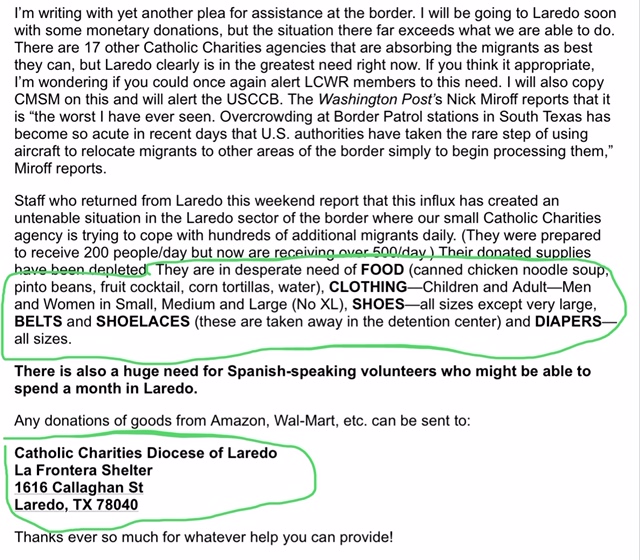
P.S. I know that many of you have responded to this request I placed on Facebook. Thank you. For those who don’t do Facebook, this is an urgent request for help for refugees at our southern border. It’s an easy way to do some good things.It was received from Sisters of Mercy Leadership Team in D.C.
Today, in Mercy, Jesus calls us his friends. What a magical, mysterious word! Making friends, being friends, keeping friends – these are some of the essential dynamics of a human life.
Many years ago, one of our family’s preschoolers was playing with his neighborhood buddies. His mom told him to introduce the boys to us. Very formally, little Charlie announced, “I would like you to meet my shrends.” He was not too sure yet about the word, but he was very clear on the concept. Among all his classmates, these guys shared something special with him.
Like all our relationships, Charlie’s would develop over time by trial and error, by imitation and intention – one confidence, care and joy shared, one after another. Trust and love would build, ultimately giving that irreplaceable gift of true and trusted friendship
Jesus is telling us today that we share something special with him. Our spiritual life is all about building those mutual confidences and shared experiences that help us to know Christ’s heart and allow him to know ours.
Jesus has given himself fully to this friendship:
I call you my friends, says the Lord, for I have made known to you all that the Father has told me.
May we ever grow stronger and more generous in our response to Christ’s amazing gift. May we learn to love as Christ loves.
This is my commandment: love one another as I love you. No one has greater love than this, to lay down one’s life for one’s friends.
Music:Today’s choice is a popular contemporary song. Ever since I was a young teen, I sometimes, in prayer, choose to sing a popular song to God (mostly in my heart now, because my voice has gone the way of all flesh). Some of these songs can be perfect for what’s in the heart. If you have never tried it, this song might encourage you to. Maybe you have a favorite you’d like to sing to God, your Friend who loves you beyond description.
Whenever I Call You Friend – Michael Johnson and Alison Krause
Today, in Mercy,the passage from John’s Gospel is part of the long farewell of Jesus. This farewell goes on for chapters, John using the form as a way to summarize all the important teachings of Jesus.
I often find John’s style lulling, like the gentle swaying back and forth of a porch swing. There are few sharp narrative curves to keep me alert. As a result, I often skip over a precious phrase like a stone across water.
A few years ago (like 30!), I decided to read John’s Gospel differently – to read it in short phrases, turning them over in my mind like a delicious candy on the tongue, or single lovely flowers plucked from a verdant bush.
It made a difference. Today’s chosen phrase is one of those candies:
…that my joy might be in you and your joy might be complete.
How delightful that Jesus wants us to be joyful, that he wants to be the source of that joy!
How amazing to think that the mighty God desires to find joy in us!
Think of the joy you find in a most beloved child, in a precious friend, in the dearest of your heart. God wants to be “in joy” with us infinitely beyond these human relationships.
What does Divine Joy look like in your life today? Gratitude? Hope? Trust? Peace? Holy Intention? Silent Companionship?
As the Father loves me, so I also love you. Remain in my love.
This was a day of blessed, evident love, spiritual pleading and mutual anxiety for my dear family.God was so good to us in blessing our dear Oliver with a successful open heart surgery. Thank you all for your prayers and generous thoughts.
Reflecting on all of this later in the day, this prayer poem came to me.
I share it for those who might wish to consider it in their own prayer
Oh, how we love our children, Daughters, sons, Grans, great-grands and God’s. They bring us life, renewed, And joy unparalleled.
They promise us that God Is still about the work Of hopeful Creation.
These dear children, They are a promise, A hope, a joy, a gift A treasure that reminds us Of God’s innocent and Loving eyes.
How we must reverence them, Our own, and those far From our own, because, Oh, my dear sisters, brothers, They are all our own.
Jakelin Caal Maquin and Felipe Gómez Alonzo died in federal custody after they fled to the US from Guatemala.
Today, in Mercy, our Gospel gives us the powerful metaphor of the Vine and the Branches.
How do we grow more deeply into God? Or how do we let God grow more deeply into us? Or do we even want those things to happen?
If our lives seem to be riding along on their own, we may not pay all that much attention to God’s Presence in our experiences. And that’s where we miss the opportunity to be grafted on to the Vine.
How unfortunate if we never learn to befriend our own souls, because that is the place where God speaks to us. St. Teresa of Avila put it this way:
What friends or kindred can be so close and intimate as the powers of our soul, which, whether we will or no, must ever bear us company? — St. Theresa of Avila, The Interior Castle
Some practices to help that “befriending” are the appreciation of quiet, the routine of prayer, the love of scripture, the reverence of nature and humanity, and the practice of charity.
The Little Flower offers us great insight into friendship with God:
I understand and I know from experience that: ‘The kingdom of God is within you.’ Jesus has no need of books or teachers to instruct souls; He teaches without the noise of words. Never have I heard Him speak, but I feel that He is within me at each moment; He is guiding and inspiring me with what I must say and do. I find just when I need them certain lights that I had not seen until then, and it isn’t most frequently during my hours of prayer that these are most abundant but rather in the midst of my daily occupations.” ― St. Therese of Lisieux, The Story of a Soul – the Autobiography of St. Therese
Lest my men readers fear I’ve gone all girly with these women saints (and by the way, they were not girly. They were powerhouses of spiritual dynamism!), try this from St. Ignatius Loyola, founder of the Jesuits:
Try to keep your soul always in peace and quiet, always ready for whatever our Lord may wish to work in you. it is certainly a higher virtue of the soul, and a greater grace, to be able to enjoy the Lord in different times and different places than in only one. ― Saint Ignatius, Letter to Francisco de Borja, Duke of Gandía
Summary of all this thought: God lives in us and we live in God, as branches live in the Vine. May we let ourselves absorb, cherish and celebrate this astounding Gift!
PS: Sending another personal thought on a little later this evening.
Today, in Mercy, our Gospel offers us a profound message: what does it mean to live in the peace of God?
So many things, from the monumental to the trivial, can make us unpeaceful. If we made a list, we might tire before we completed it! This lack of peace takes many forms in us – worry, anxiety, second guessing, distraction, self-doubt and myriad other forms of inner fragmentation.
For some of us, gaining inner peace is more difficult than for others. So much depends on the trust we have felt in our lives. For those who have felt betrayed by family, friends, or God, the journey to a peaceful heart can be a tortuous one.
But Jesus says we can do it because he showed us how.
Don’t you think he might have been confused and bewildered at times by what the Father was asking of him? Don’t you think he was disillusioned at times by the wavering faith of his disciples? Don’t you think he was frightened by the kind of death he faced?
So just how did Jesus grow to such a fullness of peace that he was able to bequeath it to us as our inheritance?
He said:
Not as the world gives peace do I give it to you.
The world gives peace by removing or dominating challenges. God gives peace by accompanying us through challenges.
Jesus came to the point, in his very human life, where he chose not to let his heart be troubled because he had found this accompaniment.
The willingness of Jesus to live, suffer, and die according to the Father’s Will gives us the pattern on which to build our peace.
Throughout the ages, many saints have found and lived this peace according to their own call from God. One of the many who inspire me is Julian of Norwich.Julian was an English anchorite of the Middle Ages.She wrote the earliest surviving book in the English language to be written by a woman, Revelations of Divine Love.
Julian was worried about the presence of sin in the world. It seems she wondered, like many of us might, why God didn’t just fix that!
“In my folly, before this time I often wondered why, by the great foreseeing wisdom of God, the onset of sin was not prevented: for then, I thought, all should have been well. This impulse [of thought] was much to be avoided, but nevertheless I mourned and sorrowed because of it, without reason and discretion.
But Jesus, who in this vision informed me of all that is needed by me, answered with these words and said: ‘It was necessary that there should be sin; but all shall be well, and all shall be well, and all manner of thing shall be well.’
These words were said most tenderly, showing no manner of blame to me nor to any who shall be saved.”
This also is a lovely quote from Julian to pray with:
“From the time these things were first revealed I had often wanted to know what was our Lord’s meaning. It was more than fifteen years after that I was answered in my spirit’s understanding. ‘You would know our Lord’s meaning in this thing? Know it well. Love was his meaning. Who showed it to you? Love. What did he show you? Love. Why did he show it? For love. Hold on to this and you will know and understand love more and more. But you will not know or learn anything else — ever.”
Music: Meg Barnhouse’s modern interpretation of Julian’s writing, which Meg has obviously studied.
Today, in Mercy, our reading from Actsshows that everything wasn’t always a bowl of cherries for the Apostles.Paul recounts that both the change-resistant Jews and Gentiles wanted to attack and stone him and Barnabas. So they left and went to Lystra where Paul cured a paralyzed man. This won them approval to the point that the populace thought they were gods!
It seems that this was a time of “feast or famine” for Paul and the other disciples. They had to stay true to their mission while learning to balance the reactions and expectations of the people to whom they preached.
They had to balance their own expectations too. Not everyone they encountered was able to receive the Word.
Our Gospel gives us an insight into how the Apostles might have felt when they met someone who was hard of heart and spirit. Jude, who has nothing but this to say in the whole Gospel, asks Jesus:
Master, then what happened that you will reveal yourself to us and not to the world?
In other words, why are we blessed with faith when others are not?
Jesus’ answer is mysterious but simple:
Whoever loves me will keep my word, and my Father will love him, and we will come to him and make our dwelling with him. Whoever does not love me does not keep my words.
John’sphraseology, as usual,is a little roundabout but the meaning is clear – love Me and do what I have asked of you, and your heart will open to My Truth.
We love Jesus by getting to know him intimately in Scripture and tradition, in ritual and sacrament, and in the faces of our sisters and brothers. If we do this, Jesus will reveal his heart to us.
Speaking of hearts, dear friends, my precious 3-year-old grandnephew will have surgery on Tuesday morning to repair a hole in his heart. My family and I would be so grateful for your prayers for his complete healing and for the skill of those who treat him. His name is Oliver and, of course, we love him beyond words. Thank you.
Music today is an old come-all-ya, and the accompanying art is so saccharin, I know! But I still love this hymn and Daniel O’Donnell could sing me the ABCs and I’d be happy. As Ollie faces his surgery, the hymn is very comforting to me, and I hope to you in whatever needs you have.







 Lavish Mercy