Psalm 116: Listen!

Second Sunday of Lent

February 28, 2021


Today, in God’s Lavish Mercy, we pray with Psalm 116 which Pope John Paul II called “A Prayer of Thanksgiving to the Lord”.

Praying the psalm today, in the context of our other Sunday readings, leads us deeper into the nature of that “thanksgiving” and its relationship to sacrifice.

Abraham and Isaac by Rembrandt

In our first reading, we meet Abraham, full of thanks that God reconsidered the command to sacrifice his dear son.


But then our second reading expresses thanks that God was willing to sacrifice his own Son for our sakes.

The Transfiguration by Titian

Finally, our Gospel takes us to the Transfiguration where that Son who will be sacrificed is revealed in his true glory.

What is the thread binding these readings? I think it can be found in this Gospel verse:

This is my beloved Son.  
Listen to him.

True listening is obedience. The words come from the same root: obedience = listen to,” from ob “to” + audire “listen, hear”.

  • Abraham listens, no matter how hard, and finally hears God’s real command to love.
  • Jesus listens to the Will of the Father even through his suffering, and is led to Resurrection.
  • We, like Peter, James and John, are called to listen to Jesus who will transfigure our perceptions about what life is really calling us to.

In each case, intent “obedience” allows the listener to hear and see beneath circumstances to the deeper Grace beyond appearances. Deep spiritual listening transfigures us!
This is the whole point of the spiritual life. Our lives are so much more than mere circumstances or appearance. Our psalm calls us to believe this even in difficulty:

I believed, even when I said,
    “I am greatly afflicted.”
Precious in the eyes of the LORD
    is the death of his faithful ones.

Psalm 116:10

When we do this, we are freed to engage our lives at the level of God’s Will which is always for our good, which is always from Love. The long tradition of faith, learned from our forbearers, assures us of this:

O LORD, I am your servant;
    I am your servant, the child of your faithful ones;
    you have loosed my bonds.
To you will I offer sacrifice of thanksgiving,
    and I will call upon the name of the LORD.

Psalm 116:16-17

Some of us go through life continually angry, frustrated, or overwhelmed by our challenges. Others, experiencing similar or even greater challenges, reflect a spirit of joy, peace, and gratitude. Why is that? I think today’s readings give us a big clue. Let’s listen to them!


Poetry: Story of Isaac, written and chanted by the bard Leonard Cohen who also wrote the currently popular “Hallelujah “.


Music: Psalm 116: Steve Green

Lyrics

I love the Lord, He heard my voice
He heard my voice. He heard my voice
He heard my cry for mercy
Because He has turned His ear to me
I will call (I will call)
I will call on the Lord for as long as I live

I love the Lord, He heard my voice
He heard my voice. He heard my voice
He heard my cry
I love the Lord, He heard my voice
He heard my voice. He heard my voice
He heard my cry for mercy
Psalm 34: Together

Tuesday of the First Week of Lent

February 23, 2021


Today, in God’s Lavish Mercy, we pray with Psalm 34, thought to be a young David’s thanksgiving prayer after God saved him from one of his many dangerous escapades.

In telling his deliverance story, David invites his friends to celebrate with him and to learn the faith-lesson he has learned:

Glorify the LORD with me,
    let us together extol his name.
I sought the LORD, and he answered me
    and delivered me from all my fears. 


I picture myself sitting in David’s audience, absorbing the words of his prayer. This line strikes me:

The LORD has eyes for the just,
    and ears for their cry.

Ah, the Lord has eyes for me….for ME! It conjures up sounds of The Flamingos, doesn’t it? (Sorry for the transcriber’s misspelling 😀)

Most of us want to think that we are individually special to God. This desire is at the core of the Protestant Evangelical model, “a personal relationship with Jesus Christ”. But for some, this model has become confused with a prosperity gospel that is quite misleading.

The only prosperity we should seek from God is the gift of grace because:

Yahweh’s peculiar inclinations are with the broken-hearted and the ones with crushed spirit. That is, Yahweh’s solidarity is not with the ones who go from success to success, but the ones denied success.

Walter Brueggemann The Message of the Psalms A Theological Commentary Ausberg Publishing House 1984

Still, such a personal relationship is not alien to a full and complete faith:

Faith is above all a personal, intimate encounter with Jesus, and to experience his closeness, his friendship, his love; only in this way does one learn to know him ever more, and to love and follow him ever more. May this happen to each one of us.

Pope Benedict XVI, General Audience, 2009

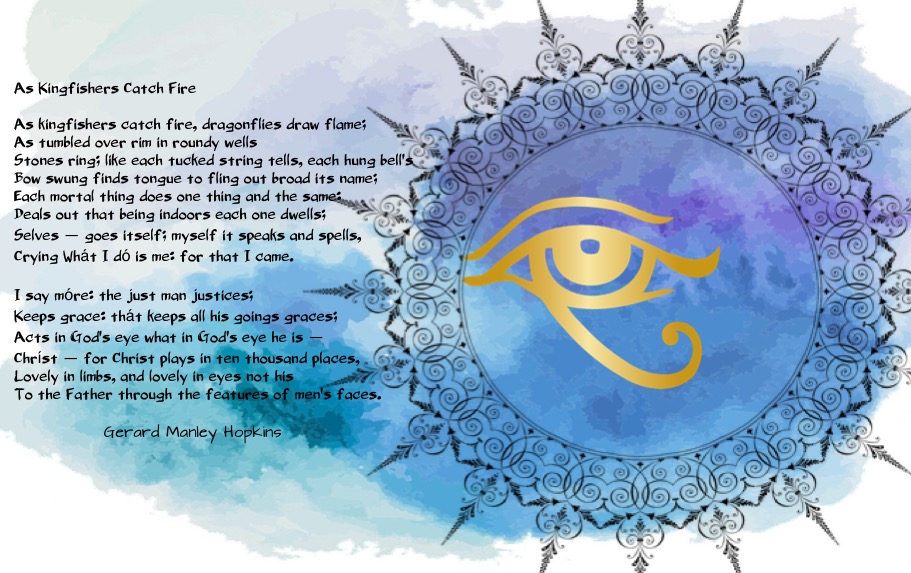
(Look for an extra prayer about “The Eye of God” in another post today.)


However, our psalm alerts us that this deeply personal dimension is only part of relationship with God.

When the just cry out, the LORD hears them,
    and from all their distress he rescues them.
The LORD is close to the brokenhearted;
   and those who are crushed in spirit he saves.

To be seen and heard by God, one must be part of the just community. To be close to God, one must feel the brokenheartedness of the poor. We come to the psalmist’s exuberant praise only by walking with suffering, either in our own lives, or beside others who bear distress.

From all their distress
God rescues the just.

Psalm 34 teaches us that our personal relationship with God is interdependent with our relationship with the whole community. David calls his community to share in his praise-song because they- together -recognize God’s mercy and share it in concern for one another.

The LORD has eyes for the just,
    and ears for their cry.


Our Gospel today confirms that a personal love for God thrives only within a communal love. The prayer Jesus shares is not “My Father”. It is “Our Father”. We come to the depths of God’s merciful heart with our sisters and brothers.


Poetry: An Inclusive Lord’s Prayer – Author unknown

Loving God, 
in whom is heaven, 
may Your name be honored everywhere.
May Your Mercy reign.
May the desire of Your heart for the world 
be done, 
in us, by us and through us.
Give us each and all
the bread we need for the day.
Forgive us.
Free us to forgive others.
Keep us from all anxiety, fear, and selfishness.
For You reign in the power that comes from love 
which is Your glory
forever and ever.
Amen.

Music: Our Father – Joe Wise

Psalm 147: Brokenhearted?

Fifth Sunday in Ordinary Time

Sunday, February 7, 2021


Today, in God’s Lavish Mercy, we pray with Psalm 147 which invites us to:

Praise the LORD, for he is good;
    sing praise to our God, Who is gracious;
    Whom it is fitting to praise.

It is a psalm for the left-brained who, like Job in our first reading, might need some explanation about just why we should praise when life seems so unpraiseworthy at times!

Job spoke, saying:
Is not man’s life on earth a drudgery?
    Are not his days those of hirelings?
He is a slave who longs for the shade,
    a hireling who waits for his wages.
So I have been assigned months of misery,
    and troubled nights have been allotted to me.

Job 7: 1-4

Job, like many of us when we suffer, feels crushed under life’s burdens. However, an extended reading of the Book of Job reveals that humility and repentance allow Job to “see God”, and to rediscover the richness and flavor of his life.

Calling us to the same kind of awareness, Psalm 147 presents a series of reasons for praising God, including God’s continual attention to the city of Jerusalem, to brokenhearted and injured individuals, to the cosmos, and to nature.

For me, the most moving of these reasons comes in verse 3:

The Lord heals the brokenhearted
    and binds up their wounds.
The Lord tells the number of the stars;
    calling each by name.


This is a beautiful picture of our infinitely compassionate God who is able to recognize our broken-heartedness. 

This loving God, who knows the stars by name, knows us as well. We, like Job, begin to heal within the divine lullaby God patiently sings over our broken hearts.

Jesus is that Healing Song, the Word hummed over the world by the merciful Creator. In today’s Gospel, we see that Melody poured out over the suffering:

When it was evening, after sunset,
they brought to him all who were ill or possessed by demons.
The whole town was gathered at the door.
He cured many who were sick with various diseases,
and he drove out many demons,
not permitting them to speak because they knew him.

Mark 1: 32-34

As we pray today,

let us hear God’s song of mercy
being sung over all Creation.
Let us rest our own brokenness
there in its compassionate chords.
Let us bring the world’s pain to our prayer.

Poetry: A Cure Of Souls by Denise Levertov

The pastor
of grief and dreams
guides his flock towards
the next field
with all his care.
He has heard
the bell tolling
but the sheep
are hungry and need
the grass, today and
every day. Beautiful
his patience, his long
shadow, the rippling
sound of the flocks moving
along the valley.

Music: God Heals My Broken Heart – Patty Felker

If Job were singing his sadness today, it might sound like this song.

Psalm: The Benedictus

Saturday of the Third Week in Ordinary Time

January 30, 2021


Today, in God’s Lavish Mercy, our Responsorial Psalm is the glorious Benedictus which is one of the three canticles in Luke’s first two chapters, the other two being the “Magnificat” and the “Nunc Dimittis”. The Benedictus was the song of thanksgiving uttered by Zechariah on the occasion of the circumcision of his son, John the Baptist.

Rembrandt: The Circumcision of John

Can you imagine Zechariah that morning, holding his little boy, eight days old? This unexpected, miraculous child would be named in a ceremony marking the ancient covenant between God and God’s People.

The little group gathered for the ritual expected the name to be an honorary repetition, probably his grandfather’s name. Instead, it is a name delivered by an angel: John, which means “Yahweh has shown favor,” — announcing John’s role in salvation history.

When Zechariah, still struck deaf and mute, indicates his agreement with Elizabeth on John’s name, his tongue is loosed. He immediately praises God and proclaims a framework for the miracles about to come – the Benedictus.

Praying with this Canticle this morning, I treasure its lovely phrases and its succinct recounting of Israel’s “God Story” even as it reflects my own.


Prose: This past Advent, one of our Sisters of Mercy offered a profound reflection on Zechariah’s song. It blessed my prayer once again today.

from Sisters of Mercy Blog

Music: Benedictus – Karl Jenkins

Blessed be the Lord, the God of Israel,
for he has visited and brought redemption to his people.
He has raised up a horn for our salvation
within the house of David his servant,
even as he promised through the mouth of his holy prophets from of old:
salvation from our enemies and from the hand of all who hate us,
to show mercy to our fathers
and to be mindful of his holy covenant
7and of the oath he swore to Abraham our father,
and to grant us that, rescued from the hand of enemies,
without fear we might worship him in holiness and righteousness
before him all our days.
And you, child, will be called prophet of the Most High,
for you will go before the Lord to prepare his ways,
to give his people knowledge of salvation
through the forgiveness of their sins,
because of the tender mercy of our God
by which the daybreak from on high* will visit us
to shine on those who sit in darkness and death’s shadow,
to guide our feet into the path of peace.”


Psalm 105: Wondrous Deeds

Wednesday of the First Week in Ordinary Time

January 13, 2021

Today, in God’s Lavish Mercy, we pray with Psalm 105 celebrating God’s covenanted faithfulness to us.

Give thanks to the LORD, invoke God’s name;
    make known among the nations God’s deeds.
Sing, sing God’s praise,
    proclaim all God’s wondrous deeds.
(because…) The Lord remembers the covenant for ever.

Psalm 105: 1-2, 8

We certainly can spend some time in prayer today remembering God’s faithfulness to us personally. A grateful review of our life journey can always offer new insights into God’s love and generosity.

But more specifically, our psalm calls us to plumb the two readings which it connects.

  • Hebrews reminds us that God’s love is so extreme that God took Flesh in Jesus to teach us, in terms we could understand, the degree of God’s love.
  • In Mark, we see the early expression of that love, as Jesus reveals his healing power to the wretchedly suffering crowds.

In these readings, we learn that God’s promise endures to each generation:

God remembers the covenant forever
    which was made binding for a thousand generations– 
Which was entered into with Abraham
    and by God’s oath to Isaac.

Psalm 105: 8

In Chronos Time, this enduring covenant was enfleshed in Jesus. It continues in Kairos Time through each person’s Baptism into Christ through the Holy Spirit.

In other words,
we are the agents of God’s covenant with the world. Our lives must enflesh God’s Mercy for our times.

In his letter to Titus, Paul puts this clearly:

But when the kindness and love of God our Savior appeared, we were saved not because of righteous things we had done, but because of God’s mercy. God saved us through the washing of rebirth and renewal by the Holy Spirit, poured out on us generously through Jesus Christ our Savior, so that, having been justified by God’s grace, we might become heirs having the hope of eternal life.  

Titus 3: 4-7

May the message of these readings free us,
inspire us, and impel us
to a grace-filled response.


Poetry: Grace by Jill Peláez Baumgartner

Is it the transparency
and lift of air?
Is it release
as when the pebble
flings out of the slingshot
or the tethered dog
suddenly is without lead?

Or is it more like standing
on a dark beach
at midnight,
the surf loud
with its own revolution,
the horizon invisible,
the entire world the threat
of rushing water?

No one who swims 
at night in the ocean
feels weightless
embracing armfuls of water
against the ballast
of the waves’ fight.

Swimming:
toward the shore lights
or out into the vast bed
of the sea's white fires?

Music: Confitemini Domino – Psalm 105 – Orlando di Lasso (first published in 1562)

Confitemini Domino et invocate nomen ejus,

annuntiate inter gentes opera ejus,

cantate ei et psallite ei.

Narrate omnia mirabilia ejus,

laudamini in nomine sancto ejus,

laetetur cor quaerentium Dominum.

Give glory to the Lord, and call upon his name,

declare his deeds among the Gentiles,

sing to him, yea sing praises to him.

Relate all his wondrous works,

Glory ye in his holy name,

let the heart of them rejoice that seek the Lord.

Psalm 97: Ordinary?

Monday of the First Week in Ordinary Time

January 11,2021


Today, in God’s Lavish Mercy, we pray with Psalm 97 which reminds us that, as Jesus begins his earthly ministry, he is accompanied by the unseen powers of heaven.

The heavens proclaim his justice,
and all peoples see his glory.
Let all his angels worship him.

Psalm 97: 6-7

The psalm is reflective of the glorious passage from our first reading describing the Divinity of Jesus:

The Son of God is…
the refulgence of God’s glory, 
the very imprint of God’s being,
who sustains all things by his mighty word.
When he had accomplished purification from sins, 
he took his seat at the right hand of the Majesty on high,
as far superior to the angels
as the name he has inherited is more excellent than theirs.

Hebrews 1: 3-4

These seem perfect readings to begin a season described as “Ordinary Time” because they remind us that the power of Jesus Christ is far from ordinary.

And our days do not feel like ordinary times, do they? They are both fraught with threat and charged with hope.

They are times belabored by pandemic struggle, political vitriol, climate dissolution, global strife and systemic oppression.

But they are also times bristling with breakthrough discovery, civic renewal, social consciousness, communal courage and spiritual awakening.


Just as in our Gospel on this first day of “Ordinary Time”, Jesus asks his disciples to “Come”, dream extraordinary dreams with him, so he asks us. 

He asks us to believe
that there are unseen angels attending us.
 
He asks us to remember that we, like him,
are made in the refulgent image of God.


He calls us, like Simon and Andrew, to believe
that our “ordinary time” is actually the “time of fulfillment”:

This is the time of fulfillment.
The Kingdom of God is at hand.
Repent, and believe in the Gospel.

Mark 1:15

Poetry: Maya Angelou – Touched by an Angel

We, unaccustomed to courage,
exiles from delight,
live coiled in shells of loneliness
until love leaves its high holy temple
and comes into our sight
to liberate us into life.

Love arrives
and in its train come ecstasies
old memories of pleasure
ancient histories of pain.
Yet if we are bold,
love strikes away the chains of fear
from our souls.

We are weaned from our timidity
In the flush of love's light
we dare be brave
And suddenly we see
that love costs all we are
and will ever be.
Yet it is only love
which sets us free.

Music: Ordinary Time – Marie Bellet

There will come a day for quiet kitchen mornings
Lunches with the girls, book clubs in the afternoon
There will come a day for chintz flowers on my sofa
Just the perfect lipstick, matching purse and shoes.

There will come a day without constant interruption
Confusing all my senses, my reason and my rhyme
But for now I trip on the backpacks in the hallway
Scrub the crayon from the walls that mark this ordinary time.

There will come a day for uneventful dinners
When no one drops their fork or spills their milk upon the floor
There will come a day, I’ll be wiser, I’ll be thinner
I will finish conversations before running out the door.

Well, isn’t that the way it is for all those happy women
Who smile at me from magazines there in the checkout line?
What about the tired, the simple and forgotten?
Blessed be the ordinary here in ordinary time.

He said “Who will feed my sheep?
Who will heed their cry?”
I said “I am vain and weak
But surely I will try.

You know everything
And You know that I’m
Just an ordinary woman 
here in ordinary time”.

There will come a day when everything is order
And I will be the queen of everything I see
But how my heart will leap to find one backpack in the hallway
With the promise of a face, and a story just for me.

So may I never yearn for those cocktail conversations
Clever observations made for fashionable minds
May I finally learn to be happy and have patience
With the constant changing rhythm of this ordinary time,
The constant changing rhythm of this ordinary time.

Psalm 29: Holy Splendor

The Baptism of the Lord

January 10, 2021
We celebrate the Baptism of Jesus in the River Jordan by John the Baptist. The Christmas season, which celebrates the revelation of God through Christ, closes with this liturgy. Jesus’ Baptism begins his public ministry.

Today, in God’s Lavish Mercy, we pray with Psalm 29 in which the psalmist invites the pray-ers to find the power of God in the storm.

One can picture a small group huddled onshore as thunder ripples across the sea. The psalmist says not to focus on the storm itself, but:

  • to see the Power Who creates it
  • to find more than meteorological meaning in the experience
  • to be soaked not only in rain, but in grace.

Give to the LORD, you children of God,
give to the LORD glory and might;
Give to the LORD the glory due God’s name.
Bow down before the LORD’s holy splendor!

Psalm 29: 1-2

The psalmist invites the community to be sanctified by nature’s manifestation of God’s power.


As I wrote earlier this week, “This short post-Epiphany season is all about “manifestation” – how Jesus begins to show us the face of God-become-flesh.” Today’s Baptism of Jesus marks the glorious culmination of these manifestations.

I have always loved this feast. I imagine it as a moment in time when everything changes – when the Timeless Trinity steps through our human perceptions to fully reveal Itself in light, color, and sound. It is a quantum moment when, time suspended, Omnipotence speaks.

The voice of the LORD is over the waters,
    the LORD, over vast waters.
The voice of the LORD is mighty;
    the voice of the LORD is majestic.

Psalm 29: 3-4

In an earlier blog, I offer a reflection on these thoughts. It contains a beautiful picture which I received the artist’s permission to share. I hope you can take time to read it again.


Our lives, too, are filled with potential manifestations of God’s power, with invitations to be bathed in God’s grace. As we pray today, let us allow our psalm to lower the barriers that keep us from hearing God’s voice in our own experiences.


Poetry: God Speaks by Rainer Marie Rilke

God speaks to each of us as God makes us,
then walks with us silently out of the night.
These are the words we dimly hear:
You, sent out beyond your recall,
go to the limits of your longing.
Embody me.
Flare up like a flame
and make big shadows I can move in.
Let everything happen to you: beauty and terror.
Just keep going. No feeling is final.
Don’t let yourself lose me.
Nearby is the country they call life.
You will know it by its seriousness.
Give me your hand.

Music: “Christ unser Herr zum Jordan kam” BWV 684 – “Christ our Lord came to the Jordan”) is a hymn by Martin Luther written in 1541. It has been set in many musical compositions, including cantatas and chorale preludes by Johann Sebastian Bach

Organist: Cecilia Yae-Jin Lee, Seoul Catholic Singers (On Youtube, there are several more prestigious organists playing this piece on magnificent organs. But I thought this young woman was extremely impressive rendering it on a rather simple instrument.)

Christ, unser Herr, zum Jordan kam
Nach seines Vaters Willen,
Von Sanct Johann’s die Taufe nahm,
Sein Werk und Amt zu ‘rfüllen.
Da wollt’ er stiften uns ein Bad,
Zu waschen uns von Sünden,
Ersäufen auch den bittern Tod
Durch sein selbst Blut und Wunden,
Es galt ein neues Leben.

Christ our Lord came to the Jordan
in accordance with his father’s will,
he received baptism from Saint John,
to fulfil his work and ministry.
By this he wanted to establish for us a bath
to wash us from our sins,
to drown also bitter death
through his own blood and wounds.
This meant a new life.

Psalm 149: Let’s Dance Again!

Saturday after Epiphany

January 9, 2021

Today, in God’s Lavish Mercy, we pray with Psalm 149.

Our psalm contains a brief line tucked at its center which foreshadows the entire message of the Gospel. 

Let them praise God’s name in the festive dance,
let them sing praise with timbrel and harp.
For the LORD loves us,
and adorns the lowly with victory.


We will find a dancing, singing joy when we give ourselves to these truths:

  • God loves us irrevocably
  • We can fully receive this great love to the degree that we become like Christ whose image we find among the poor, lowly, and suffering.

Poetry: Dance from Rumi

Come to me, and I shall dance with you
In the temples, on the beaches, through the crowded streets
Be you man or woman, plant or animal, slave or free
I shall show you the brilliant crystal fires, shining within
I shall show you the beauty deep within your soul
I shall show the path beyond Heaven.
Only dance, and your illusions will blow in the wind
Dance, and make joyous the love around you
Dance, and your veils which hide the Light
Shall swirl in a heap at your feet.

Music: Psalm 149 – Antonín Dvořák

Psalm 72: Governed with Mercy

Memorial of Saint John Neumann, Bishop

January 5, 2021

Today, in God’s Lavish Mercy, we pray with Psalm 72 which will be familiar to us because it is used six times throughout the Advent and Christmas seasons.

O God, with your judgment endow the king,
and with your justice, the king’s son;
He shall govern your people with justice
and your afflicted ones with judgment.

Psalm 72: 1-2

This short post-Epiphany season is all about “manifestation” – how Jesus begins to show us the face of God-become-flesh.

The core message, conveyed to us in the daily progressive reading of 1 John, is that God is Love.


Our Gospel today, the feeding of the 5000, shows how that Love is expressed – merciful action for those in need.

Our psalm, written a thousand years before Christ, exults in the expectation of such a merciful Messiah:


The mountains shall yield peace for the people,
and the hills justice.
He shall defend the afflicted among the people,
save the children of the poor.
Justice shall flower in his days,
and profound peace, till the moon be no more.
May he rule from sea to sea,
and from the River to the ends of the earth.

Let us begin once again, in this new year,
to soak in the words and images
describing this longed-for and loving Savior.


Poetry: When Little Was Enough – Irene Zimmerman, OSF

(LUKE 9:10–17)

“Send the people away from this deserted place
to find food and lodgings,” the twelve urged Jesus,
“for the day is advanced and it is almost evening.”

Jesus looked at the crowd (there were about five thousand)
and looked at his disciples, still excited and tired
from their first mission journey.

What had they learned from the villagers of Galilee
who shared bread and sheltered them from cold night winds?
What had they learned of human coldness on the way?

He remembered the pain in his mother’s voice
as she told of his birth night when they found no room
in all of Bethlehem, House of Bread.

“You give them something to eat!” he said.

“We have only five loaves and two fish!” they protested.
“How can we feed so many with so little?”
He understood their incredulity.

They had yet to learn that a little was enough
when it was all they had—
that God could turn these very stones to bread.

“Have the crowd sit down in groups of fifty,” he said.
Jesus took the food and looked up to heaven.
He blessed it, broke it, gave it to the disciples
to distribute to the new-formed churches.

Afterwards, when everyone was satisfied,
the twelve filled twelve baskets of bread left over—
as faith stirred like yeast within them.


Music: Justice Shall Flourish – Rory Cooney

Under Mary’s Protection

January 1, 2021
Solemnity of Mary, Mother of God

( I was invited to offer a reflection for my community for the celebration of New Year’s. I wanted to share it with our larger community here.)


Over the threshold of midnight, we step into the New Year 2021.

And, oh, how we have longed for it

  • run toward it 
  • run away from what the old year pressed on us 
  • from what we heard unceasingly referred to as “these unsettling times”

Dear friends the phrase puts it mildly, doesn’t it?


Every one of us- to some degree- has felt the

  • loss 
  • sadness 
  • fear 
  • anxiety 
  • loneliness

We have been tested in our faith

  • our hope 
  • our love 
  • and, surely, our courage

Some have walked through the middle of hell
and some only on the edge.
But we have all felt its fire.

We are a world truly brought to its knees as we clothe ourselves in 2021’s first morning.


We come to our prayer to do as our reading from Numbers encourages us, emboldens us to do – to seek a blessing for the New Year:

May the Lord bless us and keep us 
shine the face of mercy on us 
be gracious to us 
look upon us kindly 
give us peace

But how will we find such a blessing, my friends, when we know that its hope is hidden in the unrelenting circumstances of our lives?


Let’s consider our Gospel today.
Just as Christ lay shining 
but in the damp hay of a dark manger…
Just as the word of his coming was announced 
but by rude shepherds who carried the angelic words,
so the blessing will come to us….clothed in the ordinariness of what we already know.

And it is this:

The power of God is always hidden 
in the flesh of our daily lives.


Let us turn to Mary today to remind ourselves of this mystery.

Before the Annunciation, when young Mary imagined the Messiah’s coming, do you think she pictured a godforsaken manger and a birth in a barn?

Do you think she imagined herself receiving ponderable angelic words through the mouths of illiterate shepherds?

Our inscrutable God comes to us
in ways we never imagine … yes, dear friends, even through pandemic suffering,
and the painful graces
it breaks open in our hearts.

Mary, whom we celebrate and invoke today, shows us how to take the next step into a new year —a year that will not perceptibly change in its challenges for some time to come.

It, too, will be filled with what looks like mangers and shepherds rather than the heavenly palaces and angels we might desire.

But Mary shows us that faith finds God by surrender to the grace of our ordinary lives.

Today, what we pray for one another through Mary’s intercession, is the grace to find the blessing in this mystery.

We pray to be encouraging witnesses for one another of:

  • faith even in darkness
  • resilience and courage during extraordinary challenge
  • hope in the face of discouragement
  • perseverance when we languish
  • loving service despite fear
  • Mercy pouring over pain

When we do these things, we become the blessing that we seek.

When we, like Mary, keep these things in our heart, we allow Christ to be born again even in our “unsettling” times.


Maria de Mercede, fresco by Domenico Ghirlandaio (c. 1472)

The most ancient prayer to Mary is the Sub Tuum Praesidium, dating from the 2nd century. It seems a perfect way to close our reflection today, and to open our hearts to hope for the New Year:

Under your protection,
we take our refuge, 
O Holy Mother of God:
despise not our petitions in our necessities,
but deliver us from all evil,
O pure and blessed one.
Amen.

A truly blessed and joyful New Year to you all, Beloveds.


Music: Sub Tuum Praesidium in Latin (see above for English)