Psalm 90: A Thousand Years

Saturday of the Twenty-Fifth Week in Ordinary Time

September 26, 2020


Today, in God’s Lavish Mercy, we pray with Psalm 90. My daily readers may have noticed that I skipped to this psalm yesterday by mistake. Some mistakes are good ones, because this profound psalm about “a thousand years” deserves at least two days attention!😉


Today, Psalm 90 is set between two “downer” readings. The unknown author of Ecclesiastes is a phenomenal poet but definitely not a cheerleader. Telling the young man to “put away trouble from your presence, though the dawn of youth is fleeting…

The writer encourages the young man to enjoy life…

Before the silver cord is snapped
and the golden bowl is broken,
And the pitcher is shattered at the spring,
and the broken pulley falls into the well,
And the dust returns to the earth as it once was,
and the life breath returns to God who gave it.


As doleful as these images are, they rang a bell with me as I prayed. The long siege of this pandemic, its frightful toll in human life, the inexplicable resistance to controlling it, surely seem as doleful. Indeed, as Psalm 90 tells us

You make an end of them in their sleep;
the next morning they are like the changing grass,
Which at dawn springs up anew,
but by evening wilts and fades.


But what else,
what more important encouragement of hope,
does Psalm 90 offer us? 

I think this following passage is unbeatable, especially as transliterated by Stephen Mitchell in his book, A Book of Psalms.

Teach us how short our time is; 
let us know it in the depths of our souls. 
Show us that all things are transient, 
as insubstantial as dreams, 
and that after heaven and earth have vanished, 
there is only you.

Fill us in the morning with your wisdom; 
shine through us all our lives. 
Let our hearts soon grow transparent 
in the radiance of your love.

Show us how precious each day is; 
teach us to be fully here. 
And let the work of our hands prosper, 
for our little while.


Poetry: God by Khalil Gibran

In the ancient days, when the first quiver of speech came to my lips,
I ascended the holy mountain and spoke unto God, saying,
“Master, I am thy slave. 
Thy hidden will is my law
and I shall obey thee for ever more.”

But God made no answer, and like a mighty tempest
passed away.

And after a thousand years I ascended the holy mountain
and again spoke unto God, saying,
“Creator, I am thy creation. 
Out of clay hast thou fashioned me
and to thee I owe mine all.”

And God made no answer, but like a thousand swift wings
passed away.

And after a thousand years I climbed the holy mountain
and spoke unto God again, saying,
“Father, I am thy child. 
In mercy and love thou hast given me birth,
and through love and worship I shall inherit thy kingdom.”

And God made no answer, and like the mist that veils the distant hills
he passed away.

And after a thousand years I climbed the sacred mountain and again
spoke unto God, saying,
“My God, my aim and my fulfillment;
I am thy yesterday and thou are my tomorrow. 
I am thy root in the earth and thou art my flower in the sky,
and together we grow before the face of the sun.”

Then God leaned over me, and in my ears whispered words of sweetness,
and even as the sea that enfoldeth a brook that runneth down to her, he enfolded me.
And when I descended to the valleys and the plains God was there also.

Music: Psalm 90 by Charles Ives, performed by the Stamford Choir 

Psalm 90: So beautiful…

Thursday of the Twenty-fifth Week in Ordinary Time

September 25, 2020


Today, in God’s Lavish Mercy, we pray with Psalm 90 and the hopeful refrain:

Fill us at daybreak with your kindness,
that we may shout for joy and gladness all our days.

For today, I am just going to stay with that verse and with this song that I love. I hope you find it as beautiful as I do.

Poetry: a prose poem I wrote a few years ago:

Each morning, every soul is called 
out of sleep into life, out of darkness into dawn.  
As surely as the flower is kissed by the sun, 
as gently as grass is refreshed by the rain, 
the sparrow is called from its nest; 
the fox from its hollow. 

From the Oriental Sunrise, all across the nations, 
the curtain is drawn back in revelation. 
Every country is slowly illuminated  
– across its seas and deserts, 
plains and mountains, 
wars and peace. 

Across your own soul, 
all your personal geographies awaken, 
lit one by one with the awareness of life. 

Each person whose breath has crossed your life 
– be they lover, friend, sister, 
or the shadow of a stranger 
momentarily passing on a distant afternoon 
– each one, this morning, will be struck like a candle 
by the Morning Spark, by the kindling of God. 
Will they catch fire with their lives? Will you?

We are ignited by God 
to live God’s sacred life in our time. 
We will each unfurl in a vital flame 
or smolder in the embers of our unawareness. 
From the depths of our poverty 
or the shallowness of our wealth, 
it makes no difference. 
It is the same Light. 
We will all be touched. 

What differs are the shadows 
each of us has wrapped about our hearts, 
those deceptive veils where we hide 
from the mercifully incisive brilliance of God. 

What veil might I lay aside today? 
Distraction, worry, vengeance, resentment, 
self-importance, laziness, 
a failure of intention in my choices, 
the enslavement of a toxic relationship?  

At this moment in time, what unveiling 
will allow me to embrace God’s amazing gift of life?

Will I look fully into God’s bright eyes today 
by facing my own heart? 
Will I let God look back at me 
through the hearts of those 
with whom I share this sunrise?   

Psalm 145: To Life!

Saturday of the Twenty-second Week in Ordinary Time

Saturday, September 5, 2020


Today, in God’s Lavish Mercy, we pray with Psalm 145, the only chapter of this Book which is specifically identified as a “psalm”, a hymn of praise.

I think of “praise” as gratitude steeped in awe, rising from our hearts when we are overwhelmed by God’s mercy, love, generosity or power.

Praise is a connection between God and us – so powerful that it is beyond words. It flows from us in song, dance, tears, and that profound silence which enfolds us in the Holy.


My whole family is filled with praise this week because, yesterday, we welcomed our second baby this week, precious Nathaniel.

Nathaniel joins his cousin Claire, born on Monday, both shining the beautiful Face of God on our family and the world! (And they join their treasured brother/cousins Robert and Ollie who must, of course, be mentioned in our praise🤗)


As we pray today, may each of us relish the sacred icons of Divine Life that God has given us. Sometimes these signs come in very surprising costumes. May we recognize them with the eyes of faith.


Poetry: Opening Heart – an interpretation of Psalm 145 by Christine Robinson

I exalt you, Holy One, and open my heart to you
by remembering your great love.
Your expansiveness made this beautiful world
in a universe too marvelous to understand.

Your desire created life, and you nurtured
that life with your spirit.
You cherish us all—and your prayer
in us is for our own flourishing.

You are gracious to us
slow to anger and full of kindness
You touch us with your love—speak to us
with your still, small voice, hold us when we fall.

You lift up those who are oppressed
by systems and circumstances.
You open your hand
and satisfy us.

You ask us to call on you—
and even when you seem far away, our
longings call us back to you.

Music: Forever Young – Joan Baez

Psalm 33: Fashioned by God

Wednesday of the Twenty-second Week in Ordinary Time

Wednesday, September 2, 2020


Today, in God’s Lavish Mercy, we pray again with Psalm 33, this time with one different verse from a few days ago:

From heaven’s fixed throne God beholds
all who dwell on the earth,
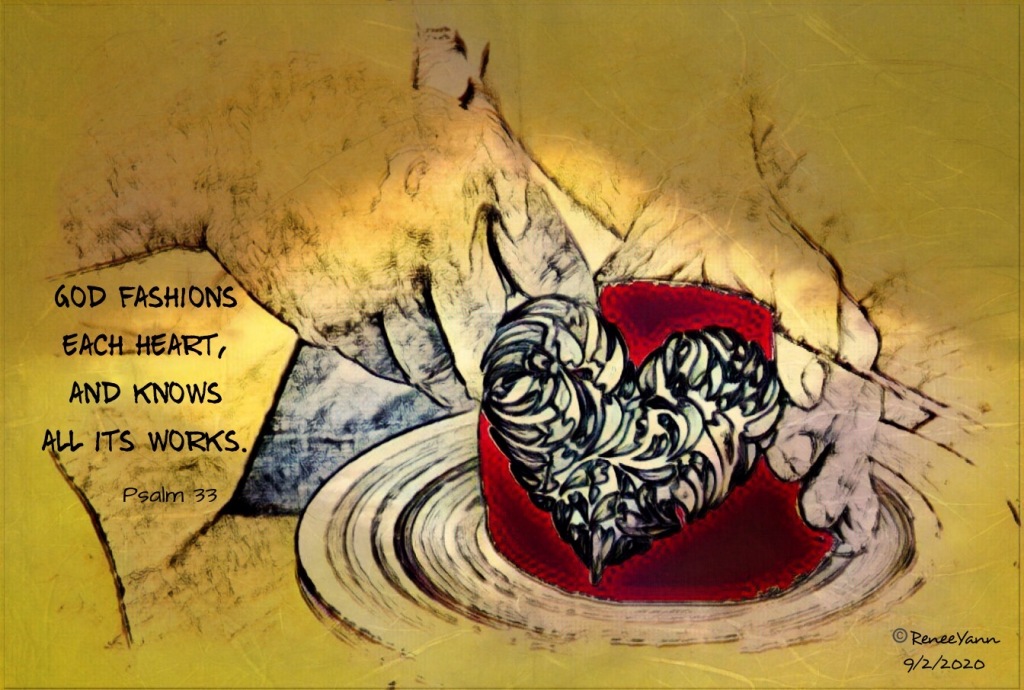
God Who fashions each heart
and knows all its works.

Think of that: God fashions each heart.

The phrase has special meaning for me today because, yesterday, we welcomed a precious new baby girl into our family.

I look at her newborn innocence and realize that she is the freshest, most hopeful breath of God, still so wrapped in the heavenly air from Whom we all receive life.


We all received that Breath once and it lives eternally within us. Every one of us has received a heart fashioned in God’s own image.

Sometimes that reality is hard to believe about ourselves and others, as it seems to have been for the Corinthians in today’s first reading. Sometimes we make a real mess of the gift we have been given!

Nevertheless, the gift is true and remains true despite our worst efforts!😉


Reflecting on today’s Gospel, there may be “various diseases” and dysfunctions that we wish to bring to the healing hands of Jesus today – for ourselves and for our world. We ask God to restore our innocence and hope throughout our lives and world.

In order to remember and live within the sacred truth that God breathed us into being, we might repeat today’s psalm refrain throughout our day:

Blessed are we, chosen to be God’s own.


Poetry: Two poems today to bless our dear new child Claire:

Songs of Innocence - William Blake
Little Lamb who made thee
Dost thou know who made thee
Gave thee life & bid thee feed.
By the stream & o’er the mead;
Gave thee clothing of delight,
Softest clothing wooly bright;
Gave thee such a tender voice,
Making all the vales rejoice!
Little Lamb who made thee?
Dost thou know who made thee?

Little Lamb, I’ll tell thee; 
Little Lamb, I’ll tell thee:
He is called by thy name, 
For He calls Himself a Lamb 
He is meek, and He is mild, 
He became a little child.
I a child, and thou a lamb, 
We are called by His name. 
Little Lamb, God bless thee! 
Little Lamb, God bless thee!


Christina Rossetti - Holy Innocents
Sleep, little baby, sleep;
The holy Angels love thee,
And guard thy bed, and keep
A blessed watch above thee.
No spirit can come near
Nor evil beast to harm thee:
Sleep, sweet, devoid of fear
Where nothing need alarm thee.
The love which doth not sleep,
The eternal Arms around thee:
The shepherd of the sheep
In perfect love hath found thee.
Sleep through the holy night,
Christ-kept from snare and sorrow,
Until thou wake to light
And love and warmth to-morrow.

Music: Innocence – Roberto Cacciapaglia

Psalm 145: Mercy Makes Us Sing

Tuesday of the Twenty-second Week in Ordinary Time

September 1, 2020

2018 reflection on Corinthians 

Today, in God’s Lavish Mercy, we pray with Psalm 145, a consoling hymn of confidence in God’s Mercy.

And, my dears, all I really want to say to you is, “September 1st! God bless us! We have made it this far in these times (as one gifted friend calls them, “these quantum weird times”.)

And, certainly, we pray in profound companionship with all those who suffer because of this pandemic. But at the same time we are so grateful for all who have, so far, been delivered from its grasp!

So hooray for us, and hooray for God! Let’s pick up our hope, energy and faith by drinking in the beauty of Psalm 145. Together, in faith, we CAN make it to a vaccine time- a time to forget,  AND to remember all that might transform and bless us from these days…

… because God is MERCY,
and there is some gift for all of us
even in shadow

The LORD is gracious and merciful,
slow to anger and of great kindness.
The LORD is good to all
and compassionate toward all his works.


Jesus meets the demon in today’s Gospel, a demon who is no match for Uncreated Grace. By the power of our Baptism, let us draw that Grace into our spirits, into our world today as we pray. 

And let us be at once both astonished and confident in the power of God’s Word to heal even the immense darkness of our world.

Jesus went down to Capernaum, a town of Galilee.
He taught them on the sabbath,
and they were astonished at his teaching
because he spoke with authority.


Poetry: The Fountain – Denise Levertov

Don’t say, don’t say there is no water
to solace the dryness at our hearts.
I have seen

the fountain springing out of the rock wall
and you drinking there. And I too
before your eyes

found footholds and climbed
to drink the cool water.

The woman of that place, shading her eyes,
frowned as she watched—but not because
she grudged the water,

only because she was waiting
to see we drank our fill and were
refreshed.

Don’t say, don’t say there is no water.
That fountain is there among its scalloped
green and gray stones,

it is still there and always there
with its quiet song and strange power
to spring in us,
up and out through the rock.

A Second Poem for the month’s beginning: September by Deborah Landau
Some of us might also find ourselves somewhere  in this wistful poem. I just like it. Thought some of you might too. 🤗

Dazzling emptiness of the black green end of summer no one
running in the yard pulse pulse the absence.

Leave them not to the empty yards.

They resembled a family. Long quiet hours. Sometimes
one was angry sometimes someone called her "wife"
someone's hair receding.

An uptick in the hormone canopy embodied a restlessness
and oh what to do with it.

(How she arrived in a hush in a looking away and not looking.)
It had been some time since richness intangible
and then they made a whole coat of it.

Meanwhile August moved toward its impervious finale.

A mood by the river. Gone. One lucid rush carrying them along.

Borderless and open the days go on—

Music: I Will Praise Your Name – Marty Hagen and David Haas

Antiphon: | will praise your name, my King and my God.
1. I will give you glory, my God and King, and I will bless your name forever.
Every day I will bless and praise your name forever.
2. The Lord is full of grace and mercy. He is kind and slow to anger.
He is good in all His works and full of compassion.
3. Let all your works give you thanks, O Lord, and let all the faithful bless you.
Let them speak of your might, O Lord, the glory of your kingdom.
4. The Lord is faithful in all His words, and always near. His name is holy.He lifts up all those who fall. He raises up the lowly.

Psalm 85: Listen!

Memorial of the Queenship of the Blessed Virgin Mary

August 22, 2020

by Bartolome Murillo

Indeed, Mary herself was a song of hope to God, sung for us and for all generations. That passionate song opened her heart to receive the Word and to carry its redeeming power to each of us.

She was the greatest prophet of all time who not only proclaimed God but enfleshed him.

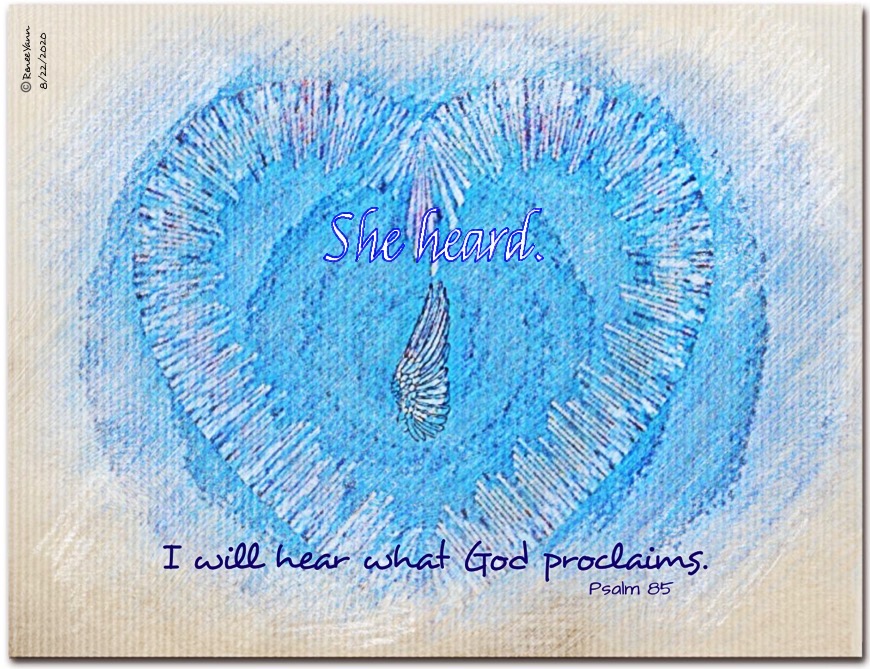
I will hear what God proclaims;
the LORD– Who proclaims peace.
Near indeed is salvation to those who fear God,
glory dwelling in our land.

As we pray to Mary today, let us ask for listening hearts and hope-filled spirits. Let us ask to enflesh love and hope in our lives in imitation of her. Let us ask to believe as she did:

The LORD himself will give his benefits;
our land shall yield its increase.
Justice shall walk before him, 
and salvation, along the way of his steps.


Poetry: Annunciation – Denise Levertov


Annunciation
_________________________________________
‘Hail, space for the uncontained God’
From the Agathistos Hymn, Greece, 6th century
_________________________________________
We know the scene: the room, variously furnished, 
almost always a lectern, a book; always
the tall lily.
       Arrived on solemn grandeur of great wings,
the angelic ambassador, standing or hovering,
whom she acknowledges, a guest.

But we are told of meek obedience. No one mentions
courage.
       The engendering Spirit
did not enter her without consent.
         God waited.

She was free
to accept or to refuse, choice
integral to humanness.
                 ____________________
Aren’t there annunciations
of one sort or another
in most lives?

         Some unwillingly
undertake great destinies,
enact them in sullen pride,
uncomprehending.
More often
those moments
      when roads of light and storm
      open from darkness in a man or woman,
are turned away from

in dread, in a wave of weakness, in despair
and with relief.
Ordinary lives continue.
                                 God does not smite them.
But the gates close, the pathway vanishes.
                  ____________________

She had been a child who played, ate, slept
like any other child–but unlike others,
wept only for pity, laughed
in joy not triumph.
Compassion and intelligence
fused in her, indivisible.

Called to a destiny more momentous
than any in all of Time,
she did not quail,
  only asked
a simple, ‘How can this be?’
and gravely, courteously,
took to heart the angel’s reply,
the astounding ministry she was offered:

to bear in her womb
Infinite weight and lightness; to carry
in hidden, finite inwardness,
nine months of Eternity; to contain
in slender vase of being,
the sum of power–
in narrow flesh,
the sum of light 

                     Then bring to birth,
push out into air, a Man-child
needing, like any other,
milk and love–

but who was God.

This was the moment no one speaks of,
when she could still refuse.

A breath unbreathed,
                                Spirit,
                                          suspended,
                                                            waiting.
                  ____________________

She did not cry, ‘I cannot. I am not worthy,’
Nor, ‘I have not the strength.’
She did not submit with gritted teeth,
                                                       raging, coerced.
Bravest of all humans,
                                  consent illumined her.
The room filled with its light,
the lily glowed in it,
                               and the iridescent wings.
Consent,
              courage unparalleled,
opened her utterly.

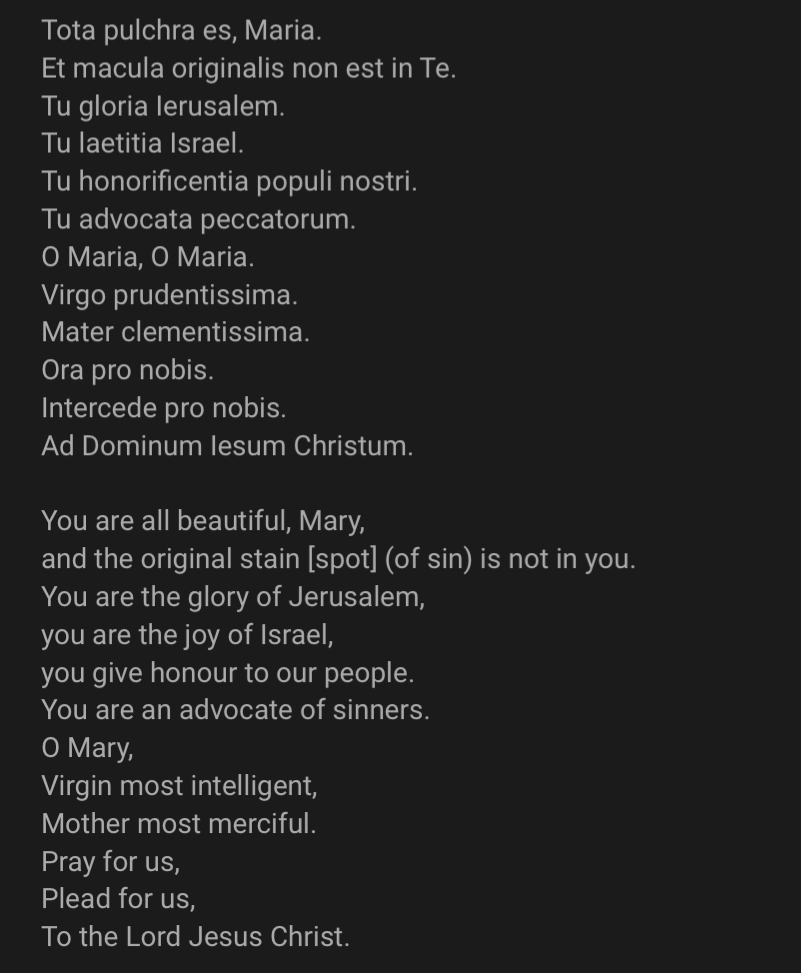
Music: Tota Pulchra Es, Maria

Psalm 107: Lost Then Found

Memorial of Saint Pius X, Pope

August 21, 2020

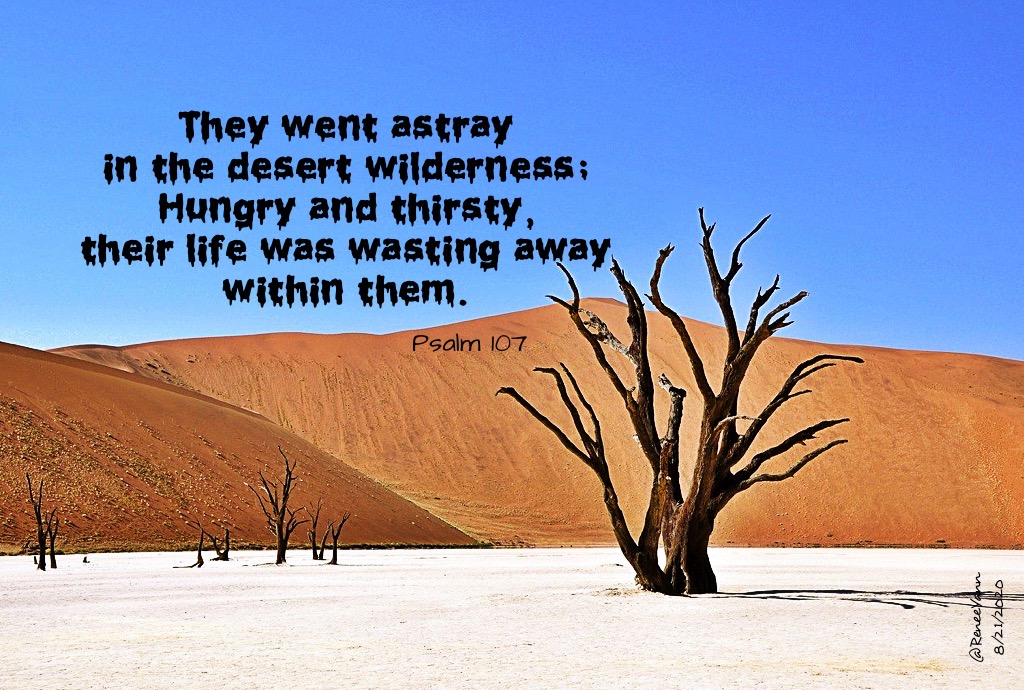
Today, in God’s Lavish Mercy, we pray with Psalm 107, a chant of gratitude to God’s Mercy from the lost who have been found.

There are all kinds of “lost”. 

There are small “losts” like when I misinterpret my GPS and keep hearing “Recalculating route…”. 

Then there are huge “losts” like when a beloved dies and our life’s anchor breaks.

This morning’s psalm and reading are speaking of a particular kind of “lost”, one that comes from wandering away from Love, for whatever reason that happens to us.


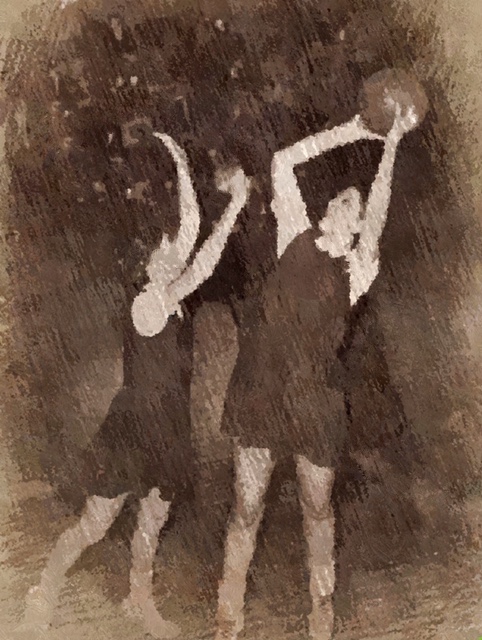
As I pray these readings, the face of a good high school friend comes to mind. Judy was a super basketball player. Everything about her was vigor, coordination, and that all-American beauty that needed no makeup to impress anybody.

After graduation, I went into the silence of the pre-Vatican II convent and Judy disappeared into her future. When our five-year reunion rolled around, I looked forward to reconnecting with her.

When I saw her, my heart broke. She was a shadow of herself, emaciated, listless, and lightless. She silently shouted a refrain like today’s verse from Ezekiel:

Our bones are dried up,
our hope is lost, and we are cut off.

We were both twenty-three years old. I was just beginning to grow into my hopes. Judy was already divorced, alone, and the mother of a father-starved child.

That kind of “lost” feels almost irredeemable. 


But Psalm 107 assures us that, in faith, no loss, no alienation is irredeemable.

They cried to the LORD in their distress;
from their straits God rescued them.
And led them by a direct way
to the healing of community.


Judy and I stayed in touch for a few years. Despite her troubles, she kept faith. That was the key.

She did the hard work to find herself again with the help of family, friends, counselors, and a supportive faith community. Eventually, she remarried and was happy the last time I saw her before she moved to the west coast.


This morning, I see such apparent parallels between Israel’s and Judy’s story. That helps me look back over my own life for the same, perhaps not so dramatic, parallels and to be grateful for the many times God found me.

Let them give thanks for God’s Mercy
and wondrous deeds to us,
Because God has satisfied the longing soul
and filled the hungry heart with good things.


Photo by Markus Spiske on Pexels.com

Poetry: Lost – Carl Sandburg

Desolate and lone 
All night long on the lake 
Where fog trails and mist creeps, 
The whistle of a boat 
Calls and cries unendingly, 
Like some lost child 
In tears and trouble 
Hunting the harbor’s breast 
And the harbor’s eyes. 


Music: Amazing Grace – Sean Clive

Isaiah Sings!

Memorial of Saint Maximilian Kolbe, Priest and Martyr

August 14, 2020


Today, in God’s Lavish Mercy, we pray with a passage from the poet-prophet Isaiah in which he calls the people to rejoice at their deliverance.

Sing praise to the LORD for his glorious achievement;
let this be known throughout all the earth.
Shout with exultation, O city of Zion,
for great in your midst
is the Holy One of Israel!


Isaiah 12 is one of a number of hymns found outside the Book of Psalms in the Old Testament. Other examples are Exodus 15:1-18, 21 and Amos 4:13; 5:8-9; 9:5-6 (Craddock, Hayes, Holliday, Tucker: Preaching through the Christian Year)

For an excellent graphic overview of these “songs”, click here. I enjoyed studying this chart.


Isaiah’s first eleven chapters center on God’s judgement for Israel’s infidelity. But Isaiah is never without hope. Chapter 12 is a joyful and grateful hymn celebrating that hope.

Isaiah’s hymn hit the right chord for me today. I think hope is a little hard to come by in these pandemic days, don’t you? 

Besides Covid, there are quite a few others “stabs” out there as we try to float the hope’s balloon – unemployment, business uncertainty, climate concerns, natural disasters, political irresponsibility, leadership failures just to reference a few. For some, these issues are so oppressive that they, “feel like it’s the end of the world”.


Isaiah is the guy when we feel even a little bit like this. Isaiah was profoundly convinced that God is with us in all our experiences and will ultimately resolve them for our good.

God indeed is my savior;
I am confident and unafraid.
My strength and my courage is the LORD,
and he has been my savior.
With joy you will draw water
at the fountain of salvation.


Poetry: To Go into the Dark by Wendell Berry

To go into the dark with a light
is to know the light.
To know the dark, go dark,
go without sight.
And find
that the dark too
blooms and sings
and is traveled by dark feet and dark wings.

Music:  Winter Cold Night – John Foley, SJ

Yes, this is a Christmas song, but I think it carries the perfect feeling for today’s reflection. Indeed, Jesus Christ is our Hope. May his Light be born in us daily.

Dark, dark, the winter cold night. Lu-lee-lay.
Hope is hard to come by. Lu-lee-lay.
Hard, hard, the journey tonight. Lu—lee-lay.
Star, guide, hope, hide our poor, winter cold night.
And on earth, peace, good will among men.
Lean, lean, the livin' tonight. Lu-lee-lay.
Star seems darker sometimes. Lu-lee-lay.
Unto you is born this day a Savior.
Pain, yes, in the bornin' tonight. Lu lee—lay.
Star, guide, hope, hide our poor, winter cold night.

Psalm 9: You Alone, O God

Memorial of Saint Dominic, Priest

August 8, 2020


Today, in God’s Lavish Mercy, we pray with Psalm 9. It, together with Psalm 10, forms an acrostic which proclaims profound hope in God’s immutable justice, especially toward the poor and oppressed.

The LORD sits enthroned forever;
he has set up his throne for judgment.
He judges the world with justice;
he governs the peoples with equity.
When we read the entire psalm, we realize that the psalmist is in a lot of trouble:
Be gracious to me, LORD;
see how my foes afflict me!
You alone can raise me from the gates of death

Psalm 9:14

But for our verses today, the writer focuses on God and God’s power rather than on the psalmist’s own dire situation. As Walter Brueggemann writes:

In this poem [Psalms 9 & 10], the decisive party is Yahweh,
who governs powerfully and equitably. 

That kind of focus is a really good way to pray, especially when we are faced with an issue over which we have no power. In such a situation, we can spend a lot of time fretting for an inaccessible solution. It can help just to stop and place our trust in God Who abides with us in any suffering and never abandons us.

For the needy will never be forgotten,
nor will the hope of the afflicted ever fade.

Psalm 9:19

It’s not an easy task to give ourselves to such trusting prayer, but if we can, peace and healing ensue.

I will praise you, LORD, with all my heart;
I will declare all your wondrous deeds.
I will delight and rejoice in you;
I will sing hymns to your name, Most High.

When my troubles recede,
they disappear before your power.
For you upheld my right and my hope,
seated on your throne, judging justly.


Poetry: Zion by Rudyard Kipling
Kipling used the image of Zion to inspire courage during World War I.
Kipling’s son had been killed in the war, so the poem is both a lament and a rally to hope.

The Doorkeepers of Zion,
They do not always stand
In helmet and whole armour,
With halberds in their hand;
But, being sure of Zion,
And all her mysteries,
They rest awhile in Zion,
Sit down and smile in Zion;
Ay, even jest in Zion;
In Zion, at their ease.


The Gatekeepers of Baal,
They dare not sit or lean,
But fume and fret and posture
And foam and curse between;
For being bound to Baal,
Whose sacrifice is vain,
Their rest is scant with Baal,
They glare and pant for Baal,
They mouth and rant for Baal,
For Baal in their pain!


But we will go to Zion,
By choice and not through dread,
With these our present comrades
And those our present dead;
And, being free of Zion
In both her fellowships,
Sit down and sup in Zion --
Stand up and drink in Zion
Whatever cup in Zion
is offered to our lips

Music: Marching to Zion (Come, We That Love the Lord) – a wonderfully melodious old hymn written by Isaac Watts, first published in his Hymns & Sacred Songs, 1707. A great song to wake up our morning and rouse up our trust.

The song became a Gospel staple often associated with the Civil Rights marches of the 1960s. Here is a Gospel rendering by The Famous Ward Gospel Singers.

Moses’s Psalm: Dark to Light

Friday of the Eighteenth Week in Ordinary Time

August 7, 2020

Today, in God’s Lavish Mercy, we pray once again with Deuteronomy 32, often referred to as the Psalm of Moses. And once again, our psalm links the heavy messages of our two main readings.

In our first reading from Nahum, the prophet describes Israel’s future restoration after the bloody destruction of Nineveh, chief city of the Assyrian conquerors.

In our Gospel, Jesus foretells his own Passion and Death, and the necessity that his disciples carry their own crosses.

The tenor of both readings is soberly captured in our psalm:

Learn then that I, I alone, am God,
and there is no god besides me.
It is I who bring both death and life,
I who inflict wounds and heal them.


Given the heavy, stormy morning here where I live, these readings are hitting me like a wet blanket! It’s hard to find the link to Light within them, but I believe there always is one – and I’ll suggest one subsequently. But first this.

Often in life, too, it’s hard to find the link to light. Harsh and insufferable realities can stubbornly darken our horizons.

Just this morning, I read about a podcast in which Michelle Obama had revealed a struggle with depression:

“These are not, they are not fulfilling times, spiritually,” Mrs Obama said. “I know that I am dealing with some form of low-grade depression. Not just because of the quarantine, but because of the racial strife, and just seeing this administration, watching the hypocrisy of it, day in and day out, is dispiriting.”


Mrs. Obama is describing her “Nineveh”.  Mine is pretty similar. What’s yours?
And how do we hold faith, even in the middle of “Nineveh”?

These assuring verses from Nahum offer the flicker of Light and the promise of Salvation. They encourage us to stay strong, remain faithful. We must keep lifting our eyes to the future that God dreams for all people, discerning its rising like the sun in a morning mist.

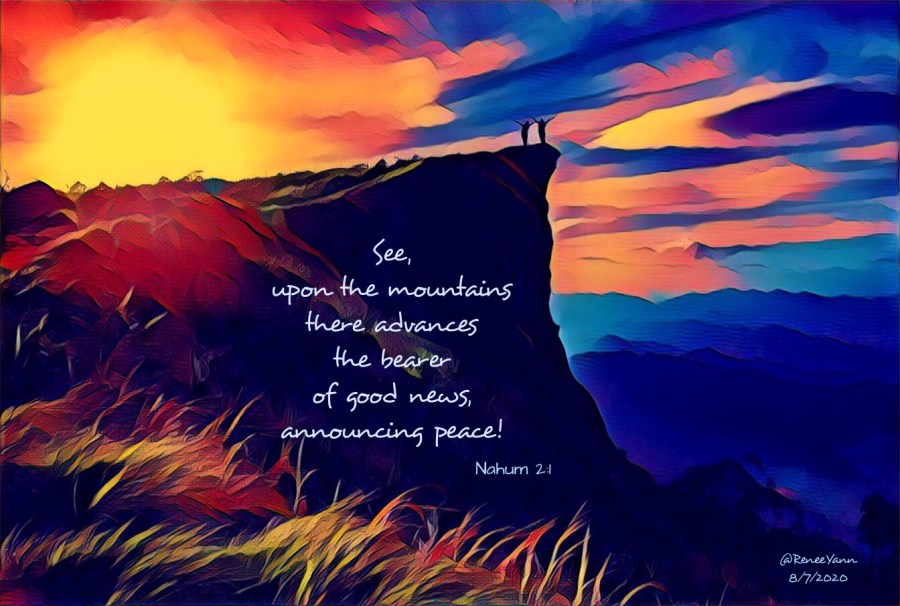
See, upon the mountains there advances
the bearer of good news, 
announcing peace!
Celebrate your feasts, O My people,
fulfill your vows!
…. The LORD will restore the beloved vine,
its hope, courage and strength …


Poetry: The Good God and the Evil God – Kahlil Gibran

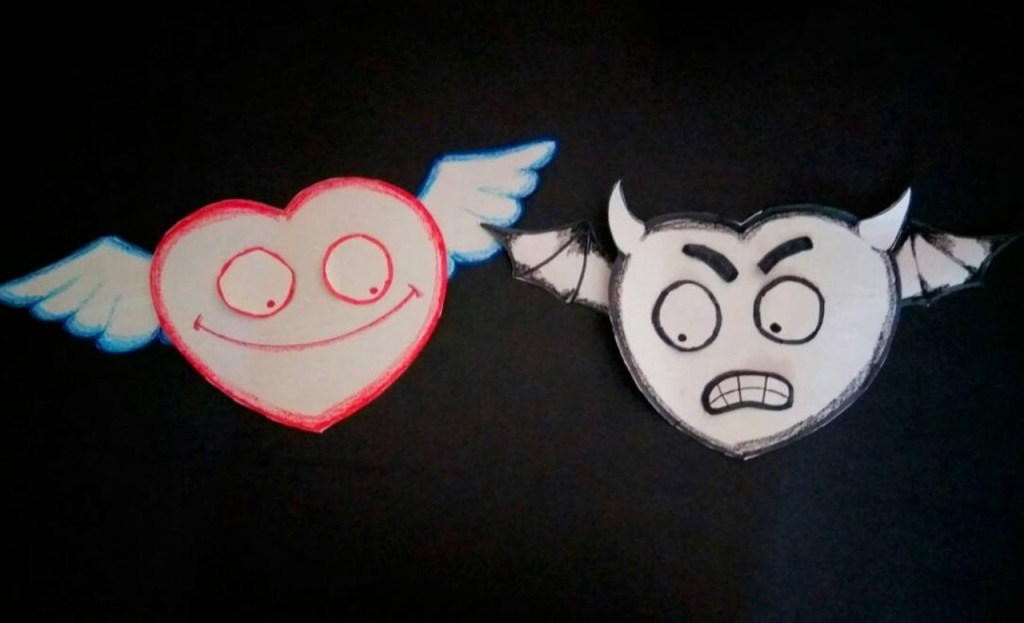
The Good God and the Evil God 
met on the mountain top.
The Good God said, 
“Good day to you, brother.”
The Evil God did not answer.

And the Good God said, 
“You are in a bad humour today.”
“Yes,” said the Evil God, 
“for of late I have been often mistaken for you, 
called by your name, and treated 
as if I were you, and it ill-pleases me.”
And the Good God said, 
“But I too have been mistaken for you 
and called by your name.”

The Evil God walked away 
cursing the stupidity of humankind.

Music: How Beautiful – Joe Wise