Today, in God’s Lavish Mercy, we pray with the magnificent Psalm 63 which captures the soul’s deep longing for God.
It is a longing that, once released in the heart, must be satisfied.
In our first reading, Jeremiah experiences it akin to an addiction, the power of it consuming his life:
I say to myself, I will not mention him, I will speak in his name no more. But then it becomes like fire burning in my heart, imprisoned in my bones; I grow weary holding it in, I cannot endure it.
Jeremiah 20:9
Paul, in his letter to the Romans, says not to resist the longing, but to let ourselves be consumed by it like a sacrificial offering:
I urge you, brothers and sisters, by the mercies of God, to offer your bodies as a living sacrifice, holy and pleasing to God, your spiritual worship.
Romans 12:1
Jesus, in our Gospel, is the One who surrenders himself fully to that holy longing. He calls us to imitate him:
For whoever wishes to save his life will lose it, but whoever loses his life for my sake will find it.
These are profound readings calling us a place that words cannot describe, a place where the Cross intersects with the truth of our lives. May we have the grace to hear and believe.
Poetry: The Longing – Rumi
There is a candle in your heart,
ready to be kindled.
There is a void in your soul,
ready to be filled.

You feel it, don't you?
You feel the separation
from the Beloved.

Invite Love to quench you,
embrace the fire.

Remind those who tell you otherwise that
Love
comes to you of its own accord,
and the longing for it cannot be learned in any school.
Today, in God’s Lavish Mercy, we pray again with Psalm 33. Today’s verses console us with the reminder that God is watching over us, as individuals and as communities.
Blessed the nation whose God is the LORD, the people chosen for God’s own inheritance. From heaven the LORD looks down; seeing all humanity.
You know, sometimes I wonder! How can God see some of the things going on in the world and not intervene? How can God let innocence suffer? The psalm seems to promise that intervention, but does it really?
But see, the eyes of the LORD are upon those who fear God, upon those who hope for God’s kindness, To deliver them from death and preserve them in spite of famine.
That last line is the zinger. It doesn’t say there will be no famine. It simply says that the God-fearing will be preserved despite the famine.
Hasn’t your life taught you that? We’ve all been through lots of things that we asked God to take away – pain, sadness, fear, loss. Probably most, if not all, of those burdens remained with us until we worked through them.
By faith and God’s Grace, we came through the other side stronger, deeper, more faithful. If we can trust God, “wait on the Lord”, the way comes to us – a way that leads us more deeply into God’s freedom and joy.
Our soul waits for the LORD, who is our help and our shield, For in God our hearts rejoice; in God’s holy name we trust.
Let’s pray for that kind of faith and trust for ourselves and for our beloveds. Let’s pray for the courage to learn it by unfailing prayer and practice.
Poetry: In Memoriam A. H. H. OBIIT MDCCCXXXIII: 54 by Alfred Lord Tennyson
Oh, yet we trust that somehow good
         Will be the final end of ill,
         To pangs of nature, sins of will,
Defects of doubt, and taints of blood;

That nothing walks with aimless feet;
         That not one life shall be destroy'd,
         Or cast as rubbish to the void,
When God hath made the pile complete;

That not a worm is cloven in vain;
         That not a moth with vain desire
         Is shrivell'd in a fruitless fire,
Or but subserves another's gain.

Behold, we know not anything;
         I can but trust that good shall fall
         At last—far off—at last, to all,
And every winter change to spring.

So runs my dream: but what am I?
         An infant crying in the night:
         An infant crying for the light:
And with no language but a cry.
Music: The Passion of John – Johann Sebastian Bach
This piece is not about John the Baptist. It is an excerpt from two hour meditation of the Passion narrative in John the Evangelist’s Gospel.
However, this beautiful excerpt fits so well with today’s reflection.
Today, in God’s Lavish Mercy, we pray with Psalm 33, a song of praise calling the people to rejoice in God’s justice and kindness.
In its attitude of trust and freedom, the Psalm might remind us of Robert Browning’s verse:
God’s in his heaven. All’s right with the world.
But neither in the psalmist’s time, nor in Browning’s, was everything really “all right” with the world. Things are never really “all right” with the world. There is always war, crime, hunger, disease, natural disasters, and a slew of other troubles brewing somewhere.
So how can the psalmist or any other preacher invite us to trust, believe, and rejoice like this?
Exult, you just, in the LORD; praise from the upright is fitting. Give thanks to the LORD on the harp; with the ten-stringed lyre chant his praises.
Keywords in this verse give us a clue: those who are just and upright will see the pattern of God’s mercy which lies deeper than the troubles of this world. They will trust and be comforted by God’s transcendent faithfulness to us in all things. Their faith and joy in the face of suffering will confound the faithless.
Calling us to the full meaning of Christ’s sacrificial love, Paul reiterates this mysteriously contradictory truth in our first reading :
For the foolishness of God is wiser than human wisdom, and the weakness of God is stronger than human strength.
For Christians, the Cross is the ultimate symbol of this profound wisdom and strength. It is a mystery too deep for our understanding, but by faith we may slowly become immersed in its Truth.
The message of the cross is foolishness to those who are perishing, but to us who are being saved it is the power of God.
1 Corinthians 18
As we pray with Psalm 33 today, let us be aware of the cause of our joy – a holy joy deeply rooted in God, trusting God’s Will for our salvation in the pattern of Jesus Christ.
For upright is the word of the LORD, and all God’s works are trustworthy. The LORD loves justice and right; of the kindness of the Lord the earth is full.
Poetry: Primary Wonder – Denise Levertov
Days pass when I forget the mystery. Problems insoluble and problems offering their own ignored solutions jostle for my attention, they crowd its antechamber along with a host of diversions, my courtiers, wearing their colored clothes; cap and bells. And then once more the quiet mystery is present to me, the throng’s clamor recedes: the mystery that there is anything, anything at all, let alone cosmos, joy, memory, everything, rather than void: and that, O Lord, Creator, Hallowed One, You still, hour by hour sustain it.
Music: Your Cross Changes Everything – Matt Redman
Today, in God’s Lavish Mercy, on this feast of St. Monica, we pray with Psalm 145.
We can almost picture the psalm’s sentiments pouring out in Monica’s prayer. For years, she had prayed for her son Augustine’s conversion. She was canonized for the level of her persevering prayer – a prayer blessed with the amazing answer of St. Augustine’s holy life.
Every day will I bless you, and I will praise your name forever and ever. Great is the LORD and highly to be praised; his greatness is unsearchable.
Like the answer to most prayers, Monica’s came after the long working of God’s mysterious ways. Her own life was shaded by suffering and loss. But, she was steadfast in her hope over the nearly two decades it took to see Light dawn in Augustine.
Generation after generation praises your works and proclaims your might. They speak of the splendor of your glorious majesty and tell of your wondrous works.
As we reflect on the generations of our own families, and the decades of our own lives, there are many “Monica-Augustine” stories. Whenever we pray for life to lead us and our beloveds to God, we pray like Monica.
Today, let’s bring our own “Augustines” to God in hopeful prayer. And let’s thank God for any “Monica” who has done this loving service for us over our lives.
I think this morning of my mother’s well-worn prayer book. The little devotional volume had been fattened with a number of prayer cards stuffed in its thin pages. One day, just before my mother died, I noticed this one: Prayer for My Daughter, a Nun. I can’t say I was exactly surprised by it. I supposed Mom prayed for me. But the card blessed me in a vey tender way and made me confident that my life would continue to be blessed.
Discovering the card also made me aware of my responsibility to pray daily for my family, friends, and community. They are my “Augustines” in whatever challenges they may face in life – just as I hope I am somebody’s too. Because, friends, we belong to one another in the Communion of Saints, and our “family” is fed not by blood, but by the Spirit.
The generations discourse of the power of your awesome deeds and declare your greatness. They publish the fame of your abundant goodness and joyfully sing of your justice.
Poetry: St. Augustine and Monica by Charles Tennyson Turner
Her weeping kiss – for years, her sorrow flowed At last into his wilful blood; he owed To her his after-life of truth and bliss: And her own joy, what words, what thoughts could paint! When o’er his soul, with sweet constraining force, Came Penitence – a fusion from remorse – And made her boy a glorious Christian saint. Oh ye, who tend the young through doubtful years Along the busy path from birth to death, Parents and friends! forget not in your fears The secret strength of prayer, the holy breath That swathes your darlings! think how Austin’s faith Rose like a star upon his mother’s tears!
Music: (something for opera fans among us) La Conversione di Sant Agostino, Oratorio by Johann Adolph Hasse
Hasse begins La Conversione di Sant’ Agostino with an orchestral introduction that establishes the work‘s tonal center in the key of B-flat major, with most arias composed within related keys. From the grandeur and dynamic intensity of the Introduction comes the first vocal entrance of the oratorio. The listener acts as a voyeur into a conversation between Simpliciano (tenor), a priest, and Monica (soprano), the mother of Saint Augustine of Hippo, in which Monica expresses her fears that her son may never change his wicked ways. This urgent desire becomes the core dramatic theme throughout the oratorio with Alipio (alto), the friend, and Navigio (bass), the brother, serving to intensify the desperate desire for conversion. The role of Saint Augustine (alto) is secondary to that of his mother, Monica. Saint Augustine only has two arias, both dealing with his desire to find release from his sinful ways. His conversion is explicitly stated in the Part Two aria in which he begs God to look upon him with compassion following the censure of his own heart.
Today, in God’s Lavish Mercy, we pray with Psalm 128 which describes what it means to be blessed by God. The psalm has only six verses, and when we read the whole thing, we get a picture of a man with a happy home, he and his family peacefully enjoying the labor of his hands.
The psalmist’s vision is very simple, and it is through that simplicity that blessing comes.
When our lives, our needs, our desires become too complex or cluttered, it is hard for blessing to reach us. We lose our capacity to experience the simple treasures of our lives when we become dulled by excess or the desire for it.
Psalm 128 offers some greats clues on how to deepen our gift of simplicity:
Take time to let yourself be awed by God – in nature, in good people, in the wonders of your own life.
Imitate that beauty and reverence in your actions.
Blessed are all who fear (are awed) the LORD, and who walk in God’s ways.
Work to build up the gifts of Creation.
Let your own labors magnify God’s generosity to all of us
What your hands provide you will enjoy; you will be blessed and prosper
Seek a community who sustain your life, (for some a traditional family, for others a different pattern)
Reverence and appreciate them, and encourage new life for that community.
Your wife will be like a fruitful vine within your home, Your children like young olive plants around your table.
Our consumeristic, power-hungry, and materialistic culture can confuse us about what is truly precious – what is truly BLESSING. Psalm 128 is reminding us of the TRUTH. Let’s listen.
In many homes and communities, members bless each other as they retire in the evening. I love to think of “Good night, God bless you” wrapping around the earth as it turns toward the western stars.
Tonight, as we offer that accustomed benediction, let’s be very conscious of the the graceful simplicity we wish for our beloveds. And let us stretch to wish that blessing out over the whole world as we ourselves hope for peaceful rest.
Poetry: blessings the boats by Lucille Clifton
(at St. Mary’s)


may the tide
that is entering even now
the lip of our understanding
carry you out
beyond the face of fear
may you kiss
the wind then turn from it
certain that it will
love your back        may you
open your eyes to water
water waving forever
and may you in your innocence
sail through this to that
Music: Sabbath Prayer from Fiddler on the Roof
May the Lord protect and defend you. May He always shield you from shame. May you come to be In Israel a shining name. May you be like Ruth and like Esther. May you be deserving of praise. Strengthen them, Oh Lord, And keep them from the strangers’ ways. May God bless you and grant you long lives. (May the Lord fulfill our Sabbath prayer for you.) May God make you good mothers and wives. (May He send you husbands who will care for you.) May the Lord protect and defend you. May the Lord preserve you from pain. Favor them, Oh Lord, with happiness and peace. Oh, hear our Sabbath prayer.
Today, in God’s Lavish Mercy, we pray with Psalm 96 which calls the people to praise God in music and dance because they have been chosen and confirmed as God’s People.
The psalm may have been composed by David to mark the return of the Ark of the Covenant to Jerusalem. At that time, Israel had a sense of great victory, restoration, and security as David assumed kingship at God’s command.
But today’s particular verses have an eschatological tone. They turn the attention of the praise singer to the overarching fact that God is infinitely larger than any present small victory. They imply that the only true victory and restoration are found in complete abandonment to God’s power in our lives no matter our situation.
Say among the nations: The Lord is king. God has made the world firm, not to be moved; God governs the peoples with equity.
That Divine Power is easy enough to sing about when things go well for us, as they were for Israel at that time. But can we still praise God’s dominion and power when things seem bleak, when we don’t feel in control of our reality?
Psalm 96 invites us to that deep abandonment of self into God’s unfailing Mercy, no matter our life’s weather.
Declare among the nations: The LORD is king. The world will surely stand fast, never to be shaken. God rules the peoples with fairness.
When we struggle to find that kind of holy equanimity, Psalm 96 suggests we look to nature, and to its persistent return to Divine Balance, even after upheaval. So too will any unbalance in us be restored within the infinite arc of God’s abiding love. And that is the real reason to always sing God’s praise!
Let the heavens be glad and the earth rejoice; let the sea and what fills it resound; let the plains be joyful and all that is in them! Then shall all the trees of the forest exult.
Before the Lord Who comes; Who comes to rule the earth. God shall rule the world with justice and the peoples with constancy.
Poetry: To Him Who Is Feared by Eleazar Ben Kalir
Translated by Lady Katie Magnus
from the Liturgy for Rosh Hashana

To Him who is feared a Crown will I bring.
Thrice Holy each day acclaim Him my King;
At altars, ye mighty, proclaim loud His praise,
And multitudes too may whisper His lays.
Ye angels, ye men, whose good deeds He records—
Sing, He is One, His is good, our yoke is the Lord’s!
Praise Him trembling to-day, His mercy is wide—
Ye who fear for His wrath—it doth not abide!
Ye seraphim, high above storm clouds may sing;
Men and angels make music, th’ All-seeing is king.
As ye open your lips, at His Name they shall cease—
Transgression and sin—in their place shall be peace;
And thrice shall the Shophar re-echo your song
On mountain and altar to whom both belong.
Today, in God’s Lavish Mercy, on this Feast of St. Bartholomew, we pray with Psalm 145. And what a perfect choice!
Your friends make known, O Lord, the glorious splendor of your Kingdom.
As our Gospel today indicates, many believe that Bartholomew is the same person as Nathaniel – in fact Nathaniel bar Talmai, (Talmai meaning “farmer”, or “son of the furrows”).
Praying with Psalm 145, I picture Nathaniel leaning back into his ancient fig tree, his fingers burrowing into the fertile earth around him. What might have been his deep thoughts as he dissolved into the fig tree’s generous shade?
Knowing Psalm 145 by heart, perhaps Nathaniel prayed it in his own very personal words:
Make me your loyal friend, O Lord.
I see your glory in all Creation.
Let me help others see that glory,
see themselves as a precious part of You.
Maybe Nathaniel had retreated to that tree because the noise around him didn’t hold an answer to his longing. He needed silence to remember that God will always find a way to bring our holy desires to fruition – just like the nearly sweet, unripe figs dancing just over Nathaniel’s pondering head:
The LORD is just in all his ways and holy in all his works. The LORD is near to all who call upon him, to all who call upon him in truth.
Psalm 145:17
Nathaniel found his truth, his answer that day. It walked right up to him in the form of his buddy Philip:
Philip found Nathanael and told him, “We have found the one about whom Moses wrote in the law, and also the prophets, Jesus son of Joseph, from Nazareth.”
John 1:45
Nathaniel, perhaps his head and belly still full of figs, takes a little while to get the full picture. But when he does, he gets it completely, unreservedly, and forever:
Rabbi, you are the Son of God; you are the King of Israel….
John1:49
You are the One we pray for in our psalms. You are the One we have waited for.
The beautiful thing for Nathaniel is that Jesus was waiting for him too.
Before Philip called you, I saw you under the fig tree.
John 1:48
We’re all under some kind of shadow at times, longing to hear the invitation of God. The story of Nathaniel assures us that the call will come through our hopeful prayer and deep desire for God’s glory.
Let all your works give you thanks, O LORD, and let your faithful ones bless you. Let them discourse of the glory of your Kingdom and speak of your might.
Poetry:Joy and Peace in Believing by William Cowper, an English poet and hymnodist. One of the most popular poets of his time, Cowper changed the direction of 18th century nature poetry by writing of everyday life and scenes of the English countryside.
Sometimes a light surprises
The Christian while he sings;
It is the Lord who rises
With healing on His wings;
When comforts are declining,
He grants the soul again
A season of clear shining,
To cheer it after rain.

In holy contemplation
We sweetly then pursue
The theme of God's salvation,
And find it ever new;
Set free from present sorrow,
We cheerfully can say,
E'en let the unknown to-morrow
Bring with it what it may!

It can bring with it nothing,
But He will bear us through;
Who gives the lilies clothing,
Will clothe His people too;
Beneath the spreading heavens
No creature but is fed;
And He who feeds the ravens
Will give His children bread.
Though vine nor fig tree neither
Their wonted fruit shall bear,

Though all the field should wither,
Nor flocks nor herds be there:
Yet God the same abiding,
His praise shall tune my voice;
For, while in Him confiding,
I cannot but rejoice.
From 21st Sunday – 2017: Today, in Mercy, we pray with the second reading, one of the magnificent Pauline hymns. The words wrap us in awed and humble worship of the mysterious majesty of God revealed to us in Christ. May we find it today in our own worship and prayer. To God be glory forever. ( An extra: Yes, a Christmas song again … but so beautiful an interpretation of our second reading.)
Today, in God’s Lavish Mercy, we pray with Psalm 138, a hymn of thanksgiving and hope.
As usual with the Sunday readings, a common cord ties the passages together. The obvious one today is how God entrusts power to us for the establishment of God’s milieu in Creation.
Psalm 138 carries, as well, a more subtle but infinitely important thread: the heart of that power is always Divine Kindness – Mercy. This fact is what generates our deep gratitude.
I will give thanks to your name, because of your kindness and your truth: When I called, you answered me; you built up strength within me.
So power, to be like God’s Power, must always be exercised in kindness. What would the world be like if only that were true! What would our own daily lives be like?
Every one of us has tremendous power whether we realize it or not. Sometimes it is physical or positional power. But more often, it is the power of: our words or our silence our acknowledgment or indifference our presence or absence our support or our resistance.
We choose how to use our power – either for or against, either with or over others.
Psalm 138 tells us how God chooses to use power.
LORD, you are exalted, yet the lowly you see, and the proud you know from afar. Your kindness, O LORD, endures forever; forsake not the work of your hands.
Our exalted and powerful God is kind, merciful. God loves the humble and lowly, but keeps distance from the proud, from those who lord it over others. This is the infinite wisdom and power of God and the mysteriously sacred way by which we are redeemed.
Psalm 138, just as our reading from Romans, is a song of amazed joy for God’s unsearchable wisdom and mercy.
Poem: Kindness – Naomi Shihab Nye
Before you know what kindness really is
you must lose things,
feel the future dissolve in a moment
like salt in a weakened broth.
What you held in your hand,
what you counted and carefully saved,
all this must go so you know
how desolate the landscape can be
between the regions of kindness.
How you ride and ride
thinking the bus will never stop,
the passengers eating maize and chicken
will stare out the window forever.


Before you learn the tender gravity of kindness
you must travel where the Indian in a white poncho
lies dead by the side of the road.
You must see how this could be you,
how he too was someone
who journeyed through the night with plans
and the simple breath that kept him alive.


Before you know kindness as the deepest thing inside,
you must know sorrow as the other deepest thing.
You must wake up with sorrow.
You must speak to it till your voice
catches the thread of all sorrows
and you see the size of the cloth.


Then it is only kindness that makes sense anymore,
only kindness that ties your shoes
and sends you out into the day to gaze at bread,
only kindness that raises its head
from the crowd of the world to say
It is I you have been looking for,
and then goes with you everywhere
like a shadow or a friend.
Music: The Fragrance of Christ – sung by Alma de Rojas
Refrain: Lord, may our prayer rise like incense in your sight. May this place be filled with the fragrance of Christ.
1. I will thank you, Lord, with all of my heart. You have heard the words of my mouth. In the presence of the angels, I will bless you. I will adore before your holy temple.
2. I will thank you, Lord, for your faithfulness and love, beyond all my hopes and dreams. On the day that I called, you answered; you gave life to the strength of my soul.
3. All who live on earth shall give you thanks when they hear the words of your voice, and all shall sing of your ways: “How great is the glory of God!”
Indeed, Mary herself was a song of hope to God, sung for us and for all generations. That passionate song opened her heart to receive the Word and to carry its redeeming power to each of us.
She was the greatest prophet of all time who not only proclaimed God but enfleshed him.
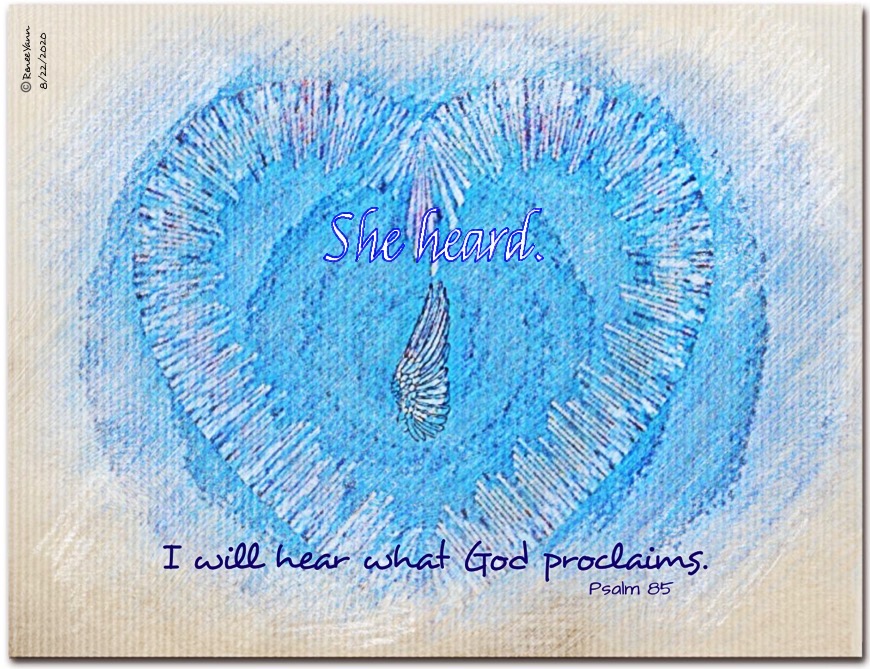
I will hear what God proclaims; the LORD– Who proclaims peace. Near indeed is salvation to those who fear God, glory dwelling in our land.
As we pray to Mary today, let us ask for listening hearts and hope-filled spirits. Let us ask to enflesh love and hope in our lives in imitation of her. Let us ask to believe as she did:
The LORD himself will give his benefits; our land shall yield its increase. Justice shall walk before him, and salvation, along the way of his steps.
Poetry: Annunciation – Denise Levertov
Annunciation
_________________________________________
‘Hail, space for the uncontained God’From the Agathistos Hymn, Greece, 6th century
_________________________________________
We know the scene: the room, variously furnished,
almost always a lectern, a book; always
the tall lily.
Arrived on solemn grandeur of great wings,
the angelic ambassador, standing or hovering,
whom she acknowledges, a guest.
But we are told of meek obedience. No one mentions
courage.
The engendering Spirit
did not enter her without consent.
God waited.
She was free
to accept or to refuse, choice
integral to humanness.
____________________
Aren’t there annunciations
of one sort or another
in most lives?
Some unwillingly
undertake great destinies,
enact them in sullen pride,
uncomprehending.
More often
those moments
when roads of light and storm
open from darkness in a man or woman,
are turned away from
in dread, in a wave of weakness, in despair
and with relief.
Ordinary lives continue.
God does not smite them.
But the gates close, the pathway vanishes.
____________________
She had been a child who played, ate, slept
like any other child–but unlike others,
wept only for pity, laughed
in joy not triumph.
Compassion and intelligence
fused in her, indivisible.
Called to a destiny more momentous
than any in all of Time,
she did not quail,
only asked
a simple, ‘How can this be?’
and gravely, courteously,
took to heart the angel’s reply,
the astounding ministry she was offered:
to bear in her womb
Infinite weight and lightness; to carry
in hidden, finite inwardness,
nine months of Eternity; to contain
in slender vase of being,
the sum of power–
in narrow flesh,
the sum of light
Then bring to birth,
push out into air, a Man-child
needing, like any other,
milk and love–
but who was God.
This was the moment no one speaks of,
when she could still refuse.
A breath unbreathed,
Spirit,
suspended,
waiting.
____________________
She did not cry, ‘I cannot. I am not worthy,’
Nor, ‘I have not the strength.’
She did not submit with gritted teeth,
raging, coerced.
Bravest of all humans,
consent illumined her.
The room filled with its light,
the lily glowed in it,
and the iridescent wings.
Consent,
courage unparalleled,
opened her utterly.
Today, in God’s Lavish Mercy, we pray with Psalm 107, a chant of gratitude to God’s Mercy from the lost who have been found.
There are all kinds of “lost”.
There are small “losts” like when I misinterpret my GPS and keep hearing “Recalculating route…”.
Then there are huge “losts” like when a beloved dies and our life’s anchor breaks.
This morning’s psalm and reading are speaking of a particular kind of “lost”, one that comes from wandering away from Love, for whatever reason that happens to us.
As I pray these readings, the face of a good high school friend comes to mind. Judy was a super basketball player. Everything about her was vigor, coordination, and that all-American beauty that needed no makeup to impress anybody.
After graduation, I went into the silence of the pre-Vatican II convent and Judy disappeared into her future. When our five-year reunion rolled around, I looked forward to reconnecting with her.
When I saw her, my heart broke. She was a shadow of herself, emaciated, listless, and lightless. She silently shouted a refrain like today’s verse from Ezekiel:
Our bones are dried up, our hope is lost, and we are cut off.
We were both twenty-three years old. I was just beginning to grow into my hopes. Judy was already divorced, alone, and the mother of a father-starved child.
That kind of “lost” feels almost irredeemable.
But Psalm 107 assures us that, in faith, no loss, no alienation is irredeemable.
They cried to the LORD in their distress; from their straits God rescued them. And led them by a direct way to the healing of community.
Judy and I stayed in touch for a few years. Despite her troubles, she kept faith. That was the key.
She did the hard work to find herself again with the help of family, friends, counselors, and a supportive faith community. Eventually, she remarried and was happy the last time I saw her before she moved to the west coast.
This morning, I see such apparent parallels between Israel’s and Judy’s story. That helps me look back over my own life for the same, perhaps not so dramatic, parallels and to be grateful for the many times God found me.
Let them give thanks for God’s Mercy and wondrous deeds to us, Because God has satisfied the longing soul and filled the hungry heart with good things.
Desolate and lone All night long on the lake Where fog trails and mist creeps, The whistle of a boat Calls and cries unendingly, Like some lost child In tears and trouble Hunting the harbor’s breast And the harbor’s eyes.

















 Lavish Mercy